Bathroom Modifications for Aging in Place: What the Research Actually Shows About Fall Reduction and Independence
This article examines the peer-reviewed evidence behind bathroom modifications for older adults, covering fall reduction rates, improvements in functional independence, caregiver burden, quality of life, and disparities in access — helping evidence-oriented caregivers make informed decisions.
Estimated cost range: Not applicable (evidence-focused article)
Potential funding: Not applicable (evidence-focused article)
Cost ranges are estimates. Verify eligibility directly with each program.
By Editorial Team
What the Systematic Review Found: An Overview of the Evidence
When a contractor tells you a grab bar will prevent a fall, or a product brochure claims a walk-in tub will restore independence, the natural question is: where is the proof? For evidence-oriented caregivers — adult children who have spent their careers reading clinical studies and cross-checking claims — the bathroom modification landscape has long felt like a marketing minefield. A 2025 systematic review published in PMC changes that.
Cha (2025) conducted a systematic review following PRISMA 2020 guidelines, the gold-standard methodology for evidence synthesis. The review examined 20 peer-reviewed studies on home modifications for older adults aging in place. The headline finding: 65% of those studies — 13 out of 20 — confirmed that home modifications are effective for fall prevention, functional independence, and cost savings. Across all 20 studies, two categories of intervention appeared in every single one: mobility and accessibility improvements, and bathroom safety enhancements.
Bathroom modifications, grab bars, and stair railings were identified as the most impactful interventions across all studies reviewed. This is not a marginal finding — it means that when researchers look at which single room or feature produces the greatest return on investment for aging in place, the bathroom consistently leads. The rest of this article unpacks what those studies actually found, study by study, so you can evaluate the evidence yourself.
Fall Reduction: What the Numbers Actually Show
Fall reduction is the most frequently cited benefit of bathroom modifications, and for good reason. The CDC reports that approximately 235,000 Americans over 65 visit emergency rooms every year due to bathroom-related falls and injuries. But what does the peer-reviewed evidence say about how much modifications actually reduce that risk?
Three studies within the Cha review provide the strongest evidence, and they approach the question from different angles — a randomized controlled trial, a program evaluation, and a population-level analysis.
Three key studies on fall reduction after home modifications, from the Cha (2025) systematic review.
Study
Design
Sample Size
Key Finding
Stark et al. (2017)
Randomized controlled trial
300 older adults
39% reduction in falls (intervention vs. control)
Hawkins et al. (2024)
Program evaluation
241 adults
79% reported no falls post-modification
Hollinghurst et al. (2022)
Population study
657,536 adults in Wales
3% quarterly reduction in fall-related emergency admissions
The Stark et al. RCT is the most methodologically rigorous of the three. With 300 participants randomly assigned to intervention or control groups, the 39% fall reduction is a statistically robust finding. This is not a before-and-after comparison where other factors could explain the change — it is a controlled experiment that isolates the effect of the modifications themselves.
The Hawkins program evaluation, while less rigorous in design, reports a strikingly high 79% rate of no falls after modification. The fear of falling measure also decreased significantly (FES: T(107)=5.14, p<0.001), which matters because fear of falling is itself a risk factor for reduced mobility and social isolation.
The Hollinghurst population study is the largest and perhaps most impressive. Studying 657,536 older adults in Wales, researchers found that fall-related emergency admissions decreased 3% per quarter after home adaptations (OR=0.97, p<0.001). A 3% quarterly reduction compounds over time — and at the population level, that translates to thousands of avoided hospital visits.
Beyond Falls: Functional Independence and Caregiver Burden
Fall prevention is the headline, but for many families, the daily reality of caregiving is what drives the decision to modify a bathroom. Bathing and toileting are among the most intimate and physically demanding activities of daily living (ADLs) that caregivers assist with. When a bathroom is unsafe, the caregiver's involvement increases — often dramatically.
The Carnemolla & Bridge (2019) study, included in the Cha review, quantified this effect. Studying 157 older adults who received home modifications, they found that weekly care hours decreased by 42% after modifications. The breakdown is revealing: informal care (provided by family members) dropped 46%, while formal care (paid aides) dropped 16%.
Weekly care hours decreased by 42% overall after home modifications
Informal (family) care hours dropped 46%
Formal (paid) care hours dropped 16%
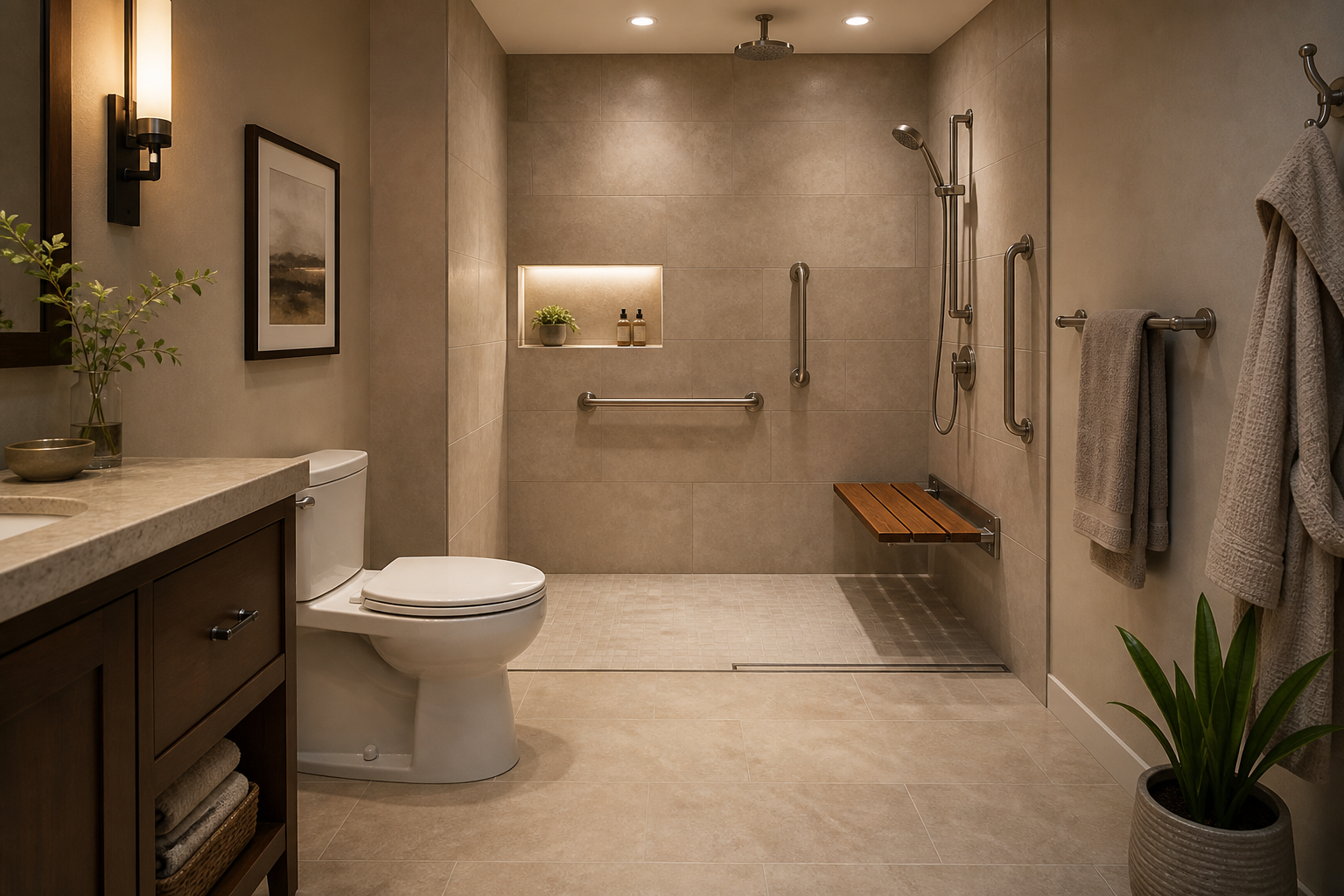
The 46% reduction in informal care is the figure that matters most for family caregivers. It means that after a bathroom is made safer — with grab bars, a curbless shower, a raised toilet, non-slip flooring — the older adult can bathe and use the toilet with less assistance. For an adult child who has been helping a parent shower every morning before work, that reduction is not just a statistic; it is hours reclaimed from the caregiving load.
This finding connects directly to the practical reality of bathing assistance. When a bathroom is designed for independent use, the caregiver shifts from a hands-on role to a supervisory one — or, in many cases, to no role at all for that particular task.
Quality of Life and Fear of Falling
Falls are the acute event, but fear of falling is the chronic condition that erodes quality of life long before a fall ever happens. Older adults who fear falling often restrict their activity — they stop bathing as frequently, avoid the bathroom at night, or limit fluid intake to reduce trips to the toilet. These adaptations carry their own health risks: dehydration, urinary tract infections, skin breakdown, and social withdrawal.
The Schorderet et al. (2022) study, included in the Cha review, provides some of the most striking evidence on this point. After individualized home adaptations — which included bathroom-specific modifications — researchers found:
Bathroom-related difficulties decreased by 93.4%
Fear of falling decreased by 12.5%
Quality of life improved by 9.8%
The 93.4% reduction in bathroom difficulties is the standout figure. It suggests that when modifications are tailored to an individual's specific needs and home layout, the bathroom can go from being the most challenging room in the house to one that poses minimal difficulty. The 9.8% quality-of-life improvement, while modest in percentage terms, is clinically significant because it represents a measurable shift in how older adults experience their daily environment.
Special Considerations for Cognitive Decline
Bathroom modifications for someone with dementia require a different approach than modifications for someone with only physical limitations. A person with Alzheimer's or another form of dementia may not recognize a new shower bench as a safety feature — they may see it as a foreign object in a familiar space, triggering confusion or agitation.
The Yeni et al. (2022) study, a nurse-led trial of 42 older adults with dementia, provides the most relevant evidence. The finding: no falls occurred in modified homes for dementia patients, and falls were significantly reduced in the second 3-month period (p=0.002). The study design included gradual implementation of modifications, which the researchers identified as a key factor in preserving the familiar environment and reducing confusion.
This finding has practical implications. For a caregiver considering bathroom modifications for a parent with dementia, the evidence supports a staged approach: introduce one change at a time, use familiar colors and materials, and avoid removing familiar fixtures all at once. A dementia-friendly home modifications guide can help with planning this process room by room.
Cost-Effectiveness: Is It Worth the Investment?
For families weighing a bathroom remodel against other uses of limited funds, the question of cost-effectiveness is central. The Wilson et al. (2017) modeling study, included in the Cha review, provides a useful benchmark. Researchers found that home modifications are cost-effective at NZD $5,480 per QALY gained.
A QALY — quality-adjusted life year — is a standard measure used in health economics to quantify the value of medical interventions. One QALY equals one year of perfect health. In most developed countries, interventions that cost less than $50,000 per QALY are considered cost-effective. At NZD $5,480 per QALY, home modifications are not just cost-effective; they are highly cost-effective, comparable to vaccines and smoking cessation programs.
Disparities in Access: Who Gets Modifications and Who Doesn't
The evidence clearly shows that bathroom modifications work. But who actually receives them? The Kim (2024) study, an analysis of 3,413 older adults from the 2019 American Housing Survey, reveals a troubling picture of unequal access.
77% of home modifications are self-funded
Rural older adults modify less than urban counterparts
Rural older adults spend less on the modifications they do make
The 77% self-funding figure means that for the vast majority of older adults, the decision to modify a bathroom depends on personal savings, not insurance or public programs. This creates a clear equity problem: the people who most need modifications — those with lower incomes, those in rural areas with older housing stock — are the least likely to be able to afford them.
A credible evidence review is transparent about its limitations. The Cha (2025) systematic review identified several gaps in the current research that are worth noting, especially for caregivers who want to make fully informed decisions.
Few studies examined personalized interventions tailored to individual needs and home layouts — most evaluated standardized modification packages.
Smart home technologies and digital monitoring systems were largely absent from the reviewed studies, despite their growing availability.
Long-term adaptability — how modification needs change as an older adult's condition progresses over years — was not addressed by most studies.
Standardized assessment tools for determining which modifications are needed are still lacking, making it difficult to compare outcomes across studies.
These gaps do not undermine the existing evidence. The case for bathroom modifications — particularly grab bars, non-slip flooring, curbless showers, and improved lighting — is strong and consistent across multiple study designs and populations. But the gaps do mean that caregivers should approach any single recommendation with a healthy dose of skepticism, especially if it comes from a source with a financial interest in selling a particular product.
For a broader look at the evidence across all types of home modifications — not just bathrooms — see our general evidence review of home modifications for aging in place. The bathroom-specific evidence covered here is one piece of a larger picture, but it is the piece with the strongest and most consistent support.

Comments
Join the discussion with an anonymous comment.