
Room checklist
A Risk-Based Priority Guide to Aging-in-Place Home Modifications
Overwhelmed by the many possible home modifications? This guide helps you decide what to fix first by organizing changes into four risk-based phases — starting with immediate bathroom and stair safety, then entry access, daily function upgrades, and finally major renovations. Caregivers can avoid wasting money on less critical changes while leaving life-threatening hazards unaddressed.
If you searched for aging in place home modifications after a fall, a hospital discharge, or one frightening moment in the bathroom, the problem is not that you need a longer checklist. The problem is that most checklists put a $15 lever handle, a $200 grab bar, a $5,000 doorway project, and a $30,000 bathroom renovation in the same emotional pile.
That is how families end up pricing stair lifts while the stair handrail is loose, or talking about a curbless shower while a parent is still reaching for a towel bar to get off the toilet. The safer order is simpler: fix the hazards most likely to cause a serious fall first, then make movement through the home easier, then improve daily function, and only then consider major structural work.
This guide assumes the older adult is still mobile but increasingly unsafe. It is not written for bed-bound, hospice, or full-time medical-care situations, where the priorities change.

The four-phase order
| Phase | Fix first | Planning range | Typical timing | Signs you need it now |
|---|---|---|---|---|
| 1. Immediate safety | Bathroom grab bars, non-slip surfaces, toilet riser if needed, stair handrails | $200–$1,500 | 1–2 weeks | Any fall in the past year, holding walls or furniture, hesitation at the toilet, tub, shower, or stairs |
| 2. Entry and mobility pathways | Threshold repairs, ramps where appropriate, lever handles, lighting, safer hallway movement | $500–$5,000 | 1–3 months | Trouble with steps, dark hallways, twist knobs that are hard to operate, catching a walker or foot at thresholds |
| 3. Daily function upgrades | Kitchen reach improvements, pull-out shelves, D-shaped handles, transfer bench, selected smart-home supports | $2,000–$10,000 | 3–6 months | Meals, bathing, laundry, or routine tasks are becoming difficult even after urgent fall hazards are addressed |
| 4. Major structural planning | Stair lift, through-floor lift, curbless shower, widened circulation, whole-home accessibility work | $5,000–$50,000+ | 6–18 months | Stairs cannot be managed, wheelchair access is needed, or the bathroom layout itself prevents safe care |
The phases are not a moral ladder. A family may stop after Phase 1 or Phase 2 if the home becomes stable and the older adult is functioning well. The point is not to complete every possible project. The point is to stop spending money out of order.
Phase 1: Bathroom and stair safety before anything cosmetic
Start where a fall is most likely to be both ordinary and devastating: the bathroom and the stairs. More than 10% of adults age 65 and older have fall injuries each year, and among bathroom injuries in people 65 and older, 28% are toilet-related.[2] That toilet number matters because families often focus on the shower and miss the quieter danger: sitting down, standing up, turning, reaching, and trying not to admit that the transfer has become frightening.
A Phase 1 walk-through is not a design consultation. It is a hazard hunt. Watch where the person’s hand goes when they stand from the toilet. Watch whether they pause before stepping into the tub. Watch whether they turn sideways on the stairs because one rail is missing or loose. If they are using a towel bar, sink edge, sliding shower door, or stair wall as a support, that is the project.
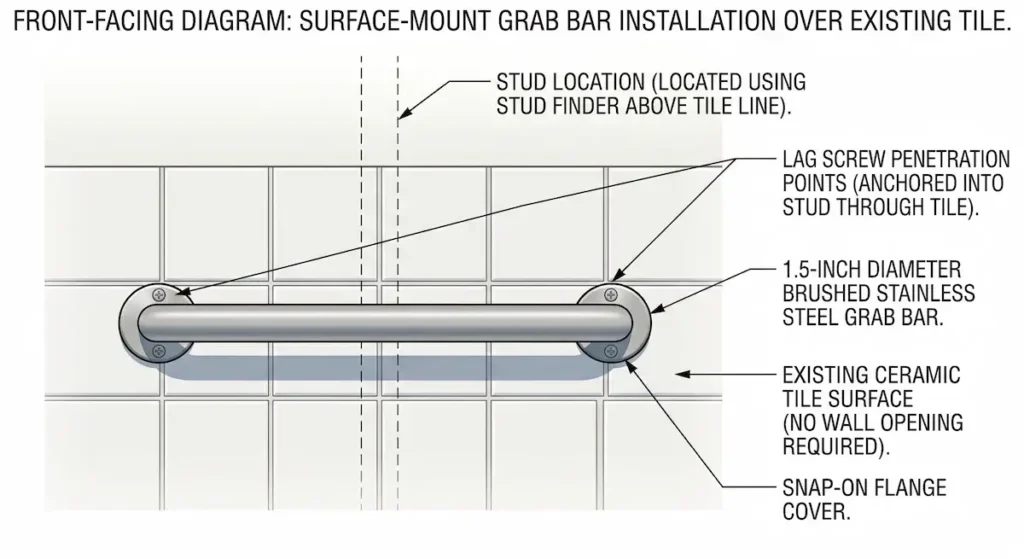
Grab bars are small only if they are installed correctly
A properly placed grab bar can turn a vague fear into a finished task. One clinical study cited in fall-prevention discussions found users were 76% more likely to recover their balance than people without a grab bar.[3] That does not make grab bars magic, and it does not mean every fall is preventable. It does mean they deserve to be ahead of nicer tile, new vanities, and most full-bathroom remodel conversations.
The installation standard is not negotiable: grab bars must be anchored into wall studs or proper blocking, not drywall alone.[4] A bar that pulls out under body weight is worse than no bar because it invites trust and then fails at the exact moment it is needed. Tile does not prove strength. A pretty flange does not prove strength. Someone needs to confirm what is behind the wall.
This is also where the cost contrast becomes useful. A grab bar installation may be a few hundred dollars, while a serious fall can trigger costs that dwarf the original fix; ElderLife Financial uses the example of a $200 grab bar installation compared with potential nursing-home costs reaching $50,000.[1] Treat that comparison as a warning about scale, not as a guarantee that one product prevents one specific bill.
Good Phase 1 bathroom work usually includes:
- A grab bar near the toilet if the person pushes off the sink, wall, or towel bar.
- A grab bar at the shower or tub entry, placed for the actual transfer path rather than centered for appearance.
- A second bar inside the bathing area if turning, standing, or reaching is unstable.
- A non-slip bathing surface that does not bunch, slide, or create a new trip edge.
- A toilet riser or toilet safety frame only when the current seat height is part of the transfer problem.
- A shower chair or transfer bench when standing to bathe is no longer safe.
If this work is happening after a recent fall, use a time-based approach rather than a shopping list. The first 24 hours, first week, and first month do not carry the same decisions; the post-fall home modification triage guide can help sort what cannot wait.
Stair rails belong in Phase 1, not in the someday file
Stairs do not need to be replaced before they are made safer. First check whether there is a secure handrail on the side the person naturally reaches for. Then check whether the rail runs the full useful length of the stairs, whether it can be gripped, and whether it moves under pressure. A loose rail is not a minor repair when someone is already unsteady.
Do not jump from “stairs are scary” to “we need a stair lift” unless the person cannot manage the stairs at all, even with a secure rail and safer lighting. Stair lifts may become necessary, but they are Phase 4 equipment in this framework because they are expensive, layout-dependent, and often chosen before simpler hazards have been corrected.
For the evidence behind which fall-prevention changes are strongest, see evidence-based home modifications that actually prevent falls. If you are deciding whether a handyman, general contractor, or specialist should install safety equipment, the CAPS contractor vs. general contractor FAQ is the better next read.
Phase 2: Make the route through the home usable
Once the bathroom and stairs are no longer the obvious emergency, move outward. Phase 2 is about getting into the home, through the home, and from room to room without a daily negotiation with thresholds, knobs, shadows, or narrow turns.
This is the phase where small barriers show their true size. A half-inch threshold can stop a walker. A heavy storm door can make an entry step dangerous. A twist knob can be impossible for arthritic hands while carrying groceries or balancing on a cane. A dark hallway can make a safe floor unsafe at night.
Common Phase 2 work includes threshold repair, better entry lighting, lever-style door handles, brighter hallway lighting, and ramps where the entry problem is not solvable with a simpler repair. Door widening may belong here if a walker, transport chair, or wheelchair cannot pass through a necessary route, but it should not be automatic. Measure the actual mobility device and the actual doorway before assuming demolition is required.
The useful question is: where does the person slow down, brace, drag equipment, or avoid going altogether? If the front entry is frightening, fix the entry. If the hallway to the bathroom is dark at 2 a.m., fix the lighting before choosing smart appliances.
Phase 3: Improve daily function after the urgent hazards are controlled
Phase 3 is where the work starts to feel less like emergency fall prevention and more like preserving independence. Kitchen reach, bathing routines, laundry access, and communication tools matter. They can reduce fatigue and make the home easier to live in. They are just not the first dollar when someone is still grabbing the shower curtain for balance.
Good Phase 3 projects solve repeated, observed difficulty:
- Pull-out shelves when bending into lower cabinets is unsafe or no longer realistic.
- D-shaped cabinet pulls when small knobs are hard to grasp.
- A transfer bench when the person can bathe safely seated but cannot step over a tub wall safely.
- Voice-activated lighting when switches are hard to reach or nighttime movement is risky.
- A video doorbell when getting to the door quickly creates a fall risk.
Before spending at this level, bring in an occupational therapist if you can. Occupational therapist-led home assessments can identify hazards and mismatches that families and contractors often miss, because the assessment is tied to how the person actually moves, transfers, cooks, bathes, and uses equipment.[5]
This is also the right point to compare funding options before signing contracts. Grants, loans, Medicaid waiver possibilities, VA-related benefits, and local programs vary by eligibility and location; the home modification funding navigator is built for that sorting process. Public-facing funding guides also stress that available programs depend heavily on the homeowner’s circumstances, location, and type of work being requested.[6]
Phase 4: Major renovations are last unless the signs are already there
There are good reasons to care about beauty, resale, family comfort, and the dignity of a home that does not look clinical. A well-designed bathroom can feel better to use. A main-floor living plan can reduce stress. A stair lift can preserve access to a bedroom that would otherwise be lost.
Those reasons still do not make Phase 4 the default starting point. Stair lifts, through-floor lifts, curbless showers, and whole-home accessibility overhauls are expensive, disruptive, and easy to mis-size if no one has first clarified the person’s actual mobility pattern. They belong at the end unless the need is already obvious: stairs cannot be managed, wheelchair access is required, the bathroom layout prevents safe transfers, or caregiving cannot happen safely in the current space.
The National Association of Home Builders’ aging-in-place remodeling checklist reflects how broad these projects can become, from entries and doors to bathrooms, kitchens, lighting, and circulation.[7] That breadth is useful for planning. It is dangerous when it makes a family feel they must remodel the whole house before fixing the handhold the parent needs tonight.
If Phase 4 is truly on the table, slow down and get the right assessment before the contractor’s estimate becomes the plan. For scope and professional selection, start with when to hire an aging-in-place specialist. For bathroom-specific decisions, use the bathroom remodel for elderly universal design guide. If you want a room-by-room companion after the priority order is clear, see the evidence-based room-by-room safety guide.
Why most families should not assume they are already behind
Many articles talk as if families are already halfway through an accessibility plan. Most are not. In a 2022 University of Michigan National Poll on Healthy Aging finding cited in aging-in-place reporting, only 31% of adults age 50 and older had made any home modifications.[2] That means a family starting from zero is normal, not negligent.
Starting from zero is also why order matters. If you can only make one change this week, do not choose the project that feels most like a renovation. Choose the change that removes the most immediate fall risk: the correctly anchored grab bar, the secure stair rail, the safer toilet transfer, the light that makes the nighttime route visible.
The safest first dollar is usually not the biggest renovation. It is the modification that stops the person you love from having to gamble on balance in the place they are already afraid to use.
References
- How Much Do Home Modifications Cost for Aging in Place? — ElderLife Financial
- Aging in Place: Statistics + How to Prepare in 2026 — Choice Mutual
- Aging in Place Home Modifications: Safety Changes That Matter — Age Safe America
- Aging in Place Home Modifications: Room-by-Room Tour — NYT Wirecutter
- The Impact of Occupational Therapist-Led Home Modifications — Rebuilding Together
- Home Modification Grants and Loans — NerdWallet
- Aging-in-Place Remodeling Checklist — NAHB
Related reading
Need a professional assessment?
Find a CAPS-credentialed professional or local aging services through our outbound resource list — we never name or rank individual contractors.
Find Local HelpNoticed something outdated or inaccurate on this page? Flag a correction. We review every report against CDC, NIA, and AARP HomeFit guidance before updating a page.