
Room checklist
CAPS vs. Occupational Therapist vs. General Contractor: Who Should You Hire for Aging-in-Place Home Modifications?
Family caregivers often face a confusing choice between a CAPS-certified remodeler, an occupational therapist with CAPS, or a general contractor for home modifications. This guide explains what each professional brings, when to hire one alone versus building a team, and how the right collaboration can prevent costly mistakes and ensure modifications truly fit your loved one's needs.

Why the Right Professional Matters for Aging-in-Place Modifications
When a parent's mobility declines or a fall reveals that the family home is no longer safe, the search for help often lands on three different professional titles: a CAPS-certified remodeler, an occupational therapist, or a general contractor. Each title sounds plausible, but they represent fundamentally different skill sets. Hiring the wrong one — or failing to understand how they complement each other — can lead to modifications that look finished but fail to meet the older adult's actual needs.
This guide goes beyond the standard two-way comparison between a CAPS contractor and a general contractor. It introduces a third, often-overlooked professional path: the occupational therapist who also holds the CAPS credential (OT-CAPS). Understanding the distinct roles of the CAPS builder, the OT-CAPS, and the general contractor — and knowing when to use one alone versus building a collaborative team — can prevent costly rework and ensure modifications genuinely support aging in place.
The Three Professionals Defined: CAPS Remodeler, OT-CAPS, and General Contractor
Before comparing costs and scenarios, it helps to understand what each professional actually does. The table below summarizes the core training, focus, and typical scope of each role.
| Professional | Core Credential / Training | Primary Focus | Typical Scope of Work |
|---|---|---|---|
| CAPS Remodeler / Builder | NAHB CAPS credential (3 courses: CAPS I, II, III); requires liability insurance, workers' comp, and business license | Construction execution, code compliance, product specification, project management | Designing and building modifications such as grab bars, roll-in showers, stair lifts, widened doorways, and ramps |
| Occupational Therapist with CAPS (OT-CAPS) | Licensed OT plus NAHB CAPS credential; clinical training in functional mobility, fall risk, cognitive assessment | Person-environment fit using clinical assessment tools (I-HOPE, SAFER-HOME, PEO model) | Home safety evaluations, functional assessments, modification recommendations, caregiver education, follow-up re-assessments |
| General Contractor (GC) | State licensing (varies); no specialized aging-in-place training required | Standard renovation, trade coordination, budget management | General home repairs, kitchen/bath remodels, flooring, painting — may lack knowledge of accessible design principles |
The CAPS credential, created by the National Association of Home Builders (NAHB) in cooperation with AARP, consists of three courses: Marketing & Communicating with the Aging-in-Place Client (CAPS I), Design Concepts and Methods for Livable Homes (CAPS II), and Details and Solutions for Livable Homes (CAPS III). The program teaches technical, business management, and customer service skills specific to the home modification industry. To earn the credential, candidates must complete the courses, submit a signed code of ethics pledge, and provide proof of insurance and licensing. Annual renewal requires four hours of continuing education.
What Each Professional Brings: Clinical Assessment, Construction Expertise, and Project Management
The real difference between these professionals is not just their training — it is the lens through which they view the home and the older adult who lives there. A general contractor sees a bathroom that needs new tile and a new toilet. A CAPS builder sees a bathroom that needs grab bars at the correct load-bearing points and a curbless shower with a linear drain. An OT-CAPS sees the same bathroom through the older adult's functional abilities: their balance during transfers, their grip strength for turning faucets, their visual perception of contrast between the toilet and the floor, and their cognitive ability to sequence the steps of bathing safely.
The OT-CAPS: Clinical Assessment and Person-Environment Fit
An occupational therapist who holds the CAPS credential brings a clinical assessment dimension that neither a CAPS builder nor a general contractor can replicate. The OT-CAPS uses the Person-Environment-Occupation (PEO) model as a framework to evaluate how the older adult's physical, cognitive, and sensory abilities interact with the home environment to support or hinder daily activities.
Standardized assessment tools used by OT-CAPS professionals include:
- In-Home Occupational Performance Evaluation (I-HOPE) — a performance-based observation and card-sorting task that measures activity performance before and after home modifications.
- Safety Assessment of Function and the Environment for Rehabilitation (SAFER-HOME v.3) — evaluates safety across multiple home domains.
- Home Safety Self Assessment Tool (HSSAT v.3) — a self-report tool for identifying fall hazards.
- Home Environmental Assessment Protocol (HEAP) — assesses environmental factors affecting function.
The evidence supporting OT-led home modifications is substantial. A 2017 randomized controlled trial by Stark et al. found that home modifications reduced falls by 39% in the experimental group compared to the control group. A case report by Somerville et al. (2016) demonstrated that OT-led modifications using the I-HOPE tool improved functional independence and reduced fall risk. A pilot RCT by Jeon et al. (2020) found that interdisciplinary home-based reablement (I-HARP) improved functional independence and quality of life in older adults with cognitive decline.
The CAPS Builder: Construction Expertise and Code Compliance
A CAPS-certified remodeler or builder is trained to turn clinical recommendations into built reality. Their CAPS training covers design concepts for livable homes, product specifications (e.g., grab bar load ratings, shower curb heights, doorway widths), and local building code requirements. They understand how to integrate modifications into existing structures without compromising safety or aesthetics.
A CAPS builder knows, for example, that a grab bar must be anchored into studs or blocking — not just drywall — and that a roll-in shower requires a properly sloped floor and a linear drain to prevent water from spreading into the rest of the bathroom. They also coordinate with electricians and plumbers to ensure that lighting, outlets, and fixtures meet accessibility standards.
The General Contractor: Standard Renovation and Trade Coordination
A general contractor without CAPS training is skilled at managing standard renovation projects — coordinating subcontractors, staying on budget, and meeting timelines. For simple, non-specialized projects, a GC may be perfectly adequate. However, a GC who has not studied aging-in-place design may install modifications that look correct but fail to address the user's specific functional needs. For example, they might install a standard shower bench at a fixed height rather than a height-adjustable transfer bench, or place a grab bar where it is structurally convenient rather than where the older adult's reach and balance require it.
The Ideal Team Model: How OT-CAPS, CAPS Builder, and GC Work Together
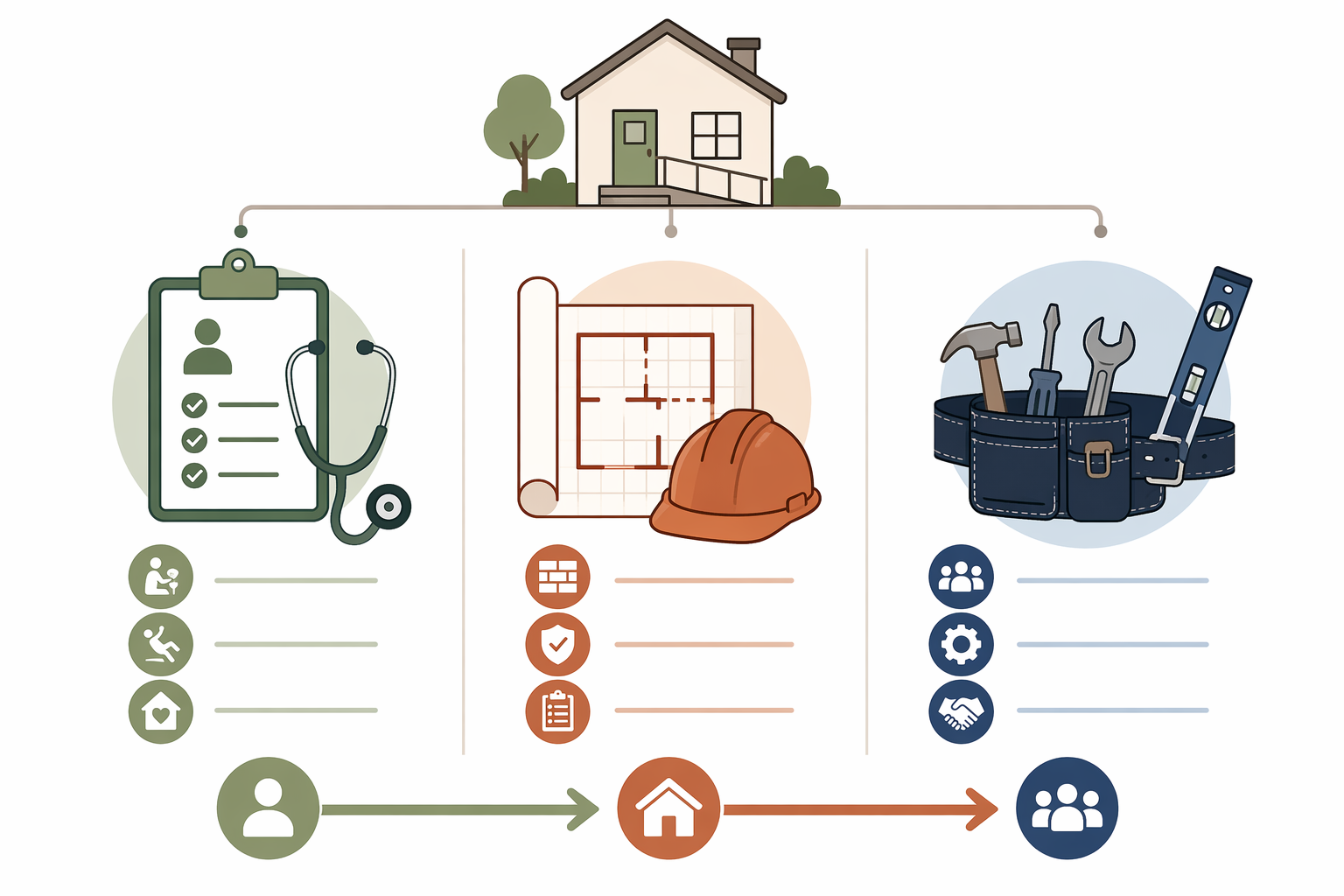
The best outcomes for complex aging-in-place projects happen when these professionals collaborate rather than work in isolation. The ideal team model follows a logical sequence:
- OT-CAPS assesses and recommends — The occupational therapist conducts a comprehensive home safety evaluation using tools like I-HOPE or SAFER-HOME, identifies the older adult's functional limitations and fall risks, and produces a prioritized list of recommended modifications.
- CAPS builder designs and builds — The CAPS-certified remodeler takes the OT's recommendations and translates them into construction plans, selects appropriate products, obtains permits, and executes the work to code.
- GC coordinates trades — For larger projects that involve multiple subcontractors (plumbers, electricians, tilers), a general contractor or the CAPS builder (who often functions as a GC) manages the schedule and budget.
This collaborative model creates what the PEO framework calls person-environment fit — a match between the older adult's abilities and the home environment that neither a builder nor an OT can achieve alone. The OT-CAPS ensures the modifications address the right functional problems; the CAPS builder ensures they are built correctly and safely.
As Andrew Myers, an occupational therapist and CAPS who founded Universal Home Consulting, explains, having the CAPS designation as an OT facilitates effective communication with contractors when developing home modification plans. The OT ensures renovations align with the client's lifestyle goals, while the builder ensures the work is structurally sound and code-compliant.
When to Hire Each Professional Alone vs. Building a Team
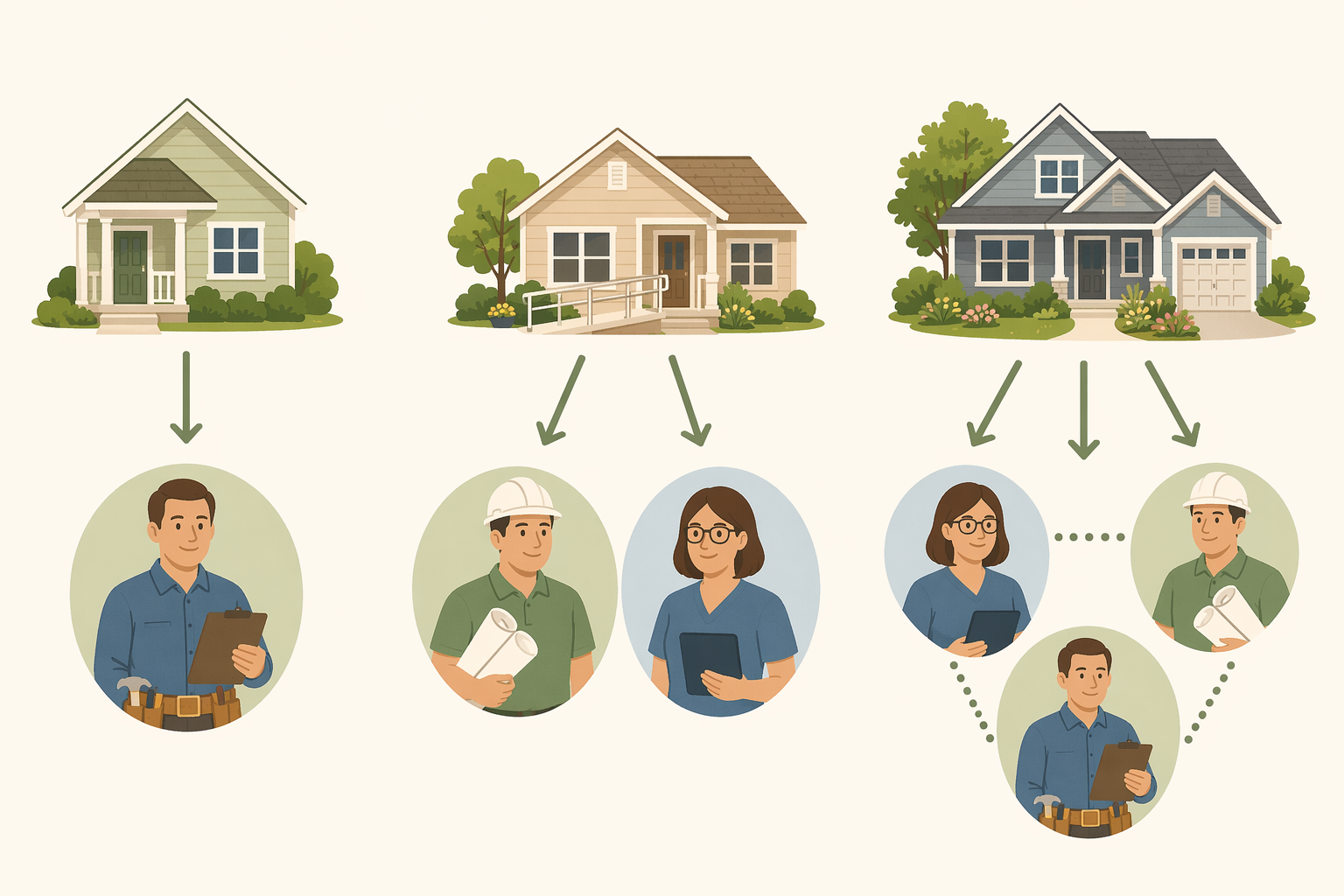
Not every aging-in-place project requires a full collaborative team. The complexity of the older adult's needs and the scope of the modifications should guide the decision. The table below outlines common scenarios and the recommended professional approach.
| Project Complexity | Example | Recommended Professional(s) | Rationale |
|---|---|---|---|
| Simple, single-modification | Installing one grab bar in the shower, replacing a doorknob with a lever handle | General contractor (or handyperson with proper licensing) | Low functional risk; standard installation skills sufficient |
| Moderate, single-room | Bathroom remodel with grab bars, walk-in shower, raised toilet, non-slip flooring | CAPS builder alone, or CAPS builder + brief OT consultation | CAPS builder ensures code compliance and product specs; OT consultation adds functional assessment if needed |
| Complex, multi-room or multi-functional | Whole-home modifications for someone with Parkinson's, recent hip fracture, or early-stage dementia | OT-CAPS + CAPS builder (collaborative team) | High fall risk and multiple functional limitations require clinical assessment to prioritize modifications and ensure person-environment fit |
| Cognitive decline or dementia | Wandering prevention, bathroom safety for someone with impaired judgment, lighting for sundowning | OT-CAPS (lead) + CAPS builder + GC | Cognitive and behavioral needs require specialized assessment that only an OT can provide; modifications must address safety without causing confusion or agitation |
A key consideration is that only about 10% of U.S. homes are adequately designed for aging populations, according to U.S. Census Bureau data cited in a 2025 systematic review. With 93% of adults 65 and older living in their own homes and the vast majority wanting to stay there, the demand for properly designed modifications far exceeds the supply of homes that are ready for them. This gap makes it even more important to get the professional team right the first time.
Cost Comparison: OT Assessment Fees, CAPS Fees, and GC Hourly Rates
The cost of hiring each professional type varies significantly by region, project scope, and the professional's experience. The table below provides national estimates for professional fees, not including the cost of materials or construction labor.
| Professional Service | Typical Fee Range (National Estimate) | Notes |
|---|---|---|
| OT home assessment (without CAPS) | $100 – $500 per visit | Fee-for-service rates; some OTs charge a flat rate for a comprehensive home evaluation and written report |
| OT-CAPS comprehensive home evaluation and report | $500 – $1,000 | Includes clinical assessment using standardized tools (I-HOPE, SAFER-HOME), written recommendations, and follow-up consultation |
| CAPS builder consultation and assessment | $500 for a full report (per Care.com) | Some CAPS builders include the assessment fee in the project cost if hired for construction |
| General contractor hourly rate | $50 – $150 per hour | Varies by region and trade; does not include subcontractor costs |
| CAPS credential (one-time certification fee) | $299 (NAHB members) / $399 (non-members) | Annual renewal: $65 (members) / $95 (non-members); 4 hours of continuing education required per year |
For a comprehensive breakdown of modification costs — including grab bars ($100–$300), stair lifts ($3,000–$10,000), walk-in tubs ($2,000–$5,000), and ramps ($1,500–$5,000) — along with funding sources such as VA grants, Medicaid waivers, and USDA Rural Development programs, see our Complete Cost Guide to Aging-in-Place Remodeling.
Questions to Ask Before Hiring Any Professional
Asking the right questions during the interview process can reveal whether a professional has the experience and collaborative mindset needed for a successful aging-in-place project. Use the following checklist as a starting point.
Questions for an OT-CAPS
- How many home safety assessments have you conducted in the past year?
- Which assessment tools do you use — I-HOPE, SAFER-HOME, or others?
- Do you have experience working with CAPS builders or general contractors to implement your recommendations?
- Will you provide a written report with prioritized recommendations and estimated costs?
- Do you offer follow-up assessments after modifications are completed?
Questions for a CAPS Builder
- When did you complete your CAPS training, and have you renewed your credential with continuing education?
- How many aging-in-place projects have you completed in the past two years?
- Do you have experience working with occupational therapists? Can you share an example of a collaborative project?
- Will you handle permit applications and code inspections, or will I need to coordinate those separately?
- Can you provide references from past clients who had similar functional needs to my family member?
Questions for a General Contractor
- Have you completed any projects specifically designed for aging in place or accessibility?
- Are you familiar with ADA guidelines or universal design principles?
- Have you ever worked with an occupational therapist or a CAPS-certified professional on a project?
- Do you carry liability insurance and workers' compensation insurance?
- Will you provide a detailed written estimate that separates materials, labor, and subcontractor costs?
Red Flags: What to Watch For When Hiring
Even well-intentioned professionals can miss critical details when they lack the right training or collaborative mindset. Watch for these warning signs during the hiring process.
- A builder who provides a quote without visiting the home or meeting the older adult. No meaningful assessment can happen over the phone or from photos alone.
- An OT who does not use standardized assessment tools. A home evaluation based on casual observation rather than validated tools like I-HOPE or SAFER-HOME may miss critical risks.
- A general contractor who treats an aging-in-place modification as a standard remodel. If they say "we do bathrooms all the time" without asking about the user's mobility, balance, or cognitive status, they are not thinking about person-environment fit.
- Any professional who lacks proper insurance or licensing. CAPS credential requirements include proof of liability insurance and workers' compensation. A GC should also carry these.
- A professional who promises a one-size-fits-all solution. Every older adult's functional profile is different. Modifications should be tailored to the individual, not selected from a menu.
- A builder who dismisses the value of an OT assessment. A CAPS builder who refuses to collaborate with an OT may be more focused on construction convenience than on the user's actual needs.
Choosing the right professional — or the right team — for aging-in-place home modifications is one of the most consequential decisions a family caregiver will make. The difference between a modification that works and one that falls short is often not the quality of the materials or the craftsmanship, but whether the design was guided by a thorough understanding of the older adult's functional needs. By understanding the distinct roles of the CAPS builder, the OT-CAPS, and the general contractor, and by knowing when to build a collaborative team, you can ensure that your loved one's home is not just modified, but truly adapted to support their independence and safety.
Related reading
- Aging-in-Place Specialist vs. General Contractor vs. Occupational Therapist: Who Should You Hire for Home Modifications?
- CAPS Contractor vs. Occupational Therapist vs. Universal Design Consultant: Which Professional Should Your Family Hire for Home Modifications?
- CAPS vs. Other Aging-in-Place Certifications: Which Credential Should You Trust for Your Parent’s Home Modifications?
Need a professional assessment?
Find a CAPS-credentialed professional or local aging services through our outbound resource list — we never name or rank individual contractors.
Find Local HelpNoticed something outdated or inaccurate on this page? Flag a correction. We review every report against CDC, NIA, and AARP HomeFit guidance before updating a page.