
STEADI: intervene
What to Ask About a Senior Living Facility's Evacuation Plan
Vague assurances about a facility's emergency plan are hard to verify — until you ask the right questions. This checklist arms family caregivers with specific questions about drills, overnight staffing, backup power, and evacuation transport, grounded in CMS emergency preparedness rules and a 2026 federal audit, so they can judge whether their loved one's senior living facility could truly evacuate residents in a disaster.
Last verified: August 4, 2026. Reviewed by: CareWise Guide Clinical Review Team, geriatric RN/OT review. This article is educational and is not legal, medical, financial, or regulatory advice. Facility rules vary by state, license type, and payer participation; use these questions to guide a conversation with the administrator, care team, ombudsman, or appropriate regulator.
After Hurricane Ida, seven Louisiana nursing homes evacuated roughly 850 residents to a warehouse. NBC News later reported 15 deaths connected to the evacuation, and Louisiana officials revoked the facilities’ licenses. The painful lesson for families was not simply that disasters are dangerous. It was that evacuation itself can become the danger when destination, staffing, supervision, medical needs, and transportation are not controlled.[1]
That is the right place to begin when a senior living community says, “We have a plan.” An emergency evacuation plan for senior living facilities should not be a reassuring sentence. It should be a set of specific, practiced, documented actions that can be matched to one resident’s real limitations: Can she transfer without help? Does he wander? Who moves the oxygen concentrator? What happens if the elevator is down? Who is on duty at 2 a.m.?
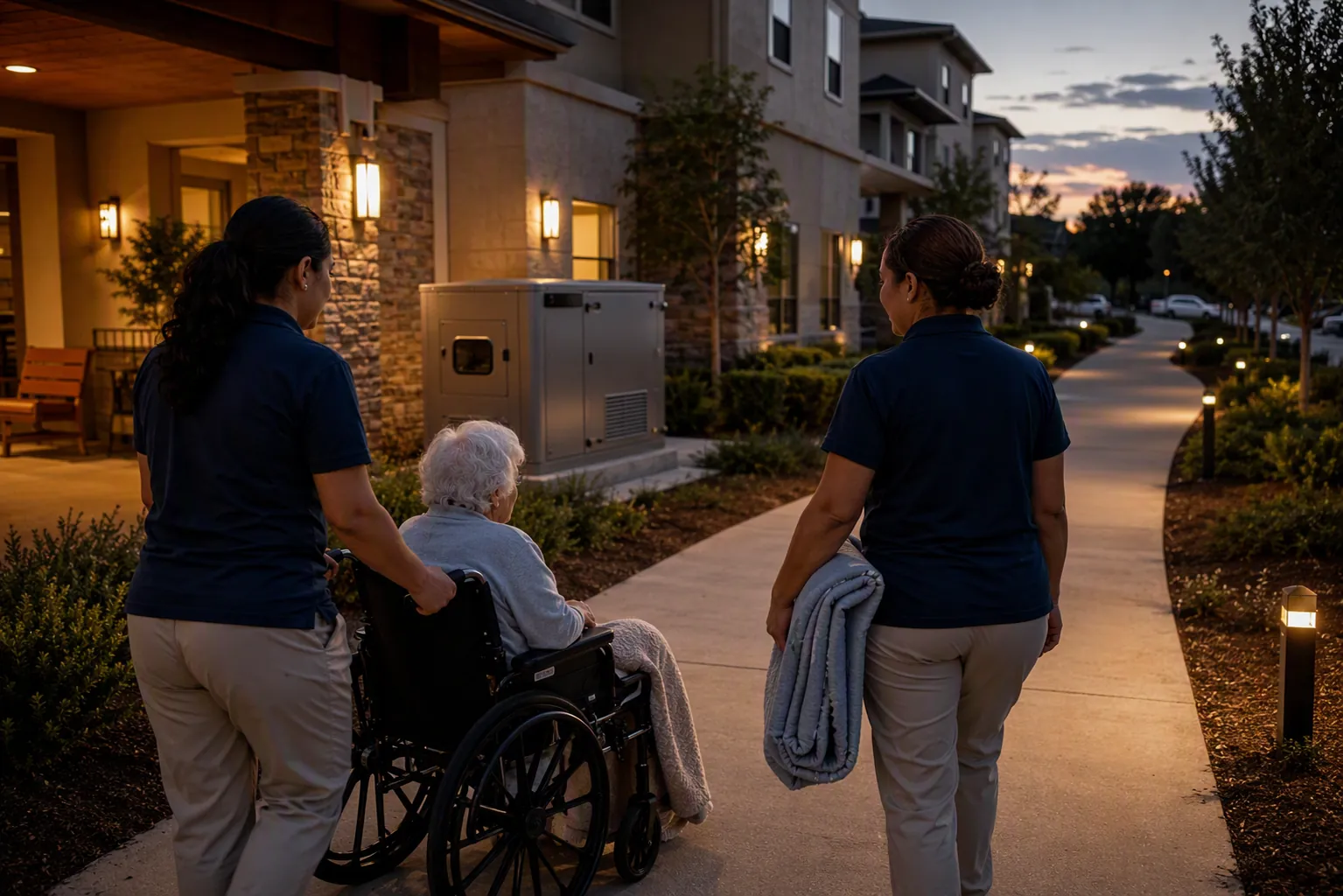
For Medicare- and Medicaid-participating facilities, the CMS Emergency Preparedness Rule gives families a useful baseline. Effective November 15, 2017, the rule requires an emergency plan, policies and procedures, a communication plan, and training and testing; it also requires planning for both sheltering in place and evacuation.[2] Assisted living and memory care settings may be regulated differently depending on the state and license, but the family questions remain the same: show me how this plan works for this resident.
The first test: can the facility show more than a binder?
Families are not expected to audit a facility the way CMS, a state survey agency, or a fire marshal would. You are not there to inspect every circuit, interpret every regulation, or decide whether a generator installation meets code. But you can ask questions that separate a practiced plan from a plan that sits in a binder.
A weak answer usually sounds complete until you ask one more question. “We coordinate with local emergency services” is not the same as naming the emergency contact, showing a communication protocol, and explaining who calls families. “We have transportation” is not the same as a current signed agreement with a provider that can move wheelchair users, residents with dementia, oxygen-dependent residents, and staff escorts. “We have a generator” is not the same as documented testing, maintenance, fuel planning, and circuit coverage for resident-care areas.
That last distinction matters. In an April 2026 audit, the HHS Office of Inspector General estimated that 10,983 of 15,115 nursing homes — 73% — did not have adequate or reliable emergency power systems. The audit cited inadequate generator maintenance in 53%, inadequate circuit coverage in 39%, and generators 40 or more years old in 10% of nursing homes reviewed.[3] This does not prove that every facility is unsafe. It does make one thing clear: “we have a generator” is not a complete answer.

Questions to ask before you trust the evacuation plan
Ask these questions during a tour, care conference, annual care plan meeting, or after a major weather event. The tone can be calm and direct: “I’m trying to understand what would happen for my mother specifically.” A good facility should be used to that level of concern.
| What to ask | What a useful answer includes | Proof to request |
|---|---|---|
| Does the plan cover both evacuation and shelter-in-place? | A decision process for when residents stay, when they leave, and who makes that call. | Emergency plan sections, policies, or recent drill scenarios. |
| Who participates in drills? | Resident-care staff, night/weekend staff, maintenance, leadership, and staff who handle transport, medications, oxygen, and records. | Drill records showing dates, shifts, participants, problems found, and corrections. |
| What staffing is present overnight? | A realistic count of aides, nurses, supervisors, and maintenance/on-call support, not just daytime staffing. | Current staffing pattern or staffing grid, with escalation process. |
| Which residents need two-person assist, lift equipment, wheelchair transport, memory-care supervision, or oxygen support? | A resident-specific evacuation profile and a process for updating it after decline, hospitalization, or new equipment. | Care plan, mobility assessment, evacuation assistance list, or resident acuity roster. |
| What does the generator actually power? | Resident-care areas, essential medical equipment, emergency lighting, HVAC or safe-temperature areas, medication storage, communication systems, and charging needs as applicable. | Generator testing and maintenance logs, circuit coverage documentation, fuel plan, and inspection records. |
| Who provides transportation? | Named provider, current agreement, vehicle types, wheelchair capacity, backup provider, and timing expectations. | Signed transportation contract or memorandum of understanding. |
| Do trained staff ride with residents? | A plan for staff escorts who know residents’ needs, medications, behaviors, and transfer requirements. | Evacuation staffing assignment or transport protocol. |
| Where do residents go? | Named receiving sites, sister facilities, hospitals when medically necessary, and a plan if the first destination is unavailable. | Receiving-site agreements and relocation procedures. |
| How are families contacted? | Primary and backup contact methods, timing, responsible staff role, and process if phones or internet fail. | Communication plan and sample family notification procedure. |
| How do medications, oxygen, mobility devices, records, and memory-care supervision travel? | A chain of responsibility for packing, labeling, transporting, and reconciling resident essentials. | Medication evacuation policy, oxygen/vendor plan, device tagging process, and records-access protocol. |
The National Consumer Voice question set, as reproduced by AgingCare, points families toward the same practical areas: access to the emergency plan, drill frequency, staffing, transportation contracts, and sister-facility arrangements.[4] Those are not abstract compliance topics. They are the places where frail residents can be lost in the gap between a written plan and a long night.
Ask how the facility decides to evacuate or shelter in place
A facility should be able to explain who has authority to decide whether residents stay or leave. Is it the administrator? The director of nursing? The incident commander? What if that person is off site? How does the facility receive evacuation orders, weather alerts, utility updates, or fire information?
For older adults with mobility limitations, the wrong decision in either direction can create harm. Evacuating may mean rushed transfers, unfamiliar environments, missed medications, dehydration, delirium, wandering, falls, or prolonged time in transport. Sheltering in place may mean heat exposure, power loss, flooding, smoke, unsafe indoor temperatures, or staff unable to reach the building. The plan should not treat “evacuate” and “stay” as simple opposites. It should show how the facility weighs resident acuity, building safety, staffing, transport availability, and destination readiness.
A useful question is: “Can you show me the part of the plan that covers both evacuation and shelter-in-place, and who makes that decision after hours?” If the answer is only, “Corporate handles that,” keep asking until someone can describe the local chain of command.
Ask about drills, especially at night and on weekends
Drill frequency depends on facility type, occupancy category, and state rules. AHCA/NCAL describes a quarterly-per-shift expectation for health care occupancies and notes that some states require more.[5] That does not mean every assisted living or memory care setting has the same federal drill schedule. It does mean families should not accept “we do drills” without asking what kind, how often, and who participates.
The overnight question is where many polished tour answers get thin. Day shift may have managers, therapists, maintenance staff, activities staff, and visitors in the building. At 2 a.m., the evacuation plan may rest on a smaller group of aides and nurses who are also responsible for continence care, dementia behaviors, medication issues, call lights, alarms, and residents who cannot understand instructions.
- “When was the last evacuation or shelter-in-place drill?”
- “Did the drill include night-shift or weekend staff?”
- “Did the drill include residents who need two-person assist, mechanical lifts, wheelchairs, oxygen, or memory-care supervision?”
- “What problems did the drill find, and what changed afterward?”
- “Can you show me the drill record?”
A drill record does not need to be perfect to be useful. In fact, a record that names problems and corrective actions may be more credible than a spotless verbal answer. Look for dates, shifts, participants, scenario type, resident-care issues identified, and follow-up.
Ask who would physically move your loved one
Evacuation is a fall-prevention problem as much as an emergency-management problem. A resident who can walk to the dining room with a rollator on a quiet afternoon may not manage stairs, smoke, alarms, darkness, wet pavement, a crowded hallway, or a rushed transfer into a van. A resident with dementia may follow a familiar aide but resist a firefighter, wander toward danger, or remove oxygen tubing during the move.
Ask the facility to connect the emergency plan to the resident’s care plan. The answer should not be generic. It should account for transfer status, weight-bearing ability, cognitive status, hearing or vision impairment, wandering risk, continence needs, oxygen use, dialysis, insulin, anticoagulants, seizure medications, pressure-injury risk, and equipment that must travel.
- “Is my father listed as independent, one-person assist, two-person assist, wheelchair transport, stretcher transport, or lift-dependent for evacuation?”
- “Where is that information kept so night staff can see it quickly?”
- “How often is the evacuation assistance list updated?”
- “If the elevator is unavailable, how would staff move residents who cannot use stairs?”
- “Who is responsible for residents in memory care who may wander, refuse, or become frightened?”
For a parent already living in memory care, pair this conversation with a broader facility review. The questions in What to Look for When Touring a Memory Care Facility can help you compare how the community handles supervision, staffing, and resident-specific risks on ordinary days as well as during emergencies.
Ask what the generator powers, not whether one exists
The OIG audit is the reason to slow down here. When nearly three-quarters of nursing homes in an April 2026 federal audit were estimated to have inadequate or unreliable emergency power systems, families should stop treating the word “generator” as a finish line.[3]
Ask what the generator supports during an outage. Does it power resident rooms, emergency lighting, nursing stations, medication refrigerators, oxygen concentrator charging, suction equipment, elevators, kitchen refrigeration, fire and alarm systems, phones, Wi-Fi, HVAC, or designated cooling and heating areas? Which areas lose power? How are residents moved if only certain zones are powered?
Then ask for documentation. The OIG audit’s findings on maintenance, circuit coverage, and generator age make the paperwork part of the safety conversation, not a bureaucratic extra.[3] You can ask for the most recent generator test log, maintenance record, fuel plan, service contract, and any recent inspection or corrective action record. The administrator may not hand you every technical document, but someone should be able to explain what exists, who maintains it, and when the system was last tested under load.
Be careful with the 96-hour benchmark. CalMatters and KQED advise families to ask whether a nursing home has enough backup power for 96 hours.[6] That is an important question for nursing homes, but it should not be repeated as a universal assisted living rule. For assisted living and memory care, ask what state law requires, what the facility’s own policy promises, and whether the emergency power plan realistically protects residents who cannot tolerate heat, cold, darkness, or loss of powered medical equipment.
Ask who is driving, where residents are going, and who rides with them
Transportation is one of the easiest places for a vague answer to sound reassuring. “We have buses available” or “the county helps us” is not enough. The AgingCare reproduction of the Consumer Voice questions specifically points families toward transportation contracts and arrangements with sister facilities.[4] CalMatters and KQED also recommend asking whether a trained employee rides with each evacuation vehicle.[6]
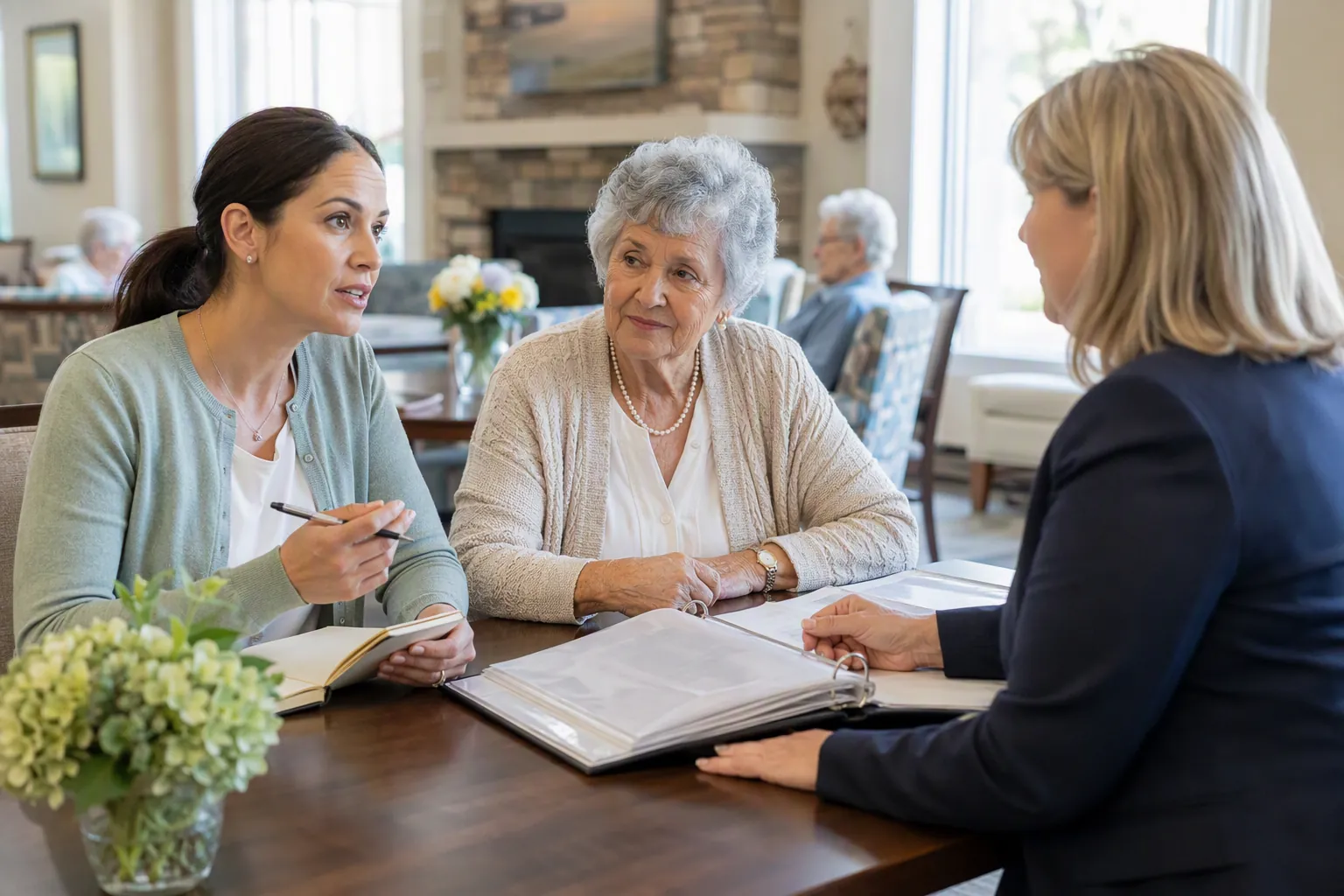
Ask for names, not categories. Who is the transportation provider? Is there a signed agreement? When was it last updated? How many wheelchair-accessible vehicles are available? Are stretcher vehicles available if needed? What happens if the same provider is serving multiple facilities during a regional evacuation? Is there a backup provider?
The staff-escort question is just as important as the vehicle question. A bus full of residents with dementia, oxygen needs, mobility limitations, or complex medication schedules is not safe simply because it is moving away from danger. Someone on that vehicle needs to know who is at risk for wandering, who cannot transfer without help, who becomes combative when frightened, who needs thickened liquids, and who must not miss time-sensitive medication.
- “Can you show me the current transportation agreement?”
- “How many wheelchair users can be moved at one time?”
- “Who decides which residents leave first?”
- “Does a trained employee ride with each vehicle?”
- “How are residents supervised if a trip takes longer than expected?”
- “What is the backup plan if roads close or the transportation provider is unavailable?”
Ask where residents go after they leave the building
A destination should be more than “another facility” or “a safe location.” Ask for named receiving sites. Are they sister facilities, contracted facilities, hospitals, shelters, hotels, or community centers? Are they licensed and staffed to handle residents with skilled nursing needs, dementia, oxygen, bariatric equipment, or isolation precautions? If the first destination is full, damaged, or under the same evacuation order, where is the backup?
The Ida warehouse case is the warning here. Evacuating a building does not automatically mean residents arrive at a place prepared to care for them. The receiving location must have staffing, sanitation, medication access, supervision, food, water, safe temperatures, sleep surfaces, and a way to maintain resident identity and records.[1]
Ask: “Can you show me the receiving-site agreement?” If the facility uses sister communities, ask whether those sites have accepted residents in a real event or drill. If the plan relies on hospitals, ask whether that applies only to residents with medical necessity or to all residents. Hospitals are not a general relocation plan for an entire senior living community.
Ask how families are contacted when systems are strained
Family communication often looks simple on paper until phone lines, cell towers, power, or internet access fail. The CMS rule’s communication-plan requirement gives families a reasonable basis to ask how the facility communicates during an emergency, who is responsible, and what backup methods exist for participating facilities.[2]
Make sure the facility has more than one contact for your loved one and that those contacts are current. Ask whether families receive a message before evacuation, after departure, upon arrival, and after the resident is checked in. Ask whether updates come by phone, text, email, resident portal, recorded hotline, website notice, or another method. If the facility has used its emergency notification system in a drill or real event, ask what it learned.
- “Who calls families, and from where?”
- “What happens if the main phone system is down?”
- “How often do you verify emergency contacts?”
- “Will families be told the destination before residents leave, or only after arrival?”
- “How do you identify and track residents during transport and at the receiving site?”
Ask how medications, oxygen, devices, and records move with the resident
A resident’s safety can unravel because of one missing item: a walker left behind, a wheelchair cushion not labeled, an oxygen vendor not reachable, insulin not kept at the right temperature, a medication administration record not accessible, or hearing aids packed in the wrong bag. These are ordinary care details, but an evacuation turns them into urgent safety details.
Ask how the facility prepares a go-with-resident package. It may include medication lists, advance directives, allergies, diagnoses, physician orders, emergency contacts, payer information, mobility status, diet orders, behavior notes, oxygen orders, wound-care instructions, and copies or access to essential records. For residents with dementia, ask whether staff include comfort items, identification, recent photos, and behavior plans.
The facility should also explain how it tags mobility devices, oxygen equipment, chargers, eyeglasses, dentures, hearing aids, and communication devices. A wheelchair is not interchangeable for a resident who needs a certain cushion, width, brake style, leg support, or tilt feature. A walker or cane left behind can change a supervised evacuation into a fall risk at the receiving site.
How to judge the answer you get
The goal is not to catch a staff member off guard. Many caregivers and administrators are working under real constraints, especially during nights, weekends, outbreaks, storms, and staffing shortages. The goal is to understand whether the facility can move from reassurance to evidence.
| Answer level | What it sounds like | How to respond |
|---|---|---|
| Verbal assurance | “We have a plan.” “We are compliant.” “We work with emergency services.” | Ask one level deeper: “Who does that after hours?” or “Can you show me the procedure?” |
| Named procedure | “The charge nurse prints the evacuation roster, maintenance starts the generator checklist, and Unit B evacuates first.” | Ask how it is practiced and whether it matches your loved one’s needs. |
| Documented evidence | Recent drill records, signed transport agreements, generator maintenance logs, receiving-site agreements, resident evacuation profiles. | Review whether the documents are current, specific, and connected to resident care. |
A facility may not be able to hand over every internal document, and some records may contain confidential information. That is different from refusing to describe the system. A trustworthy answer usually includes roles, timing, backups, documentation, and resident-specific application. A thin answer stays at the level of intention.
Use neutral follow-ups when the first answer is vague:
- “Can you show me where that is written?”
- “Who is responsible for that on night shift?”
- “When was this last tested?”
- “What changed after the last drill?”
- “How would this work for my mother, who needs a two-person transfer?”
- “Who is the backup if that person, vendor, or destination is unavailable?”
When the answers stay vague
One imperfect answer does not automatically mean your loved one must move. It may mean the person giving the tour is not the right person to answer, or that the administrator, director of nursing, maintenance lead, or emergency preparedness coordinator needs to join the conversation. Ask for a follow-up meeting and put your questions in writing.
If the facility still cannot explain who is on duty, how residents are categorized for evacuation assistance, what the generator powers, who provides transportation, where residents go, or how medications and oxygen travel, treat that as meaningful. Compare other facilities. Ask the administrator directly. Contact the long-term care ombudsman or appropriate state agency if you believe resident safety is at risk.
For an older adult living at home rather than in a facility, the planning questions are different because the family controls the evacuation plan directly. Use the home-focused guides on wildfire smoke and evacuation, flood evacuation safety, evacuating wildfire zones early, power outage planning, and fire escape safety for seniors living alone for that separate situation.
A facility evacuation plan deserves trust when the facility can explain it, document it, and connect it to the resident in front of you. If the answers never get more specific than “we have a plan,” keep asking.
References
- U.S. scrutinizes nursing home evacuation rules after Hurricane Ida, NBC News.
- Emergency Preparedness Rule, Centers for Medicare & Medicaid Services.
- Most Nursing Homes Throughout the United States Do Not Have Adequate or Reliable Emergency Power Systems, HHS Office of Inspector General, April 2026.
- Long-Term Facility Disaster Preparedness Questions, AgingCare.
- Conducting Effective and Compliant Fire Drills, AHCA/NCAL.
- What to ask your loved one's nursing home in case of disaster, CalMatters/KQED.
Related reading
Noticed something outdated or inaccurate on this page? Flag a correction. We review every report against CDC, NIA, and AARP HomeFit guidance before updating a page.
Part of the Fall Prevention section.