
Caregiver decision guide
A CDC-Based Weekly Fitness Plan for Aging Adults
Turn the CDC's physical activity guidelines for older adults into a concrete weekly schedule with home-friendly exercises, intensity checks, and progressive steps to help you or an aging parent start moving safely.
The useful answer to “fitness tips for aging adults” is not a longer list of exercises. It is a week that an older adult can actually repeat. The CDC’s physical activity guidance for adults 65 and older has three parts: aerobic activity, muscle-strengthening activity, and balance work. The weekly target is 150 minutes of moderate-intensity aerobic activity, or 75 minutes of vigorous-intensity activity, plus muscle-strengthening activity on 2 or more days that works all major muscle groups; balance activity is also recommended, especially for older adults at risk of falling [1].
That sounds clear until someone has to turn it into Monday, Tuesday, and Wednesday. The gap matters. In 2022 National Health Interview Survey data reported by CDC, 13.9% of adults 65 and older met both the aerobic and muscle-strengthening guidelines; the percentage was 16.8% among adults ages 65 to 74 and 6.2% among adults 85 and older [2]. That is not a character flaw in older adults. It is a sign that “walk more” is too vague to run a normal week.
This is a general wellness plan, not a medical prescription or a rehab program. Anyone with chronic conditions, new or changing symptoms, medication concerns, a recent fall, or uncertainty about balance should check with a doctor or physical therapist before starting or increasing activity. The NHS also advises people to speak with a GP before exercising if they have not exercised for some time or have medical conditions or concerns [3].
A workable CDC-based week
Here is the week first, because the schedule is the part most people are missing. The “full target” version reaches the CDC’s 150 minutes of moderate aerobic activity by using five 30-minute walking days. The “starter” version is for someone who is not ready for that yet; it keeps the same pattern but lowers the dose.
| Day | Full target week | Starter week |
|---|---|---|
| Monday | 30-minute moderate walk + 5 minutes of balance practice | 10-minute comfortable walk + 1 or 2 supported balance drills |
| Tuesday | Strength day at home: chair sit-to-stands, wall push-ups, heel raises, gentle band or towel rows | Chair-based strength: 1 set of a few simple moves, stopping well before fatigue |
| Wednesday | 30-minute moderate walk | 10-minute walk, or two 5-minute walks if that feels better |
| Thursday | 30-minute moderate walk on a flat route, with balance practice only if steady | Rest or light movement around the house; add balance only if steady |
| Friday | Strength day at home, repeating Tuesday’s main moves | Chair-based or supported strength again if Tuesday felt fine; otherwise rest |
| Saturday | 30-minute moderate walk + brief balance practice | 10-minute walk, or a normal errand done intentionally at an easy pace |
| Sunday | 30-minute moderate walk, or split into two 15-minute walks | Rest, gentle stretching, or an easy social walk |
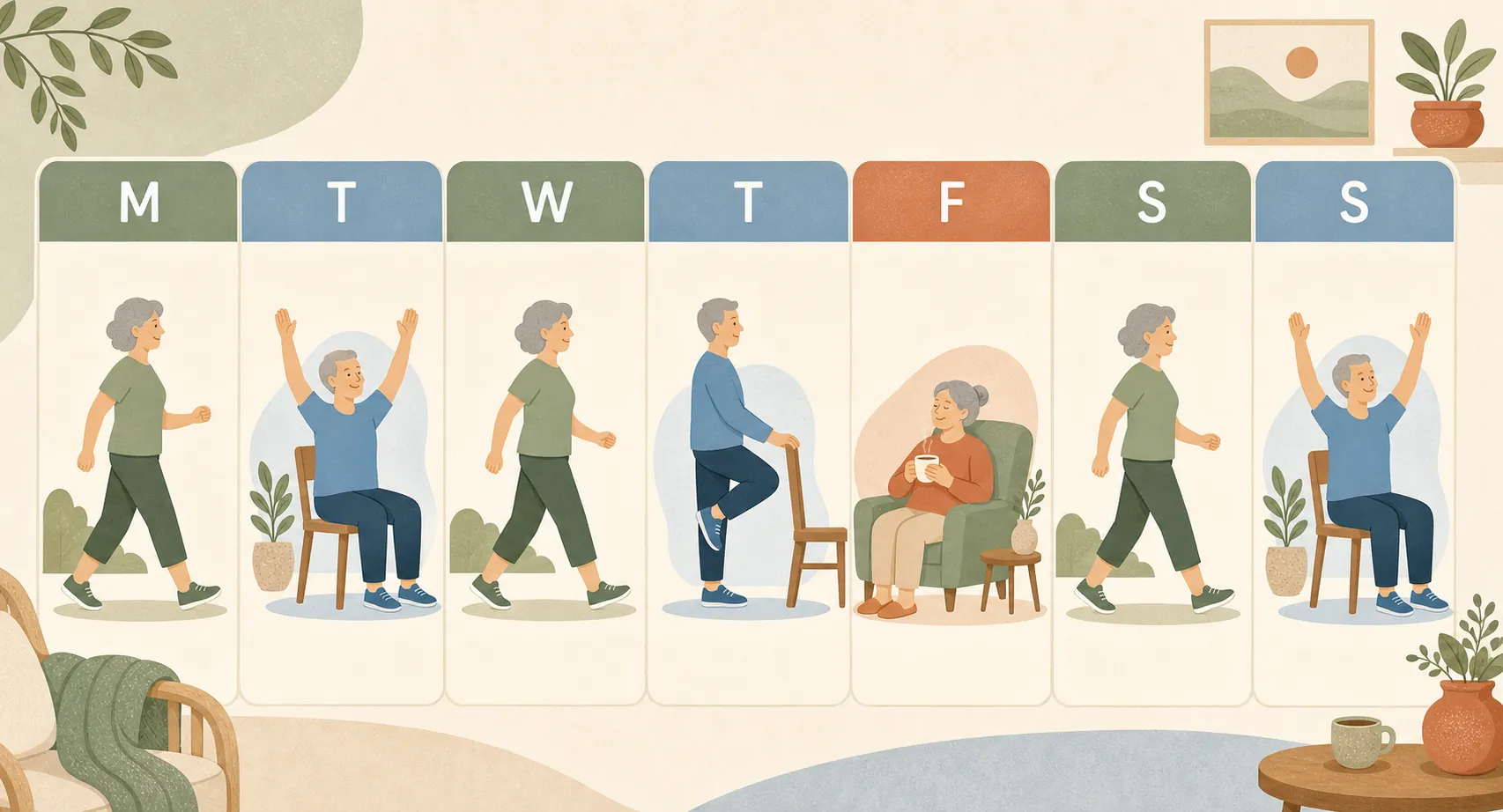
The starter week is not a lesser plan. It is the same plan scaled down. For many older adults, the first win is learning where activity belongs in the week without creating two days of soreness and five days of avoidance. The CDC’s own guidance allows that some physical activity is better than none, and older adults who cannot do 150 minutes should be as physically active as their abilities and conditions allow [1].
How to know whether the walk counts
A slow 10-minute walk counts as starting. Whether it counts toward the moderate-intensity target depends on effort. The simplest check is the talk test: during moderate-intensity activity, a person can talk but cannot sing; during vigorous-intensity activity, they can say only a few words before pausing for breath [3].
That makes the walking days easier to adjust. If an older adult can sing easily through the whole walk, it may be light activity. Light activity is still useful for building the habit, warming up joints, and replacing sitting, but it may not be moderate exercise yet. If they cannot speak in short sentences, the pace is probably too hard for a routine starter walk unless a clinician has cleared vigorous exercise.
The walking route should be boring in the best possible way: flat, familiar, well lit, and easy to shorten. A hallway, driveway, indoor mall, community center loop, or repeated block can all work. The purpose is not scenery; it is repeatability. LCMC Health’s safety advice for older adults includes staying hydrated, wearing well-fitting shoes, warming up, and avoiding extreme temperatures [4]. On hot days, the safer fitness choice may be an indoor route or a postponed walk, not “pushing through.” For more heat-specific planning, see the site’s guidance on heatstroke and fall prevention during a heatwave and red-alert heat safety.
Strength days do not require a gym
The CDC guideline says strength work should happen on 2 or more days per week and involve all major muscle groups [1]. In a home routine, that usually means choosing a few movements that cover legs, hips, chest, back, shoulders, arms, and the trunk without requiring machines.
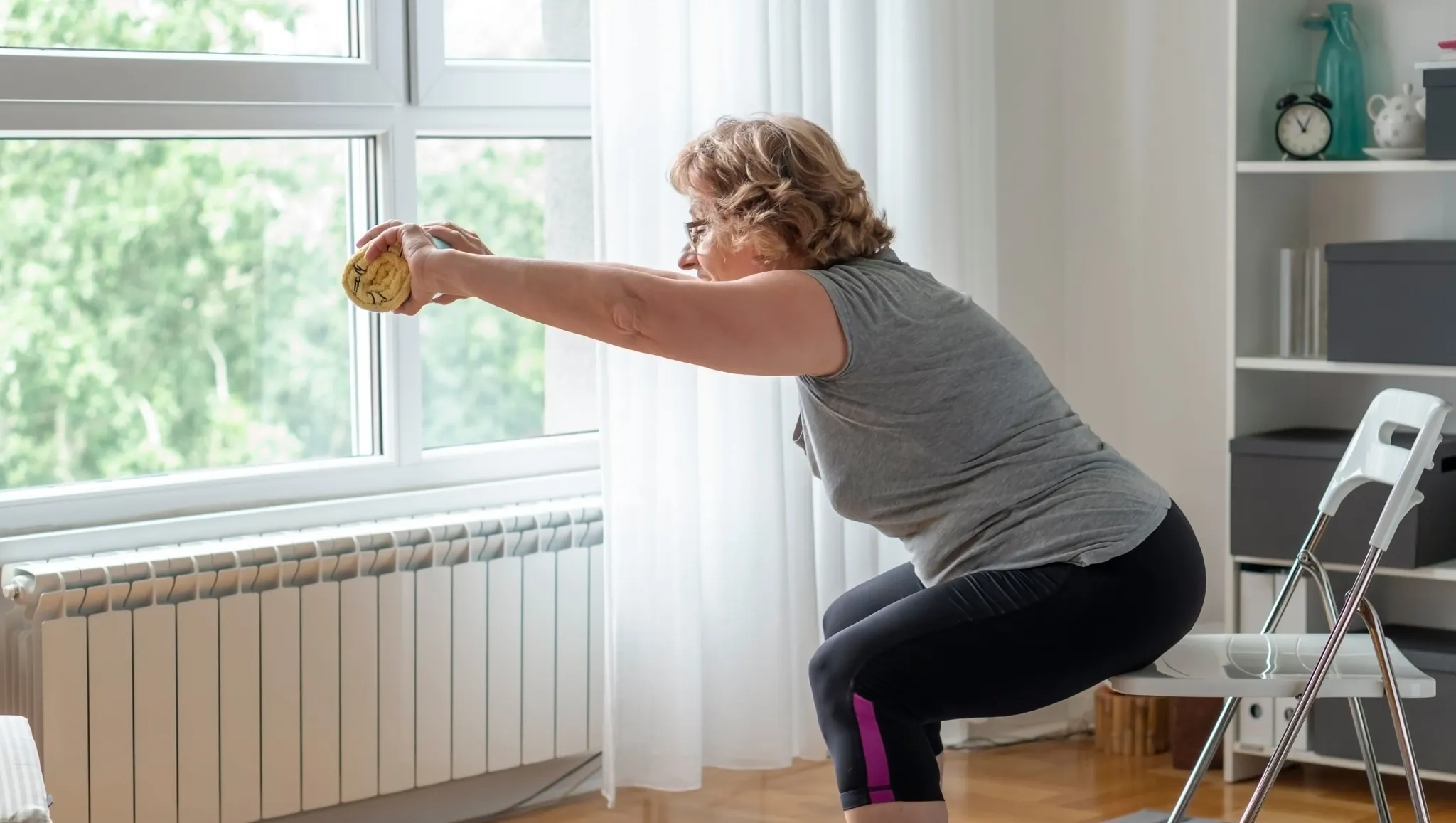
A simple Tuesday-and-Friday strength session might include:
- Chair sit-to-stands, using the arms of the chair if needed.
- Wall push-ups, standing far enough from the wall to feel effort without losing control.
- Seated knee extensions or seated marching.
- Heel raises while holding the back of a sturdy chair or a counter.
- Gentle rows using a resistance band, towel, or controlled shoulder-blade squeeze.
- Standing side leg lifts while holding support, if balance allows.
The starting dose should be deliberately modest. NCOA’s fall-prevention exercise guidance suggests starting with 5 to 10 repetitions, resting up to a minute as needed, alternating exercise days with walking days, and gradually building toward a 30-minute walk three times a week [5]. That fits the schedule above: walking and strength are not piled onto the same hard day unless the person is already tolerating the routine well.
For someone who needs to begin seated, chair exercise can be a real starting point rather than a consolation prize. Cleveland Clinic recommends using a firm, non-wheeled chair, starting with one set of 10 repetitions, and building toward 2 to 3 sets as strength improves [6]. The non-wheeled chair detail is not fussy; it is the difference between a support surface and a moving hazard.

A useful strength day should leave the person feeling worked, not punished. Stop a set when form changes, breath becomes strained, pain appears, or the person starts using momentum to finish the movement. If Tuesday’s session causes soreness that changes walking or stair climbing on Wednesday, Friday’s session should be shorter, easier, or skipped.
Balance work belongs in the week, but it should stay controlled
Balance work is often the piece left out of general fitness advice, even though falls are a major threat to mobility and independence. CDC fall data show that more than 1 in 4 older adults report falling each year [7]. That does not mean every older adult should start challenging balance drills in the living room. It means balance deserves a planned, supported place in the week.
Keep balance practice short and near something stable: a kitchen counter, a heavy table, or the back of a sturdy chair. Good starter options include standing with feet closer together while lightly holding the counter, shifting weight from one foot to the other, marching in place while holding support, or practicing heel-to-toe positioning only if it feels safe. The test is control. If the person has to grab, lunge, or twist to recover, the drill is too difficult for unsupervised practice.

A recent fall changes the assignment. This article is not a post-fall triage plan. If someone has fallen recently, is newly afraid of walking, is holding furniture more than usual, or has dizziness, weakness, or medication changes, use a clinician or physical therapist as the next step and follow a dedicated fall-prevention path rather than simply adding harder exercises.
Progress without turning week one into a test
The safest progression rule is to increase only one thing at a time: minutes, repetitions, sets, pace, or balance difficulty. If a parent is currently walking 10 minutes three times a week, the next step might be adding a fourth 10-minute walk, not jumping to 30 minutes every day. If chair sit-to-stands feel easy, the next step might be one or two more controlled repetitions, not removing all hand support.
Use the next-day check. If the older adult is unusually tired, more unsteady, short of breath beyond the session, or sore enough to avoid normal activities the next day, the previous session was too much. The plan then goes back to the last comfortable level. Progression is not earned by enduring a bad session; it is earned by repeating a manageable one.
| If this is the current level | A reasonable next move | What not to change at the same time |
|---|---|---|
| 10-minute easy walk feels fine | Add another 5 minutes to one walk, or add one extra short walk day | Do not also make the route hillier or faster |
| One set of 5 to 10 chair exercises feels controlled | Add a few repetitions, or add a second set later | Do not switch to an unstable chair or remove support suddenly |
| Supported balance practice feels steady | Use a lighter touch on the counter for brief moments | Do not close the eyes or practice away from support |
| The full week feels tiring | Keep two strength days but shorten the walks temporarily | Do not remove rest and light days first |
For caregivers, the calendar is useful because it prevents the enthusiastic first day from becoming the problem. A new routine often fails after one overlong walk, one hard strength session, or one balance scare. The better question is not “Can Dad do this today?” It is “Can Dad do this again on Friday and still feel steady on Saturday?”
Where rest days fit
Rest is not the opposite of the plan. It is part of the plan. Older adults who are starting from low activity, returning after illness, or managing joint pain often need lighter days between strength sessions. The Tuesday-and-Friday strength pattern gives muscles time to recover while keeping walking available on other days.
A rest day can still include ordinary movement: getting the mail, standing during a phone call, walking from room to room, or doing gentle mobility. What it should not include is guilt. The CDC target is weekly, not a command to make every day equally hard [1].
When the plan should pause
Stop the session and get appropriate medical advice if exercise brings chest pain, fainting, new or severe shortness of breath, sudden weakness, new confusion, unusual dizziness, or pain that changes walking. Also pause after a fall, a medication change that affects balance or blood pressure, or a new diagnosis until a clinician has clarified safe activity limits.
The boundary is especially important for people who are already frail, have unstable heart or lung symptoms, have neuropathy, use walking aids, or are recovering from surgery or hospitalization. A physical therapist can turn the same aerobic-strength-balance framework into a safer individualized plan.
Making it last after the first week
Motivation helps, but it should not be asked to carry the whole routine. NCOA’s exercise motivation advice for older adults includes choosing enjoyable activities, setting realistic goals, tracking progress, finding social support, and building activity into a regular schedule [8]. Those ideas work best when the weekly structure is already simple enough to follow.
For one person, the anchor may be a Monday-Wednesday-Saturday walk with a neighbor. For another, it may be Tuesday and Friday chair strength after breakfast. For an adult daughter helping a parent, the anchor may be a paper calendar on the refrigerator with check marks for walking, strength, and balance. The point is not to create a perfect fitness identity. It is to reduce the number of decisions required next Tuesday.
Readers comparing this neutral CDC-based plan with more structured named routines may also want the site’s reviews of Arnold Schwarzenegger’s senior workout, gym workouts for older adults, and fitness challenges for seniors. Those are adjacent options; the basic safety baseline remains the same: aerobic activity, strength work, balance practice, gradual progression, and medical clearance when risk is present.
The best fitness tips for aging adults are not scattered tips at all. They are a weekly pattern: walk or do other aerobic activity often enough to build toward the CDC target, strengthen the major muscle groups twice a week, practice balance in controlled conditions, start below the full dose when needed, and treat safety limits as part of the routine.
References
- Older Adult Activity: An Overview, Centers for Disease Control and Prevention.
- QuickStats: Percentage of Adults Aged ≥18 Years Who Met the 2018 Federal Physical Activity Guidelines for Both Aerobic and Muscle-Strengthening Activities, by Age Group — National Health Interview Survey, United States, 2022, Centers for Disease Control and Prevention.
- Physical activity guidelines for older adults, NHS.
- 6 Tips for Exercising Safely as an Older Adult, LCMC Health, December 2021.
- What Exercises Can Help You Prevent a Fall?, National Council on Aging.
- Chair Exercises for Seniors, Cleveland Clinic.
- Older Adult Falls Data, Centers for Disease Control and Prevention.
- 5 Tips to Help Older Adults Stay Motivated to Exercise, National Council on Aging.
Questions to bring to a clinician or OT
This is not medical, legal, or a family's final decision — only a framework. Bring these questions to a clinician, occupational therapist, or your local Area Agency on Aging.
Find Local HelpRelated reading
Noticed something outdated or inaccurate on this page? Flag a correction. We review every report against CDC, NIA, and AARP HomeFit guidance before updating a page.