
Glossary entry
Help Button or Passive Monitoring? Choosing the Right Elderly Monitoring System for Your Parent
The problem usually shows up in an ordinary place: the help button is on the nightstand, the charger is across the room, or the pendant is hanging from a hook in the bathroom because your parent says they "only take it off for showers." The family has technically bought protection. The parent technically owns an emergency device. But the system depends on a chain of small behaviors that may already be breaking.
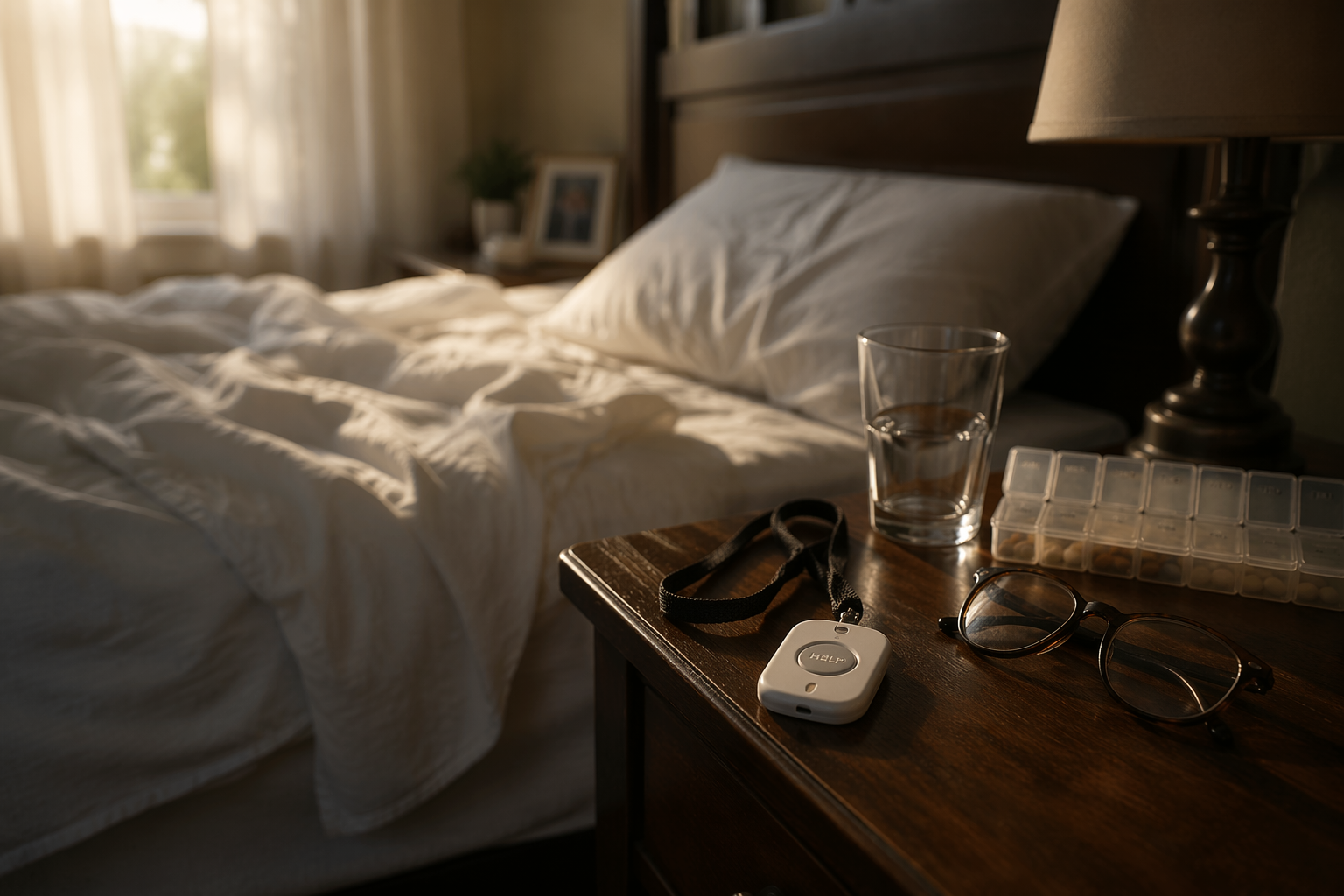
That is the first question to ask about elderly monitoring systems. Not which device has the longest battery life, the sleekest app, or the most impressive fall-detection claim. The first question is whether the protection model matches the parent you actually have. A help button works when the person wears it, keeps it charged, understands what is happening, and presses it or tolerates the alert process when something goes wrong. If any of those steps are unreliable, the feature list starts to matter less.
Families often reach this point after a fall, not before one. NCOA reported in its medical alert system research that most medical alert users in its 2025 survey purchased a device after a fall, which means many households are making decisions with a recent scare still fresh in the room.[1] That timing is understandable. It is also when people are most likely to accept a comforting answer too quickly: buy the pendant, pay the monthly fee, check the box.
The elderly monitors market was estimated at $4.66 billion in 2026, so there is no shortage of products trying to become that answer.[2] What families need first is not another ranked list. They need to decide which category can still work on a bad day.
The Help Button Model Has a Human Requirement
A traditional medical alert system is simple in a way that can be genuinely useful. The person wears a pendant, wrist button, or similar device. When they need help, they press the button. Depending on the plan, that alert may go to a monitoring center, a caregiver, emergency services, or some combination of contacts.
For the right parent, that is a reasonable setup. If your mother lives alone, walks around the neighborhood, remembers her phone, accepts the pendant as part of her routine, and has the judgment to press the button after a fall or sudden symptom, a wearable medical alert may be the cleanest option. It is portable. It is familiar. It can travel outside the home in ways most room-based systems cannot.
But the model is not passive. It asks the older adult to do several things consistently:
- Wear the device during the moments when a fall or medical event might happen.
- Keep it charged or docked correctly.
- Recognize that the situation is serious enough to ask for help.
- Press the button, speak with the responder if required, and not cancel the alert out of embarrassment or confusion.
That sounds manageable when everyone is sitting at the kitchen table. It is less tidy at 2:17 a.m., after a trip to the bathroom, when the pendant is on the dresser because it was uncomfortable in bed. It is also less tidy when the parent is proud, frightened, in pain, or already having memory lapses.
This is where many families quietly fudge the truth. "She usually wears it" becomes treated as close enough. "He knows he should press it" becomes treated as a plan. In a real emergency, almost wearing a device is the same as not wearing it.
Where Pendants Fail in Real Homes
The most common failure is not technical. It is behavioral. The pendant is removed for bathing and never put back on. The wrist device feels bulky. The charging cradle gets moved. A parent says the device makes them feel old. A family member visits, sees it on the counter, reminds them again, and leaves pretending the reminder fixed the system.
Bathrooms are a good example of the mismatch. They are one of the places families worry about most, but they are also where some older adults remove wearables for comfort, modesty, or habit. A pendant cannot help from the vanity if the fall happens in the shower. A button cannot call anyone if the person is dazed, unconscious, or too embarrassed to press it.
Early cognitive decline adds another layer. The issue is not only forgetting to wear the device. A parent may not understand that the event counts as an emergency. They may try to get up repeatedly instead of calling for help. They may press the button at the wrong times, remove the device because it feels unfamiliar, or cancel an alert because a stranger's voice from a speaker feels intrusive. For families dealing with dementia-specific trade-offs, the better question is often not "Can we teach this?" but "How much teaching does the safety plan require every day?" A deeper discussion of that issue belongs in a dementia-focused comparison like passive vs. wearable elderly monitoring for dementia caregivers.
Fall detection can help, but it does not erase the compliance problem. NCOA discusses studies in which chest-worn devices reached about 98% accuracy under controlled conditions, while also warning that fall-detection research varies by device placement, study method, and sample size.[1] A sensor that performs well when worn correctly is still absent when it is sitting on a nightstand.
There is also a nuisance-alert problem that families should not wave away. NCOA cites a four-month study of commercial fall detection systems in which 83 of 84 alarms were false alarms.[1] That does not mean all fall detection is useless. It means "automatic" and "reassuring" are not the same thing. Too many false alarms can train a parent to ignore, remove, or resent the device, and can train family members to discount alerts until the one real emergency arrives.
NCOA's testing is useful, especially because it separates device types and discusses methodology, but it also discloses affiliate relationships with some companies it reviews.[1] That does not make the information worthless. It does mean families should avoid turning one brand result or one accuracy figure into a universal rule.
When a Wearable Still Makes Sense
A pendant or wrist button is still a good fit for some older adults. The best candidate is cognitively intact, cooperative, and mobile enough that protection outside the home matters. They understand why the device exists. They will wear it without a daily argument. They can manage charging or accept help with charging. They are willing to press a button when something feels wrong.
That last point matters. Some parents will wear the pendant but refuse to use it. They do not want to bother anyone. They do not want an ambulance. They do not want neighbors seeing emergency responders at the house. If your parent has already shown that they minimize symptoms, hide falls, or wait hours before calling, the device may be physically present without being functionally available.
| Question | What the answer tells you |
|---|---|
| Does your parent wear the device without repeated reminders? | If no, the system is already depending on unreliable compliance. |
| Can your parent charge or dock it correctly? | If no, someone else must own that routine or choose a model with less daily maintenance. |
| Would your parent press the button after a fall, chest pain, dizziness, or sudden weakness? | If no, the help-button model may fail even when the device is worn. |
| Does your parent leave home alone? | If yes, a wearable may still be important because room-based sensors cannot follow them outside. |
| Are memory problems affecting daily routines? | If yes, reduce the number of safety steps that depend on your parent remembering what to do. |
For families still sorting out the broad categories, a primer on the three main types of elderly monitoring systems can be useful before comparing individual products. The category decision should come before the brand decision.
What Passive Monitoring Changes
Passive monitoring changes the safety chain by removing the wearable from the parent. Instead of asking the older adult to press a button, the home has sensors that watch for patterns such as movement, room activity, door use, or changes in routine. The details vary by system, but the practical difference is simple: the parent does not have to remember to put something on every morning.
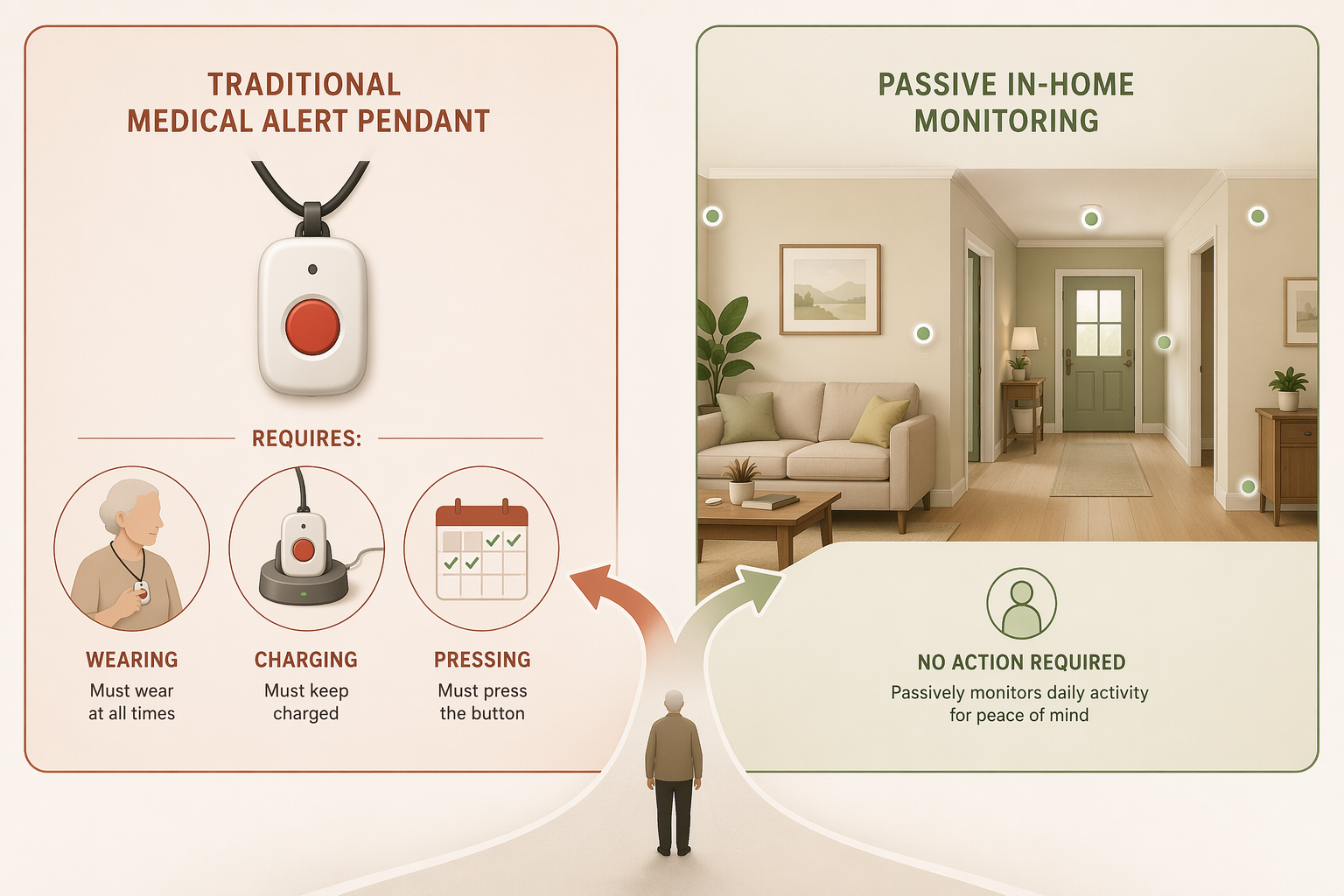
That makes passive monitoring a better match when the problem is compliance. If your parent will not wear a pendant, cannot keep it charged, or has memory changes that make the button model shaky, a passive system is not a fancier version of the same idea. It is a different protection model.
Privacy is the other reason families look at passive sensors. Some older adults reject cameras for good reasons. They do not want to be watched in their bedroom, bathroom, or living room. Passive remote monitoring systems are commonly described as using no cameras, microphones, or wearables, which can make them easier to accept than camera-based monitoring while still giving caregivers signals that something has changed.[3][4]

The trade-off is that passive monitoring is usually strongest inside the home. It may tell you that Dad has not left the bedroom by late morning, that kitchen activity looks unusual, or that there was nighttime movement followed by inactivity. It is not the same as a wearable with GPS for a parent who walks outside alone. It is also not the same as a caregiver standing nearby during transfers.
This is where families need to be honest about what problem they are solving. If the concern is "Mom refuses the pendant and I need to know if her normal routine breaks down," passive sensors may fit. If the concern is "Mom needs hands-on help bathing, toileting, transferring, or staying safely supervised," monitoring is not enough. Alerts can tell someone to respond. They cannot lift a person, prevent every fall, clean up an accident, or provide judgment in the room. Families at that point should be comparing technology with paid care, family coverage, or a different living arrangement, not just choosing between devices. A practical next step is a guide on when monitoring is not enough.
The Decision Is Really About Failure Mode
A product comparison can make these choices look like a feature contest: pendant versus sensor, fall detection versus activity monitoring, app alerts versus call center. That is not how the decision feels from the caregiver side. The better question is: when this plan fails, how will it fail?
| Parent situation | Better starting category | Why |
|---|---|---|
| Cognitively intact, cooperative, active outside the home | Medical alert pendant or wearable | The parent can participate, and portability matters. |
| Frequently forgets or refuses the pendant | Passive monitoring | The system should not depend on daily wearing behavior. |
| Early memory changes affecting routines | Passive monitoring, sometimes paired with other care | The safety plan should reduce the need for correct real-time decisions. |
| Strong privacy objection to cameras | Passive sensors | The home can be monitored for activity changes without video or audio. |
| Needs help with bathing, toileting, transfers, or supervision | In-person care planning | Monitoring may alert someone, but it cannot provide hands-on assistance. |
Some households will use more than one layer. A parent who still drives, shops, or walks outside may need a wearable away from home and passive sensors indoors. Another parent may start with a pendant and later move to passive monitoring as memory changes. You do not need to be loyal to a device category. You need to stop pretending the same safety model works after the parent's behavior has changed.
If cameras are also on the table, the comparison gets more complicated because cameras may answer different questions while raising sharper privacy concerns. A fuller landscape comparison of passive sensors, wearables, and cameras can help separate those trade-offs.
How to Talk About the Choice Without Turning It Into a Fight
The monitoring conversation often goes badly when the adult child leads with fear and the parent hears surveillance. The more useful framing is practical: "We need a system that does not depend on perfect habits during an emergency." That is different from saying, "You cannot be trusted." It names the weak point in the plan.
For a parent who is still cognitively intact, the choice should include their preferences. Some will accept a pendant because it feels less invasive than sensors around the home. Others will prefer passive sensors because they do not want to wear anything. Some will reject both at first, then accept one after the family narrows the decision to the least intrusive option that still addresses the real risk.
The conversation should be specific. Talk about the actual failure you have seen: the pendant left by the bed, the missed charge, the fall that was not reported, the morning when no one could reach them. Then talk about what the system must do without relying on that behavior. Families who need help with wording can use a dedicated guide on how to talk to an aging parent about elderly monitoring systems.
Cost will come up quickly, especially with monthly monitoring fees. Coverage depends on the type of device, plan, and payer, and families often need a separate answer to whether Medicare helps pay for medical alert systems. That question is best handled directly in a Medicare medical alert systems FAQ rather than guessed during a device comparison.
The Practical Answer
There is no single best elderly monitoring system. There is a best-fit model for the parent in front of you.
If your parent is cognitively intact, willing to wear a device consistently, able to keep it charged, and likely to press the button when help is needed, a traditional medical alert pendant or wearable remains a reasonable, often simpler choice. It is especially useful when your parent spends time outside the home and needs portable access to help.
If the system depends on behavior your parent is already not demonstrating, passive monitoring is the more reliable protection model. It removes daily wearing, charging, and button-pressing from the safety chain. It also offers a middle ground for families who need visibility into changes at home without putting cameras or microphones into private spaces.
The hard part is accepting what the current pattern is already telling you. A pendant on the nightstand is not protection. A fall detector that is not worn is not protection. A parent who will not press the button needs a different plan. Choose the system that matches the parent you have, not the parent the brochure assumes.
References
- Best Medical Alert Systems with Fall Detection, NCOA, 2026.
- Elderly Monitors Market Report 2026, Research and Markets, February 2026.
- Smart Home Monitoring Systems for Elderly Care, Age Space, 2026.
- Enhancing Peace of Mind with Elderly Monitoring Systems, Care.com, 2026.
Browse more in the Glossary.