
Caregiver decision guide
Passive vs. Wearable Elderly Monitoring: What Dementia Caregivers Need to Know About the Trade-Offs
For adult children caring for a parent with mild cognitive impairment or dementia, wearable medical alert pendants often fail due to non-compliance. This guide compares passive ambient monitoring systems (motion sensors, door sensors, no cameras) with wearable devices across cost, privacy, fall detection accuracy, and early health signal detection — helping you decide which approach fits your parent's needs.
The Compliance Problem: Why Medical Alert Pendants Fail for Seniors with Cognitive Decline
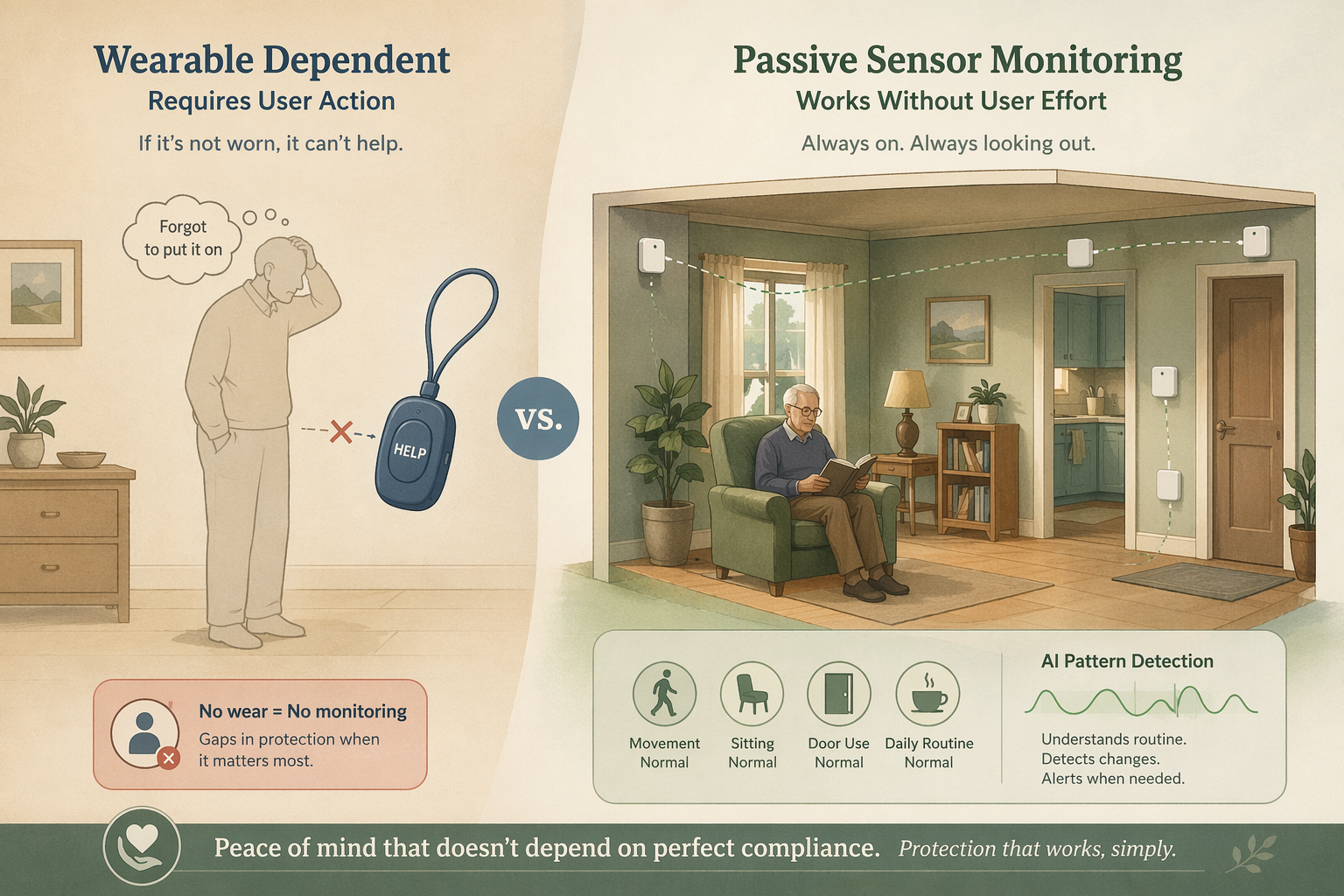
The logic of a medical alert pendant is straightforward: press the button, help arrives. But this logic collapses when the person wearing it has mild cognitive impairment or dementia. The device depends entirely on the user remembering to put it on each morning, keep it charged, and recognize when they need help — three tasks that become unreliable as cognitive decline progresses.
Research consistently shows that between 30% and 50% of seniors with cognitive decline fail to wear their pendants consistently. This is not a user error; it is a design mismatch. A device that requires daily conscious action from someone whose memory and judgment are fading is a device that will fail at the moment it is most needed. The consequences are severe: older adults who cannot get up after a fall face what researchers call the "long lie" — extended time on the floor that dramatically increases the risk of hospitalization, pressure injuries, dehydration, and death.
For adult children managing care from a distance, the compliance problem creates a constant undercurrent of anxiety. You cannot know whether your parent is wearing the device today. You cannot know whether they remembered to charge it last night. And if they fall while the pendant sits in a drawer, you will not find out until hours or days later — if at all.
This is the fundamental failure that passive ambient monitoring systems are designed to solve. They remove the human element entirely. No wearing. No charging. No remembering. The technology works in the background, watching patterns instead of waiting for a button press.
For a deeper look at why traditional pendants fail specifically in dementia care, see our guide on why medical alert buttons fail for dementia — and what actually works.
How Passive Ambient Monitoring Works — Without Cameras or Wearables
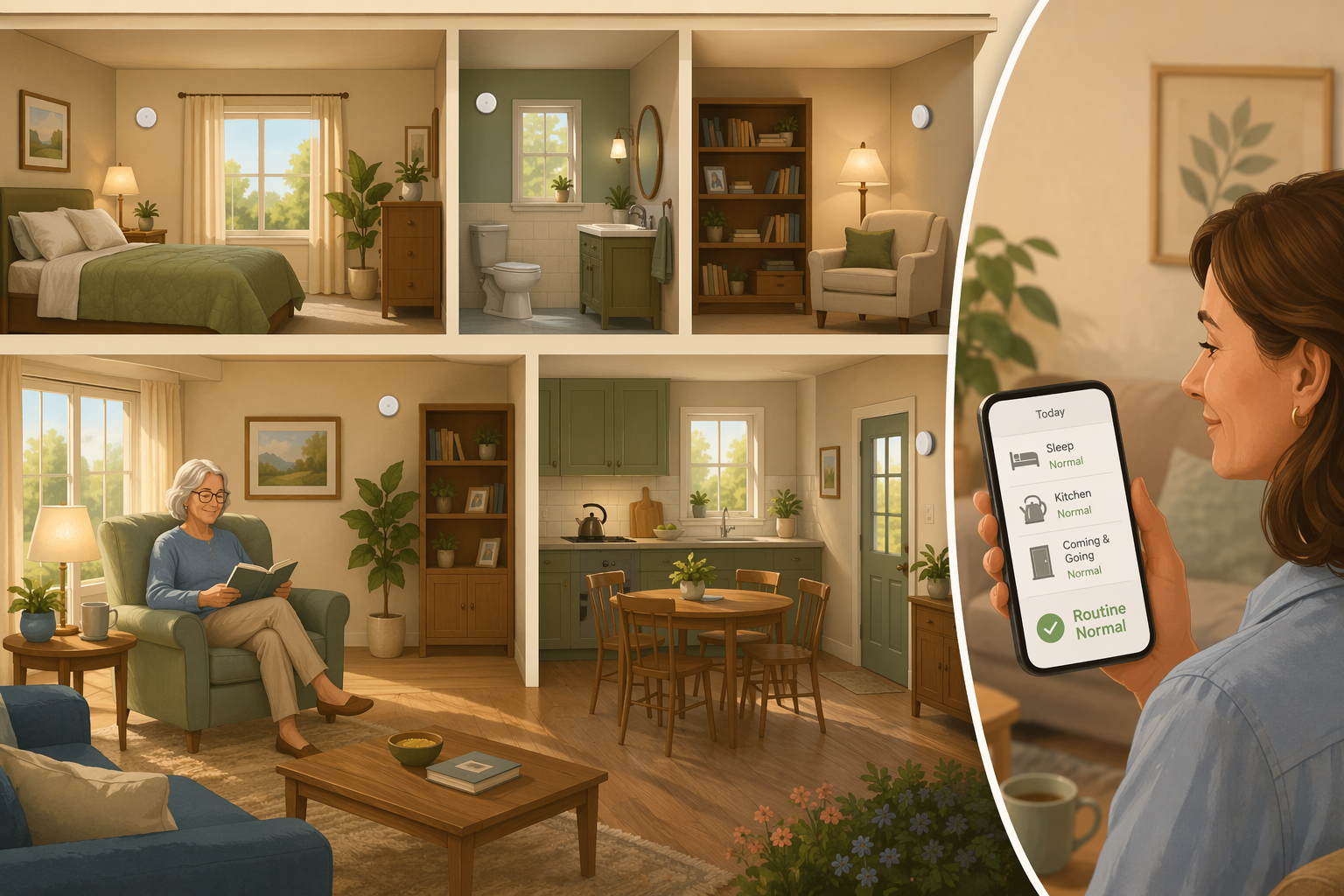
Passive ambient monitoring uses a network of small, wireless sensors placed throughout the home — on walls, doors, cabinets, and near the bed. These sensors detect motion, door openings, cabinet use, and bed occupancy. They do not record video or audio. They do not require the senior to wear, charge, or interact with anything.
A 2022 NIH scoping review of 30 studies found that passive infrared (PIR) motion sensors and contact sensors are the most common types used in in-home monitoring for aging adults. The review specifically excluded wearable systems from its analysis due to usability barriers for older adults with cognitive impairment — an acknowledgment that the technology category itself recognizes the compliance problem.
The sensors communicate wirelessly to a hub that sends data to a cloud platform. Machine learning algorithms analyze the data to establish a baseline of normal activity patterns for each individual: typical wake time, meal times, bathroom frequency, movement between rooms, and sleep quality. Once the system learns what "normal" looks like for that person, it can detect deviations.
The key distinction from cameras is intentional. Camera-based monitoring raises significant privacy concerns — a 2013 NIH longitudinal study found that only 7% of cognitively intact older adults would agree to be videotaped around the house after one year of participation. Passive sensors collect no images, no identifiable video, and no audio. They detect presence and movement, not identity or conversation.
For a detailed explanation of how camera-free sensor technology functions, read our guide on passive ambient monitoring for seniors.
What Passive Systems Detect That Wearables Miss: Early Health Signals Before Emergencies
This is the most important distinction between passive monitoring and wearable devices — and the reason many dementia caregivers are turning to sensors over pendants. Wearables are reactive: they detect a fall after it happens and call for help. Passive systems are proactive: they detect changes in behavior that signal a health problem days or even weeks before a fall or hospitalization occurs.
Consider a common example: increased nighttime bathroom trips. A wearable device will not flag this as a concern because it has no context for what "normal" bathroom frequency looks like for that individual. A passive system, however, learns the person's typical sleep pattern. When the number of nighttime bathroom trips suddenly increases from one to five, the system alerts the caregiver.
As Ryan Herd of Caregiver Smart Solutions explained to AARP in 2020, "If they suddenly start getting up in the middle of the night to use the bathroom five times, that could be a sign of a urinary tract infection." UTIs are a leading cause of sudden confusion and hospitalization in older adults — and catching them early can prevent a cascade of more serious complications.
Passive systems can detect a range of early signals:
- Reduced overall mobility — fewer trips between rooms, longer periods in a single position — which may indicate pain, weakness, or depression.
- Skipped meals — detected by lack of cabinet or refrigerator sensor activity during typical meal times.
- Sleep disturbances — increased nighttime wakefulness or restlessness that may signal pain, medication side effects, or cognitive changes.
- Wandering patterns — unusual movement at odd hours, which is particularly relevant for dementia caregivers.
- Missed morning routines — failure to get out of bed or move through the home at the expected time, which may indicate a fall, illness, or injury.
Wearable devices, by contrast, are designed to detect one thing: a sudden impact or change in orientation that indicates a fall. They do not track bathroom frequency, meal patterns, or mobility trends over time. A pendant that sits in a drawer provides no data at all. A passive system that runs continuously provides a constant stream of health-relevant information — even when nothing is wrong, which is itself useful information for a long-distance caregiver.
Passive vs. Wearable: Side-by-Side Trade-Off Analysis
Choosing between passive and wearable monitoring is not about which technology is "better" in the abstract. It is about which set of trade-offs aligns with your parent's cognitive stage, living situation, and your caregiving needs. The table below compares the two approaches across the dimensions that matter most for dementia caregivers.
| Dimension | Passive Ambient Monitoring | Wearable Medical Alert |
|---|---|---|
| Cognitive suitability | Ideal — no action required from the senior; works regardless of memory or judgment | Poor — requires daily wearing, charging, and recognition of need; fails with cognitive decline |
| Fall detection accuracy | Radar-based systems achieve up to 98.74% accuracy in lab settings; WiFi-based systems reach 95% detection rate | Chest-worn devices reach ~98% accuracy in lab tests; wrist devices are less accurate due to arm motion; real-world accuracy drops if not worn |
| Early health signal detection | Yes — detects behavioral changes (nocturia, reduced mobility, skipped meals) days or weeks before emergencies | No — reactive only; detects falls after they occur |
| Privacy level | High — no cameras, no audio, no identifiable data; 60% of seniors still express concerns, but only 7% accept videotaping | Moderate — device collects location and movement data; no video or audio |
| Alert speed | Minutes to hours — system detects deviation from baseline and sends alert; not instantaneous | Seconds — automatic fall detection triggers immediate alert to monitoring center |
| Cost (monthly) | $30–$100/month | $20–$50/month (including fall detection add-on) |
| Equipment cost | $200–$400 one-time | $0–$100 (often included with subscription) |
| Maintenance burden | Low — sensors are battery-powered or plugged in; no user maintenance | Moderate — user must charge device regularly; battery failure means no protection |
| Coverage area | Inside the home only (sensor range) | Anywhere the user wears the device (cellular or WiFi) |
The trade-off that matters most for dementia caregivers is the one in the first row: cognitive suitability. A wearable that achieves 98% accuracy in a lab is useless if it is sitting on the nightstand. A passive system that detects a fall a few minutes later than a wearable would have is infinitely better than a system that never detects the fall at all because the device was not worn.
For a deeper exploration of the ethical considerations around monitoring and privacy, see our guide on privacy vs. safety in elderly monitoring.
Cost Comparison: What You'll Pay for Each Approach
Cost is often the first question caregivers ask, and the answer is not as simple as comparing monthly subscription fees. The total cost of each approach includes equipment, monthly service, and — critically — the hidden cost of gaps in coverage.
| Cost Component | Passive Monitoring | Wearable Medical Alert |
|---|---|---|
| Monthly subscription | $30–$100 | $20–$50 (including fall detection add-on of ~$10/month) |
| One-time equipment | $200–$400 (sensors, hub) | $0–$100 (device included with subscription) |
| Installation | Self-install (sensors mount with adhesive or screws) | None — device is worn |
| Annual cost (year 1) | $560–$1,600 | $240–$700 |
| Annual cost (year 2+) | $360–$1,200 | $240–$700 |
| Hidden cost of coverage gaps | Low — system runs continuously; no user action needed | High — days when device is not worn or charged = zero protection |
To put these numbers in real-world context, one commercial passive monitoring system charges $99 per month with a $399 one-time equipment fee. That is on the higher end of the passive range but includes all sensors, hub, cloud storage, and caregiver alerts. A wearable system with fall detection typically runs $30–$45 per month with little or no upfront equipment cost.
The cost analysis shifts when you factor in the compliance gap. A $30/month wearable that is worn only 60% of the time effectively costs $50 per month of actual protection — and still leaves 40% of the time uncovered. A $60/month passive system that runs 24/7 with no compliance gap provides continuous protection at a predictable cost. For many dementia caregivers, the higher monthly cost of passive monitoring is offset by the elimination of coverage gaps.
When a Hybrid Approach Makes Sense
Passive and wearable monitoring are not mutually exclusive. In fact, combining both approaches can provide the most comprehensive coverage — especially during the transition period when a parent is still willing to wear a device some of the time but is becoming less reliable.
A hybrid setup might look like this:
- Passive sensors throughout the home provide continuous baseline monitoring — detecting falls, mobility changes, and behavioral shifts 24/7.
- A simplified wearable — such as a watch-style device rather than a pendant — provides an additional layer of protection when the parent is willing to wear it, especially outside the home where passive sensors cannot reach.
- The passive system acts as the safety net: if the wearable is not worn, the sensors still provide coverage. If the wearable is worn and detects a fall, the alert is faster. The two systems complement each other.
This approach acknowledges a reality that many caregivers discover through trial and error: no single system is perfect. A parent who refuses a pendant might accept a watch. A parent who removes the watch at night still has sensor coverage in the bedroom. The goal is not to find the one perfect device — it is to build a system of overlapping protections that covers the gaps any single technology leaves open.
The hybrid approach is particularly useful for long-distance caregivers who cannot check in daily. The passive system provides the continuous visibility they need, while the wearable adds an extra layer of reassurance for the times their parent is out of sensor range — in the garden, at a doctor's appointment, or visiting a neighbor.
Questions to Ask Vendors About Data Privacy and Storage
Privacy is the most common concern caregivers and seniors raise about monitoring technology — and for good reason. The 2013 ORCATECH/NIH longitudinal study found that while over 72% of older adults accepted in-home monitoring and were willing to share data with their doctor or family, a majority (60%) reported concerns related to privacy or security. Those concerns actually increased after one year of participation, suggesting that experience with the technology does not automatically resolve privacy worries.
When evaluating any monitoring system — passive or wearable — ask the vendor these questions before signing up:
- Who owns the data generated by the sensors? Can the senior or their family request deletion?
- How is the data encrypted during transmission and at rest? What security standards does the platform follow?
- How long is the data stored? Is there an automatic deletion policy after a certain period?
- Can family members access the data directly? Is there a family dashboard or mobile app?
- Is there any video or audio recording capability in the system — even if it is not currently activated?
- Does the vendor share or sell anonymized data to third parties for research or marketing?
- What happens to the data if the subscription is canceled or the vendor goes out of business?
Camera-free passive systems address the most significant privacy objection: the feeling of being watched. As one vendor put it, "People don't want anybody watching them. They don't like that 1984 stuff." Sensors that detect motion without recording images or sound strike a balance that many families find acceptable — but the specific privacy terms still vary widely between vendors, and the burden is on the caregiver to read the fine print.
For a comprehensive discussion of the ethical dimensions of monitoring an aging parent, see our guide on navigating the privacy vs. safety decision.
Making the Decision: A Step-by-Step Approach for Dementia Caregivers
The decision between passive and wearable monitoring — or a combination of both — does not have to be made all at once. Many caregivers start with one approach and adjust as their parent's needs and preferences evolve. The following steps can help you move from confusion to a clear plan.
- Assess your parent's cognitive stage and wearable compliance. Have they already stopped wearing a pendant or watch? Do they forget to charge devices? If the answer to either question is yes, passive monitoring should be your primary consideration.
- Evaluate privacy concerns honestly — both yours and your parent's. If your parent is strongly opposed to any form of monitoring, a camera-free passive system may be the only option they will accept. If they are open to a wearable, a watch-style device may feel less medical and more acceptable than a pendant.
- Compare costs across the full picture — not just the monthly fee, but the equipment cost, the expected lifespan of the system, and the cost of coverage gaps. A cheaper system that is not worn is more expensive than a pricier system that runs continuously.
- Consider a trial period. Many passive monitoring vendors offer a 30-day trial. Use this time to see how your parent responds to the sensors (most barely notice them) and whether the alert patterns provide useful information for your caregiving situation.
- Have the monitoring conversation early and transparently. Frame the technology as a tool that helps your parent stay at home longer — not as surveillance. For guidance on how to approach this conversation, see our guide on how to talk to an aging parent about monitoring technology.
The most important thing to remember is that the goal is not to find the most technologically advanced system. The goal is to find a system that will actually be in place and functioning when it is needed. For a parent with dementia, that almost always means a system that requires nothing from them — no wearing, no charging, no remembering. Passive ambient monitoring is not a compromise. For this specific population, it is often the most effective solution available.
Questions to bring to a clinician or OT
This is not medical, legal, or a family's final decision — only a framework. Bring these questions to a clinician, occupational therapist, or your local Area Agency on Aging.
Find Local HelpRelated reading
Noticed something outdated or inaccurate on this page? Flag a correction. We review every report against CDC, NIA, and AARP HomeFit guidance before updating a page.