
Glossary entry
Home Health Care vs. Home Care: What Medicare Actually Pays For (and What You'll Pay For)
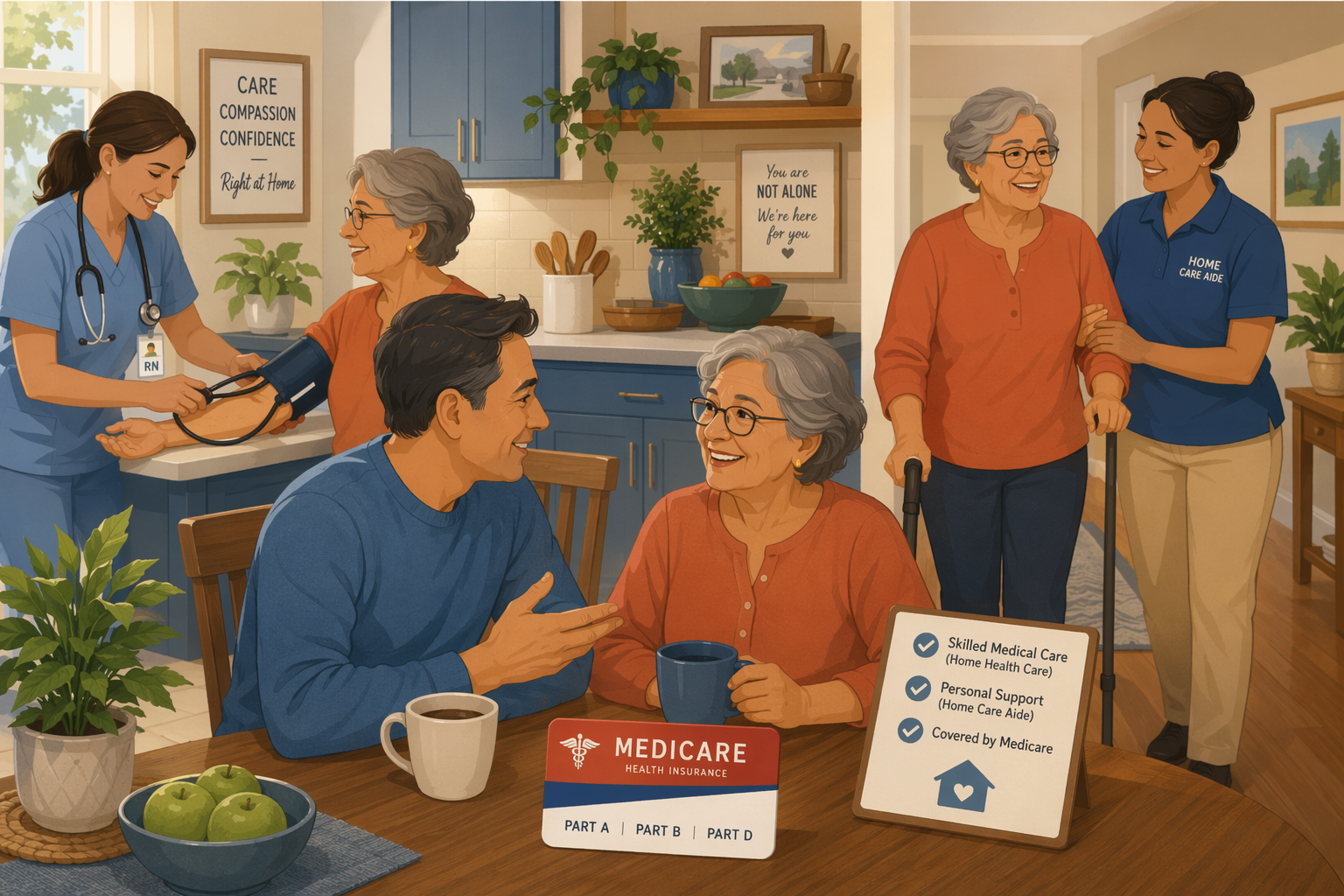
The phone call lasts two minutes. A hospital discharge planner says, "Don't worry, Medicare covers home care." The family nods, relieved. Six weeks later they get a bill for $8,400. That is 28 days of a home health aide at $30 an hour, because Medicare covered exactly zero hours of what the family thought was covered. The planner used the wrong word. "Home care" sounds like "home health care." To Medicare they are not even the same species.
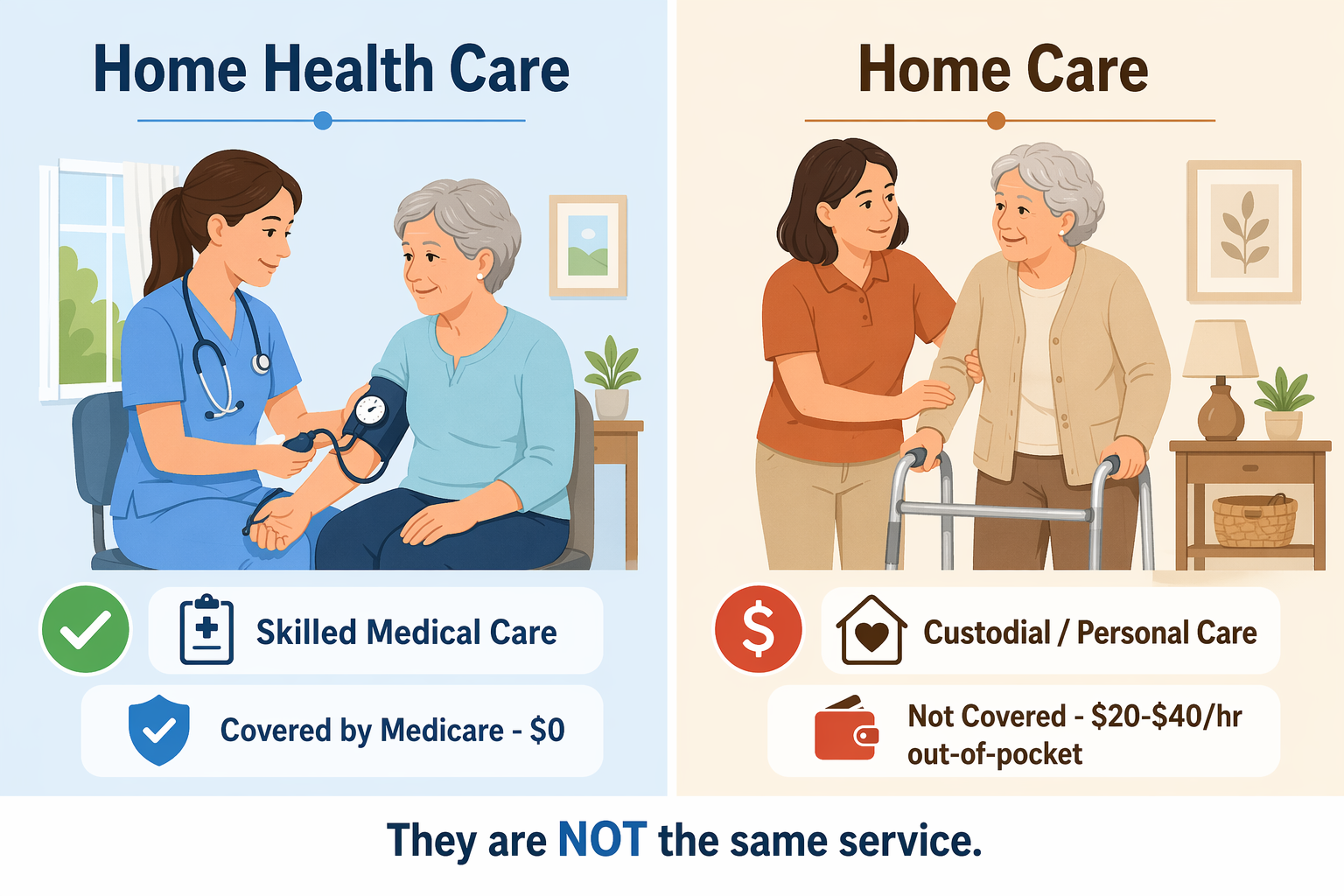
Home health care vs. home care: the master comparison table
The entire Medicare benefit hinges on a distinction that the English language treats as trivial. I have watched families, social workers, and even some hospital staff use the terms interchangeably. The table below is the only defense. Read it once, and the financial surprise disappears.
| Home Health Care | Home Care (Non‑Medical) | |
|---|---|---|
| What it is | Skilled nursing, physical therapy, occupational therapy, speech therapy, medical social work, home health aide (only when paired with skilled care) | Personal care (bathing, dressing, toileting), homemaker services, companionship, meal prep, transportation |
| Who provides it | Medicare‑certified home health agency (nurses, therapists, aides under a care plan ordered by a doctor) | Private home care agencies, independent aides, or family members |
| Medicare coverage | Covers service at $0 for eligible beneficiaries. No copay, no deductible for the services themselves. | Not covered. $0 from Medicare. Paid entirely out‑of‑pocket or through Medicaid/VA/LTC insurance if eligible. |
| Typical duration | Part‑time or intermittent: up to 8 hours/day, 28 hours/week; may be extended to 35 hours/week for short periods if medically necessary. No legal time limit as long as criteria still met. | As needed: from a few hours a week to 24/7 live‑in care. No Medicare limits because Medicare does not pay. |
| What you pay | $0 for covered services. After Part B deductible ($257 in 2025), 20% coinsurance for durable medical equipment (e.g., walker, wheelchair). | Out‑of‑pocket $20–$40 per hour (industry average, 2025–2026). A part‑time schedule of 20 hours/week would run $1,600–$3,200 per month. |
Only 5.2% of seniors qualify: the homebound trap
Medicare's home health benefit was designed to cover short‑term, skilled recovery at home — not ongoing help with daily life. To qualify, a patient must meet three conditions:
- Be homebound — leaving home requires considerable effort and is generally not recommended. Only 5.2% of Medicare beneficiaries are classified as homebound (Generations/ASA, 2023).
- Need skilled care — nursing, physical therapy, occupational therapy, or speech therapy ordered by a doctor.
- The care must be part‑time or intermittent — fewer than 8 hours per day and 28 hours per week combined (up to 35 for short periods). Many families mistakenly think this is a hard cap. Per the Center for Medicare Advocacy, there is actually no legal duration limit for the benefit; it continues as long as the criteria are still met.
That first condition — homebound — is the one that kills coverage for 94.8% of seniors. Even if a family fully understands the difference between home health and home care, the vast majority of older adults who need help with daily activities can leave home with effort — a trip to the doctor, a short walk to the car. That effort alone disqualifies them from Medicare coverage. The 5.2% figure is the single most underappreciated number in Medicare home care planning.
The trap deepens with Medicare Advantage plans. 90% of Medicare Advantage enrollees are in plans that require prior authorization for home health services (KFF, 2026). Even if a patient meets all original Medicare criteria, the insurance company can still say no — and nearly 8% of all prior authorization requests to Medicare Advantage plans were denied in 2024. More than half of those denials were later overturned on appeal, but a family fighting an appeal does not have care while they wait.
For a deeper walk through the homebound definition and how it is commonly misinterpreted, see our dedicated guide to the Medicare homebound rule.
Real scenarios: when each service applies and what you actually pay
The table is useful. The scenarios make it real.
Scenario A: Hip replacement recovery
A 74‑year‑old woman is discharged after hip replacement. She needs physical therapy to regain walking, a nurse to change the surgical dressing, and someone to help with bathing for the first two weeks. She cannot drive and uses a walker — she is homebound. Her doctor orders skilled nursing and PT from a Medicare‑certified home health agency. The nurse visits three times a week, the PT twice a week, and a home health aide comes daily for 30 minutes to assist with bathing. Medicare pays for all of it at $0. She pays 20% of the Medicare‑approved amount for a walker (after the Part B deductible). Total out‑of‑pocket: roughly $60 for the walker. Total covered value: several thousand dollars.
Scenario B: Progressive dementia with custodial needs
An 82‑year‑old man with moderate Alzheimer's needs help bathing, dressing, toileting, and meal preparation every day. He can still walk to the mailbox with supervision — he is not homebound. He has no active skilled medical need. His family calls a home care agency. The cost: $25 per hour, 5 hours a day = $3,750 per month. Medicare pays exactly $0. The family will either pay this out of pocket, qualify for Medicaid (if their income and assets are below the strict limits), or find another funding source.
The difference between Scenario A and Scenario B is not the person's age or affection. It is the type of care needed. One is skilled and temporary; the other is custodial and chronic. Medicare covers one completely and the other not at all.
Your real options when Medicare says $0
For the majority of families who need custodial home care, Medicare will not step in. Here are the real alternatives — with honest caveats.
- Medicaid. Medicaid pays for roughly 70% of all home care spending in the U.S. (Generations/ASA). But eligibility is tight: for Home and Community Based Services (HCBS) waivers, a single applicant generally must have income below $2,901/month and assets below $2,000 (2025 figures, varies by state). 94% of the 1.6 million Medicaid HCBS recipients aged 65+ also have Medicare, meaning they rely on the dual-eligible safety net. If your parent's income and assets exceed those limits, Medicaid is not an option without spending down or transferring assets (with a five-year lookback penalty).
- VA benefits. The VA offers homemaker and home health aide programs for qualifying veterans. Eligibility depends on service‑connected disability status and income. It is not available to all older veterans. Contact the nearest VA medical center or a Veterans Service Officer.
- Long‑term care insurance. Fewer than 10% of older adults have a long‑term care policy (industry estimate). If a policy exists, it may cover in‑home care if the policy explicitly includes home care benefits and the care needs meet the policy's definition. Check the elimination period, daily benefit amount, and benefit period.
- Private pay. This is the default. At $20–$40/hour, even 20 hours per week can exhaust a modest retirement savings quickly. Some families combine private pay with part‑time Medicaid (if partial eligibility exists) or with informal family caregiving. See our funding guide for caregivers for a deeper breakdown of options.
- Medicare Advantage supplemental benefits. In 2026, 12% of individual Medicare Advantage plans and 87% of Special Needs Plans are expected to offer a Special Supplemental Benefit for the Chronically Ill (SSBCI), which may include non‑medical in‑home support. Availability varies wildly by plan, county, and year. Do not assume — verify with the specific plan.
For a fuller view of the gap between what Medicare covers and what families actually need, read our planning guide to the Medicare home health coverage gap.
The $20,000 surprise ends here
The cheapest fix is to stop assuming Medicare covers what most seniors actually need. The terminology confusion is not a trivial detail — it is the root cause of the surprise bill. Once you accept that Medicare covers skilled, short‑term, homebound care only, you can plan for the real cost: $20–$40 per hour out of pocket, or a Medicaid application, or a VA claim, or a long‑term care policy.
Here is the four‑step action plan:
- Determine whether the person needs skilled care (nursing, therapy) or custodial care (help with daily living). If skilled, verify homebound status and get a doctor's order for Medicare‑certified home health.
- If the need is custodial only, assume Medicare pays $0. Immediately explore Medicaid eligibility, VA benefits, or long‑term care insurance. If none apply, budget $20–$40 per hour for private pay.
- Before any service starts, if the person has a Medicare Advantage plan, call the plan to confirm prior authorization requirements for home health. Get written confirmation.
- Use our step‑by‑step guide to setting up home assistance to move from plan to action.
The two‑minute phone call that started this article does not have to end with a bill. It ends when the family knows the difference — and plans for the gap.
Last reviewed: June 24, 2026.
Browse more in the Glossary.