
Overnight Care Decision Framework: Matching Care Models to Nighttime Risk Profiles
Last reviewed: — Review date is particularly important for Medicare coverage, device specifications, and clinical guidance, which change frequently.
Why "Overnight Care" Means Different Things — and Why It Matters
When a family first starts talking about overnight care, the phrase sounds straightforward: someone stays with Mom or Dad through the night. But in practice, "overnight care" covers four fundamentally different arrangements, and the difference between them is measured in thousands of dollars per month and, more importantly, in whether your parent actually gets the support they need.
The core mistake families make is treating overnight care as a single product. They call an agency and ask for "nighttime help" without understanding whether they need a caregiver who sleeps on the premises and wakes when called, or one who stays alert through the entire shift. The wrong choice means either paying for alert coverage you do not need or — far worse — hiring a sleeping caregiver for a parent who needs active monitoring.
The Four Overnight Care Models
| Model | How It Works | Typical Cost Anchor | Best For |
|---|---|---|---|
| Sleeping Shift | Caregiver sleeps at the home, available if needed. Usually 8–12 hours. Not expected to stay awake. | ~$200/night flat rate ($120–$200 range) | Low-risk nights with predictable, infrequent needs |
| Awake Shift | Caregiver stays awake and alert for the entire shift. Provides active monitoring and assistance. | ~$250+/night or $25–$35/hour | Frequent toileting, wandering risk, severe sundowning, high fall risk |
| Live-In | Caregiver lives in the home, provides up to 16 hours of care per day with 6–8 hours of uninterrupted sleep. | $200–$350/day flat rate | Moderate needs that span day and night but allow caregiver downtime |
| 24/7 Rotating | Two or three caregivers working 8- or 12-hour shifts, paid hourly plus overtime. | ~$35/hour+; can approach $21,823/month | High-acuity needs requiring constant awake coverage |
If you are unsure whether your parent needs overnight care at all, start with our red flags guide — then use this framework to match the right model to your parent's specific nighttime risk profile.
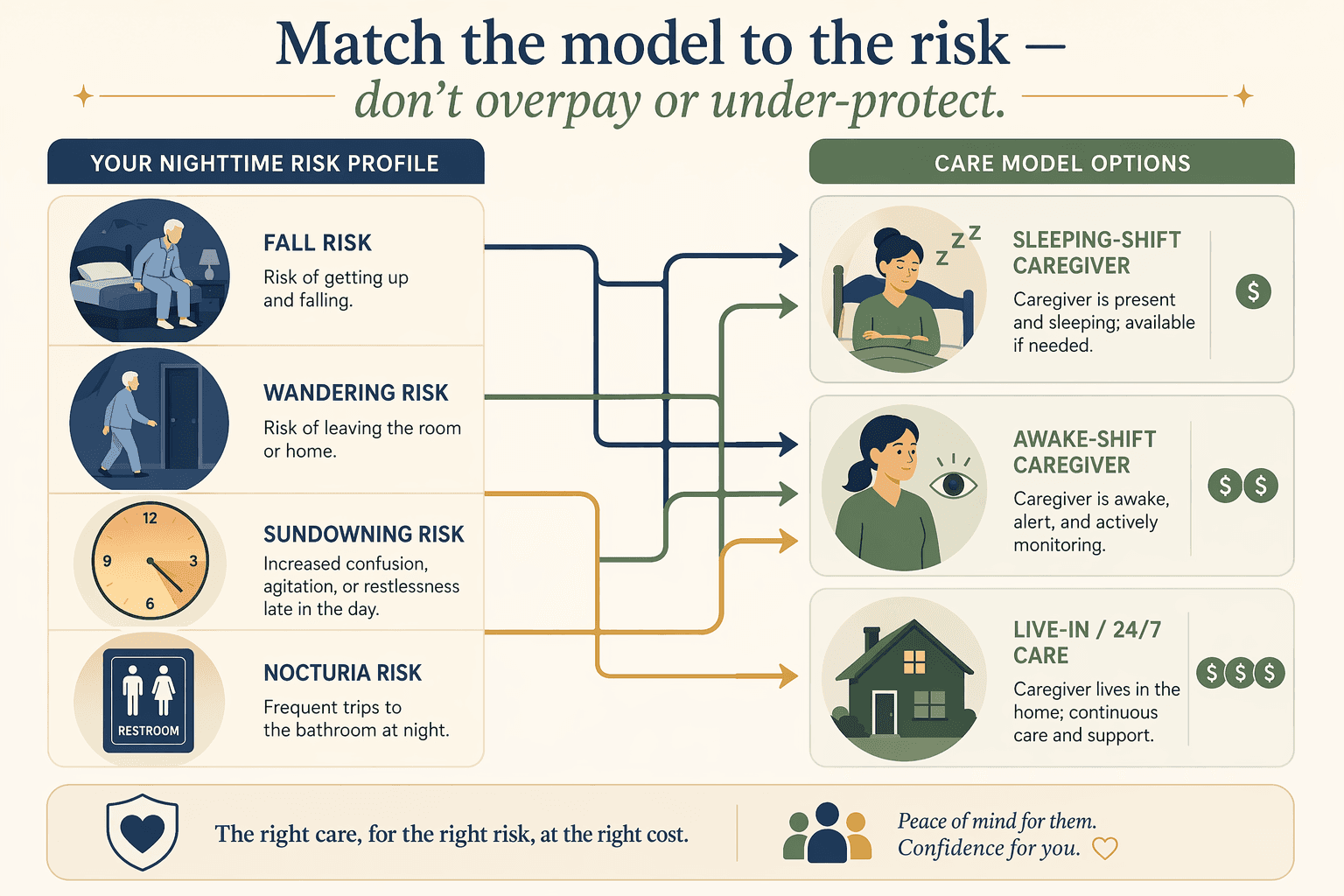
The Four Nighttime Risk Profiles That Determine the Right Model
The right overnight care model depends entirely on what happens between bedtime and morning. Sleep problems affect 40% to 70% of seniors, according to SeniorSite, and many cases go undiagnosed. But the specific type of nighttime disruption determines whether a sleeping caregiver is sufficient or an awake caregiver is essential.
Risk Profile 1: Falls Risk and Nocturia
Nocturia — waking up two or more times per night to urinate — is the single most common driver of overnight falls. A University of Alabama at Birmingham study found that seniors with nocturia are nearly 30% more likely to fall, and 76.8% of older adults with hip fractures reported at least one nocturnal void. The National Institutes of Health notes that most falls occur overnight and that evening falls tend to result in more serious injuries than daytime falls.
For this profile, the key question is frequency. A parent who gets up once or twice per night and can safely navigate the bed-to-bathroom route may only need a sleeping caregiver who can assist if called. But a parent who gets up four or more times, has unsteady gait, or has already fallen at night likely needs an awake caregiver who can intervene before a fall happens.
Risk Profile 2: Wandering and Elopement
Wandering is one of the most dangerous dementia-related behaviors, and it is most dangerous at night. The Alzheimer's Association reports that 6 in 10 people with dementia will wander at least once, and many do so repeatedly. Nearly half of seniors who wander will suffer an injury or worse if not found within 24 hours.
A sleeping caregiver is not appropriate for this risk profile. Wandering can happen silently and quickly — a person with dementia may get dressed, open a door, and walk outside without making a sound. Only an awake caregiver who is actively monitoring can respond in time. Families managing this risk should also develop a comprehensive wandering safety plan that goes beyond overnight care.
Risk Profile 3: Sundowning and Agitation
Sundowning refers to increased confusion, anxiety, and agitation that begins in the late afternoon and extends into the night. The Mayo Clinic notes that it affects 20% to 45% of people with Alzheimer's, manifesting as pacing, aggression, ignoring directions, and difficulty separating reality from dreams. The Alzheimer's Association adds that factors like fatigue, low lighting, and disruption of the body's internal clock can worsen symptoms.
Sundowning creates a unique overnight care challenge because the peak of confusion often coincides with the time when family caregivers are most exhausted. A sleeping caregiver cannot manage active agitation or reorientation needs. Families dealing with moderate to severe sundowning typically need an awake caregiver who can provide reassurance, maintain a calm environment, and prevent escalation.
Risk Profile 4: Incontinence and Repositioning Needs
Frequent incontinence episodes or the need for repositioning to prevent pressure ulcers creates a high-interruption night. A caregiver may be needed every one to two hours for toileting, changing, or turning. At this frequency, a sleeping caregiver cannot get the five hours of uninterrupted sleep that federal rules require for sleep-time pay exclusions to apply. If interruptions prevent five hours of sleep, the entire shift becomes billable at the awake rate.
This profile often signals that overnight care alone may not be sufficient. When a parent needs repositioning or toileting assistance every one to two hours around the clock, the family should evaluate whether a live-in or 24/7 rotating model is more appropriate.
Risk-Profile-to-Care-Model Matching Matrix
The following matrix maps each risk profile to the most appropriate care model. Use it as a starting point, then refine based on your parent's specific frequency and severity.
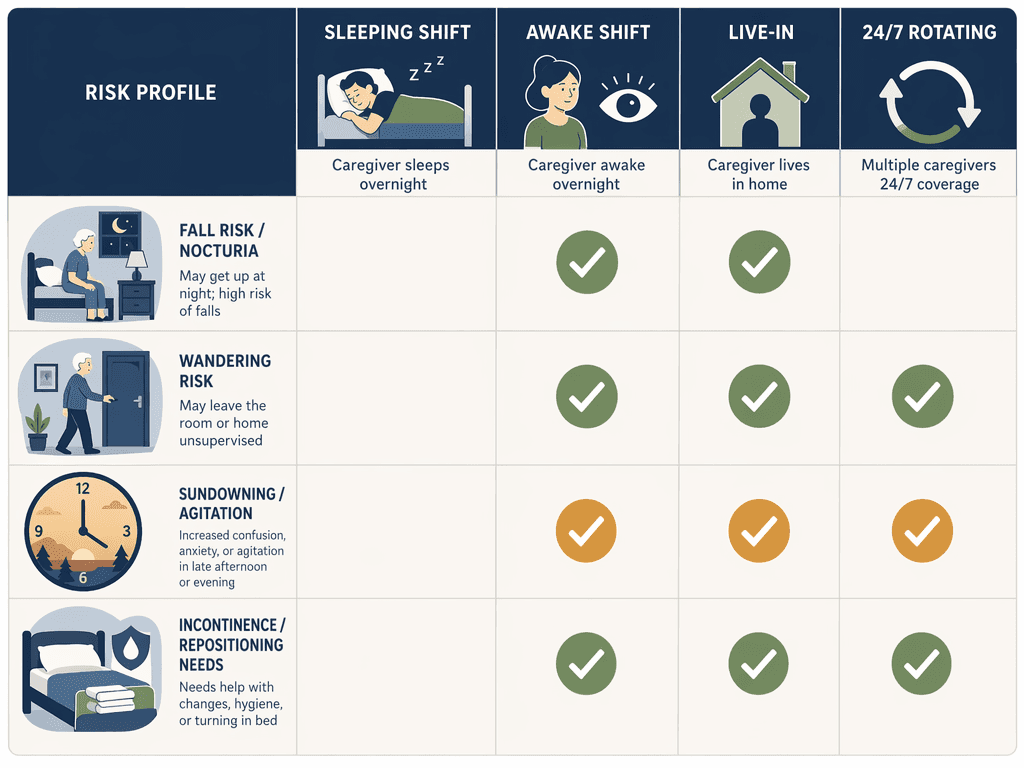
| Risk Profile | Sleeping Shift | Awake Shift | Live-In | 24/7 Rotating |
|---|---|---|---|---|
| Falls / Nocturia (1–2x/night) | Best match | Possible | Overkill | Overkill |
| Falls / Nocturia (3+ times/night) | Not appropriate | Best match | Possible | Possible |
| Wandering / Elopement | Not appropriate | Best match | Possible | Best match if daytime wandering also present |
| Sundowning / Agitation (mild) | Possible | Best match | Possible | Overkill |
| Sundowning / Agitation (severe) | Not appropriate | Best match | Possible | Best match if daytime agitation also present |
| Incontinence / Repositioning (frequent) | Not appropriate | Possible | Best match | Best match if round-the-clock needs |
Decision Flowchart: Is Your Parent Safe Alone for 6+ Hours at Night?
Use this step-by-step self-assessment to determine which care model fits your situation. Answer each question honestly — the goal is to match the model to the risk, not to minimize cost at the expense of safety.
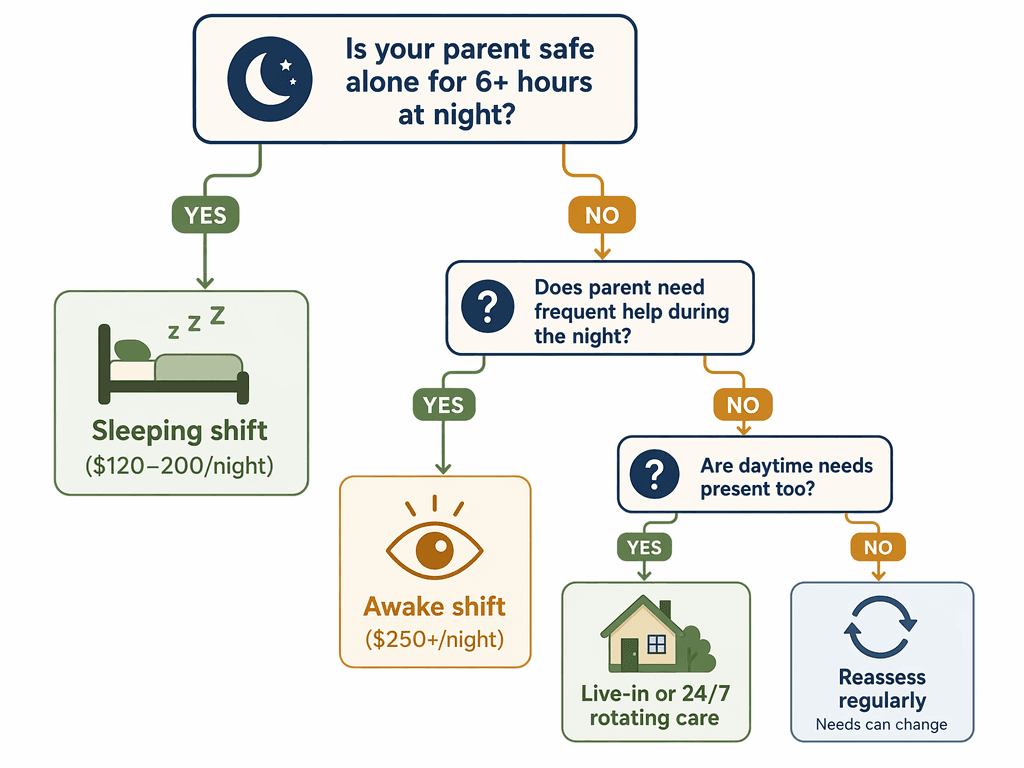
- Step 1: Can your parent get through the night without needing help to use the bathroom, reposition, or take medication? If YES, proceed to Step 2. If NO, count the average number of nighttime interruptions.
- Step 2: Has your parent fallen in the past 12 months? A history of a single fall doubles the chances of falling again, per the CDC STEADI initiative. If YES and the fall occurred at night, proceed to awake shift evaluation.
- Step 3: Does your parent have a dementia diagnosis? If YES, assess wandering risk. Has your parent attempted to leave the home at night, or expressed a desire to "go home" or "go to work" after dark? If YES, an awake shift is the minimum safe option.
- Step 4: Does your parent experience sundowning? If confusion, anxiety, or agitation begins in the late afternoon and extends into the night, evaluate severity. Mild sundowning (brief confusion that resolves with reassurance) may be manageable with a sleeping caregiver. Moderate to severe sundowning (pacing, aggression, inability to settle) requires an awake caregiver.
- Step 5: How many hours of uninterrupted sleep do you, the family caregiver, get per night? If you are waking up three or more times per night to assist your parent, you are sleep-deprived. A study found that 70% of dementia family caregivers ultimately placed their loved one in a nursing home primarily because of sleep disruptions and exhaustion from overnight caregiving (Rowe et al., Alzheimer's & Dementia Journal). Your sleep matters — and it is a valid reason to bring in overnight help.
Cost Comparison: Sleeping Shift vs. Awake Shift vs. Live-In vs. 24/7 Rotating
Cost is often the deciding factor, but the cheapest option is only a bargain if it actually meets the need. The table below projects monthly costs for each model based on national median data. Regional variation is significant — for example, Minnesota averages $43/hour while Mississippi averages $24/hour, according to SeniorLiving.org.
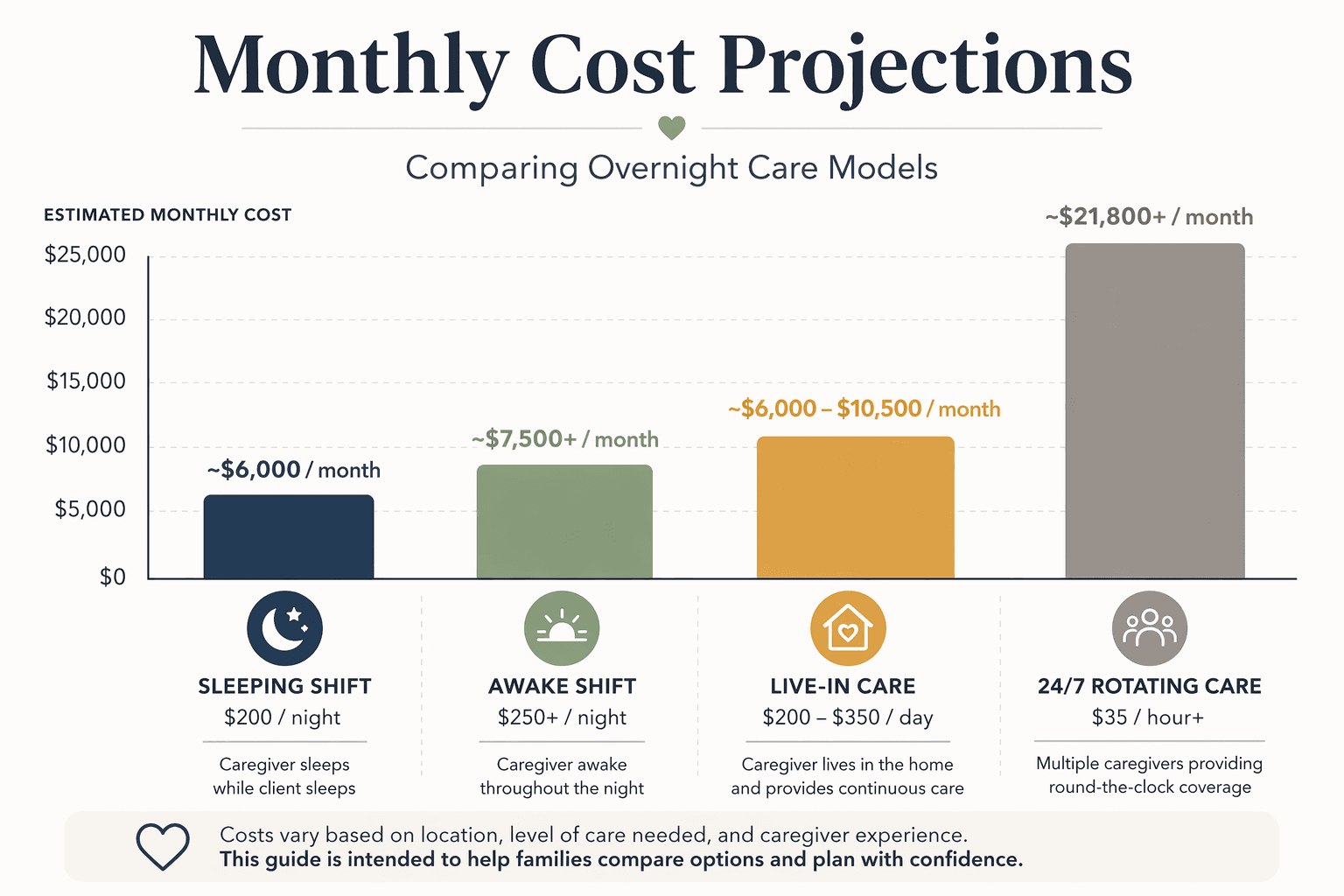
| Model | Typical Rate | Monthly Estimate (30 days) | Best For |
|---|---|---|---|
| Sleeping Shift | $120–$200/night flat | $3,600–$6,000 | Low-risk, low-interruption nights |
| Awake Shift | $250+/night or $25–$35/hr | $7,500–$10,500+ | Frequent needs, wandering, sundowning |
| Live-In | $200–$350/day flat | $6,000–$10,500 | Moderate day-and-night needs with caregiver downtime |
| 24/7 Rotating | $35/hr+ (2–3 caregivers) | $15,000–$21,823+ | High-acuity, round-the-clock needs |
For a deeper dive into overall home care costs — including daytime care — see our in-home senior care cost breakdown for 2026.
Hiring Pathway: Agency vs. Private Hire for Overnight Care
Once you have identified the right care model, the next decision is how to hire. You have two main pathways: work with an agency or hire a private caregiver directly. Each has trade-offs that go beyond the hourly rate.
Agency Hire
- Costs 20–30% more than private hire, according to SeniorLiving.org
- Provides backup coverage if the assigned caregiver calls out sick
- Handles payroll taxes, workers' compensation insurance, and compliance with labor laws
- Screens and trains caregivers; typically bonds and insures them
- Easier to replace a caregiver who is not a good fit
Private Hire
- Lower cost — you pay the caregiver directly, typically $15–$25/hour depending on your market
- You become the employer, responsible for payroll taxes, workers' comp, and compliance with federal and state labor laws
- No backup coverage — if the caregiver cannot make it, you are on your own
- You handle vetting, background checks, and references yourself
- More flexibility in scheduling and care arrangements
When to Reassess: The Sliding Scale from Occasional Nights to 24/7 Care
Overnight care needs are rarely static. A parent who needs a sleeping shift twice a week today may need an awake shift every night in six months. The key is to recognize the signals that indicate it is time to move up the care ladder.
- Signal 1: Your parent's nighttime interruptions increase in frequency or severity. If they go from one to two bathroom trips per night to four or more, or if they begin getting out of bed without calling for help, the risk profile has shifted.
- Signal 2: A fall occurs at night, even if no serious injury results. A single fall doubles the risk of another fall, and nighttime falls tend to cause more serious injuries than daytime falls.
- Signal 3: Wandering behavior emerges or escalates. If a parent who previously stayed in bed at night begins attempting to leave the home, immediate escalation to awake care is necessary.
- Signal 4: The family caregiver's sleep deprivation reaches a crisis point. More than 60% of caregivers experience symptoms of burnout, according to the Cleveland Clinic, and sleep disruption is a primary driver. If you are consistently getting fewer than five hours of sleep per night, you cannot sustain caregiving long-term.
- Signal 5: Daytime needs escalate alongside nighttime needs. When a parent requires assistance with multiple activities of daily living during the day and also needs frequent nighttime attention, a live-in or 24/7 rotating model may be more cost-effective than separate day and night caregivers.
When overnight care alone is no longer sufficient, our 24-hour home care decision framework can help you evaluate whether it is time to move to round-the-clock coverage.
Read the Full Guide
FAQs provide a concise answer. For comprehensive coverage, see these related guides.
- Medication Errors at Home: A Caregiver's Guide to the Six Most Common Mistakes and How to Prevent Each One
This guide helps family caregivers identify and prevent the six most common medication errors at home — from wrong dosages and duplicate medications to drug interactions and communication failures — with specific, evidence-backed strategies for each type.
- The First 30 Days as a Family Caregiver: A Step-by-Step Onboarding Guide
A week-by-week plan for adult children who have just taken on caregiving after a crisis. This guide breaks the overwhelming first month into four actionable stages: assess, organize, build your team, and create a daily operating system.
- When Your Parent Needs a Sitter but Not a Nurse: How to Recognize the Signs and Take Action
Many family caregivers wait too long to hire a sitter because they normalize gradual decline. This guide provides a three-signal framework — social withdrawal, home environment decline, and nutritional neglect — to help you recognize when companion care is needed, plus conversation tips and a one-week trial plan.
Comments
Join the discussion with an anonymous comment.