
Room checklist
Aging in Place Home Modifications: The Evidence-Based Room-by-Room Safety Guide for Family Caregivers
This evidence-based guide helps family caregivers prioritize home modifications after a fall or near-fall, with room-by-room recommendations grounded in peer-reviewed research showing up to 40% reduction in fall rates.
Your father fell in the bathroom last Tuesday. He's okay—a deep bruise, a shaken sense of balance—and now you're standing in his bathroom, scanning for the culprit. Your eye goes straight to the old clawfoot tub. The high step. The slick porcelain. That feels like the danger.
I have done hundreds of home assessments, and almost every family starts in the wrong room. The evidence points somewhere else first.
More than one in four adults 65 and older fall each year, according to the National Institute on Aging. Bathrooms are the most common location, but within the bathroom the numbers are clear: 28% of bathroom injuries among people 65 and older are toilet-related. That is from a CDC MMWR study. The bathtub is not the lead problem.
What the evidence actually says about home modifications
A 2025 systematic review by An et al. looked at 20 studies on environmental modifications and fall prevention. The headline: when properly implemented, home modifications reduce fall rates by 30–40%. I am reading this from a secondary source—the original review was behind a paywall—so treat that number as a strong directional signal, not a precise promise. But 13 of the 20 studies individually confirmed a significant reduction. The consistency is hard to dismiss.
The same review notes that 30–50% of all falls are attributable to environmental hazards. That means a large share of falls are not inevitable mobility accidents; they are preventable by changing the home.
And the cost argument is surprisingly direct. The mean total cost of home modifications (Grasso et al. 2023) is about $10,396—a one-time investment. Compare that to the average annual healthcare costs for older adults who do not modify their homes: anywhere from $22,763 to $154,478, depending on injury severity and setting. That range includes hospital stays, rehab, and long-term care. The modification cost is a one-time figure; the healthcare costs are per year. Even at the low end, modifications pay for themselves if they prevent one serious fall.
Start in the bathroom – with the toilet
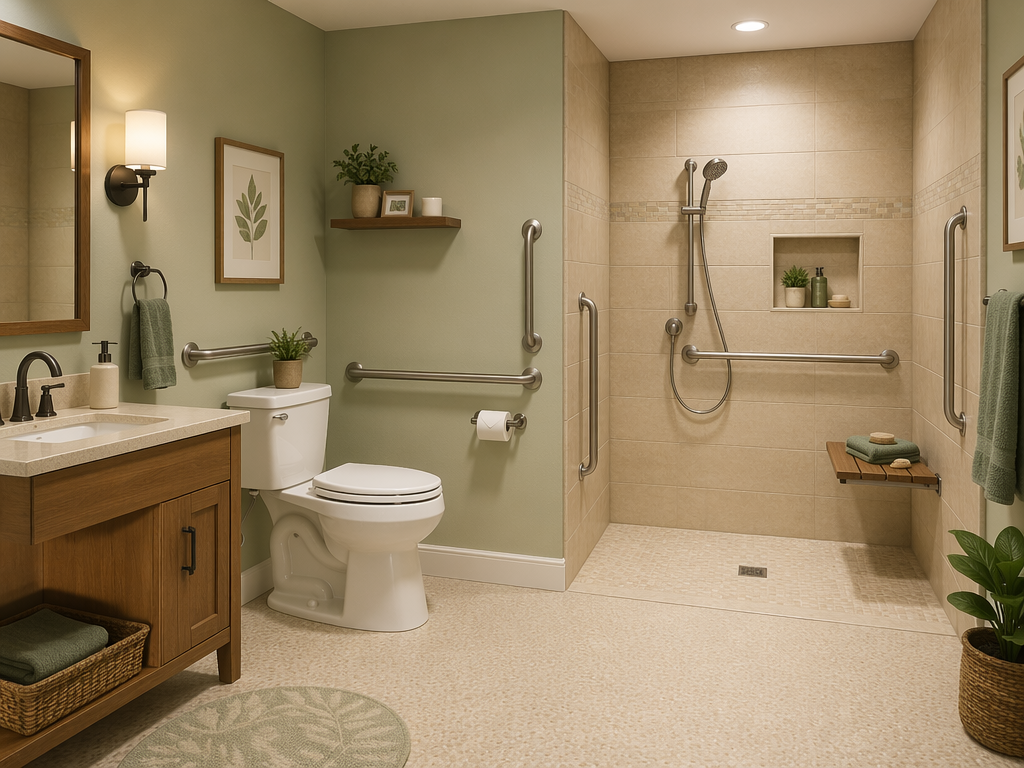
A specific study on grab bars found that people using them were 76% more likely to recover their balance than those without. That sounds dramatic, and it is—but it is a single observational study, not a randomized trial. I would not claim grab bars guarantee safety. I will say that in my assessments, the difference between a home with properly placed grab bars and one without is often the difference between a near-miss and a hospital visit.
The key phrase is "properly placed." A grab bar installed over the toilet at the wrong angle or anchored into drywall without blocking is worse than no bar at all—it gives false confidence. Bars need to be anchored into wall studs or blocking, placed at a height the person can comfortably grip, and positioned to help with the most common movements: standing from the toilet, entering the shower, and steadying during transfers.
Given the CDC data that 28% of bathroom injuries are toilet-related, the priority order in the bathroom should be:
- Toilet area — install a grab bar on the wall beside the toilet (the side the person leads with), and consider a raised toilet seat or comfort-height toilet if the existing seat is low.
- Shower and tub — a grab bar at the entry and inside the shower; a non-slip mat or textured flooring; a handheld shower head; and, if feasible, a curbless shower pan that removes the step-over threshold.
- General lighting — motion-sensor nightlights along the path from bed to bathroom, and a bright, easy-to-find switch near the bathroom door.
For a detailed breakdown of bathroom-specific modifications, costs, and common mistakes, see our Bathroom Remodel for Elderly guide. Here I am focusing on the room's place in the overall home safety order.
Then the stairs and front door
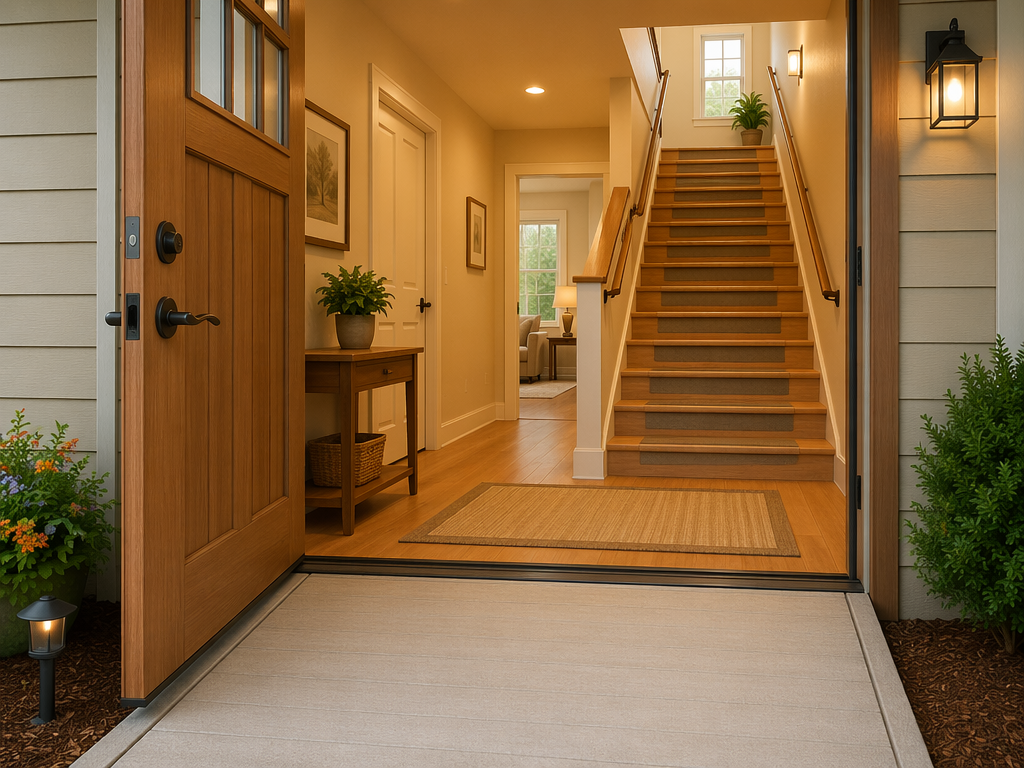
Falls on stairs and thresholds are less discussed than bathroom falls, but they account for a substantial share of emergency room visits. The 30–50% environmental hazard figure applies strongly here: steps, poor lighting, and lack of handrails are modifiable risks.
The evidence base specific to entryways is thinner than for bathrooms—there is no single grab-bar-equivalent study for ramps. But the mechanism is intuitive: a person with reduced leg strength or balance who navigates a two-inch threshold or a staircase with only one handrail is taking a risk every time they cross. The interventions are straightforward and low-cost:
- Handrails on both sides of every staircase, continuous from top to bottom. Many homes have a railing on only one side; this forces the person to favor their weaker side.
- Non-slip treads on each step, especially if the existing surface is smooth wood or tile.
- Lighting at both the top and bottom of stairs, with switches at both ends so the person never has to navigate a dark flight.
- A zero-step entry at the main door—either a small ramp or a regraded threshold—and a clear path wide enough for a walker or wheelchair.
If the staircase is the only way to reach a bedroom or bathroom, a stair lift may become necessary. Those range from $3,000 to $10,000 installed, and they belong in the "this year" category of the prioritization that follows.
Other rooms come third
Kitchen, bedroom, and living areas have fewer studies linking specific modifications to fall prevention, but they still matter. The risks here are less about a single fall event and more about cumulative hazards—reaching, twisting, tripping over furniture or rugs.
In the kitchen: lever-style handles, induction cooktop if possible, organize frequently used items at waist height. In the bedroom: a bed at seat height (18–20 inches), clear path to the bathroom with motion-sensor nightlights. In living areas: remove throw rugs or secure them, create wide straight pathways, improve general lighting—older eyes need two to three times more light. These are good to do, but do not delay the bathroom and stairs while you reorganize the kitchen.
A three-timeframe plan
Evidence is useless without a timeline. After countless assessments, I have found that caregivers need a plan that matches their energy and budget. Here is a sequence that respects the evidence hierarchy: bathrooms and entryways first, everything else when you can. The Aging in Place Readiness Checklist can help you identify which rooms need attention before you start spending.
| Timeline | Actions |
|---|---|
| This week | Install grab bars in the bathroom (toilet area first). Add motion-sensor nightlights in the bathroom and along the path from bed to bathroom. Remove or secure all throw rugs. Clear pathways of furniture and cords. Test existing lighting—replace dim bulbs and add a lamp at the top and bottom of stairs. |
| This month | Install a raised toilet seat or comfort-height toilet. Add handrails on the second side of the staircase. Replace round door knobs with lever handles. Add non-slip treads to stairs. Declutter high-traffic areas. |
| This year | Plan a curbless shower or a walk-in tub if the existing tub is a barrier. Install a ramp or regrade the main entrance threshold for zero-step entry. Add a stair lift if stairs are unavoidable. Replace a traditional cooktop with an induction model. Consider a full bathroom remodel if multiple hazards exist. |
The one-time mean cost of modifications, about $10,396, is a helpful benchmark, but many homes need far less. The "this week" column costs under $200 and addresses the highest-risk areas first. That is where I tell every family to start.
When to call an occupational therapist
You can do a lot yourself—the actions above are all within reach of a motivated family caregiver. But after a fall with injury, when the person has multiple medical conditions, or when you feel like you are missing hazards that an expert would see, it is time to bring in an occupational therapist.
An OT does not just look at grab bars and ramps. They assess the person's strength, balance, vision, and daily routines, then match the home modification to their actual movement patterns. They also know which products work for different conditions—arthritis, stroke recovery, Parkinson's, dementia—without recommending a specific brand. Our guide on CAPS vs. General Contractor vs. Occupational Therapist walks through who does what and when to hire each.
A single systematic review does not make a law. But when a 2025 review of 20 studies finds that environmental modifications reduce falls by 30–40%, and when the cost of those modifications is a fraction of a single hospital stay, the case for acting now is strong.
The simplest first step: this week, install a grab bar beside the toilet and put a nightlight in the bathroom. That alone reduces the risk where it is highest. Do not worry about making every room perfect at once. Do the one thing that the evidence points to most clearly, and then do the next.
Related reading
Need a professional assessment?
Find a CAPS-credentialed professional or local aging services through our outbound resource list — we never name or rank individual contractors.
Find Local HelpNoticed something outdated or inaccurate on this page? Flag a correction. We review every report against CDC, NIA, and AARP HomeFit guidance before updating a page.