
Room checklist
CAPS vs. General Contractor vs. Occupational Therapist: Who Should You Hire for Aging-in-Place Home Modifications?
Family caregivers often don't know which professional to call first for home modifications. This article explains the distinct roles of a CAPS-certified specialist, an occupational therapist, and a general contractor — and shows how combining them can save money, ensure safety, and unlock funding.
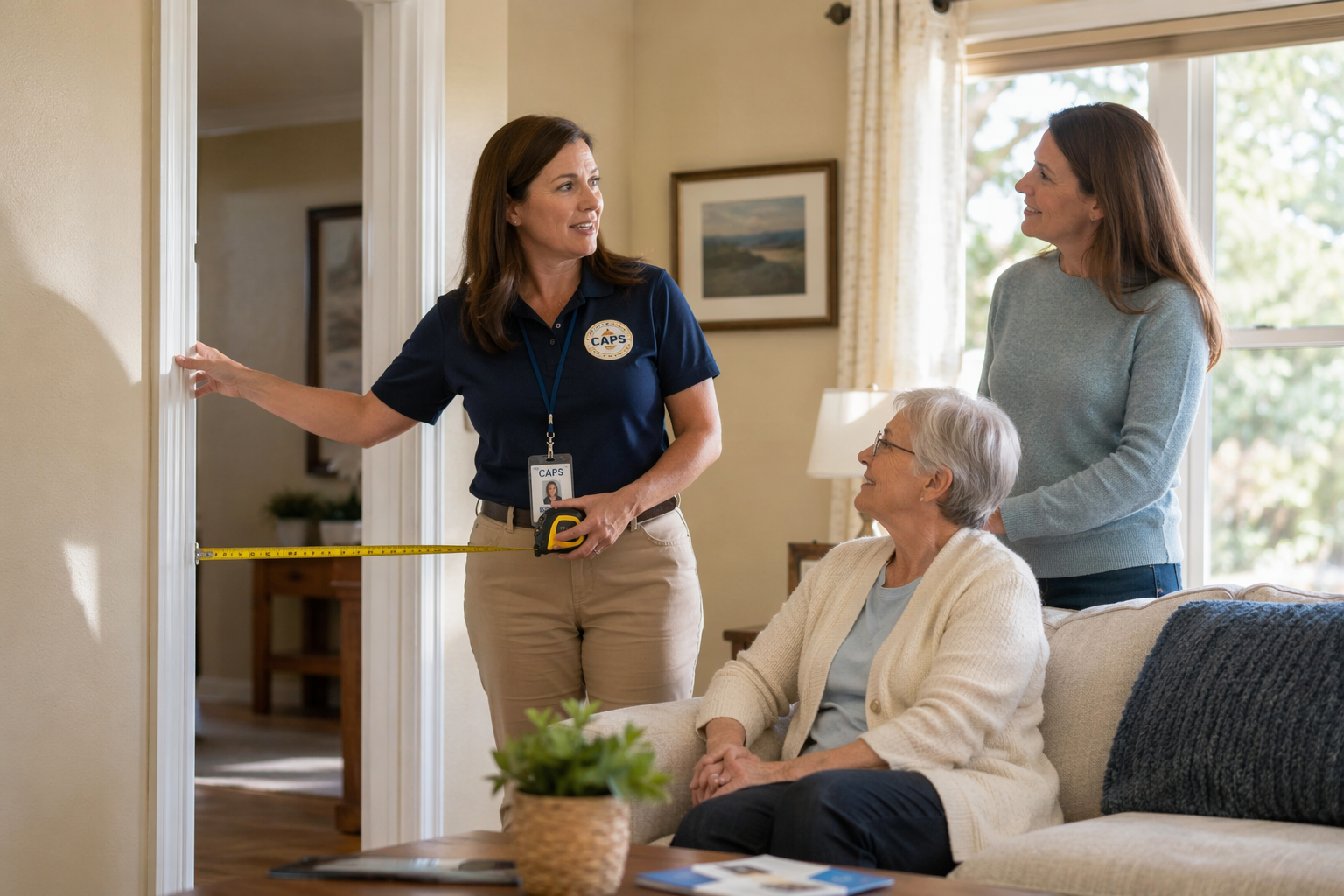
Why Families Call the Wrong Person First
The sequence is almost always the same. An older adult has a fall, receives a new diagnosis, or starts showing clear signs that the family home is no longer safe. The adult child — often living hours away — calls a general contractor, describes the problem, and receives a quote for a bathroom remodel or a stairlift installation. The contractor is competent, the price seems reasonable, and the work gets done. But six months later, the parent still cannot transfer safely into the shower, or the newly installed grab bar is anchored in drywall instead of a stud, or the modifications do not meet the requirements for a Medicaid waiver the family had hoped to use.
This is not a story about bad contractors. It is a story about calling the wrong professional first. The home modification ecosystem involves three distinct roles — a Certified Aging-in-Place Specialist (CAPS), an occupational therapist (OT), and a general contractor — and each one brings a different expertise to the table. Knowing which one to call, and in what order, can mean the difference between a modification that works and one that creates new problems.
The Three Roles: CAPS, Occupational Therapist, and General Contractor
Each of these professionals operates in a different domain. A CAPS specialist is trained in the design and execution of safe, accessible home modifications. An occupational therapist is a licensed healthcare professional who assesses the person's functional abilities and identifies environmental barriers. A general contractor manages the structural construction and coordinates subcontractors. The table below lays out the key differences.
| Dimension | CAPS Certified Specialist | Occupational Therapist (OT) | General Contractor |
|---|---|---|---|
| Primary focus | Design and execution of safe, accessible home modifications | Assessment of the person's functional needs and barriers to daily living | Structural construction, project management, and subcontractor coordination |
| Training and credential | NAHB CAPS credential (3 courses: Marketing & Communicating, Design Concepts, Details & Solutions) | Master's or doctoral degree in occupational therapy; state licensure | State license; may or may not have aging-in-place training |
| What they assess | The home's physical structure, safety hazards, and modification feasibility | The person's mobility, strength, balance, cognition, and daily activity performance | Structural integrity, building codes, material specifications, and timeline |
| Key output | Design plan, cost estimates, contractor management, project oversight | Clinical evaluation report, functional recommendations, OT notes for funding applications | Construction bid, permits, subcontractor schedules, completed installation |
| Typical fee model | Fee-for-service: $300–$1,000 for a home assessment | Insurance-covered (Medicare Part B, private insurance) with copay; $100–$500 per visit | Free initial bid; paid on project completion or milestone basis |
| Can unlock funding? | Yes — provides specs and cost estimates for VA grants (HISA, SAH) | Yes — clinical notes are often required for Medicaid HCBS waivers | No — cannot provide clinical documentation or CAPS-certified design |
The CAPS credential, developed in 2001 by the National Association of Home Builders (NAHB) in cooperation with AARP, teaches technical, business management, and customer service skills specifically for the aging-in-place market. An occupational therapist who also holds CAPS certification is uniquely positioned to assess both the person and the home — a combination that the American Occupational Therapy Association and NAHB both recognize as the gold standard for comprehensive home modification planning.
When Each Professional Is the Right First Call
The right starting point depends entirely on the situation. Here is a decision framework based on the most common scenarios families face.
- Start with an occupational therapist if: the older adult has a new diagnosis (Parkinson's, stroke, dementia, recent hip replacement) or a recent functional decline. The OT will assess the person's current abilities — not just the home's physical barriers — and produce a clinical evaluation that may be covered by health insurance. That evaluation becomes the foundation for every modification decision that follows. It also creates the clinical documentation needed for Medicaid waiver applications.
- Start with a CAPS specialist if: the home has clear physical barriers (narrow doorways, steps at every entrance, a bathroom that cannot accommodate a walker) and the family needs a comprehensive design plan and contractor management. A CAPS assessment costs $300 to $1,000 depending on location and experience, but it produces a prioritized, buildable roadmap that prevents costly mistakes.
- Start with a general contractor only if: the project is purely cosmetic or non-safety-related — replacing flooring, painting, updating cabinets — and does not involve accessibility, fall prevention, or structural changes. Even then, a brief CAPS consult before the work begins is a wise investment. A contractor who lacks aging-in-place training might install a beautiful new bathroom that is functionally unusable for someone with limited mobility.
Why the Best Approach Combines a CAPS and an OT
The most effective aging-in-place projects involve both a CAPS and an OT working together — what some in the industry call the "dream team" for home modifications. Here is why the combination is so powerful.
The OT brings clinical insight that no home assessment alone can provide. An OT evaluates the person's specific challenges: how they transfer from sitting to standing, how much weight they can bear on each leg, whether their vision or cognition affects their ability to navigate space safely. These are not questions a contractor or even a CAPS specialist can answer without clinical training. The OT's evaluation produces a functional profile that directly informs where grab bars should be placed, what type of shower entry is safest, and whether a stairlift or a first-floor bedroom is the better solution.
The CAPS specialist then translates that functional profile into a buildable design. A CAPS knows how to specify materials that meet both the person's needs and building codes, how to position grab bars at the correct load-bearing angle, and how to sequence modifications so the home remains livable during construction. They also manage the general contractor to ensure the design is executed correctly.
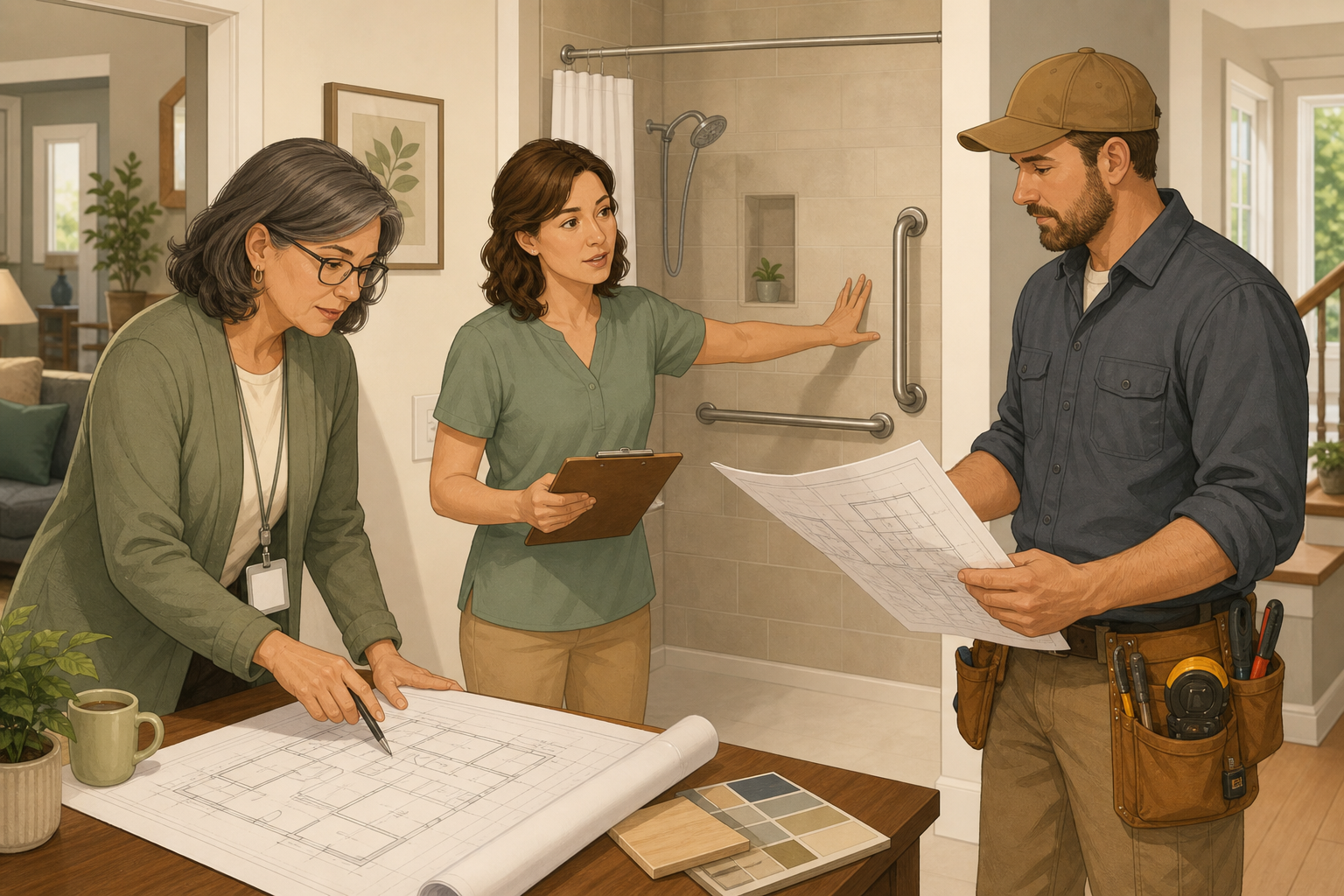
Cost Comparison: CAPS Assessment vs. OT Evaluation vs. Contractor Bid
Cost is often the deciding factor for families, and the pricing models for these three professionals are very different. Understanding the cost structure upfront helps families budget appropriately and avoid surprises.
| Service | Typical Cost | Insurance Coverage | What You Get |
|---|---|---|---|
| CAPS home assessment | $300 – $1,000 (fee-for-service) | Not covered by health insurance | Detailed home safety evaluation, prioritized modification plan, cost estimates, contractor coordination |
| OT home evaluation | $100 – $500 per visit (copay may apply) | Often covered by Medicare Part B and private insurance with a physician referral | Clinical functional assessment, barrier identification, OT notes for funding applications, recommendations |
| General contractor bid | Free (initial estimate) | Not applicable | Construction cost estimate, timeline, material specifications — no clinical or design expertise |
For a more detailed breakdown of specific modification costs — grab bars ($100–$300), walk-in tubs ($5,000–$15,000), stairlifts ($3,000–$5,000), and major renovations ($10,000–$50,000+) — see our Aging in Place Home Modifications Cost Guide, which provides room-by-room budget tiers.
Case Example: A Bathroom Remodel Using All Three Professionals
To see how these roles work together in practice, consider a realistic scenario: a 78-year-old woman with arthritis in both knees and a history of balance issues lives alone in a two-story home. Her adult daughter, who lives three hours away, has noticed her mother struggling to step into the bathtub and has started to worry about a fall.
Here is how the process unfolds when all three professionals are involved in the right order.
- Step 1 — OT evaluation: The daughter arranges an in-home OT evaluation through her mother's primary care physician. The OT spends 90 minutes assessing the mother's transfer ability, balance, strength, and how she currently manages bathing. The OT identifies that a walk-in tub would be unsafe because the mother cannot lift her legs high enough to clear the tub wall, and recommends a curbless walk-in shower with a built-in bench instead. The OT documents everything in a clinical report.
- Step 2 — CAPS design and planning: The daughter hires a CAPS-certified specialist who reviews the OT's report and conducts a home assessment. The CAPS designs the bathroom layout: a 36-inch-wide curbless shower entry, a linear drain, grab bars at 33 and 36 inches on two walls, a handheld showerhead on a slide bar, and a comfort-height toilet. The CAPS provides a detailed cost estimate and a construction timeline.
- Step 3 — General contractor execution: The CAPS manages the bidding process and selects a general contractor with experience in accessible renovations. The contractor handles demolition, plumbing relocation, waterproofing, tile installation, and grab bar mounting — anchoring each bar into blocking that the CAPS specified in the design. The CAPS inspects the work at key milestones.
- Step 4 — Funding application: The daughter applies for a state Medicaid HCBS waiver using the OT's clinical notes as supporting documentation. The CAPS's cost estimate and design specifications are submitted with the VA HISA grant application for the mother's veteran benefits. Between the two funding sources, the family covers 70% of the $18,000 project cost.
For a complete room-by-room breakdown of bathroom modifications, including specific product categories and cost ranges, see our Bathroom Remodel for Elderly Safety guide.
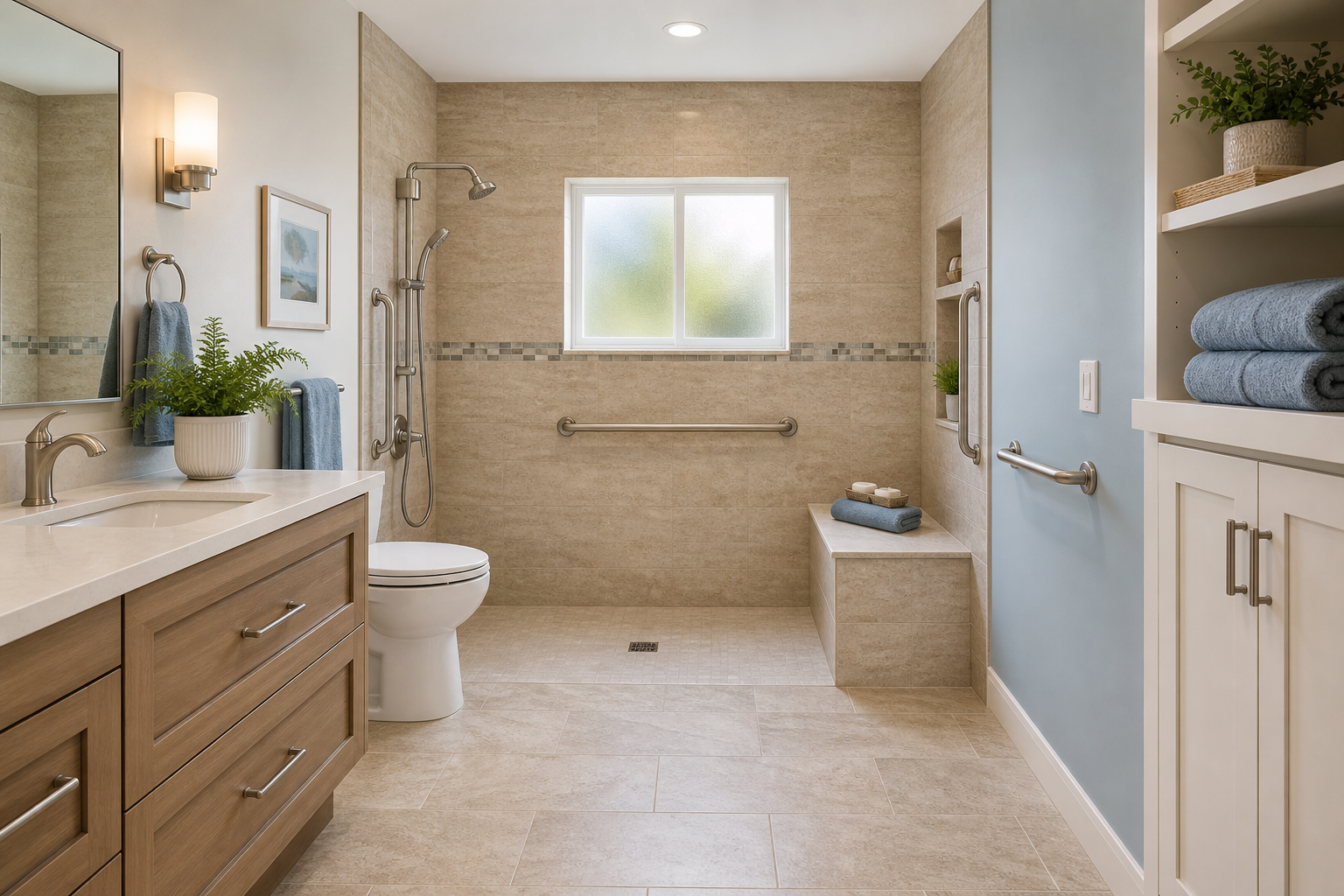
Which Professionals Can Help Unlock Funding
One of the most important — and least understood — reasons to involve both an OT and a CAPS is that they can unlock funding sources that a general contractor alone cannot access.
| Funding Source | Required Documentation | Which Professional Provides It | Typical Coverage |
|---|---|---|---|
| Medicaid HCBS waivers (state-dependent) | Clinical evaluation and OT notes documenting medical necessity | Occupational therapist | Varies by state; may cover grab bars, ramps, shower modifications, and doorway widening |
| VA Home Improvement and Structural Alterations (HISA) grant | CAPS design specifications, cost estimates, and physician's statement of medical need | CAPS specialist + physician | Up to $6,800 for life; up to $2,000 for non-life (2026 figures; verify current limits) |
| VA Specially Adapted Housing (SAH) grant | CAPS design specifications, cost estimates, and VA determination of eligibility | CAPS specialist + VA | Up to $126,526 for fiscal year 2026 (ending Sept 30, 2026); exact amount may change annually |
| USDA Section 504 Home Repair Program | Proof of very-low-income status and homeownership; CAPS cost estimate | CAPS specialist | Up to $10,000 in loans; up to $7,500 in grants for seniors 62+ |
| Nonprofit and community programs | Varies; often requires a needs assessment | OT or CAPS depending on program | Often covers grab bars, railings, small ramps, and lighting improvements |
The key takeaway: if your family hopes to use any form of financial assistance — a Medicaid waiver, a VA grant, or a USDA loan — you will almost certainly need documentation from both an OT (for clinical necessity) and a CAPS (for design specifications and cost estimates). A general contractor's bid alone will not satisfy the requirements of these programs.
For a comprehensive overview of all available funding options — including eligibility criteria and application steps — see our How to Pay for Aging in Place Home Modifications guide.
How to Find the Right Professional for Your Situation
Once you understand the roles, the next step is finding the right people. Here is a practical checklist to guide your search.
- Find a CAPS specialist: Use the NAHB CAPS directory at nahb.org to search for certified professionals in your area. Look for someone who has completed all three CAPS courses (Marketing & Communicating, Design Concepts, and Details & Solutions) and has experience with projects similar to yours.
- Get an OT referral: Ask the older adult's primary care physician, hospital discharge planner, or local Area Agency on Aging for a referral to an occupational therapist who specializes in home modifications. Some OTs also hold CAPS certification — these dual-credentialed professionals are especially valuable.
- Vet a general contractor: Ask potential contractors whether they have experience with aging-in-place projects, whether they have worked with a CAPS specialist before, and whether they are willing to follow a CAPS-designed plan. Request references from similar projects.
- Ask the right questions: Before hiring any professional, ask: Have you worked with older adults with mobility or cognitive challenges? Can you provide documentation that meets Medicaid or VA requirements? Do you carry liability insurance? Can you provide references from similar projects?
To evaluate whether your parent's home is ready for modifications — and whether you are prepared for the process — use our Aging in Place Readiness Checklist. It covers the four domains that every family should assess before calling a professional: the home's physical condition, the older adult's functional status, the caregiver's capacity, and the financial picture.
Related reading
Need a professional assessment?
Find a CAPS-credentialed professional or local aging services through our outbound resource list — we never name or rank individual contractors.
Find Local HelpNoticed something outdated or inaccurate on this page? Flag a correction. We review every report against CDC, NIA, and AARP HomeFit guidance before updating a page.