
Room checklist
Does an Aging-in-Place Remodel Pay Off? ROI Data, Cost Avoidance, and the Case for Investing Now
This article builds the financial case for aging-in-place remodeling, using ROI data, RCT-level fall reduction evidence, and healthcare cost avoidance to show how modifications preserve home equity, prevent expensive falls, and cost far less than assisted living.
The Growing Market for Aging-in-Place Renovations
The decision to modify a home for aging in place is no longer a niche concern. The aging-in-place renovation economy was valued at $74 billion in 2024 and is projected to exceed $113 billion by 2033, according to industry data cited by AgingInPlace.com. This growth reflects a massive demographic shift: a 2021 AARP poll found that 75% of people aged 50 and older want to remain in their homes as long as possible.
For adult children in their 40s and 50s who are helping a parent navigate this decision, the numbers validate what they already sense: this is not a fringe home improvement category but a mainstream market responding to a clear, sustained need. The financial infrastructure — from specialized contractors to dedicated funding programs — is growing alongside demand, which means that the cost and availability of modifications are becoming more predictable and accessible.
The ROI of Universal Design: 68–70% Return on Bathroom Remodels
The most direct financial argument for an aging-in-place remodel is the return on investment it delivers at resale. According to the 2023 Cost vs. Value survey, converting a standard bathroom to meet universal design standards — zero-threshold showers, grab bars, widened doorways — yields an average ROI of 68–70%. That places it among the top seven remodeling projects nationwide in terms of cost recovery.
This is not a niche upgrade that only appeals to a narrow buyer pool. A general bathroom remodel that incorporates accessibility features can boost a home's resale value by as much as 3%, and the broader buyer demographic — including families with young children, people recovering from surgery, and anyone who values single-level living — means the home spends less time on the market.
| Project Type | Average ROI | Key Features | Resale Value Impact |
|---|---|---|---|
| Universal design bathroom remodel | 68–70% | Zero-threshold shower, grab bars, widened doorway | Up to 3% boost |
| Standard bathroom remodel | Up to 70% | Updated fixtures, improved layout | Up to 3% boost |
| Full home aging-in-place renovation | Varies by scope | Multi-room modifications, structural changes | Broader buyer appeal |
The Cost of Doing Nothing: $80 Billion in Fall-Related Healthcare Costs
The ROI argument becomes significantly more compelling when you factor in what happens if modifications are not made. Falls are the leading cause of fatal and nonfatal injuries for older Americans. In 2020, the total healthcare cost of non-fatal older adult falls reached $80 billion per year, up from $50 billion in 2015. The CDC projects that figure will exceed $101 billion by 2030.
The per-incident costs are staggering. The estimated average cost per inpatient hospital visit for a fall injury is $18,658. An emergency department visit averages $1,112. With 14 million older adults — 1 in 4 Americans aged 65 and older — falling each year, these costs accumulate rapidly. In 2021 alone, falls caused 38,000 deaths among those 65 and older, and emergency departments reported 3 million visits for older adult falls.
| Metric | Value | Year | Source |
|---|---|---|---|
| Total healthcare cost of non-fatal falls (65+) | $80 billion/year | 2020 | NCOA / CDC |
| Projected total cost | $101 billion/year | 2030 | CDC (Houry et al.) |
| Average cost per inpatient fall visit | $18,658 | 2024 | NCOA |
| Average cost per ED visit for fall | $1,112 | 2024 | NCOA |
| Older adults who fall each year | 14 million (1 in 4) | 2021 | NCOA |
| Fall-related deaths (65+) | 38,000 | 2021 | NCOA |
What the Evidence Says: Home Modifications Reduce Falls by 39–79%
The cost-avoidance argument is only as strong as the evidence that modifications actually prevent falls. The research is robust and includes randomized controlled trials — the gold standard of clinical evidence.
A 2017 randomized controlled trial by Stark et al. (n=300) found that home modifications led to a 39% reduction in falls among older adults. A 2024 program evaluation by Hawkins et al. (n=241) reported that 79% of participants had no falls post-modification, with the average number of falls per year dropping from 2.53 to 1.5. A large longitudinal cohort study by Hollinghurst et al. (2022, n=657,536) found that home adaptations reduced fall-related emergency admissions by 3% per quarter (OR = 0.97, p < 0.001).
| Study | Year | Sample Size | Key Finding |
|---|---|---|---|
| Stark et al. (RCT) | 2017 | n=300 | 39% reduction in falls |
| Hawkins et al. (program evaluation) | 2024 | n=241 | 79% reported no falls post-modification; falls/year decreased from 2.53 to 1.5 |
| Hollinghurst et al. (longitudinal cohort) | 2022 | n=657,536 | 3% quarterly reduction in fall-related emergency admissions (OR = 0.97, p < 0.001) |
| Carnemolla et al. (pre-post study) | 2019 | n=157 | 42% reduction in weekly care hours; informal care down 46%, formal care down 16% |
Avoided Assisted Living Costs: A One-Time Remodel vs. Recurring Facility Payments
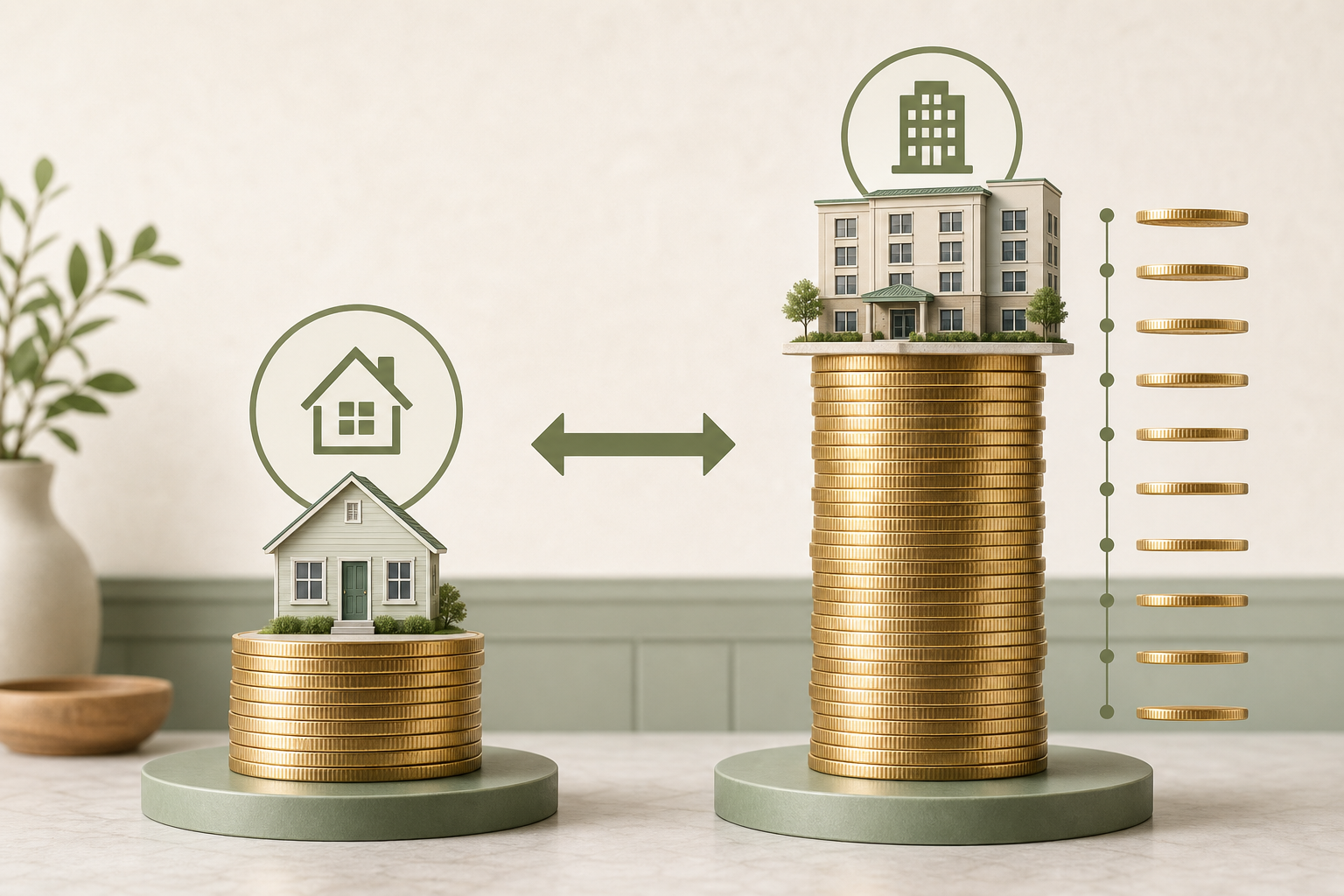
Perhaps the most intuitive financial comparison is between a one-time remodel cost and the recurring monthly expense of assisted living. The average cost of aging-in-place remodeling ranges from $3,000 to $15,000 for targeted modifications, with full home renovations running $15,000 to $60,000 or more. By contrast, assisted living facilities typically charge $4,500 to $10,000 per month.
The math is straightforward: even a $15,000 full-home remodel pays for itself in 2 to 4 months of avoided facility costs. A $3,000 targeted modification — such as installing grab bars, a walk-in shower, and improved lighting — pays for itself in less than one month.
Proactive vs. Reactive: The Cost Difference of Waiting for a Fall
One of the most compelling arguments for acting now rather than later is the cost difference between proactive modifications and reactive medical expenses. The bathroom is the most dangerous room in the house: 35.7% of fall injuries in older adults occur there, according to a study by the National Center for Injury Prevention and Control.
Consider the cost of making a bathroom safe before a fall occurs versus the cost of treating a fall after it happens.
| Modification | Proactive Cost | Reactive Cost (Single Fall) | Payback Period |
|---|---|---|---|
| Grab bars (2–3 units) | $150–$400 each | $18,658 (avg inpatient visit) | Immediate — one fall avoided covers the cost many times over |
| Barrier-free shower | $8,000–$18,000 | $18,658 (avg inpatient visit) | One fall avoided covers 43–100% of the cost |
| Stair lift | $2,500–$18,000 | $18,658 (avg inpatient visit) | One fall avoided covers 100% of lower-end installations |
| Door widening (per door) | $700–$2,000 | $18,658 (avg inpatient visit) | One fall avoided covers the cost 9–26 times over |
The asymmetry is stark. A $150 grab bar can prevent a fall that would cost $18,658 to treat. Even a $15,000 full bathroom remodel is less expensive than a single inpatient fall visit. And because 1 in 4 older adults falls each year, the probability that a fall will occur without modifications is not hypothetical — it is statistically likely.
How to Finance Your Aging-in-Place Remodel
The financial case for remodeling is strong, but the upfront cost can still be a barrier. Several funding sources exist to help offset the expense, though availability varies by state and eligibility criteria.
- USDA Rural Development grants: Available to low-income homeowners in eligible rural areas for home repairs and modifications.
- HUD Title 1 Property Improvement Loans: Fixed-rate loans for home improvements, including accessibility modifications, up to $60,000 for single-family homes.
- VA Specially Adapted Housing (SAH) grants: For veterans with service-connected disabilities, providing up to $117,014 (2025 rate) for home modifications.
- Medicaid waivers: State-specific home and community-based services (HCBS) waivers may cover certain modifications for eligible individuals. Availability and scope vary significantly by state.
- Nonprofit programs: Habitat for Humanity's Aging in Place program and local Area Agencies on Aging may offer grants or low-cost modification services.
For a comprehensive overview of all funding options, including application steps and eligibility requirements, see our full guide: How to Pay for Aging in Place Home Modifications: A Complete Guide to Grants, Loans, and Assistance Programs.
The Bottom Line: A Financial Investment with Compound Returns
When viewed through a purely financial lens, an aging-in-place remodel is not an expense — it is an investment with three layers of return.
- Home equity preservation: Universal design bathroom remodels return 68–70% at resale, and the modifications make the home marketable to a broader buyer demographic.
- Avoided medical costs: RCT-level evidence shows a 39% reduction in falls, which translates directly into avoided emergency department visits ($1,112 each) and inpatient stays ($18,658 each).
- Avoided facility costs: A one-time remodel of $3,000–$15,000 pays for itself in 2–4 months of avoided assisted living costs ($4,500–$10,000/month).
These three returns compound. The home retains its value. The older adult avoids the physical and financial trauma of a fall. The family avoids the recurring cost of facility care. And because 75% of older adults want to age in place, the decision aligns financial prudence with personal preference.
Related reading
Need a professional assessment?
Find a CAPS-credentialed professional or local aging services through our outbound resource list — we never name or rank individual contractors.
Find Local HelpNoticed something outdated or inaccurate on this page? Flag a correction. We review every report against CDC, NIA, and AARP HomeFit guidance before updating a page.