
Room checklist
Aging in Place Services: A 6-Step Guide for Families After a Crisis
After a parent's fall or hospital discharge, families need a structured decision framework, not more options. This guide provides a six-step process — assess safety, identify care needs, find services, secure funding, coordinate providers, and monitor over time — to turn panic into a manageable plan.
The Moment of Crisis: What to Do in the First 48 Hours
The phone call comes at 2:00 AM. Your mother has fallen. She's in the emergency room, and the doctors say she'll be discharged tomorrow, but she can't manage the stairs to her bedroom. In that moment, the abstract idea of "aging in place" collapses into a single, urgent question: What do we do now?
You are not alone in this moment. According to data cited by the National Institute on Aging, approximately 96% of seniors want to remain in their own homes as they age. Yet the gap between that desire and a safe, workable reality is vast — only 18% of adults over 50 have made even basic home modifications to support aging in place, according to a 2026 report from Choice Mutual. That gap is where families get stuck.
This guide offers a different approach than a day-by-day timeline. Instead of a chronological sequence, it provides a generalizable six-step decision framework — assess safety, identify care needs, find services, secure funding, coordinate providers, and monitor over time — that you can apply whether the crisis happened yesterday or you are planning ahead. If you prefer a chronological companion guide with specific daily milestones, see our 30-Day Timeline for Setting Up Aging in Place Services.
In the first 48 hours, your job is not to solve everything. Your job is to stabilize the situation and gather enough information to make the first decision. Do not sign any discharge paperwork from the hospital until you have a clear picture of what your parent can and cannot do safely at home. Ask the hospital discharge planner for a physical therapy evaluation before discharge — this will give you a baseline assessment of mobility, balance, and fall risk that you will need for every subsequent step.

Step 1: Conduct a Home Safety Assessment
Before you can decide what services your parent needs, you need to understand what hazards exist in the home. The National Institute on Aging provides a free home safety checklist that walks you through every room. This is your starting point.
Walk through the house with a notepad and a critical eye. Focus on the areas where a fall is most likely to happen and where mobility challenges will surface first. The bathroom is the highest-risk area — nearly 80% of older adults report needing modifications such as grab bars and walk-in showers, according to the Choice Mutual survey. But do not stop there. Check every threshold, every rug, every light switch, and every step.
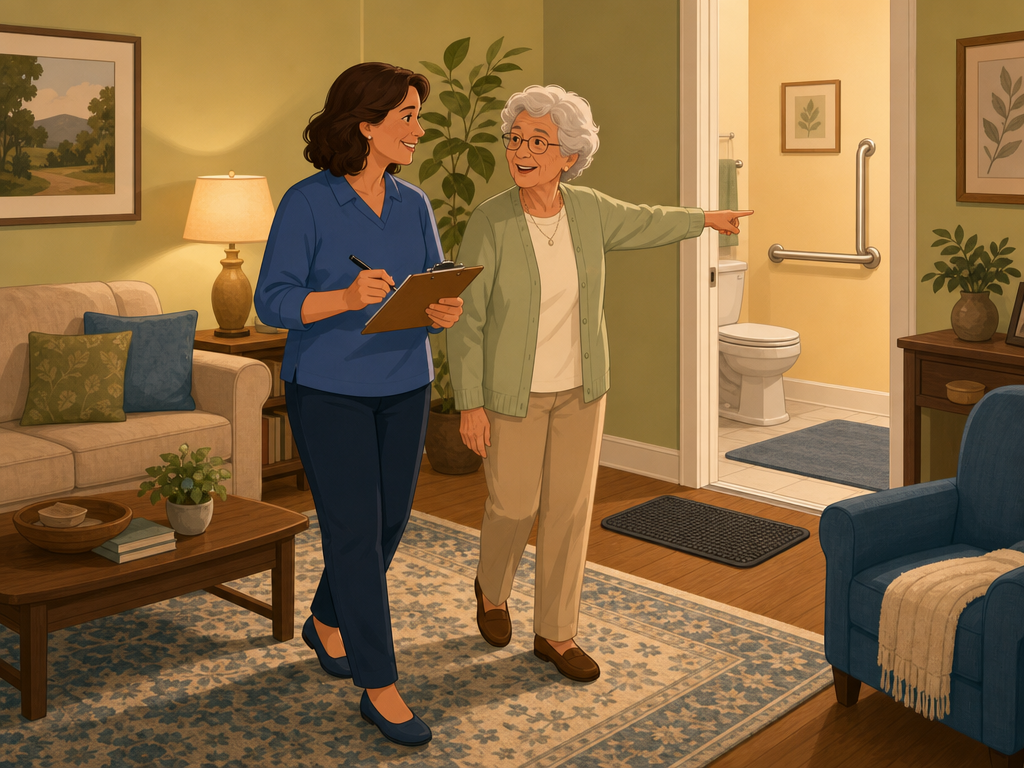
Room-by-Room Hazard Checklist
- Bathroom: Are there grab bars near the toilet and in the shower? Is the floor non-slip? Can the toilet be raised to 17–19 inches (ADA height)? Is the shower entry step-free or does it require a high step-over?
- Bedroom: Is the path from the bed to the bathroom clear? Is there a nightlight? Is the bed height appropriate for safe transfer (not too low, not too high)?
- Stairs: Are there sturdy handrails on both sides? Is the lighting adequate at the top and bottom? Are the steps free of clutter? Can your parent safely carry items up and down?
- Kitchen: Are frequently used items within easy reach (not on high shelves)? Is the flooring non-slip? Are there any loose rugs or mats?
- Entryways: Are there steps or high thresholds at the doors? Is there a clear path for a walker or wheelchair? Is the exterior lighting adequate?
For a deeper dive into fall-specific risks and prevention strategies, see our Fall Prevention Services Roadmap. For families who want a professional assessment, the National Institute on Aging recommends consulting an occupational therapist for a home safety audit — a $200 grab bar installation could prevent a $50,000 nursing home bill, as noted by ElderLife Financial.
Step 2: Identify What Type of Help Is Needed
Once you know what the home looks like, the next question is what your parent can and cannot do for themselves. This is where the clinical framework of Activities of Daily Living (ADLs) and Instrumental Activities of Daily Living (IADLs) becomes your most practical tool.
ADLs are the fundamental self-care tasks: bathing, dressing, toileting, transferring (getting in and out of bed or a chair), eating, and continence management. IADLs are the higher-level tasks needed for independent living: managing medications, preparing meals, handling finances, using transportation, shopping, housekeeping, and using the telephone or communication devices. Skilled care — such as wound care, physical therapy, or medication injections — requires a licensed professional such as a registered nurse or physical therapist.

Matching Needs to Service Types
| Level of Need | Examples | Typical Service Type |
|---|---|---|
| ADL assistance (1–2 tasks) | Help with bathing or dressing | Personal care aide (non-medical) |
| IADL assistance only | Meal prep, transportation, medication reminders | Companion care or home health aide |
| Multiple ADL deficits | Bathing, dressing, toileting, transferring | Personal/private duty care (higher hours) |
| Skilled medical needs | Wound care, IV medications, post-surgery PT | Home health nurse or physical therapist |
| Cognitive impairment (dementia) | Wandering, sundowning, safety supervision | Specialized dementia care or memory care facility |
If you are still in the early stages of figuring out what your parent needs and how to start the conversation, our 5-Step Triage Framework for New Caregivers covers the initial conversations and legal/financial foundations that come before service delivery.
Step 3: Find Local Services Using the Eldercare Locator
This is the single most actionable step in the entire process. The Eldercare Locator — 1-800-677-1116 — is a free, nationwide service funded by the U.S. Administration on Aging that connects older adults and their families to local support resources. It is operated by the National Association of Area Agencies on Aging and is available Monday through Friday, 9:00 AM to 8:00 PM Eastern Time.
When you call, you will speak with a trained information specialist who will ask about your parent's location, needs, and situation. They will then provide contact information for the local Area Agency on Aging (AAA) and other relevant state and community resources. The AAA can connect you to:
- In-home personal care and homemaker services
- Meal delivery programs (such as Meals on Wheels)
- Senior transportation services (often low-cost or free through local governments)
- Caregiver support groups and respite programs
- Home modification and repair programs
- Medicaid waiver and state-funded assistance programs
For a more detailed walkthrough of the entire aging and disability resource system, including how to navigate state-specific programs, see our Step-by-Step Guide to Navigating the Aging and Disability Resource System.
Step 4: Understand Costs and Identify Funding Sources
One of the most common mistakes families make is overestimating the cost of home modifications and underestimating the cost of ongoing in-home care. According to a 2026 guide from All Heart Home Care, many families are surprised to learn that the monthly cost of in-home care can rival or exceed the cost of a single modification project. Understanding the full cost landscape is essential to making a sustainable plan.
Cost Comparison: Aging in Place vs. Assisted Living
| Option | Typical Monthly Cost | What It Includes |
|---|---|---|
| Aging-in-place services (caregiver + modifications) | $1,500 – $4,000 | Personal care, homemaker services, meal delivery, transportation, and minor home modifications |
| Assisted living facility | $5,350 (national median) | Housing, meals, personal care, social activities, and 24/7 staff supervision |
| Home modifications only (one-time) | $10,000 – $100,000 | Grab bars, ramps, stair lifts, walk-in showers, door widening, full bathroom remodel |
Common Funding Sources
| Funding Source | What It Covers | Key Details |
|---|---|---|
| Personal funds / savings | Any service or modification | Most common source; no eligibility requirements |
| Long-term care insurance | In-home care, personal care, some modifications | Check policy for home care benefits and elimination periods |
| Medicare (Original) | Skilled home health care (PT, OT, nursing) — not personal care or modifications | Requires homebound status and a doctor's order; does not cover 24/7 care |
| Medicare Advantage (Part C) | May cover walk-in showers, medical alert systems, some home modifications | Coverage varies by plan; check with the specific insurer |
| Medicaid HCBS waivers | Personal care, homemaker services, home modifications | State-specific; requires financial eligibility and prior authorization; often includes OT assessment |
| VA benefits (HISA, SAH, SHA grants) | Medically necessary home modifications for veterans | HISA: up to $6,800 (basic) or $41,000 (special); SAH: up to $126,526 for service-connected disabilities (FY2026); requires VA medical determination |
| USDA Section 504 | Home repairs and modifications for very-low-income homeowners | Loans up to $40,000; grants up to $10,000 for seniors 62+ |
| Nonprofit programs (Habitat for Humanity, Rebuilding Together) | Minor home modifications and repairs | Income-qualified; availability varies by location |
For a comprehensive breakdown of how to find and pay for home help, including detailed guidance on each funding source, see our Step-by-Step Guide to Finding and Paying for Home Help. For families trying to understand when home care costs more than assisted living, our Break-Even Analysis provides a detailed comparison.
Step 5: Coordinate and Layer Services
Once you have identified the services your parent needs and secured funding, the next challenge is making everything work together. A typical aging-in-place support plan might include a personal care aide who visits three mornings a week, a Meals on Wheels delivery every weekday, a weekly transportation service for medical appointments, and a family member who handles medication management and finances. Without coordination, these services can become fragmented, leading to missed care, communication breakdowns, and caregiver burnout.
The key is to define who does what, when, and how they communicate. Create a simple care plan document that includes:
- Daily schedule: What time does the personal care aide arrive? When does Meals on Wheels deliver? Who checks in by phone each evening?
- Medication management: Who fills the pill organizer? Who administers or supervises medication? What is the backup plan if someone is unavailable?
- Emergency contacts: Who does the personal care aide call if they find your parent unwell? Who is the primary family contact? What is the protocol for calling 911?
- Communication channel: How do all providers and family members share updates? A shared notebook, a group text, a care coordination app, or a daily phone call?
- Backup coverage: What happens when the primary personal care aide is sick or on vacation? Who covers transportation if the usual driver is unavailable?
For a comprehensive reference covering all the service categories families may need to consider — from personal care to technology to home modifications — see our Complete Guide to Home Helps for the Elderly.
Step 6: Build in Monitoring and Reassessment Triggers
Aging in place is not a one-time decision. It is an ongoing process that requires regular reassessment. The needs of an older adult can change rapidly — after a hospitalization, a medication change, a fall, or a gradual decline in cognitive function. A care plan that works in June may be inadequate by September.
Plan to reassess the care plan every three to six months, even if nothing seems to have changed. In addition to scheduled reviews, watch for specific triggers that signal the need for an immediate re-evaluation:
- A new fall or near-fall: Even if no injury occurred, a fall indicates that the current safety measures or mobility support may be insufficient.
- Unexplained weight loss or changes in appetite: This can signal difficulty with meal preparation, depression, or an underlying medical issue.
- Increased confusion, memory lapses, or wandering: Cognitive decline may require a higher level of supervision or a transition to memory-specific care.
- Caregiver burnout: If the primary family caregiver is showing signs of exhaustion, irritability, or declining health, the care plan needs to be adjusted — not the caregiver.
- Multiple hospitalizations or emergency room visits: This pattern often indicates that the current level of support is not sufficient to prevent crises.
- Social isolation or withdrawal: If your parent is no longer engaging with visitors, activities, or phone calls, it may signal depression or cognitive decline that requires a different approach.
Quick-Reference Checklist: Your 6-Step Action Plan
Use this checklist as a printable reference to track your progress through the six steps. Each item represents a concrete action you can take today or this week.
- Conduct a home safety assessment: Walk through every room using the NIA home safety checklist. Identify immediate fall hazards. Note which rooms need grab bars, non-slip flooring, improved lighting, or clear pathways.
- Identify care needs: List which ADLs and IADLs your parent needs help with. Determine whether skilled care (nursing, PT) is needed. Match needs to service types.
- Find local services: Call the Eldercare Locator at 1-800-677-1116. Contact your local Area Agency on Aging. Ask about in-home care, meal delivery, transportation, and financial assistance programs.
- Understand costs and identify funding: Estimate monthly in-home care costs ($1,500–$4,000). Get quotes for needed modifications. Check long-term care insurance, Medicare Advantage, Medicaid HCBS waivers, VA benefits, and USDA Section 504.
- Coordinate and layer services: Create a care plan document with daily schedule, medication management, emergency contacts, communication channel, and backup coverage. Share it with all providers and family members.
- Build in monitoring and reassessment: Schedule a reassessment every 3–6 months. Watch for triggers: new falls, weight loss, increased confusion, caregiver burnout, or multiple hospitalizations. Adjust the plan as needed.
This checklist is designed to be printed and kept on your refrigerator, in your care notebook, or shared with other family members. The six steps are not a linear path you complete once — they are a cycle you return to as your parent's needs evolve.
Related reading
Need a professional assessment?
Find a CAPS-credentialed professional or local aging services through our outbound resource list — we never name or rank individual contractors.
Find Local HelpNoticed something outdated or inaccurate on this page? Flag a correction. We review every report against CDC, NIA, and AARP HomeFit guidance before updating a page.