
Room checklist
Habitat for Humanity Aging in Place vs. Other Senior Home Repair Programs: Which Option Is Right for Your Family?
A comprehensive comparison guide for adult children helping a parent choose between Habitat for Humanity's Aging in Place program and other options like Rebuilding Together, USDA Section 504, HUD loans, Medicaid waivers, and Weatherization Assistance. Includes a decision framework based on income, location, age, home condition, and urgency.
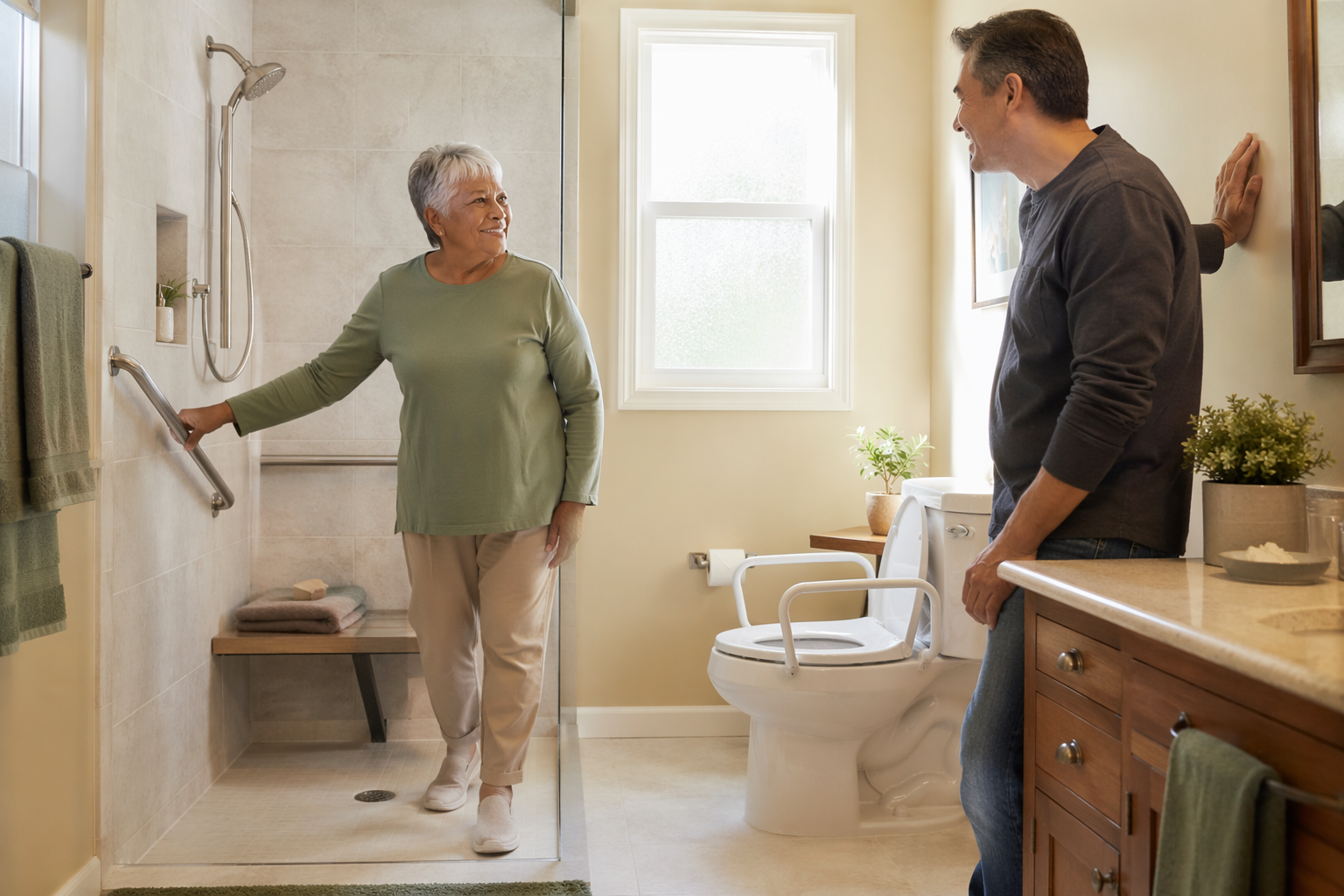
The Landscape of Senior Home Repair Assistance Programs
More than 19 million older adults in the United States live in homes that are in disrepair or lack basic accessibility features, according to Habitat for Humanity. That figure represents roughly one in three households headed by someone 65 or older. Yet the funding landscape designed to help these families is fragmented, under-resourced, and confusing to navigate.
If you are an adult child helping a parent decide which program to apply for, you have likely run into the same wall: each option has different eligibility rules, cost structures, scope limitations, and timelines. There is no single application that covers everything, and the wrong choice can mean months of waiting only to be denied.
This guide compares six major programs side by side:
- Habitat for Humanity's Aging in Place program (grant-based, nonprofit)
- Rebuilding Together (volunteer labor, free health-and-safety repairs)
- USDA Section 504 (grants and loans for rural seniors)
- HUD Title 1 and 203(k) loans (for homeowners with equity)
- Medicaid Money Follows the Person (nursing home transition)
- Weatherization Assistance Program (energy efficiency focus)
Each program fills a distinct niche. Understanding the trade-offs — cost, eligibility, scope, and timeline — is the only way to match your parent's situation to the right resource.
Habitat for Humanity Aging in Place: Free or Low-Cost Modifications for Low-Income Homeowners
Habitat for Humanity's Aging in Place (AIP) program provides home repairs and accessibility modifications at little or no cost to qualifying low-income older adults. Unlike Habitat's traditional homeownership program, AIP does not require a mortgage or sweat equity — it is a grant-based model designed specifically for seniors who already own and occupy their home.
The core features of the program include:
- Grant-based forgiveness: In many affiliates, the cost of the work is forgiven at 20% per year. For example, the Memphis affiliate's program requires the homeowner to remain in the home for five years after the project — if they do, they owe nothing. A $19 fee to record a deed restriction may apply.
- Typical age threshold: Most affiliates set a minimum age of 62, though this is determined locally and can vary.
- Income limits: Set by each affiliate based on HUD Area Median Income (AMI) guidelines. In Memphis, as of April 2025, the maximum gross household income was $31,900 for a one-person household and $36,450 for two people.
- Housing Plus model: Habitat pairs the home repair assessment with a health or human services assessment, connecting homeowners to community resources like Area Agencies on Aging, meal services, or cleaning help. This holistic approach is a key differentiator from most other programs.
- Typical modifications: Interior work includes safety bars, improved lighting, floor repairs, ADA-compliant toilets and sinks, walk-in shower stalls, and energy efficiency projects. Exterior work includes ramps, new roofs, siding, paint, and porch repairs.
Habitat AIP is best suited for low-income senior homeowners who own and live in their home full-time, need significant accessibility modifications (ramps, walk-in showers, grab bars), and are willing to navigate a potentially competitive application process. It is not a good fit for renters, for homeowners who need only minor cosmetic repairs, or for families who cannot wait through a potentially lengthy assessment and approval timeline.
Rebuilding Together: Free Health-and-Safety Repairs Through Volunteer Labor
Rebuilding Together is a national nonprofit that provides free home repairs focused on health and safety, using volunteer labor. Unlike Habitat AIP, which can fund major structural modifications, Rebuilding Together typically handles smaller-scale projects: grab bar installation, porch and stair repairs, handrail replacement, smoke detector installation, and basic plumbing or electrical fixes.
Key characteristics of the program:
- Cost: Free to eligible homeowners. Repairs are funded through grants and corporate sponsorships, and labor is provided by volunteers.
- Eligibility: Income-based, typically targeting low-income homeowners, older adults, veterans, and people with disabilities. Age thresholds vary by local affiliate.
- Scope: Focused on health, safety, and livability — not cosmetic upgrades. Typical projects include fall prevention modifications, accessibility improvements, and critical system repairs (heating, plumbing, electrical).
- Timeline: Projects are often completed in a single day or weekend through volunteer build events, making this one of the faster options for urgent safety fixes.
Rebuilding Together is a strong alternative when your parent needs urgent safety repairs but does not qualify for Habitat AIP (perhaps because their income is slightly above the limit, or their local Habitat affiliate does not offer AIP). It is also a good option when the scope of work is smaller — a few grab bars and a handrail rather than a full bathroom remodel.
USDA Section 504: Grants and Loans for Rural Seniors
The USDA Section 504 Home Repair program is a federal option specifically for homeowners in rural areas. It offers two distinct funding paths: a grant that does not require repayment, and a loan that must be repaid.
The grant component provides up to $10,000 for homeowners aged 62 and older, and the funds are intended to remove health and safety hazards. The loan component offers up to $40,000 and can be used for a broader range of repairs and improvements. Both are available only in areas designated as rural by the USDA.
- Grant: Up to $10,000; no repayment required; available only to homeowners 62+; must be used to address health and safety hazards.
- Loan: Up to $40,000; must be repaid with interest (currently 1% fixed); available to homeowners of any age who meet income limits; can be used for a wider range of repairs.
- Geographic restriction: Only available in rural areas as defined by the USDA. This is the most significant limitation — urban and suburban homeowners are not eligible.
- Income limits: Set at very low-income thresholds (typically 50% or less of the area median income).
For families living in rural areas, USDA Section 504 can be a powerful option. The grant component is particularly valuable because it does not require repayment, similar to Habitat AIP. However, the $10,000 grant cap is significantly lower than the cost of major modifications like a stair lift ($3,000–$10,000) or a full bathroom remodel ($10,000–$25,000). Families who need more extensive work may need to combine the grant with the loan component or layer it with other programs.
HUD Title 1 and 203(k) Loans: For Homeowners with Equity
Unlike the grant-based programs above, HUD's Title 1 and 203(k) loans are financing tools — they must be repaid. They are best suited for homeowners who have sufficient equity or income to support a loan payment, and who need more funding than grant programs can provide.
HUD Title 1 Property Improvement Loans: These are FHA-insured loans that can be used for home improvements, including accessibility modifications. They come in two forms: secured (up to $25,000 for a single-family home, requires collateral) and unsecured (up to $7,500, no collateral required). Title 1 loans are a good option for homeowners who lack substantial equity in their home but need a moderate amount of funding for repairs.
HUD 203(k) Rehabilitation Mortgage Insurance: This program allows homeowners to combine the cost of purchasing or refinancing a home with the cost of renovations into a single mortgage. It is most commonly used by buyers purchasing a fixer-upper, but it can also be used by existing homeowners who want to refinance and fund major modifications. The 203(k) program offers two variants: the Standard 203(k) for projects over $5,000, and the Limited 203(k) for smaller projects up to $35,000.
- Best for: Homeowners with sufficient equity or income to support loan payments; families planning a larger renovation that combines multiple modifications.
- Not ideal for: Low-income seniors who cannot afford additional monthly payments; families who need only minor repairs.
- Key trade-off: You get more funding and broader scope than grant programs, but you must repay the loan with interest.
HUD loans are fundamentally different from Habitat AIP and other grant programs. They are a financing solution, not a subsidy. If your parent has equity in their home and can manage a modest monthly payment, a HUD loan can unlock significantly more funding than any grant program. But if your parent is on a fixed income with little room for additional expenses, a grant-based program is almost always the better choice.
Medicaid Money Follows the Person: Transitioning from Nursing Homes Back Home
Medicaid's Money Follows the Person (MFP) program is a federal-state partnership that supports individuals who want to transition from institutional care (nursing homes, intermediate care facilities) back to their own homes or community-based settings. It is a niche program with a very specific eligibility trigger: the individual must have resided in a qualifying institution for at least 90 consecutive days.
For those who qualify, MFP can cover a range of home modifications necessary for a safe transition: wheelchair ramps, bathroom modifications (grab bars, roll-in showers, raised toilets), stair lifts, doorway widening, and other accessibility improvements. The program also covers home-delivered meals, personal care services, and other supports that enable independent living.
- Eligibility: Must be enrolled in Medicaid and have lived in a nursing home or other qualifying institution for at least 90 days.
- Scope: Covers modifications needed for safe transition home, plus ongoing community-based services.
- Cost: Free to the participant (funded by Medicaid).
- Limitation: Only available in states that participate in the MFP program, and only for individuals who meet the institutional residency requirement.
MFP is not a general home repair program. It is a transition program designed to reduce unnecessary institutionalization. If your parent is currently living at home and needs modifications to stay there, MFP is not an option. But if your parent is in a nursing home and wants to return home, MFP can cover the full cost of the modifications needed to make that possible — including major accessibility work that other programs might not fund.
Weatherization Assistance Program: Energy Efficiency Focus
The federal Weatherization Assistance Program (WAP) helps low-income households reduce energy costs through efficiency improvements. It is administered by state and local agencies and provides free services including insulation, air sealing, HVAC repairs or replacement, and minor energy-related home repairs.
WAP is not an accessibility modification program. It will not fund grab bars, ramps, walk-in showers, or stair lifts. However, it can be a valuable complementary program that frees up other resources. For example, if WAP replaces an old, inefficient furnace and seals air leaks, the homeowner saves on utility bills — money that can then be directed toward accessibility modifications through another program.
- Cost: Free to eligible low-income households.
- Scope: Energy efficiency only — insulation, air sealing, HVAC, lighting, and minor energy-related repairs.
- Eligibility: Income-based (typically at or below 200% of the federal poverty level); priority given to households with older adults, people with disabilities, and families with children.
- Best use: As a layering strategy — combine WAP with Habitat AIP, Rebuilding Together, or USDA Section 504 to address both energy efficiency and accessibility needs.
WAP is worth pursuing for any low-income senior homeowner, even if the primary need is accessibility. The energy savings can be meaningful, and the program's free services reduce the overall financial burden of maintaining a home. Just be clear-eyed about what it does not cover: if your parent needs a ramp, WAP is not the answer, but it can be part of a broader strategy.
Decision Framework: Which Program Fits Your Family's Situation?
The right program depends on four key factors: income, location, age, and the type of work needed. The table below summarizes the trade-offs across all six programs to help you narrow down the options.
| Program | Cost to You | Income Limit | Age Requirement | Geographic Limit | Typical Scope | Best For |
|---|---|---|---|---|---|---|
| Habitat AIP | Free (grant-based, sliding forgiveness) | Low-income (local AMI-based) | Typically 62+ | Varies by affiliate | Major accessibility mods (ramps, walk-in showers, grab bars, roofs) | Low-income senior homeowners needing significant modifications |
| Rebuilding Together | Free | Low-income (local) | Varies by affiliate | Varies by affiliate | Health/safety repairs (grab bars, handrails, porch repairs) | Urgent safety fixes; smaller projects; no local Habitat AIP |
| USDA Section 504 Grant | Free (up to $10,000) | Very low-income (≤50% AMI) | 62+ | Rural areas only | Health/safety hazard removal | Rural seniors needing modest safety repairs |
| USDA Section 504 Loan | Repayable (1% fixed, up to $40,000) | Low-income | None | Rural areas only | Broader repairs and improvements | Rural homeowners needing more funding than the grant provides |
| HUD Title 1 Loan | Repayable (market rate, up to $25,000 secured) | None (credit-based) | None | None | General home improvements | Homeowners with equity needing moderate funding |
| HUD 203(k) Loan | Repayable (market rate, combined mortgage) | None (credit-based) | None | None | Major renovation (combined purchase/refinance + repairs) | Homeowners planning large-scale renovations |
| Medicaid MFP | Free | Medicaid-eligible | None (must be in nursing home 90+ days) | Participating states only | Accessibility mods for nursing home transition | Nursing home residents wanting to return home |
| Weatherization Assistance | Free | Low-income (≤200% FPL) | None (priority for seniors) | Nationwide | Energy efficiency (insulation, HVAC, air sealing) | Layering with other programs to reduce energy costs |
Use the following decision flow to identify the most promising programs for your family's situation:
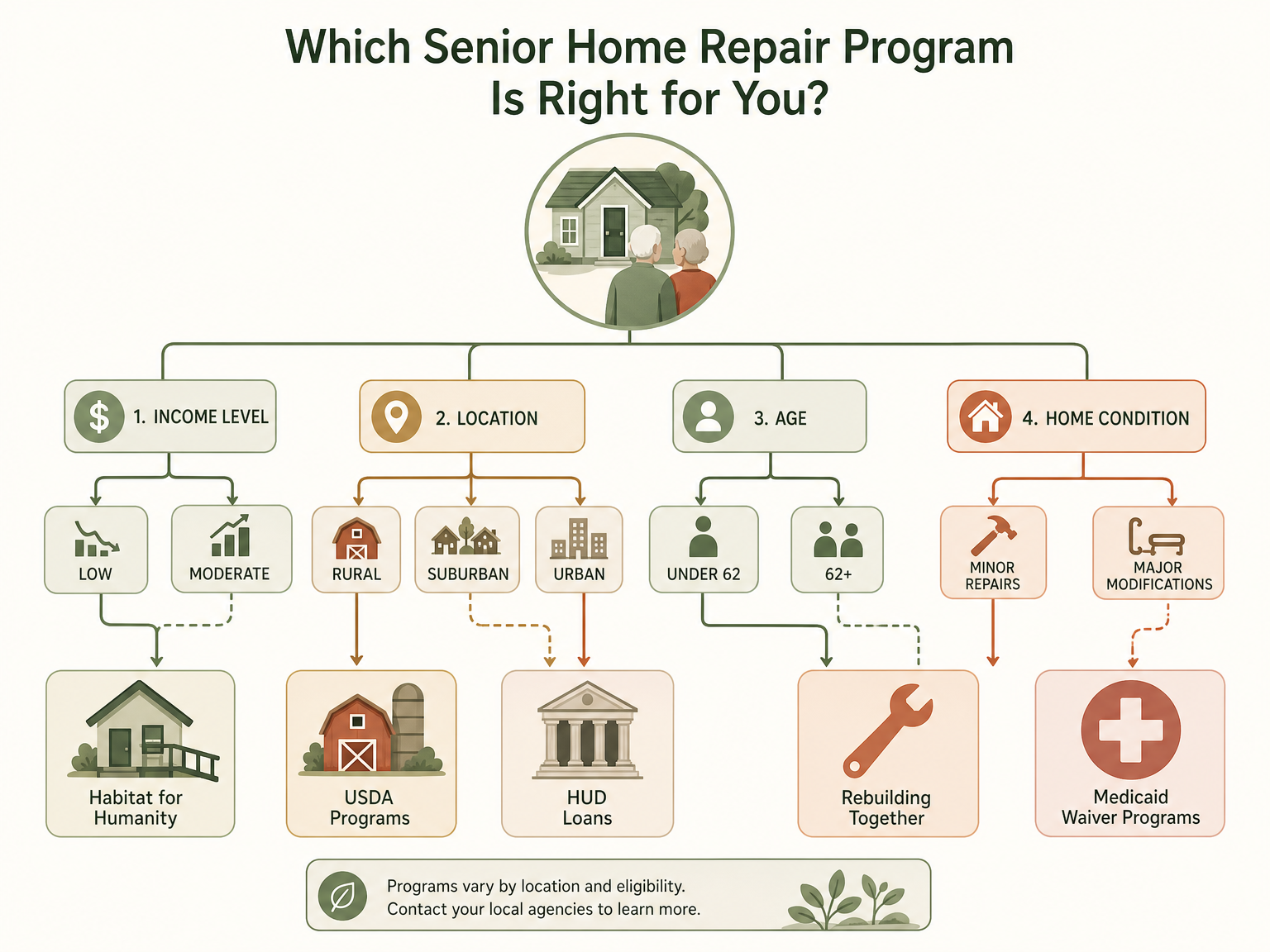
Step 1: Start with income and location
If your parent's income is at or below the local low-income threshold (typically 50–80% of AMI), grant-based programs like Habitat AIP, Rebuilding Together, and USDA Section 504 are the most realistic options. If their income is higher, HUD loans or self-funding may be the only paths.
Location is the next filter. If your parent lives in a rural area, USDA Section 504 becomes available — and it should be a top consideration. If they live in an urban or suburban area, Habitat AIP and Rebuilding Together are the primary nonprofit options, but availability varies by affiliate.
Step 2: Match the scope of work to the program
Different programs are designed for different scales of work:
- Major modifications (ramps, bathroom remodels, stair lifts, roof replacement): Habitat AIP, USDA Section 504 loan, HUD 203(k) loan.
- Moderate safety repairs (grab bars, handrails, porch repairs, lighting): Rebuilding Together, USDA Section 504 grant, Habitat AIP.
- Energy efficiency (insulation, HVAC, air sealing): Weatherization Assistance Program.
- Nursing home transition (full accessibility package): Medicaid Money Follows the Person.
Step 3: Consider urgency and timeline
If the need is urgent — a parent recently discharged from the hospital after a fall, or a home with active safety hazards — prioritize programs with faster timelines. Rebuilding Together can often complete projects in a single day or weekend. Habitat AIP, by contrast, can take months from application to completion due to assessment, approval, and construction scheduling. HUD loans require a mortgage application process that can take 30–60 days.
Step 4: Layer programs when possible
There is no rule that says you can only use one program. Many families successfully layer multiple sources of funding. For example:
- Use Weatherization Assistance to replace an old furnace and seal air leaks, reducing monthly utility costs.
- Apply for Habitat AIP to fund a wheelchair ramp and bathroom modifications.
- If the grant falls short, supplement with a USDA Section 504 loan (if rural) or a HUD Title 1 loan (if urban).
Layering requires coordination and careful timing, but it can unlock significantly more funding than any single program provides.
When to consider assisted living instead
Not every home can be safely modified, and not every family can manage the logistics of coordinating multiple programs. If the cost of modifications exceeds 50% of the home's value, or if your parent's care needs have progressed beyond what home modifications can address, it may be time to consider a move. Our guide on aging in place remodel cost vs. assisted living can help you weigh the financial and practical trade-offs.
Next Steps: Where to Start Today
The funding landscape for senior home repairs is fragmented, but it is not impossible to navigate. Start with these concrete actions:
- Contact your local Habitat for Humanity affiliate and ask whether they offer the Aging in Place program. Be prepared with your parent's income, age, and a list of needed repairs.
- Search for a local Rebuilding Together affiliate if your parent needs urgent safety repairs and Habitat AIP is not available or has a long wait.
- Check the USDA eligibility map to see if your parent's home is in a designated rural area. If so, contact the local USDA Rural Development office about Section 504 grants and loans.
- If your parent is in a nursing home and wants to return home, ask the discharge planner about Medicaid Money Follows the Person.
- Apply for Weatherization Assistance through your state or local energy office — it is a free service that can reduce utility costs regardless of which other programs you pursue.
- For a complete overview of all funding sources including local grants, tax credits, and insurance options, read our full guide on how to pay for aging in place home modifications.
No single program will solve every problem. But by understanding the trade-offs — cost, eligibility, scope, and timeline — you can build a strategy that combines the right programs for your parent's specific situation. The goal is not to find the perfect program. It is to find the combination that works.
Related reading
- Habitat for Humanity Aging in Place vs. Government Home Repair Programs: Which Option Fits Your Senior Parent’s Situation?
- What Habitat for Humanity Aging in Place Modifications Install: A Room-by-Room Guide to Making Your Home Safer
- Habitat for Humanity Aging in Place vs. Other Senior Home Repair Programs: A Comparison for Family Caregivers
Need a professional assessment?
Find a CAPS-credentialed professional or local aging services through our outbound resource list — we never name or rank individual contractors.
Find Local HelpNoticed something outdated or inaccurate on this page? Flag a correction. We review every report against CDC, NIA, and AARP HomeFit guidance before updating a page.