
Room checklist
CAPS Specialist vs. Occupational Therapist: Who Should Assess Your Parent's Home for Aging in Place?
Adult children often don't know whether to hire an Occupational Therapist (OT) or a Certified Aging-in-Place Specialist (CAPS) for a home safety assessment. This guide explains their distinct roles — OTs assess the person's functional abilities, while CAPS professionals focus on structural solutions — and outlines the ideal collaborative workflow for the best outcomes.
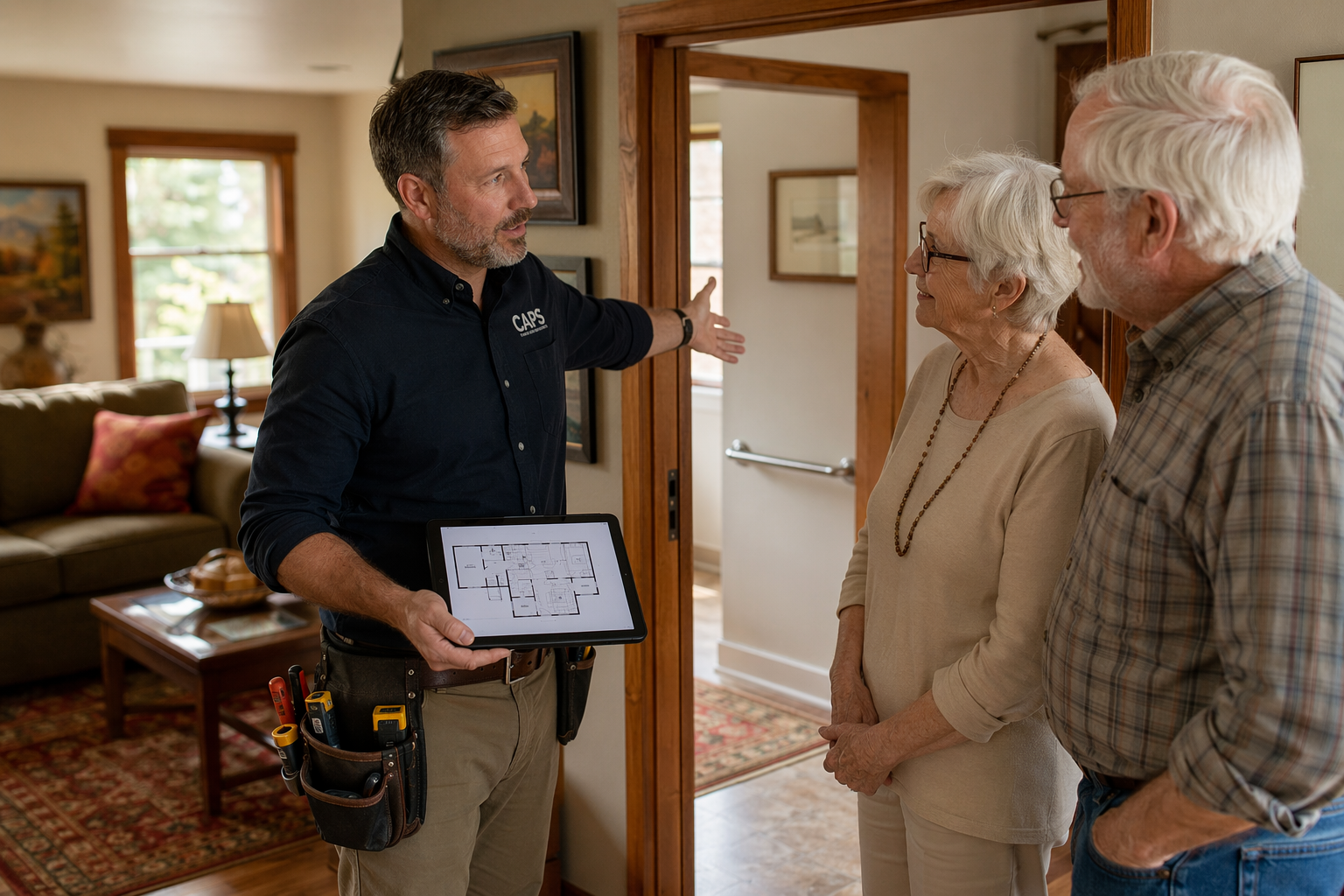
The Confusion: Two Professionals, Overlapping Scope
You know your parent's home needs changes — grab bars in the bathroom, better lighting on the stairs, maybe a ramp at the front door. But when you start researching who to call, you hit a wall of unfamiliar titles. Occupational therapist. CAPS specialist. General contractor. Each one claims to assess home safety, but they come from different worlds and charge different fees. Which one do you call first?
The confusion is understandable. Both occupational therapists (OTs) and Certified Aging-in-Place Specialists (CAPS) evaluate a home's suitability for an older adult, but they look through completely different lenses. An OT is a licensed healthcare professional trained to analyze how a person's body interacts with their environment. A CAPS is a design and construction specialist trained to modify the environment itself. They are not interchangeable, and hiring the wrong one first can cost you time and money.
What an Occupational Therapist Does in Home Safety
An occupational therapist is a healthcare professional with a master's or doctoral degree and clinical training in how aging, disability, and chronic conditions affect a person's ability to perform activities of daily living (ADLs) — bathing, dressing, cooking, toileting, and moving around the home. When you hire an OT for a home safety assessment, they do not walk in with a tape measure and a list of products. They walk in with a clinical framework for understanding your parent's specific functional limitations.
A typical OT home evaluation includes:
- Observing your parent perform everyday tasks — reaching for a cup, stepping into the shower, getting out of a chair — to identify where the environment creates barriers.
- Assessing strength, balance, range of motion, and endurance to determine what kind of support is needed.
- Recommending adaptive strategies, such as changing how a task is done, using assistive devices (reachers, dressing sticks), or modifying the home.
- Providing a written report with prioritized recommendations — but typically not a construction-ready plan with measurements, materials, or contractor specifications.
The key limitation: OTs are not trained in building codes, structural load calculations, or construction sequencing. They know what needs to change, but they generally do not know how to install it or whether local code allows it. The American Occupational Therapy Association (AOTA) recommends that occupational therapy practitioners play a central role on home modification teams, but that role is clinical assessment and recommendation — not construction management.
What a CAPS-Certified Professional Does
A Certified Aging-in-Place Specialist (CAPS) is a professional trained through the National Association of Home Builders (NAHB) program, which covers three core areas: marketing and communicating with aging clients, design concepts for livable homes, and technical details and solutions for aging-in-place projects. CAPS professionals typically come from backgrounds in remodeling, architecture, interior design, or construction.
When you hire a CAPS for a home assessment, their focus is the structure itself:
- Measuring doorways, hallways, and turning radii to determine whether a wheelchair or walker can pass through.
- Evaluating floor transitions, threshold heights, and surface materials for trip hazards.
- Identifying structural opportunities for grab bar installation (blocking in walls, verifying stud locations).
- Creating a detailed implementation plan with product specifications, cost estimates, and contractor scopes of work.
- Managing the bidding process, hiring contractors, and performing a final walk-through to confirm the work meets the plan.
Gina Knight, a CAPS and president of Kastle Keeper, describes a personalized home evaluation with visuals costing around $500. The CAPS credential program teaches how to collaborate effectively with allied professionals like OTs, architects, and contractors — but it does not provide clinical training in assessing a person's functional abilities.
Key Differences at a Glance
The table below summarizes the fundamental differences between an OT and a CAPS professional to help you decide which one fits your current situation.
| Dimension | Occupational Therapist (OT) | CAPS Professional |
|---|---|---|
| Training background | Healthcare: master's or doctoral degree in occupational therapy, clinical licensure | Design/construction: NAHB certification (3-course program), backgrounds in remodeling, architecture, or interior design |
| Primary focus | The person: functional abilities, ADLs, safety strategies, compensatory techniques | The home: structural assessment, building codes, product selection, installation planning |
| Scope of assessment | Clinical observation of task performance, strength, balance, and endurance | Measurement of doorways, floor transitions, structural support, lighting, and accessibility features |
| Deliverable | Written recommendations and prioritized list of changes | Detailed implementation plan with product specs, cost estimates, and contractor scope of work |
| Construction expertise | None — does not design or manage structural work | Full — understands building codes, materials, and contractor coordination |
| Typical cost | $150–$500 per home evaluation | $300–$1,000 per home assessment |
| When to hire first | You need to understand your parent's functional limitations and what changes would help | You already know what modifications are needed and need a structural plan to execute them |
The Ideal Workflow: OT First, Then CAPS
The strongest evidence supports a staged, collaborative approach. A systematic review of home modification studies found that 65% of studies confirmed effectiveness in fall prevention, functional independence, and cost savings, with the best outcomes occurring when an occupational therapist and a builder (or CAPS professional) worked together. The AOTA explicitly recommends that occupational therapy practitioners play a central role on home modification teams.
Here is the recommended four-step sequence:
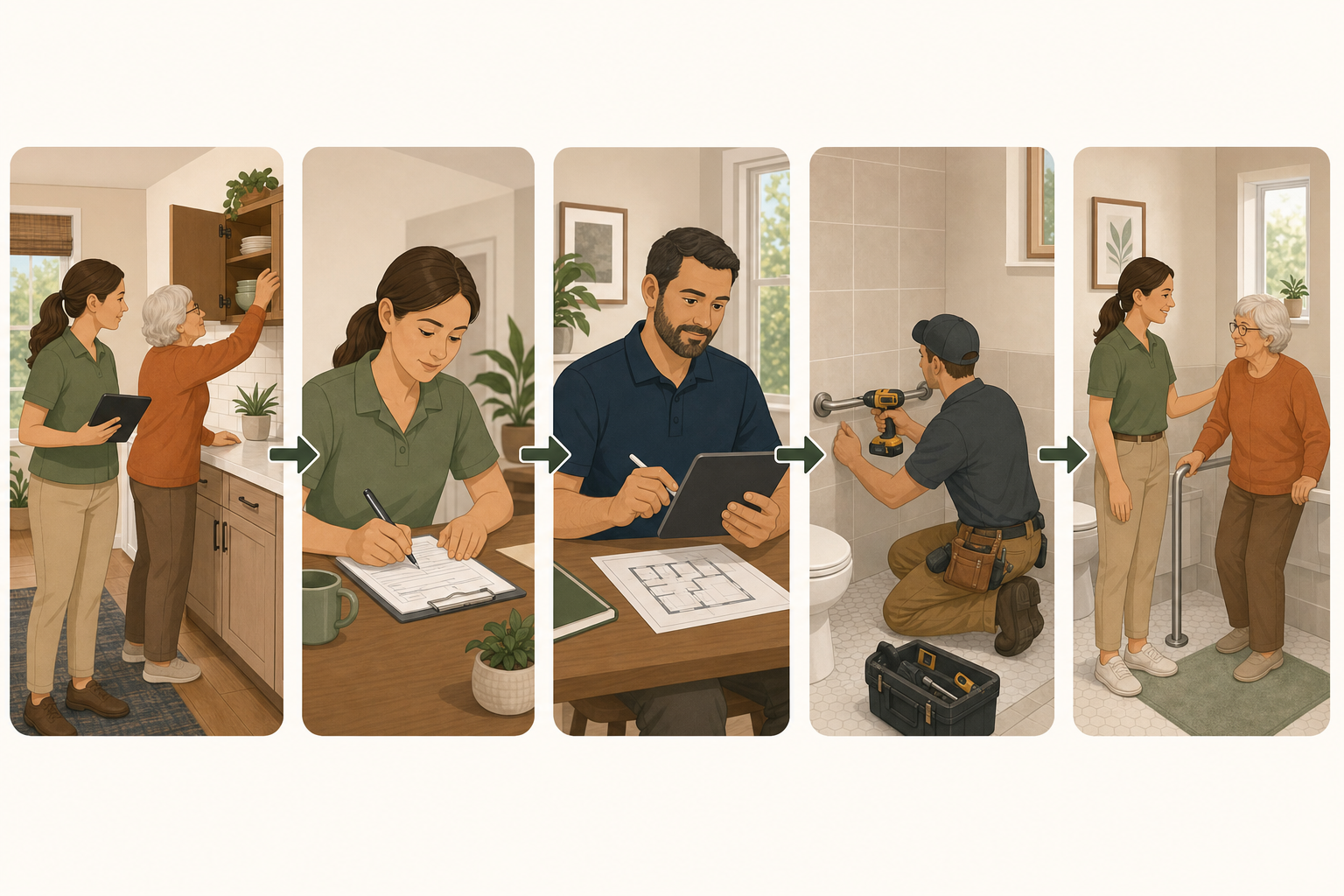
- OT functional assessment. The OT evaluates your parent's abilities, identifies environmental barriers, and produces a prioritized list of recommendations — for example, "install grab bars at the toilet and shower, widen the bathroom doorway to 32 inches, add a curbless shower entry."
- CAPS review and implementation plan. The CAPS professional takes the OT's recommendations and translates them into a construction-ready plan: determining which walls need blocking, selecting specific products that meet code, obtaining contractor bids, and sequencing the work to minimize disruption.
- Contractor work guided by the CAPS plan. The CAPS either manages the contractor directly or provides the contractor with a detailed scope of work, ensuring the installation matches the OT's clinical goals.
- OT follow-up. After the modifications are installed, the OT returns to confirm that the changes actually work for your parent — that the grab bar is at the right height, the shower chair is positioned correctly, and the new layout supports safe movement.
Professionals Who Hold Both Credentials
Some occupational therapists pursue the CAPS certification to bridge the gap between clinical assessment and construction planning. A dual-credentialed professional can perform the functional evaluation and then produce the structural implementation plan themselves, eliminating the handoff step. This can be particularly valuable for complex cases where the clinical and structural considerations are tightly intertwined — for example, a home with multiple floor levels, narrow historic doorways, or a progressive condition like Parkinson's that will require phased modifications over time.
However, even a dual-credentialed professional typically does not perform the actual construction. They still need a licensed contractor to install grab bars, build ramps, or widen doorways. The dual credential streamlines the assessment-to-plan pipeline but does not replace the contractor role.
How to Find Each Type and What to Ask
Finding the right professional starts with knowing where to look and what questions to ask.
Finding an Occupational Therapist
Start with your parent's primary care physician, who can refer you to an OT with experience in home safety assessments. Hospital rehabilitation departments and home health agencies also employ OTs who perform in-home evaluations. The AOTA offers a professional directory on its website.
Key questions to ask an OT before hiring:
- "What percentage of your practice involves home safety assessments for older adults?" — You want someone who does this regularly, not occasionally.
- "Do you provide a written report with prioritized recommendations that I can share with a contractor or CAPS?" — The report is the bridge to the next step.
- "Do you have experience with my parent's specific condition — dementia, Parkinson's, stroke recovery, arthritis?" — Different conditions require different environmental strategies.
- "Do you offer a follow-up visit after modifications are installed?" — Confirming the changes actually work is essential.
Finding a CAPS Professional
The NAHB maintains a searchable directory of CAPS-certified professionals on its website. You can also ask senior care organizations, local chapters of the Alzheimer's Association, or your parent's physician for recommendations. Online reviews and ratings can provide additional insight into a CAPS professional's reputation and reliability.
Key questions to ask a CAPS before hiring:
- "Have you worked with an occupational therapist's recommendations before?" — A CAPS who regularly collaborates with OTs will understand the clinical context of the modifications.
- "Do you provide a detailed scope of work with product specifications and cost estimates?" — You need a document that contractors can bid on.
- "Do you manage the contractor relationship, or do I need to hire and supervise separately?" — Some CAPS professionals act as project managers; others provide the plan and leave execution to you.
- "Can you provide references from recent aging-in-place projects?" — Ask for projects similar in scope to what your parent needs.
Estimated Costs: OT Evaluation vs. CAPS Assessment
Understanding the cost difference between an OT evaluation and a CAPS assessment helps you budget for the full process. Note that these are assessment costs only — they do not include the actual modification work.
| Service | Typical Cost Range | What's Included |
|---|---|---|
| OT home evaluation | $150–$500 | Clinical observation, functional assessment, written recommendations, and follow-up visit (if included) |
| CAPS home assessment | $300–$1,000 | Structural measurement, product recommendations, cost estimates, contractor scope of work, and final walk-through |
| CAPS hourly consultation | $75–$200 per hour | Advisory services for specific questions or smaller projects |
Some OT home evaluations may be partially or fully covered by Medicare Part B if the OT is providing a skilled service under a physician's plan of care. CAPS assessments are almost never covered by insurance, though the modifications themselves may qualify for funding through Medicaid waivers, VA grants, or other programs.
Bringing It All Together: A Decision Framework for Families
The decision between an OT and a CAPS comes down to one question: Do you know what your parent needs, or do you need someone to figure that out first?
- Start with an OT if your parent has recently experienced a decline in function — a fall, a new diagnosis, or increasing difficulty with daily tasks. The OT will identify the specific barriers and recommend the right changes.
- Start with a CAPS if you already have a clear understanding of the needed modifications — perhaps from a hospital discharge plan, a physical therapist's recommendations, or your own observation — and need a structural plan to get them built.
- Hire both in sequence for the best outcome. The evidence is clear: the OT-to-CAPS workflow produces safer, more effective, and more cost-efficient results than either professional working alone.
Less than 4% of homes in the U.S. housing market are currently aging-in-place ready, according to CAPS professional Amy Roberts. With 88% of adults aged 50 and older preferring to remain in their homes, the need for thoughtful, professionally guided home modifications will only grow. Taking the time to understand the distinct roles of OTs and CAPS professionals — and hiring them in the right order — is one of the most important decisions you can make for your parent's safety and independence.
Related reading
Need a professional assessment?
Find a CAPS-credentialed professional or local aging services through our outbound resource list — we never name or rank individual contractors.
Find Local HelpNoticed something outdated or inaccurate on this page? Flag a correction. We review every report against CDC, NIA, and AARP HomeFit guidance before updating a page.