
Room checklist
CAPS-Certified vs. General Contractor: Why the Right Credential Matters After a Parent’s Fall
After a parent’s fall, choosing between a CAPS-certified remodeler and a general contractor is a high-stakes decision. This article explains how CAPS training prevents costly rework and missed safety hazards — from improperly anchored grab bars to undersized doorways — that a standard contractor may overlook.
The Post-Fall Decision That Could Cost You Thousands
Your mother took a bad step getting out of the shower. The ER doctor ruled out a fracture but said the home needs modifications — grab bars, better lighting, maybe a curbless shower. Your neighbor recommends a general contractor who did their kitchen remodel for a fair price. A quick online search introduces you to something called a Certified Aging-in-Place Specialist (CAPS). The GC can start next week. The CAPS professional wants to do a home assessment first. Which one do you call?
This is the moment where a seemingly straightforward decision — hire a contractor, install some safety features — can set a family back thousands of dollars and, more critically, create a dangerous illusion of safety. The central tension is real: the general contractor is often cheaper upfront and available sooner, but the CAPS-certified professional is trained to design for how a person moves now and how they may need to move in three to five years. Choosing wrong means paying twice — once for the initial installation and again for the rework when the first solution fails to meet actual needs.
What CAPS Certification Actually Covers (And Why It Matters)
The CAPS credential, administered by the National Association of Home Builders (NAHB), is not a single-day seminar or a manufacturer's product certification. It is a three-course curriculum that teaches professionals to think about homes as systems that must adapt to changing physical needs over time.
- CAPS I — Marketing & Communicating Aging in Place: Understanding the aging-in-place market, identifying client needs, and collaborating with allied professionals like occupational therapists and physical therapists.
- CAPS II — Design Concepts and Methods: Learning universal design principles, legal and functional considerations, and how to plan for future mobility needs — not just current ones.
- CAPS III — Details and Solutions: Product selection, proper installation techniques, budget planning, phased construction strategies, and how to avoid common design and installation errors that compromise safety.
A general contractor may have decades of experience building kitchens and bathrooms. But unless they have completed this specific curriculum, they have not been trained to think about the path from a bedroom to a bathroom at 2 a.m. in a dimly lit hallway, or how a 32-inch doorway becomes a 28-inch barrier once a walker is added, or why a grab bar rated for 250 pounds is useless if it is anchored into drywall instead of a stud. The CAPS curriculum explicitly covers these details. A standard contractor's experience does not.
The Core Difference: Installing Features vs. Designing Solutions
The most important distinction between a CAPS-certified professional and a general contractor is not technical skill — it is the scope of the problem they are solving. A general contractor typically approaches a bathroom modification as a single-room project: install a grab bar where the homeowner points, replace the tub with a walk-in shower, add a raised toilet. The job is done when the fixtures are in place.
A CAPS professional approaches the same bathroom as one node in a whole-home path of travel. They ask questions a general contractor would not think to ask: How does the person get from the bedroom to the bathroom in the dark? Is there a clear path for a walker or wheelchair? Will the current doorway width accommodate a mobility device in two years? Is the lighting adequate for someone with reduced depth perception? Where should the grab bar be placed so it supports the person's strongest side during a transfer, not just where the stud happens to be?
Concrete Risks of Hiring a Non-CAPS Contractor
The risks of hiring a general contractor without universal design training are not theoretical. They are specific, documented installation failures that compromise safety and require expensive rework. Here are the most common hazards a non-CAPS contractor is likely to miss:
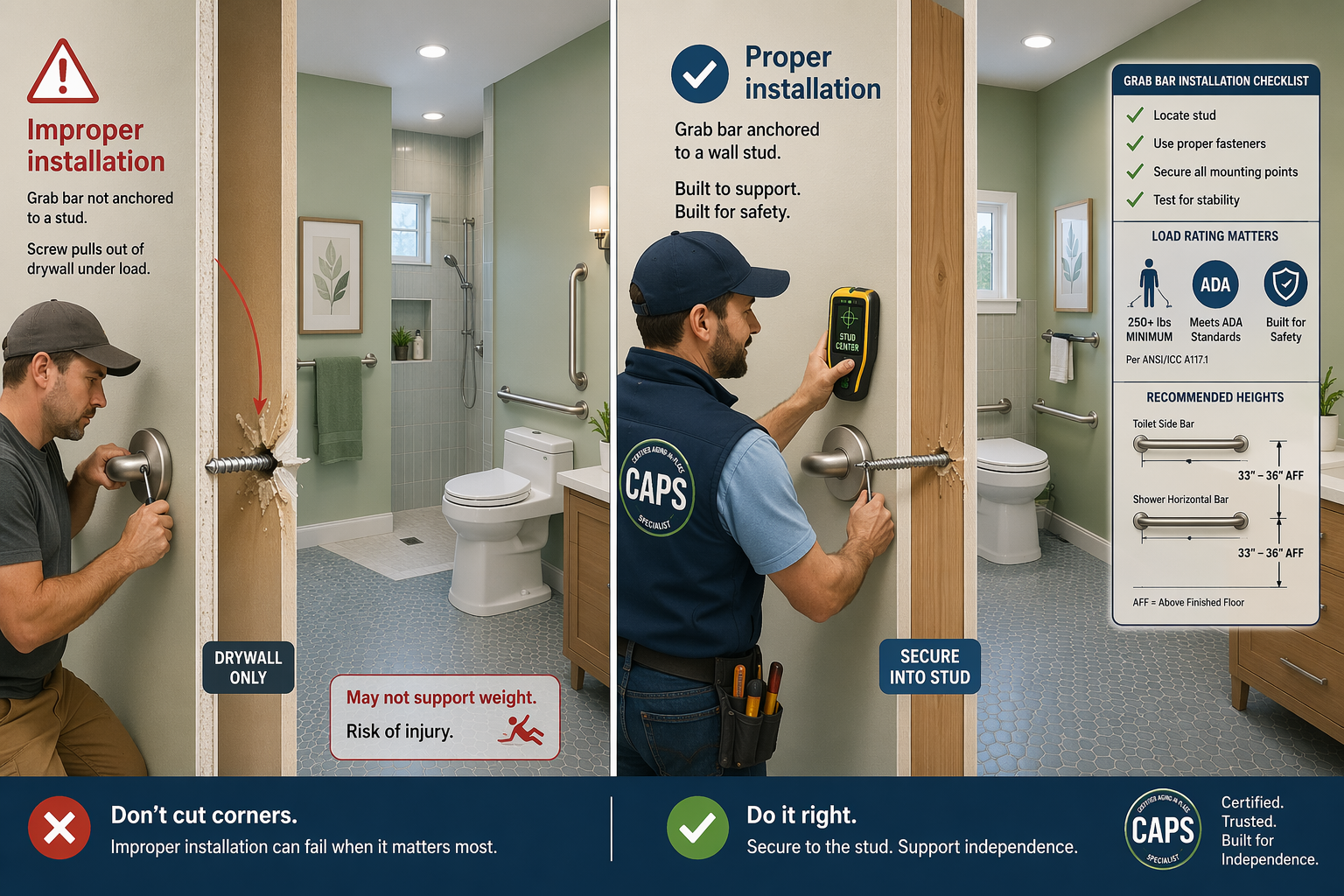
- Grab bars anchored into drywall instead of studs: A properly installed grab bar must support 250 pounds or more. Anchoring into drywall with hollow-wall anchors is insufficient. A CAPS professional uses a stud finder and ensures the bar is secured to a wall stud or uses blocking installed between studs. A general contractor who treats a grab bar like a towel bar creates a fall risk, not a fall prevention solution.
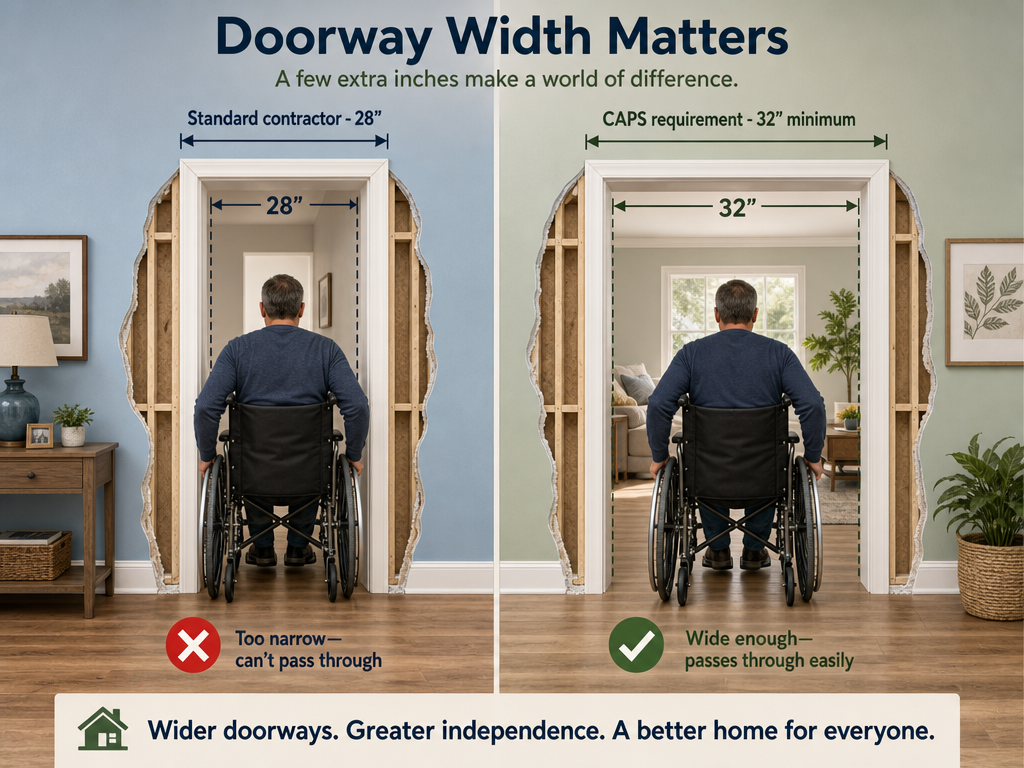
- Doorways left at 28–30 inches instead of the 32-inch minimum: Standard interior doorways are typically 28 to 30 inches wide. A wheelchair or walker requires a minimum of 32 inches of clear passage space. A general contractor focused on cosmetic updates may not widen doorways at all. A CAPS professional plans for future mobility needs and ensures doorways meet accessibility standards.
- Non-flush thresholds that create trip hazards: Raised thresholds between rooms or at entryways are a common fall trigger. A CAPS professional ensures thresholds are flush with the flooring to eliminate tripping points. A general contractor may leave thresholds as-is, not recognizing them as hazards.
- Lack of phased planning that forces rework: A family may install a walk-in tub today, only to discover in two years that a roll-in shower is needed because the parent can no longer step over the tub wall. A CAPS professional plans modifications in phases, ensuring that today's work does not have to be torn out and redone tomorrow.
- Shower controls placed out of reach: A CAPS professional places shower controls near the entry point so the user does not have to lean through the water stream to adjust temperature or flow. A general contractor may place controls in the standard position, forcing a person with limited mobility to reach across the shower — a fall risk in itself.
Cost Comparison: Upfront Savings vs. Long-Term Rework
The most common objection to hiring a CAPS-certified professional is cost. A general contractor may quote a lower hourly rate, and the CAPS home assessment adds an upfront expense that feels unnecessary when you already know what you want installed. But the comparison is misleading when you factor in the cost of rework.
| Modification | Typical Cost Range (Installed) | Rework Cost If Done Incorrectly |
|---|---|---|
| CAPS home assessment | $300 – $1,000 | N/A (prevents rework) |
| Grab bars (per bar) | $100 – $300 | $100 – $300 + drywall repair |
| Wheelchair ramp | $1,500 – $5,000 | $1,500 – $5,000 (if slope or width is wrong) |
| Stairlift | $3,000 – $5,000 | $3,000 – $5,000 (if rail doesn't fit future chair) |
| Walk-in tub | $5,000 – $15,000 | $10,000 – $50,000+ (if roll-in shower needed later) |
| Full bathroom accessibility remodel | $10,000 – $50,000+ | Full cost of redo if not designed for future needs |
The CAPS home assessment — typically $300 to $1,000 — is the single most cost-effective step a family can take. It produces a phased plan that accounts for current needs and anticipates future changes. That plan ensures that the grab bars installed today are still in the right place when a walker is needed next year, and that the bathroom remodel done this year does not have to be torn out when a wheelchair becomes necessary. The upfront cost of the assessment is recouped many times over by avoiding even one round of rework.
For a deeper look at room-by-room budgeting, see the site's Aging in Place Home Modifications Cost Guide. For information on financial assistance programs that can offset these costs, including VA grants and Medicaid waivers, see the complete guide to grants, loans, and assistance programs.
The Statistical Reality: Why Most Homes Aren't Ready
The decision to hire a CAPS-certified professional becomes clearer when you understand the scale of the problem. The vast majority of American homes were not designed for aging in place, and most families undertaking modifications are doing so without expert guidance.
- 75% of adults aged 50 and older want to stay in their homes as they age, according to a 2024 AARP survey.
- Less than 4% of homes in the U.S. housing market are aging-in-place ready, according to Amy Roberts, a senior real estate specialist and CAPS professional, as reported by Care.com. The Census Bureau uses a different definition and estimates about 10% of homes meet basic aging-ready criteria.
- More than 1 in 4 older adults (65+) falls each year, according to the CDC. These falls result in approximately 3 million emergency department visits and about 1 million fall-related hospitalizations annually.
- 83% of hip fracture deaths and 88% of emergency department visits and hospitalizations for hip fractures are caused by falls (CDC, 2019 data).
These numbers tell a clear story: the need for home modifications is widespread and urgent, but the existing housing stock is almost entirely unprepared. Families who attempt to retrofit their homes without expert guidance are navigating unfamiliar territory. A general contractor who has never studied universal design is not equipped to identify the full range of hazards or plan for future needs. The result is modifications that look right but function poorly — or, worse, create new hazards.
Your Bottom-Line Recommendation: Start With the Assessment
After a parent's fall, the instinct is to act quickly. A general contractor who can start next week is tempting. But the data and the installation hazards outlined above make a strong case for a different first step: pay for the CAPS home assessment.
Here is the recommended sequence:
- Schedule a CAPS home assessment ($300–$1,000). This assessment covers the entire home — not just the room where the fall occurred — and produces a written report with prioritized recommendations and a phased plan.
- Get a phased plan that accounts for current mobility and anticipates future needs. A good plan will tell you what to do now, what can wait, and what to avoid doing today that would have to be undone later.
- Compare bids from CAPS-certified contractors using the phased plan as your scope of work. Because the plan is already designed for universal access and future mobility, you are comparing execution, not design.
- Explore funding options early. VA grants, Medicaid waivers, and other assistance programs can offset the cost of modifications. A CAPS professional can help you understand which programs apply to your situation.
For a detailed walkthrough of what happens during a CAPS assessment — from the initial scheduling to the final report — see What Happens During a CAPS Home Assessment. If you are still deciding between a CAPS professional and an occupational therapist, the comparison guide Aging in Place Specialist vs. Occupational Therapist can help clarify which professional to call for your specific situation.
Related reading
Need a professional assessment?
Find a CAPS-credentialed professional or local aging services through our outbound resource list — we never name or rank individual contractors.
Find Local HelpNoticed something outdated or inaccurate on this page? Flag a correction. We review every report against CDC, NIA, and AARP HomeFit guidance before updating a page.