
Room checklist
The Occupational Therapist’s Guide to Aging-in-Place Home Modifications: Evidence-Based Room-by-Room Safety Upgrades
Most home modification advice comes from contractors or marketers, not clinicians. This guide explains how occupational therapists assess homes for safety, which modifications they prioritize based on functional limitations, and how to get a professional OT home assessment—often covered by Medicare Part B.
Why an Occupational Therapist’s Perspective Matters for Home Modifications
Search for "aging in place home modifications" and you will find thousands of articles written by contractors, real estate agents, and content marketers. They will tell you to install grab bars and remove throw rugs. They are not wrong, but they are incomplete. The missing piece is clinical reasoning — the ability to match a specific modification to a specific person’s functional limitations, not just to a generic checklist.
Occupational therapists (OTs) are the only professionals trained to conduct comprehensive home safety assessments that connect a person’s medical condition, mobility, balance, strength, vision, and cognition to the physical environment. A contractor knows how to anchor a grab bar into a stud. An OT knows whether that grab bar should be placed at 33 inches or 36 inches based on the user’s height, reach, and specific balance deficit — and whether the person even needs a grab bar at all or would benefit more from a transfer bench or a raised toilet seat.
The gap between desire and readiness is stark. According to data cited by the National Council on Aging, over half of all falls take place at home. Yet a University of Michigan National Poll on Healthy Aging found that only 18% of adults age 50 and older have made any home modifications. The Census Bureau data cited by Choice Mutual indicates that only 10% of U.S. homes are "aging ready." That means 9 in 10 homes are structurally unprepared for the functional changes that come with aging — even though more than 90% of older adults say they want to remain in their current homes.
An OT does not just hand you a checklist. They walk through every room with you, watch how you move, ask about your daily routines, and identify hazards you would never notice because you have lived with them for years. Then they produce a written plan that prioritizes modifications by risk level, not by cost or convenience. That clinical methodology is what this article will walk through — so you understand how an OT thinks, what they prioritize, and how to get one into your home.
How Occupational Therapists Assess a Home: The Clinical Framework
An OT home assessment is not a casual walk-through. It is a structured clinical evaluation that follows a consistent framework, often aligned with the CDC’s STEADI (Stopping Elderly Accidents, Deaths & Injuries) model. The assessment has three phases: screen, assess, and intervene.
What OTs Look For
During a home visit, an OT evaluates the following dimensions for every room and transition point:
- Entry and egress: Can the person get in and out of the home safely? Are there steps, thresholds, or narrow doorways that create a trip or transfer hazard? Is there a clear path to a safe exit in an emergency?
- Bathroom: This is always the highest priority. OTs assess the toilet height, the tub or shower step-over height, the presence of grab bars (and whether they are properly anchored), the floor surface, and the lighting. The bathroom combines wet surfaces, hard surfaces, and the need to be undressed — a uniquely dangerous combination.
- Kitchen: OTs look at storage height (are frequently used items between waist and shoulder level?), counter depth, faucet type, stove controls, and whether the person can safely carry hot liquids or heavy pots.
- Bedroom: The focus is on the path from bed to bathroom (especially at night), bed height, the presence of a clear path to the door, and whether the person can dress independently.
- Stairs and hallways: OTs check for handrails on both sides, adequate lighting, step height and depth, and whether the person can safely carry items while navigating stairs.
- Living areas: The assessment covers furniture height and stability, cord management, floor transitions, and the presence of throw rugs — which OTs consistently identify as one of the most dangerous fall hazards in any home.
How OTs Prioritize
OTs do not prioritize by cost or aesthetics. They prioritize by fall risk and ADL (Activities of Daily Living) difficulty. A modification that prevents a fall in the bathroom — where a fall is most likely to cause serious injury — will always rank above a convenience upgrade in the kitchen, even if the kitchen upgrade is cheaper and easier to install.
The typical OT prioritization hierarchy looks like this:
| Priority Level | Room or Area | Why OTs Prioritize This Way |
|---|---|---|
| 1 — Critical | Bathroom | Highest fall risk; wet surfaces + hard surfaces + undressed state; nearly 28% of bathroom injuries in adults 65+ are toilet-related (CDC) |
| 2 — High | Entryway and stairs | Entry/egress safety affects independence and emergency evacuation; stairs are the most common location for serious falls |
| 3 — Moderate | Bedroom | Nighttime bathroom trips create fall risk; bed height and path clearance affect safe transfers |
| 4 — Moderate | Kitchen | Burn and scald risk; carrying hot items; reaching for stored items |
| 5 — Lower | Living areas | Trip hazards (cords, rugs, furniture placement); lighting adequacy |
What the Research Says: Evidence Behind OT-Recommended Modifications
OTs do not make recommendations based on intuition or tradition. Their clinical decisions are grounded in published research. Here is the evidence that shapes OT home modification guidance:
The Grab Bar Study: 76% Balance Recovery
A PubMed study cited by the New York Times Wirecutter found that people who used grab bars during a balance loss were nearly 76% more likely to recover their balance than those who did not. This is not a small effect. It is the difference between a momentary stumble and a fall that results in a hip fracture, a hospital stay, and a cascade of functional decline. This single study is why OTs place grab bars at the top of every bathroom modification list — and why they insist on proper installation into wall studs, not into tile or drywall with hollow anchors.
Systematic Review: Home Modifications Reduce Falls Up to 39%
A systematic review published in Healthcare (MDPI, 2025) examined the effectiveness of home modifications for aging in place. The review found that home modifications — when properly selected and installed — effectively prevented falls, maintained functional independence, and supported aging in place. While the full text of this review was not accessible due to access restrictions, its title and abstract confirm the direction of the evidence: targeted home modifications work.
CDC and NCOA Fall Data
The National Council on Aging reports that over half of all falls take place at home. The CDC data cited by the National Institute on Aging indicates that more than one in four people age 65 and older fall each year. These are not abstract statistics. They translate to 36 million falls annually among older adults, resulting in over 32,000 deaths and 3 million emergency department visits. The bathroom alone accounts for a disproportionate share: a CDC study found that nearly 28% of bathroom injuries in adults 65 and older are toilet-related.
OTs use these data points to make the case for proactive modification — not waiting until after a fall. As Matt Haase, an occupational therapist interviewed by Wirecutter, put it: start making adaptations as soon as you are in your "forever home." Waiting until after an injury means modifying the home while recovering from a fracture, which is harder, more expensive, and more stressful.
Room-by-Room: OT-Recommended Modifications with Clinical Rationale
The following room-by-room breakdown explains not just what to install, but why — from an OT clinical perspective. Each recommendation is tied to a specific functional limitation or fall risk mechanism.
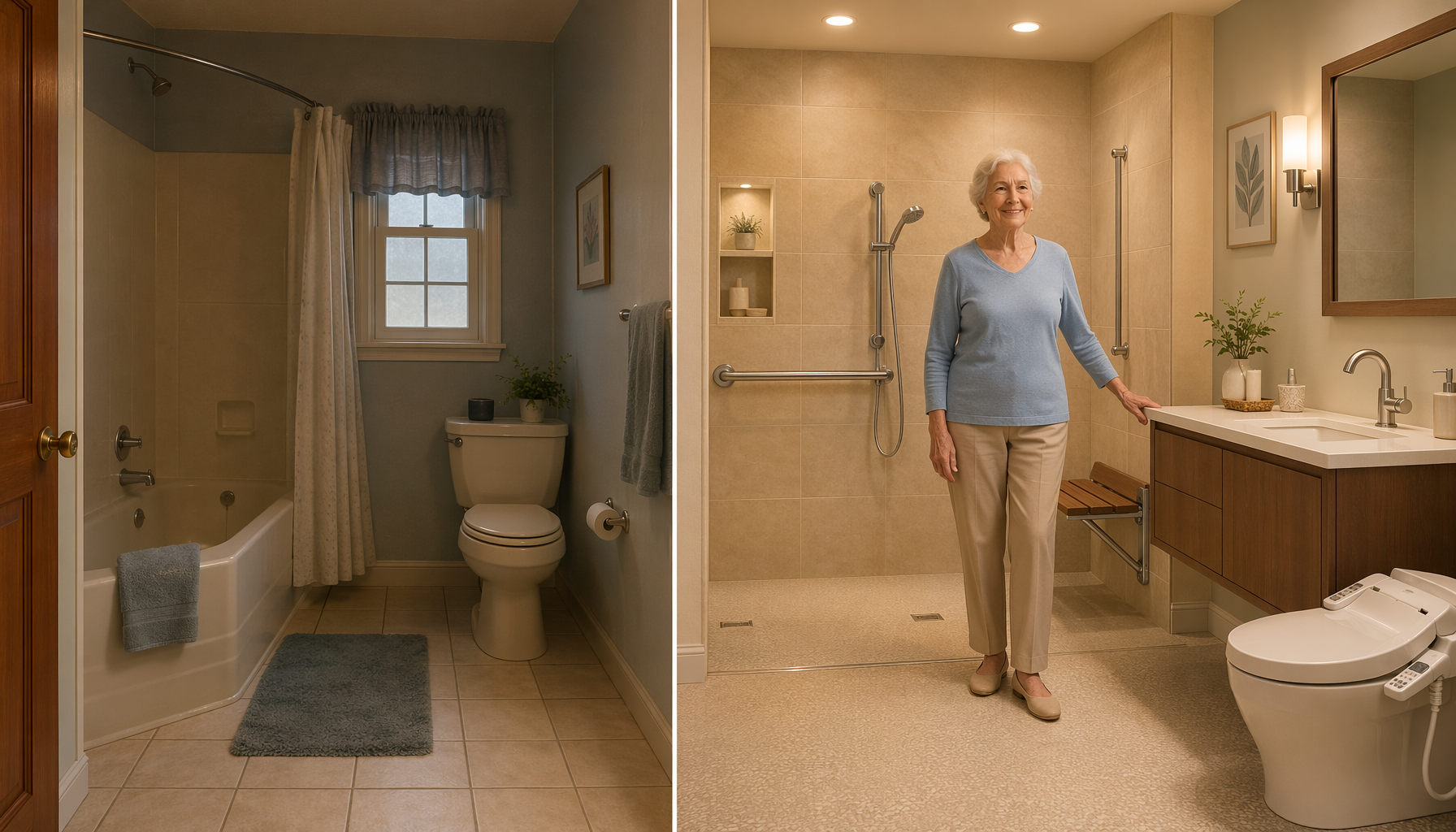
Bathroom: The Highest-Risk Room
Cheryl Hall, an occupational therapist interviewed by Wirecutter, stated plainly: "The bathroom poses more physical hazards than any other room in the house." Her reasoning: "You're naked and wet." The combination of water, hard surfaces (tile, porcelain, glass), and the need to be in a vulnerable physical position makes the bathroom uniquely dangerous.
OT-recommended bathroom modifications include:
| Modification | OT Clinical Rationale | Key Installation Note |
|---|---|---|
| Grab bars (toilet and shower area) | 76% balance recovery rate during a loss of balance; provides upper body support for transfers | Must be anchored into wall studs or blocking — never use suction-cup or adhesive-only grab bars |
| ADA-height toilet (17–19 inches seat height) | Reduces hip and knee flexion required to stand; lowers fall risk during sit-to-stand transfer | Standard toilets are 14–15 inches — a 3–4 inch difference significantly changes transfer biomechanics |
| Curbless (roll-in) shower | Eliminates the step-over height that causes tripping and loss of balance during entry/exit | Requires structural modification to slope the floor; best done during a full bathroom remodel |
| Shower chair or transfer bench | Reduces standing time on wet, slippery surfaces; allows seated bathing | Must be height-adjustable and have non-slip feet; pair with a handheld showerhead |
| Handheld showerhead with adjustable height | Allows seated bathing without leaning or reaching; reduces scald risk from fixed overhead heads | Choose a model with a pause button and anti-scald valve |
| Bidet or bidet attachment | Reduces need to twist and reach for perineal hygiene; lowers fall risk during toileting | Nearly 28% of bathroom injuries in adults 65+ are toilet-related (CDC) |
| Non-slip flooring or mat | Reduces slip risk on wet surfaces; provides stable footing during transfers | Use textured vinyl or rubber flooring — avoid small bath mats that can shift or bunch |
| Motion-sensor night-light | Reduces fall risk during nighttime bathroom trips; eliminates need to find a light switch in the dark | Place along the path from bed to bathroom, not just inside the bathroom |
Kitchen: Reducing Reach, Burn, and Load Hazards
The kitchen presents a different set of risks: reaching, carrying, and heat. Matt Haase, OT, told Wirecutter that "90% of homes I go to, plates and cups are stored up high." For a person with reduced balance, shoulder strength, or grip, reaching above shoulder height while standing on the balls of the feet is a fall waiting to happen.
- Sliding drawers and pull-out shelves: Replace fixed lower cabinets with full-extension sliding drawers so the user can see and reach items without bending or squatting. Bending to access a deep lower cabinet shifts the center of gravity forward and increases fall risk.
- Induction cooktop: Induction surfaces only heat when a pan is present and cool rapidly when the pan is removed. This eliminates the open-flame and hot-surface burn risks of gas and electric coil stoves. For a person with reduced sensation (common in diabetes) or cognitive impairment, this is a significant safety upgrade.
- Single-lever faucet: Requires only one hand and minimal grip strength to operate. Reduces scald risk because the user can set the temperature before putting hands under the water. Lever handles are also recommended for all interior doors for the same reason.
- Anti-fatigue mat: Provides cushioning and reduces lower-body fatigue during standing tasks. For a person with balance issues, a stable, non-slip surface at the sink and stove reduces the risk of losing footing.
- Shallow-basin sink: A sink with a shallow basin (5–6 inches deep instead of the standard 8–10 inches) allows the user to wash dishes or fill pots without bending the torso forward, which shifts the center of gravity and increases fall risk.
Bedroom: Safe Transitions and Nighttime Paths
The bedroom assessment focuses on two critical moments: getting in and out of bed, and navigating to the bathroom at night. OTs recommend:
- Adjustable bed: Allows the user to raise the head for reading, eating, or breathing comfort, and to raise the entire bed height to a level that makes sit-to-stand transfers easier. A bed that is too low forces the user to squat deeply to stand, which is difficult for anyone with reduced leg strength or hip mobility.
- Bed rails or bed assist bar: Provides a stable handhold for repositioning in bed and for pushing up to a seated position. Not the same as hospital bed rails — a bed assist bar slides under the mattress and provides a vertical grab bar for transfer support.
- Clear path to the bathroom: Remove all furniture, cords, and rugs from the path between the bed and the bathroom door. Install motion-sensor night-lights along this path. Most nighttime falls happen because the person is groggy, the room is dark, and an obstacle was in the way.
- Adaptive dressing tools: A long-handled shoehorn, a sock aid, and a dressing stick reduce the need to bend or balance on one leg while dressing. These are low-cost, high-impact tools that OTs recommend before structural modifications.
Entryway and Stairs: First and Last Line of Defense
The entryway is the first thing an OT evaluates because it determines whether the person can leave the home independently in an emergency. Stairs are the most common location for serious falls. OT recommendations include:
- Handrails on both sides of stairs: A single handrail forces the user to rely on one side of the body. Two handrails allow reciprocal arm support, which is critical for someone with unilateral weakness (e.g., post-stroke) or balance deficits.
- Lever-style door handles: Require a pushing or pulling motion rather than gripping and twisting. For someone with arthritis, reduced grip strength, or carpal tunnel syndrome, lever handles are the difference between independent entry and being locked out.
- Keypad or smart lock: Eliminates the need to manipulate a small key, which is difficult for people with reduced fine motor control or vision impairment. Also allows caregivers to enter without a physical key.
- Well-lit walkways: Exterior lighting should illuminate the full path from the door to the driveway or sidewalk, with no dark spots. Motion-sensor lights eliminate the need to find a switch in the dark.
- Threshold ramp: A low-profile ramp (beveled on both sides) eliminates the trip hazard of a raised threshold. For wheelchair or walker users, even a 1-inch threshold can be an impassable barrier.
Common Home Modification Mistakes OTs See Most Often
OTs see the same mistakes over and over. These errors are not just ineffective — they are often more dangerous than making no change at all, because they create a false sense of security.
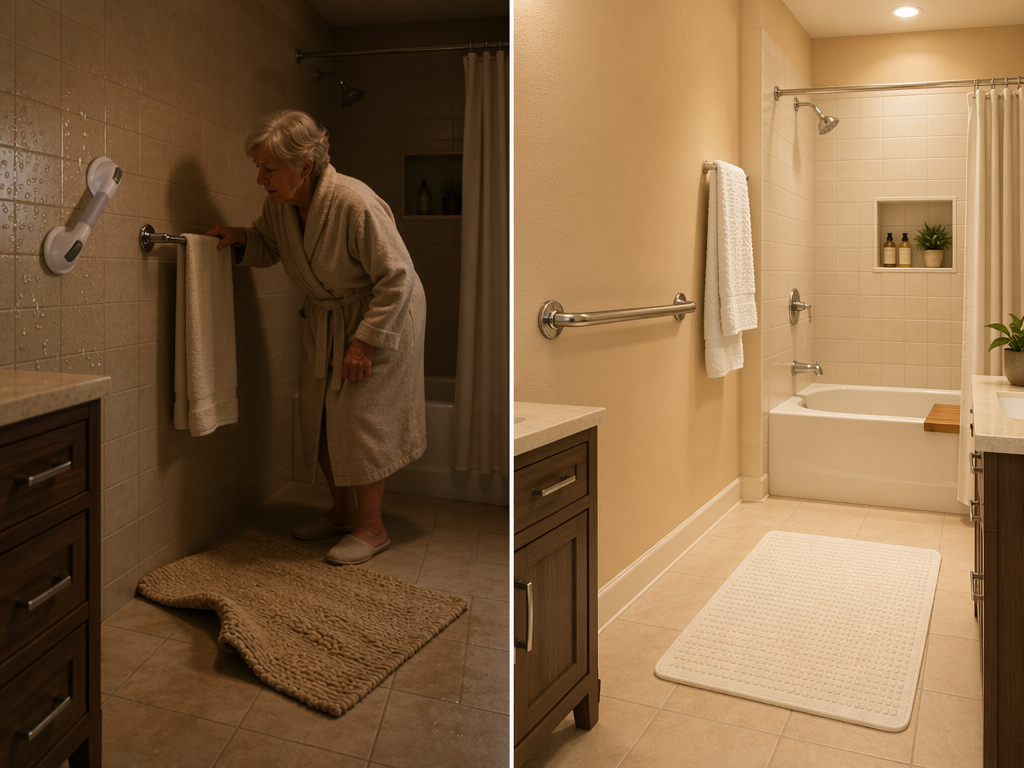
- Suction-cup grab bars: These are not grab bars. They are bathroom accessories that will fail under the dynamic load of a fall. An OT will never recommend a suction-cup grab bar. A properly installed grab bar must be anchored into wall studs or plywood blocking and support at least 250 pounds of static load.
- Using towel bars as grab bars: Towel bars are designed to hold a few pounds of wet fabric. They are not load-rated. When someone grabs a towel bar during a fall, it will pull out of the wall, and the person will fall backward with a metal bar in their hand. This is one of the most dangerous mistakes OTs see.
- Throw rugs anywhere: OTs universally recommend removing all throw rugs. The edge of a rug is a trip hazard. A rug on a hard floor can slide. A rug on carpet can bunch. There is no safe throw rug for an older adult with balance or gait impairment.
- Poor lighting contrast: Aging eyes require more light and more contrast to perceive depth and edges. A white toilet on a white floor, or a white step on a white shower floor, creates a visual hazard. OTs recommend high-contrast color transitions (e.g., a dark toilet seat on a light toilet, a colored strip on the edge of a step) and bright, non-glare lighting.
- Installing modifications without considering the user: A grab bar installed at the wrong height is useless. A raised toilet seat that is too high creates a different set of transfer problems. A shower chair that is too low forces the user to squat to sit. Every modification must be matched to the specific person’s height, reach, strength, and mobility pattern.
- Storing items too high or too low: The NCOA recommends keeping frequently used items between waist and shoulder height. Matt Haase, OT, confirmed that 90% of homes he visits have plates and cups stored above shoulder level. Reaching overhead while standing on the toes is a fall risk. Bending to a low cabinet is a fall risk. The solution is to reorganize storage, not just install grab bars.
How to Get an Occupational Therapy Home Assessment
Getting an OT home assessment is more straightforward than most people assume. Here is the step-by-step process:
- Get a physician referral: Medicare Part B covers occupational therapy services when they are deemed medically necessary and ordered by a physician. The referral should specify that a home safety assessment is needed. The physician does not need to be a specialist — a primary care doctor can write the referral.
- Find an OT who does home visits: Not all OTs provide in-home assessments. Ask the physician’s office for a referral to a home health agency that employs OTs, or search for independent OTs who specialize in home safety and aging in place. The American Occupational Therapy Association (AOTA) maintains a finder tool on its website.
- Schedule the home visit: A typical home assessment takes 60 to 90 minutes. The OT will walk through every room, observe the person performing daily tasks (getting in and out of bed, using the toilet, bathing, preparing food), and ask about recent falls, near-misses, and specific difficulties.
- Receive a written plan: After the assessment, the OT provides a written report with prioritized recommendations. This document is invaluable — it gives you a clear roadmap, and it can be used to justify funding requests to insurance, VA, or grant programs.
- Implement the recommendations: Some recommendations are simple (reorganize cabinets, remove rugs, install night-lights). Others require a contractor. The OT can advise on which modifications need a CAPS-certified professional and which can be done by a handyperson or family member.
Medicare Part B Coverage: What You Need to Know
Medicare Part B covers occupational therapy services at 80% of the Medicare-approved amount after the annual deductible is met. There is no cap on medically necessary OT services. However, coverage varies by plan and by region. Some Medicare Advantage plans may require prior authorization or may only cover OT through specific home health agencies.
Occupational Therapists vs. CAPS Specialists: When to Use Each
A common point of confusion is the difference between an occupational therapist and a Certified Aging-in-Place Specialist (CAPS). They serve complementary but distinct roles.
| Role | What They Do | When to Use Them |
|---|---|---|
| Occupational Therapist (OT) | Assesses the person’s functional limitations and the home environment; recommends modifications based on clinical evaluation; provides a written prioritized plan | Always first. An OT assessment should precede any modification work to ensure the right changes are made for the right reasons |
| CAPS Specialist | Designs and installs home modifications; understands universal design principles and building codes; can manage complex renovation projects | After the OT assessment. A CAPS specialist implements the OT’s recommendations. For complex structural changes (curbless showers, stair lifts, ramps), a CAPS professional is essential |
| Both (OT + CAPS) | The OT assesses and recommends; the CAPS designs and installs. They may communicate directly to ensure the installation matches the clinical need | For complex cases involving multiple rooms, structural changes, or specific medical conditions (e.g., post-stroke, Parkinson’s, ALS) |
Related reading
Need a professional assessment?
Find a CAPS-credentialed professional or local aging services through our outbound resource list — we never name or rank individual contractors.
Find Local HelpNoticed something outdated or inaccurate on this page? Flag a correction. We review every report against CDC, NIA, and AARP HomeFit guidance before updating a page.