
Room checklist
How Much Does a Certified Aging-in-Place Specialist Cost? Full Breakdown of Fees, Modifications, and Funding Sources
This article breaks down the costs of hiring a CAPS professional — from assessments and hourly consults to project management — and compares them against common home modification expenses and the annual cost of assisted living. It also covers funding sources like Medicaid waivers and VA grants that can offset the upfront investment.
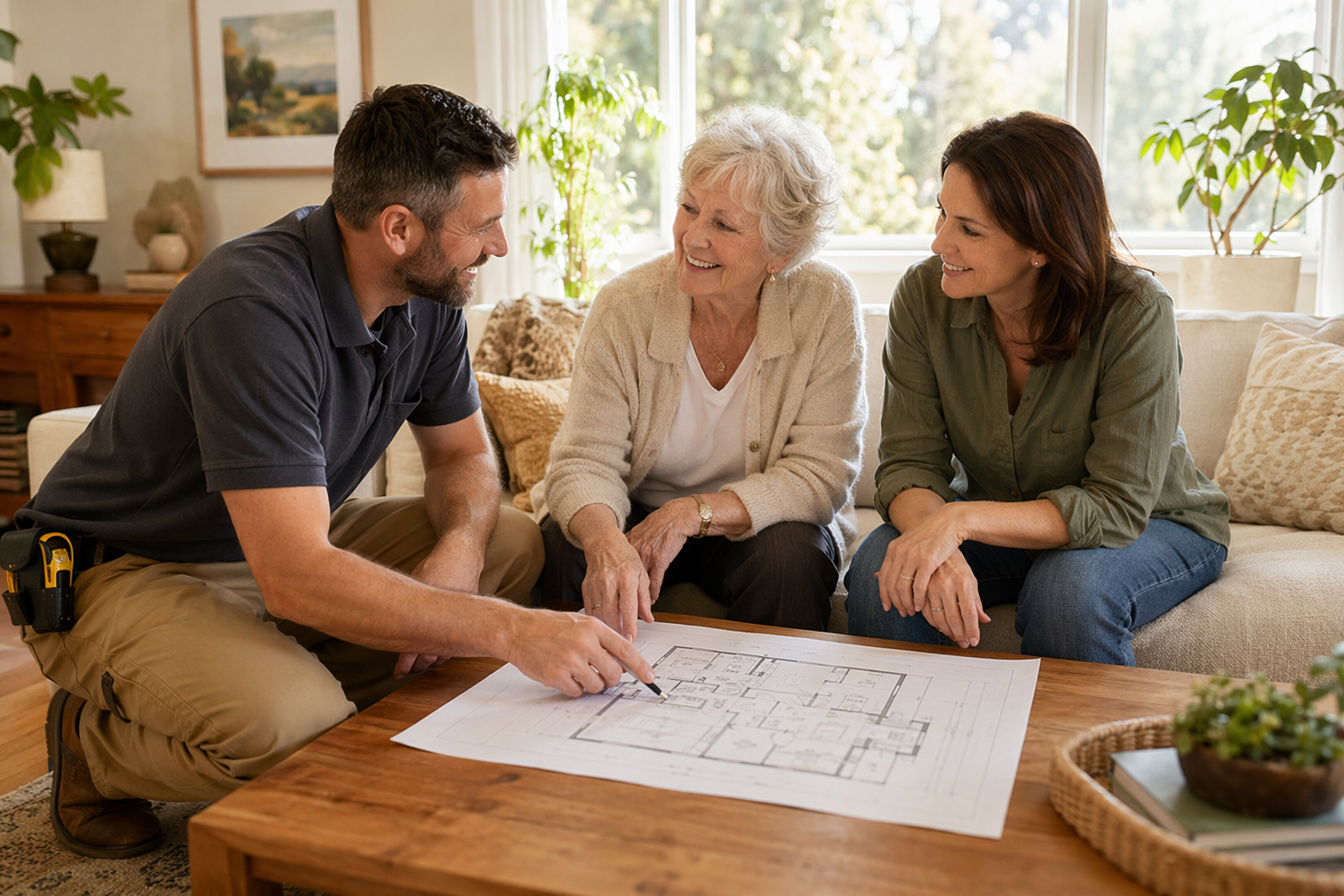
The Cost Question: The #1 Barrier to Aging in Place
Every family caregiver reaches the same crossroads: the home that holds decades of memories no longer works as well as it once did. The bathroom threshold has become a tripping hazard. The step up at the front door feels insurmountable. The shower is no longer safe. The instinct is to act, but the first question that stops most families cold is, "How much will this cost?"
That hesitation is understandable. A full home modification project can feel like a financial unknown, especially when you are also weighing the monthly price tag of assisted living. But the data tells a different story. According to a University of Michigan National Poll on Healthy Aging, 88% of adults aged 50 to 80 feel it is important to remain in their own homes. Yet only about 10% of U.S. homes are equipped to fully accommodate an older adult, according to a 2020 Census Bureau report cited by Retirement Living. That gap between desire and readiness is where a Certified Aging-in-Place Specialist (CAPS) comes in.
This article breaks down the real costs of hiring a CAPS professional and making your home safer, then compares those one-time expenses against the recurring cost of assisted living. You will also learn about funding sources — from Medicaid waivers to VA grants — that can dramatically reduce your out-of-pocket investment.
CAPS Professional Fees: What You Pay For
A Certified Aging-in-Place Specialist brings a specific set of skills that a general contractor typically does not. The CAPS credential, offered jointly by the National Association of Home Builders (NAHB) and AARP since 2002, requires completing three courses covering marketing and communication, design concepts, and construction details. This training equips CAPS professionals to assess a home's accessibility, recommend modifications, estimate costs, manage contractors, and follow up after completion.
The fees you pay a CAPS professional generally fall into three categories:
| Service | Typical Cost Range | What It Includes |
|---|---|---|
| Home Safety Assessment | $300 – $1,000 | On-site evaluation, full report with photos or visuals, prioritized recommendations |
| Hourly Consultation | $75 – $200 per hour | Advice on specific modifications, contractor coordination, product selection |
| Comprehensive Project Management | Varies (often % of project cost or flat fee) | End-to-end oversight from assessment through contractor hiring to final inspection |
Gina Knight, a CAPS professional quoted by Care.com, notes that a personalized home evaluation with a full report and visuals costs approximately $500. This assessment is often the first and most important investment you will make, because it prevents costly mistakes. Without a professional assessment, families may spend money on modifications that do not address the most critical safety issues.
For context on how a CAPS compares to other professionals, see our guide on CAPS vs. General Contractor vs. Occupational Therapist to understand which type of expert best fits your situation.
Common Home Modification Costs at a Glance
Once the assessment is complete, the CAPS professional will provide a prioritized list of recommended modifications. Costs vary significantly by region, contractor, and material quality, but the following ranges provide a useful starting point for budgeting.
| Modification | Typical Cost Range | Notes |
|---|---|---|
| Grab bars (installed) | $100 – $300 | One of the most cost-effective safety upgrades |
| Wheelchair ramp | $1,500 – $5,000 | Depends on length, material, and site conditions |
| Walk-in tub | $5,000 – $15,000 | Includes installation; higher end for whirlpool features |
| Stairlift | $3,000 – $5,000 | Straight staircases; curved tracks cost significantly more |
| Full bathroom accessibility remodel | $10,000 – $50,000 | Widened doorways, roll-in shower, grab bars, non-slip flooring |
| Major kitchen or full-home remodel | $10,000 – $100,000 | Comprehensive accessibility upgrades across multiple rooms |
These ranges are directional. A CAPS professional can help you refine them for your specific home and local market. For a more detailed room-by-room breakdown, see our Aging in Place Home Modifications Cost Guide, which covers budget tiers for every room in the house.
Modifications vs. Assisted Living: The Financial Reality Check

The most important financial comparison is not between two remodeling bids — it is between the one-time cost of modifying your home and the ongoing, escalating cost of facility-based care.
According to Choice Mutual, the national average cost of assisted living is approximately $64,200 per year, or about $5,350 per month. That figure has been rising steadily, and many families face even higher costs in urban areas or for higher levels of care.
| Scenario | One-Time Cost | Annual Cost | Breakeven vs. Assisted Living |
|---|---|---|---|
| CAPS assessment + grab bars + ramp | $2,000 – $6,000 | N/A | Less than 1 month of assisted living |
| Full bathroom remodel + stairlift | $15,000 – $55,000 | N/A | 3–10 months of assisted living |
| Comprehensive whole-home remodel | $50,000 – $100,000 | N/A | 9–19 months of assisted living |
| Assisted living (national average) | N/A | $64,200 | Recurring every year |
The math is striking. A $15,000 bathroom remodel is equivalent to less than three months of assisted living. A $50,000 comprehensive remodel is equivalent to less than ten months. After that breakeven point, the modifications have effectively paid for themselves — and the family continues living in their own home, on their own terms.
For a deeper analysis of this comparison, including the impact of home equity and property taxes, read our full article: Does an Aging-in-Place Remodel Pay for Itself?
Funding Sources That Change the Math

The sticker price of modifications is only half the story. Several funding sources can significantly reduce — or in some cases fully cover — the cost of making a home safer. These programs are underutilized because many families simply do not know they exist.
- Medicaid Home and Community-Based Services (HCBS) Waivers: Many states offer HCBS waivers that cover home modifications as part of a broader effort to keep people out of nursing facilities. For example, Colorado's waiver has a $14,000 lifetime maximum for modifications. Eligibility and covered services vary significantly by state.
- Veterans Affairs (VA) Grants: The VA offers Specially Adapted Housing (SAH) and Special Home Adaptation (SHA) grants for eligible veterans and service members. These grants can fund ramps, widened doorways, roll-in showers, and other structural modifications.
- IRS Medical Expense Deductions: Under IRS Publication 502, some home modifications that qualify as medical expenses may be tax-deductible. This includes costs for installing ramps, grab bars, and other equipment prescribed by a physician. The deduction applies to expenses exceeding 7.5% of your adjusted gross income.
- Area Agencies on Aging (AAA): Local AAAs often administer grant programs or can connect families with nonprofit organizations that provide free or low-cost home safety modifications.
- Nonprofit and Community Programs: Organizations like Habitat for Humanity and Rebuilding Together offer aging-in-place modification programs in many communities, often at reduced or no cost for qualifying households.
For a comprehensive overview of these programs, including eligibility requirements and application steps, see our two dedicated guides: Paying for Aging in Place Home Modifications: A Guide to Grants, Loans, and Assistance Programs and Funding Sources for Home Modifications: A Complete Guide to VA, Medicaid, Grants, and More.
The ROI of Aging-in-Place Modifications
Home modifications are not just an expense — they are an investment in the property. When the time comes to sell, accessibility features can increase a home's resale value and broaden the pool of potential buyers.
According to data cited by Choice Mutual, accessibility renovations can deliver a 49% to 70% return on investment (ROI) at resale. Homes with zero-step entries and wider doorways can sell for up to 7% more than comparable homes without those features. This is because the aging population is large and growing — the U.S. Census Bureau projects that Americans aged 65 and older will number 82 million by 2050, a 47% increase from 2023. Homes that are already accessible will be in high demand.
This ROI perspective further strengthens the financial case. Even if you do not plan to sell, the modifications add value to your most significant asset. And if you do sell, the investment is partially — or fully — recouped.
A Phased Approach: Spreading Costs Over Time
Not every family can write a $50,000 check for a full bathroom remodel. The good news is that you do not have to do everything at once. A CAPS professional can help you develop a phased plan that prioritizes the most critical safety issues first and spreads larger projects over months or years.
- Phase 1 — Immediate Safety (under $1,000): Install grab bars in the bathroom and shower. Add non-slip mats. Improve lighting in hallways and stairways. Replace round doorknobs with lever handles. Remove loose rugs and clutter from walking paths.
- Phase 2 — High-Impact Modifications ($1,000 – $10,000): Install a ramp at the main entry. Add a handheld showerhead and shower chair. Replace the toilet with a comfort-height model. Install a stairlift if needed.
- Phase 3 — Major Structural Changes ($10,000+): Full bathroom accessibility remodel. Kitchen modifications (pull-out shelves, lowered counters). Widening doorways. Creating a first-floor bedroom or bathroom if none exists.
This phased approach allows families to address the most urgent hazards immediately while planning and saving for larger projects. A CAPS professional's assessment provides the roadmap, ensuring that early-phase work does not conflict with later-phase plans.
For a detailed prioritization framework organized by room, see our Aging in Place Home Modifications Cost Guide, which includes budget tiers for every room in the house.
Red Flags and Smart Questions to Ask
As with any home improvement project, there are contractors who will overcharge, underdeliver, or pressure you into unnecessary work. Here are the most common red flags to watch for when hiring a CAPS professional or any contractor for aging-in-place modifications.
- Vague or bundled quotes: A reputable CAPS professional will provide an itemized quote that separates the assessment fee, consultation fees, material costs, and labor. Be wary of a single lump-sum number with no breakdown.
- Pressure to approve a full remodel immediately: A good CAPS will offer a phased plan and respect your budget. If a contractor insists you must do everything at once or the work will not be effective, get a second opinion.
- No CAPS credential or proof of insurance: Ask to see the CAPS certificate and verify it through the NAHB directory. Also request proof of liability insurance and workers' compensation coverage. NAHB requires CAPS credential holders who are remodelers or contractors to submit proof of these.
- Unwillingness to coordinate with an occupational therapist: For complex medical or mobility needs, a CAPS should be willing to collaborate with the older adult's occupational therapist or primary care provider. Resistance to this is a red flag.
- No follow-up plan: A CAPS professional should schedule a follow-up visit after the work is complete to ensure the modifications are being used correctly and are meeting the family's needs.
For a complete list of questions to ask before hiring, see our guide: CAPS vs. General Contractor vs. Occupational Therapist: Who Should You Hire?
Related reading
- How Much Does It Cost to Hire a Certified Aging-in-Place Specialist? Real Pricing, What You Get, and How to Find Funding
- CAPS vs. General Contractor vs. Occupational Therapist: Who Should You Hire for Aging-in-Place Home Modifications?
- How to Pay for Aging in Place Home Modifications: A Complete Guide to Grants, Loans, and Assistance Programs
Need a professional assessment?
Find a CAPS-credentialed professional or local aging services through our outbound resource list — we never name or rank individual contractors.
Find Local HelpNoticed something outdated or inaccurate on this page? Flag a correction. We review every report against CDC, NIA, and AARP HomeFit guidance before updating a page.