
Room checklist
How Oil Price Spikes Affect Senior Home Modification Budgets
With oil prices driving up costs and shrinking retirement income, this guide shows seniors and their families how to prioritize home safety modifications — from low-cost grab bars to major renovations — and find underutilized funding programs to avoid deferring critical safety upgrades.
- Room
- bathroom
- Modification type
- low-cost fix
The practical answer to how an oil price spike affects senior retirement portfolios is not found only in brokerage statements. It shows up when a heating bill, a pharmacy receipt, and a bathroom safety estimate land on the same kitchen table. In 2026, crude oil moved past $100 a barrel amid the Iran conflict and Strait of Hormuz closure, while gas prices rose 11% in one week in March reports; those numbers are still moving, and any household plan should treat them as date-stamped pressure rather than a permanent forecast.[1]
Heating costs are part of the squeeze. CNN, citing EIA data, reported heating oil around $1,587 for the season in February 2026.[2] AARP’s May 2026 survey found that 69% of older adults said prices were rising faster than their income, 60% worried about outliving savings, and 37% felt financially insecure.[3] That is not an abstract inflation mood. It is the reason a family starts asking whether the grab bar can wait.
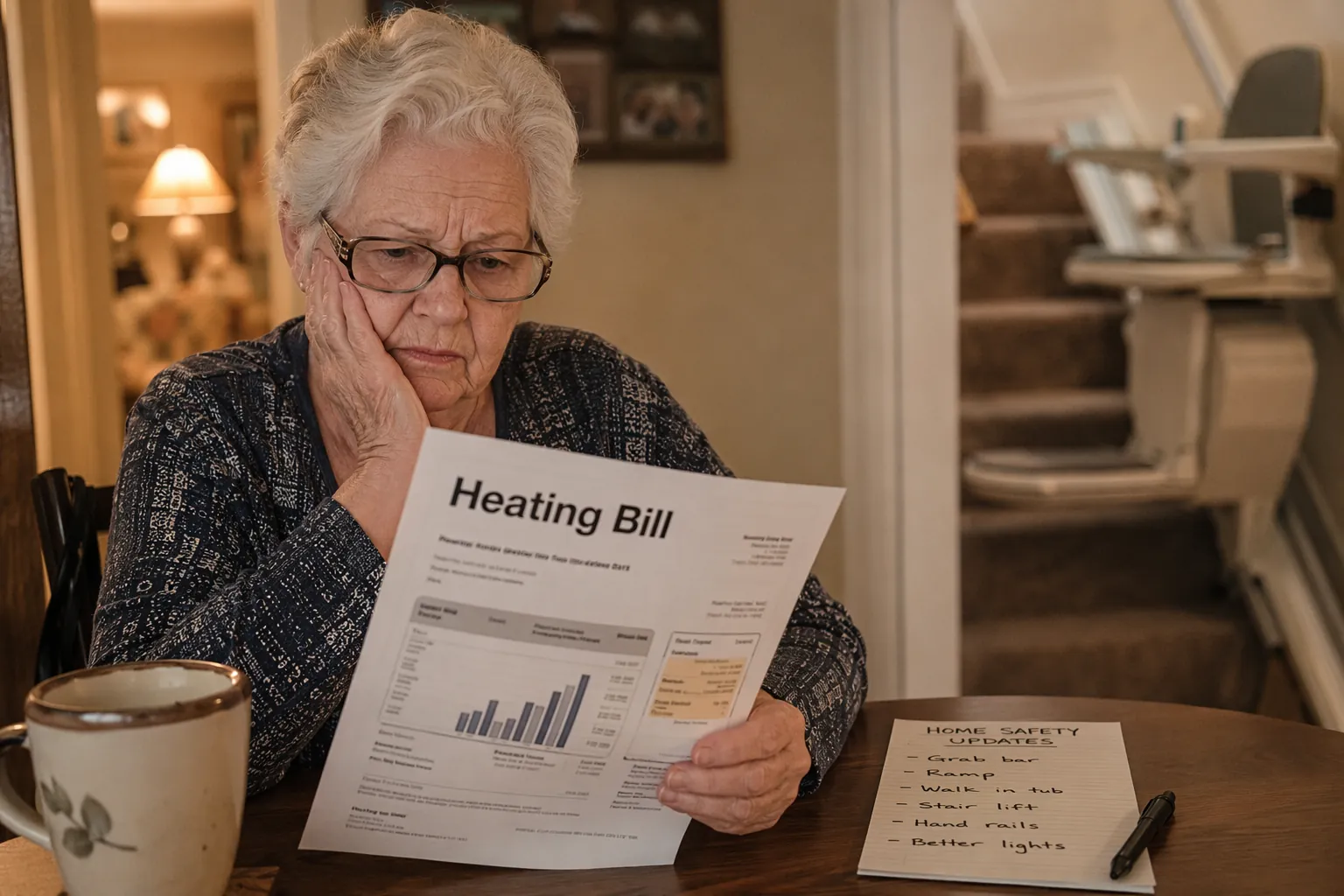
Retirees are vulnerable to this kind of pressure because much of their income is less flexible than their expenses. A Center for Retirement Research at Boston College analysis, published before the 2026 oil shock, found that retirees are disproportionately hurt by inflation because their income is less indexed to prices and they tend to hold less fixed-rate debt than working households.[4] Social Security’s 2026 cost-of-living adjustment was 2.8%, while CNBC reported that senior-specific inflation pressures were running higher in March 2026.[5]
None of that means every renovation should be rushed. It does mean the safety budget needs triage. A fall hospitalization averages $18,658, and that one figure should sit next to any decision to postpone a $150 grab bar, a $300 threshold fix, or even a $5,000 stair lift.[6]
Start With Fall Risk, Not the Remodeling Wish List
When money tightens, families often make the wrong first cut. They postpone every home project because the full list feels unaffordable. That treats a loose rug, a dark hallway, a slick tub, a front-step problem, and a full bathroom remodel as if they belong in the same decision pile. They do not.
The better question is: which missing modification leaves someone most likely to fall this month? A room-by-room home safety assessment helps separate annoyance from danger. The bathroom, stairs, entryway, bedroom path, and kitchen usually tell the truth quickly. If a person is already grabbing the towel bar to step out of the shower, the house has already issued its warning.
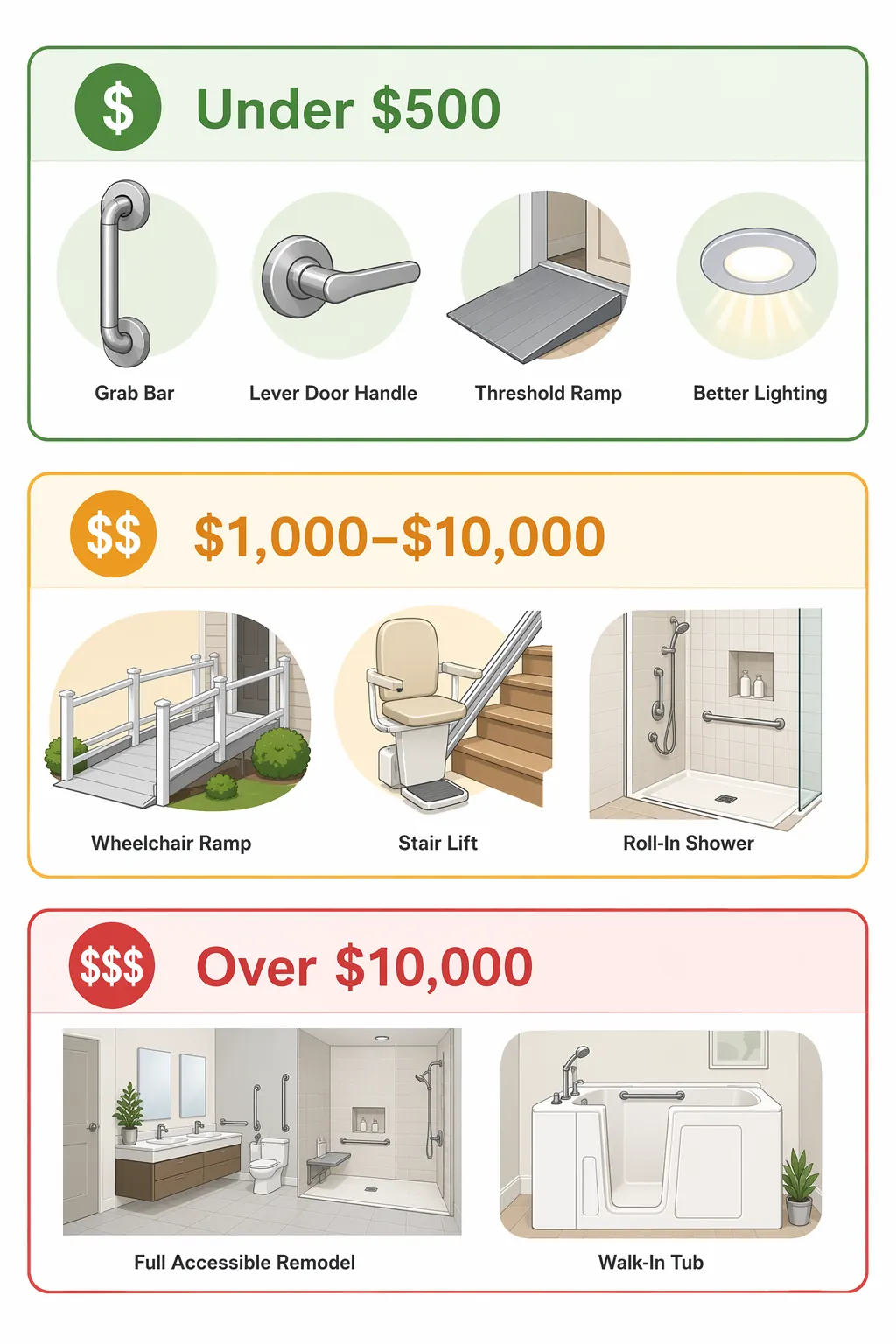
| Priority tier | Typical projects | How to judge it during an oil-price squeeze |
|---|---|---|
| Under $500 | Grab bars, lever handles, threshold ramps, lighting, non-slip surfaces in small areas | Do now when the hazard is active and the work reduces daily fall risk |
| $1,000-$10,000 | Wheelchair ramps, stair lifts, roll-in showers, larger flooring fixes | Plan quickly when the project solves a repeated transfer, stair, bathing, or entry problem |
| Over $10,000 | Walk-in tubs, full accessible remodels, larger structural changes | Check eligibility, bids, and professional assessment before committing |
Tier 1: Under $500 Is Where Waiting Usually Makes the Least Sense
The under-$500 tier is not glamorous, which is why it gets neglected. It is also where families can often act before a grant application, contractor backlog, or portfolio withdrawal decision is finished. MoneyGeek’s 2026 cost guide lists grab bars at $100 to $350 installed, lever handles at $100 to $250 per door, threshold ramps under $200, and non-slip flooring at $5 to $14 per square foot.[6]
Grab bars come first when someone has trouble stepping into a tub, rising from the toilet, or standing at the sink. A properly anchored bar is not the same as a suction-cup handle or a towel bar that happens to be nearby. If the family is handy and the wall structure is straightforward, a bathroom grab bar installation guide can help decide whether this is a safe DIY job or one for a handyman.
Lever handles matter when arthritis, neuropathy, stroke weakness, or tremor makes round knobs difficult. They rarely solve a dramatic problem by themselves, but they remove small daily struggles that lead to rushed, awkward movement. The same is true for brighter lighting on the path from bed to bathroom. A person who wakes up at night should not have to choose between turning on a harsh overhead light from across the room or walking in the dark.
Threshold ramps under $200 deserve special attention. A one-inch lip at a doorway can be enough to catch a walker, cane, or tired foot. If the person has already stumbled there, do not bury that fix behind a future porch renovation. Handle the trip point now, then decide later whether the entry needs larger work.
- Do now: grab bars where hands already reach for unsafe support.
- Do now: lighting for the bed-to-bathroom route and stair landings.
- Do now: threshold ramps where walkers, canes, or feet catch.
- Do soon: lever handles when grip weakness is changing daily routines.
- Price carefully: non-slip flooring when the area is large enough to push the job out of the under-$500 tier.
The useful standard is not whether a project looks small. It is whether it removes a known fall point. Washington University occupational-therapy-guided home modification evidence cited in the funding literature found an average cost around $766 per person, about a 38% fall-rate reduction, and roughly $2 in health care savings for each $1 spent.[6] That is the kind of modest, guided spending that should survive a tight month.
Tier 2: $1,000-$10,000 Projects Need a Faster Plan, Not Panic
The middle tier is where many families freeze. These jobs are too expensive to put on a casual weekend list, but not always large enough to qualify for the programs people assume they need. They include wheelchair ramps, stair lifts, roll-in showers, and broader surface changes. MoneyGeek lists wheelchair ramps at $1,121 to $3,596, stair lifts at $2,500 to $5,000, and roll-in showers at $2,900 to $6,600.[6]
A wheelchair ramp should move up the list when the person is avoiding medical appointments, skipping family events, or relying on two people to manage steps. The cost is not only lumber, aluminum, or labor. The cost is also the caregiver strain and the risk of one bad transfer at the front door.
A stair lift belongs in serious consideration when the bedroom, only full bathroom, laundry, or main exit requires stairs and the person is already crawling, pulling hard on the railing, or limiting fluids to avoid nighttime trips. A $2,500 to $5,000 stair lift is not cheap.[6] It is still far below the average fall hospitalization cost, and it may be the difference between using the whole home and living in two unsafe rooms.
Roll-in showers are trickier. They can solve a real bathing hazard, especially for wheelchair users or people who cannot step safely over a tub wall. But if the immediate danger is lack of hand support, start with grab bars and a bathing seat while the larger shower bid is being evaluated. A roll-in shower should not be delayed forever because oil prices are high, but it also should not crowd out three smaller fixes that reduce today’s risk.
Use the aging-in-place priority checklist to rank these middle-tier projects by consequence. The best candidate is the one attached to a repeated unsafe movement: transferring, bathing, entering the home, or using stairs. A project tied only to future convenience can wait behind one tied to a likely fall.
Tier 3: Over $10,000 Calls for Eligibility Checks Before Big Commitments
The over-$10,000 tier is where families need more homework, not more fear. MoneyGeek lists walk-in tubs at $6,000 to $13,100 and full accessible remodels at $15,000 to $60,000.[6] Some of these projects are appropriate. Some are oversold. Some are right for one diagnosis and wrong for another.
A full accessible remodel may make sense when the home’s layout blocks safe daily life: narrow bathroom entry, unusable shower, unsafe bedroom access, and no workable first-floor setup. It should involve measurements, mobility equipment, caregiver needs, and at least a couple of bids. If a contractor starts with finishes before asking how the person transfers, that is not the right first conversation.
Walk-in tubs need the same sober review. They can help some people bathe with less climbing, but they still require sitting, waiting while water fills and drains, and managing a wet transfer. For someone with poor balance, weakness, or cognitive changes, a roll-in shower or seated shower setup may be safer. The price tag alone should not decide it; the person’s actual movement pattern should.
This is also the tier where funding checks should happen before the family rules the work out. A large project may be unrealistic out of pocket but possible through veteran benefits, rural repair assistance, Medicaid waiver services, a renovation loan, or a tax strategy. The reverse is also true: possible funding does not make every large remodel necessary.
Funding Routes Families Often Miss
Funding is not a single door. It is a set of imperfect doors, each with eligibility rules, timing problems, and paperwork. The mistake is assuming none apply before checking. The second mistake is counting on one program as guaranteed money.
Veteran Disability-Related Grants
For eligible veterans with qualifying service-connected disabilities, the VA Specially Adapted Housing grant can be one of the largest home-modification resources. The FY2026 maximum is $126,526, up from $90,364 in FY2020.[6] That number is large enough to make people assume it applies broadly. It does not. The grant is tied to specific disability and service-connection requirements.
Still, a veteran family should not dismiss a ramp, widened doorway, bathroom change, or access project without checking VA eligibility. If the answer is no, move on. If the answer is maybe, the application path is worth starting before the family drains savings.
USDA Section 504 for Rural Homeowners
USDA Section 504 is easy to overlook because many families do not think of home safety as a rural housing issue. In FY2026 materials, the program includes loans up to $40,000 and grants up to $10,000 for eligible very-low-income rural homeowners, with grant availability generally tied to age and inability to repay a loan.[6] Local eligibility, income limits, and property location matter.
This route is especially worth checking for ramps, bathroom safety work, flooring hazards, heating-related repairs, and structural issues that keep a senior from living safely at home. It may not move quickly enough for an immediate fall hazard, so pair the application with under-$500 fixes instead of waiting with the house unchanged.
Medicaid HCBS Waivers
Medicaid Home and Community-Based Services waivers may cover certain modifications when they help a person remain at home rather than in an institution. The hard part is that waiver names, covered items, caps, and waitlists vary by state. Available summaries flag more than 607,000 people on HCBS waiver waitlists and an average wait around 32 months, but those figures hide major state differences.[6]
That means two things at once. Families should check the waiver route early, especially for a mid-cost or large project. They should not leave an active hazard in place while waiting for a state process to unfold. A temporary ramp, grab bars, lighting, or safer bathing equipment may be the bridge between application and approval.
FHA 203(k), Reverse Mortgages, and Home Equity
The FHA 203(k) renovation loan can finance eligible home improvements, with a limited 203(k) option up to $75,000 in 2026 materials.[6] It may fit a homeowner who is refinancing or buying and needs accessibility work folded into the mortgage structure. It is less useful for a senior who needs a grab bar this week and does not want new loan complexity.
A Home Equity Conversion Mortgage, or reverse mortgage, may be available to older homeowners with sufficient equity; the 2026 HECM limit is listed at $1,249,125.[6] That ceiling is not a recommendation to borrow. It is a program limit. Fees, spouse protections, taxes, insurance, heirs, and long-term residence plans all need review before using home equity for modifications.
ABLE Accounts and Tax Deductions
ABLE accounts can help eligible people with disabilities pay qualified disability expenses without the same treatment as ordinary savings for certain benefits. In January 2026, eligibility expanded to people whose disability onset occurred before age 46, and annual contributions are listed up to $20,000 in 2026 materials.[6] This does not help every older adult, especially when disability onset happened later in life, but it is worth checking for adult children, younger disabled retirees, and households already navigating benefit limits.
Tax treatment is another narrow but useful lane. Some medically necessary home modifications may qualify as medical expenses when deductions exceed 7.5% of adjusted gross income.[6] This is not the same as a rebate at the cash register. It helps only if the household itemizes and has enough qualifying expenses. Keep invoices, prescriptions or medical necessity notes when appropriate, and ask a tax professional before assuming a deduction.
LIHEAP Can Protect the Safety Budget
LIHEAP is not a grab bar program. That is exactly why it belongs in this discussion. If heating assistance covers part of a winter bill, the family may be able to preserve cash for the bathroom, entry, or stair work that prevents a fall. LIHEAP availability, eligibility, benefit amounts, and application windows vary by state and funding cycle.[6]
Do not ask an older homeowner to choose between warmth and fall prevention before checking both tracks. Heating help and modification funding can run in parallel. A family can call the local LIHEAP office, check Area Agency on Aging referrals, and price the most urgent safety fix in the same week.
For families comparing programs side by side, a home modification funding triage guide can help sort which options fit the project size, location, veteran status, disability status, and urgency.
When Higher Bids Are Real, Still Separate Delay From Discipline
Some families are not imagining it: home work can feel more expensive in 2026. Remodeling-sector reporting in May 2026 described signs of demand softening as costs rose, which is consistent with households backing away from projects under pressure.[7] Vanguard also noted in March 2026 that high oil prices can affect economies through energy costs and broader inflation channels, though the exact effect depends on how long the shock lasts and how households, businesses, and policy makers respond.[8]
That supports caution on large projects. It does not support ignoring a known fall hazard. Get more than one bid for a ramp, stair lift, shower conversion, or remodel. Ask whether a smaller interim fix can reduce risk while funding is pending. Do not let the perfect version of the home block the safer version of the home.
If a parent has already fallen, the budget conversation changes. Use a post-fall aging-in-place checklist and focus on what failed: lighting, footwear, transfer setup, medication timing, stairs, bathroom entry, or lack of assistive equipment. A post-fall home review should produce work orders, not just worries.
The Heat-vs-Safety Decision Tree
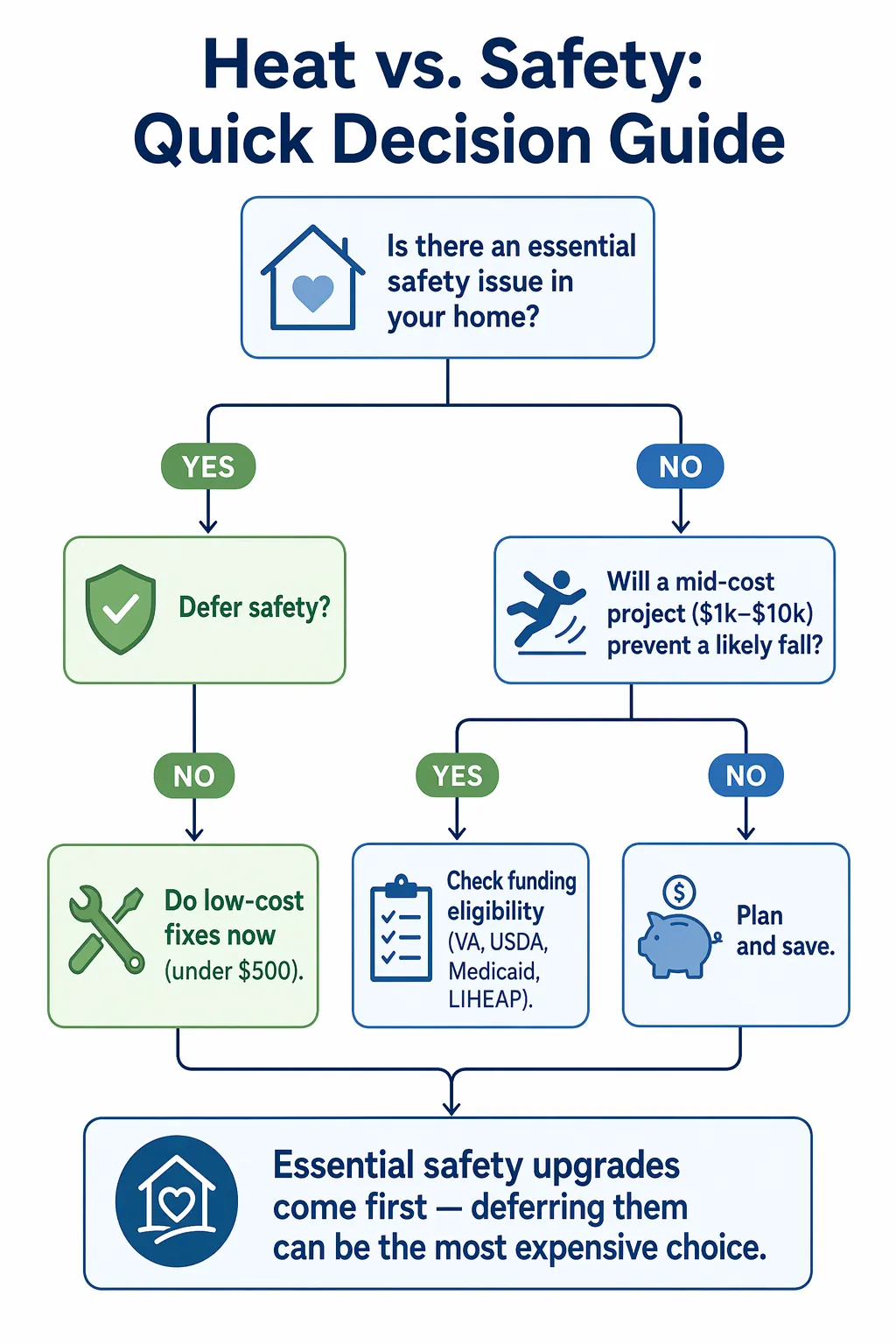
When the heating bill is crowding out the safety budget, use a short decision tree instead of a long family argument.
- Is there an active fall hazard in a daily route, bathroom, stairway, or entry? If yes, fix the lowest-cost version now.
- Can the hazard be reduced for under $500? If yes, do not wait for oil prices, markets, or a grant cycle to settle.
- Does the needed fix fall between $1,000 and $10,000? Get bids, ask whether a temporary safety measure is possible, and check Medicaid waiver, VA, USDA, local nonprofit, and loan options.
- Is the project over $10,000? Confirm that the proposed work matches the person’s mobility and care needs before committing, then check eligibility before ruling it out.
- Is heat competing with safety? Apply for LIHEAP or local heating assistance while also pricing the urgent modification.
- Is everyone waiting because the whole plan feels unaffordable? Break the plan into this week, this quarter, and funding-dependent work.
This week’s work is usually plain: install the grab bar, improve the lighting, remove the threshold problem, add the non-slip surface, or schedule the assessment. This quarter’s work may be the ramp, stair lift, or shower plan. Funding-dependent work may be the full remodel, doorway widening, or structural change.
Oil prices may ease, worsen, or move sideways from here. The unsafe bathroom will not become safer because the family waited for a cleaner forecast. Deferring essential safety upgrades can be the most expensive option, especially when a modest modification may prevent a much costlier fall.
References
- How Higher Oil Prices Are Rippling Through Household Budgets, Forbes, March 2026.
- Home heating bills are soaring as temperatures plunge, CNN, February 2026.
- Older Americans Feeling Financial Strain as Costs Rise, AARP, May 2026.
- How Does Inflation Impact Near Retirees and Retirees?, Center for Retirement Research at Boston College, June 2024.
- Social Security COLA: High oil prices may affect 2027 forecast, CNBC, March 2026.
- Home Accessibility Modifications: Costs and Funding 2026, MoneyGeek, May 2026.
- Home remodeling sector shows signs of flagging as costs rise, Marketplace/Harvard JCHS, May 2026.
- The potential impact of high oil prices on economies, Vanguard, March 2026.
Related reading
Need a professional assessment?
Find a CAPS-credentialed professional or local aging services through our outbound resource list — we never name or rank individual contractors.
Find Local HelpNoticed something outdated or inaccurate on this page? Flag a correction. We review every report against CDC, NIA, and AARP HomeFit guidance before updating a page.