
Room checklist
Senior Emergency Kit Checklist for Wildfire Evacuation
Use this senior wildfire evacuation checklist to pack the items generic kits miss — medications, eyeglasses, mobility aids, and medical paperwork — in a bag one person can lift, with a plan for older adults who cannot evacuate on their own.
- Room
- entryway
- Reviewed by
- Editorial Team
A senior emergency kit checklist for wildfire evacuation has to start before anyone smells smoke or receives an evacuation order. The ordinary household kit asks, “Do we have food, water, flashlights, and documents?” The senior version asks a harder question first: if this older adult leaves home today, what keeps them medically identifiable, mobile, able to hear and see instructions, and able to continue essential care?
That changes the packing order. Medications, prescription copies, eyeglasses, hearing aids, mobility backups, medical condition lists, allergy information, contact numbers, and device power needs are not extras. They are the items that prevent a safe evacuation from turning into a medical scramble in a parking lot, shelter, hotel room, or adult child’s guest room.
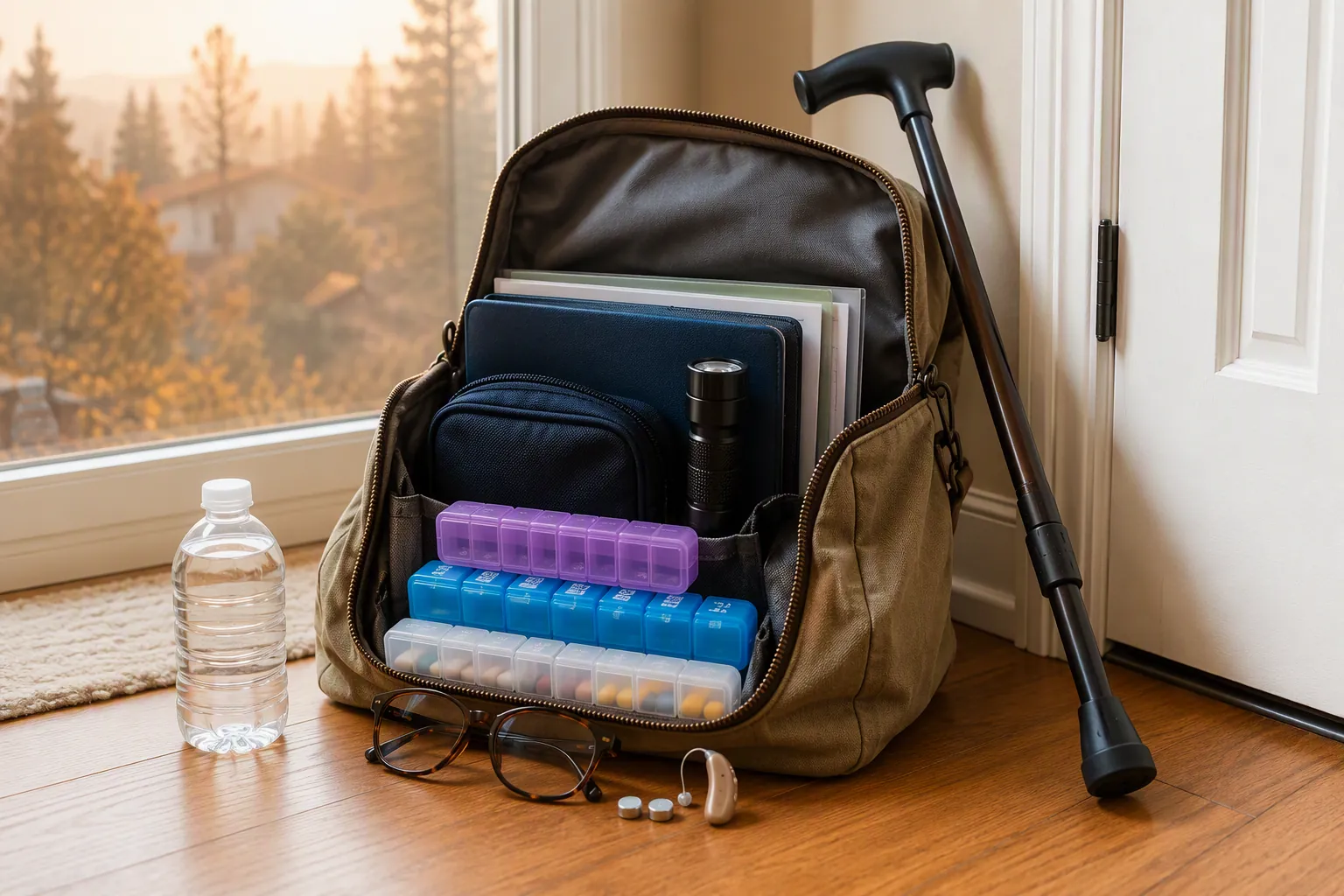
Senior emergency kit checklist for wildfire evacuation
Use this as a plan-ahead checklist, not a mid-evacuation sorting project. Pack the pieces now, label them clearly, and keep them where the person who will help evacuate can find them without opening every closet.
| Where it belongs | What to pack or stage | Why it matters for an older adult |
|---|---|---|
| Grab-and-go essentials bag | Current medication list, prescription copies, several days of essential medications when feasible, medical conditions, allergies, doctors, emergency contacts, insurance cards, ID copies, eyeglasses, hearing aids or batteries, phone charger, small flashlight, keys, cash, hygiene items, and copies of important documents. | This is the bag one person grabs while helping the older adult move. CAL FIRE includes prescriptions, extra eyeglasses, and copies of important documents in its go-bag guidance; Ready.gov warns that an emergency can close the only open pharmacy, and about half of Americans take a prescription daily. [1][2] |
| Medication and medical-item reserve | Follow the older adult’s clinician, pharmacist, insurance, and refill rules. The American Red Cross lists a 7-day supply of medications and medical items for an emergency kit; Sonoma County recommends a 3–7 day supply of life-saving medications plus prescription copies. [3][4] | Do not merge those source-specific ranges into one fake rule. The point is to plan refills and documentation before a wildfire threatens the area. |
| Wheeled food-and-water container | Non-perishable food for 3 days and 3 gallons of water per person, stored in a wheeled tub or similar container that remains light enough to lift into a vehicle. [1] | Food and water are heavy. CAL FIRE’s split between a backpack for essentials and a wheeled container for food and water is useful because it acknowledges the physical load. [1] |
| Beside or near the older adult | Walking aid, extra cane or walker if available, eyeglasses, hearing aids, shoes, medication, phone, charger, and a written medical/contact list. | If the older adult cannot cross the room safely without these items, they should not be buried in a storage bin. |
| Mobility and medical-device backup | Extra cane or walker, lightweight manual chair as a backup to a power wheelchair when appropriate, backup oxygen supply if used, extra hearing-aid batteries, and a cooler with chemical ice packs for refrigerated medicines. [5] | Power outages and evacuation delays can make electrically powered equipment unreliable. These backups need to be reachable, not merely owned. |
| Support plan | Named helpers, extra key access, transportation plan, equipment instructions, local registry or assistance options where available, and a check-in procedure if alerts are issued. | For someone who cannot self-evacuate, the kit is only one part of the system. |
Pack the essentials bag around medical continuity
The essentials bag should be the part a caregiver can lift with one hand while steadying a parent with the other. It does not need to contain every useful object in the house. It needs to contain the items that are hard to reconstruct after the door is locked behind you.
Start with a medication and health folder. Include a current medication list, dosing schedule, prescribing clinician names, pharmacy name and phone number, known allergies, major diagnoses, implanted device information if relevant, insurance cards, photo ID copy, emergency contacts, and copies of prescriptions. California Department of Aging disaster tip sheets recommend keeping written medication, condition, allergy, and contact information ready with eyeglasses, medication, and walking aids. [6]
The medication supply itself needs more care than a checklist can provide. The Red Cross lists a 7-day supply of medications and medical items in its survival kit supplies; Sonoma County’s personal go-bag guidance recommends a 3–7 day supply of life-saving medications plus prescription copies. [3][4] If the older adult uses controlled medications, refrigerated medications, oxygen, insulin supplies, inhalers, eye drops, wound-care items, or dialysis-related supplies, ask the pharmacist or prescribing clinician what can legally and safely be kept in reserve.
Temperature-sensitive medication should not be handled by internet guesswork. Ready.gov’s disability guidance includes a cooler with chemical ice packs for refrigerated medicines. [5] Beyond that, verify storage requirements on the medication label and with a pharmacist or clinician, because different medications have different limits. This checklist is for emergency planning, not medical advice.
Then pack the sensory items that make instructions usable: extra eyeglasses, a glasses case, hearing aids if they are not worn continuously, spare hearing-aid batteries, contact lenses and solution if used, and a large-print copy of essential phone numbers. The Red Cross lists hearing aids with extra batteries, glasses, and contact lenses as family-specific additions to an emergency kit. [3]
- Medication list and copies of prescriptions.
- Several days of critical medications when refill rules and clinical guidance allow.
- Allergy list, diagnosis list, clinician contacts, pharmacy contact, and emergency contacts.
- Photo ID copy, insurance cards, Medicare or Medicaid information if applicable, and relevant legal or caregiving documents.
- Eyeglasses, hearing-aid batteries, contact lens supplies, denture supplies, and other personal assistive items.
- Phone charger, backup battery if available, small flashlight, whistle, keys, cash, masks, hygiene supplies, and a change of clothing.
A simple folder is often better than a perfect binder no one can lift. Label it “Medical and Evacuation Documents.” Put the most important page first: name, date of birth, medications, allergies, conditions, primary contacts, pharmacy, doctors, and equipment needs. If the older adult has memory changes, communication difficulties, or complex medical needs, make the first page understandable to a shelter worker, neighbor, or paramedic who has never met them.
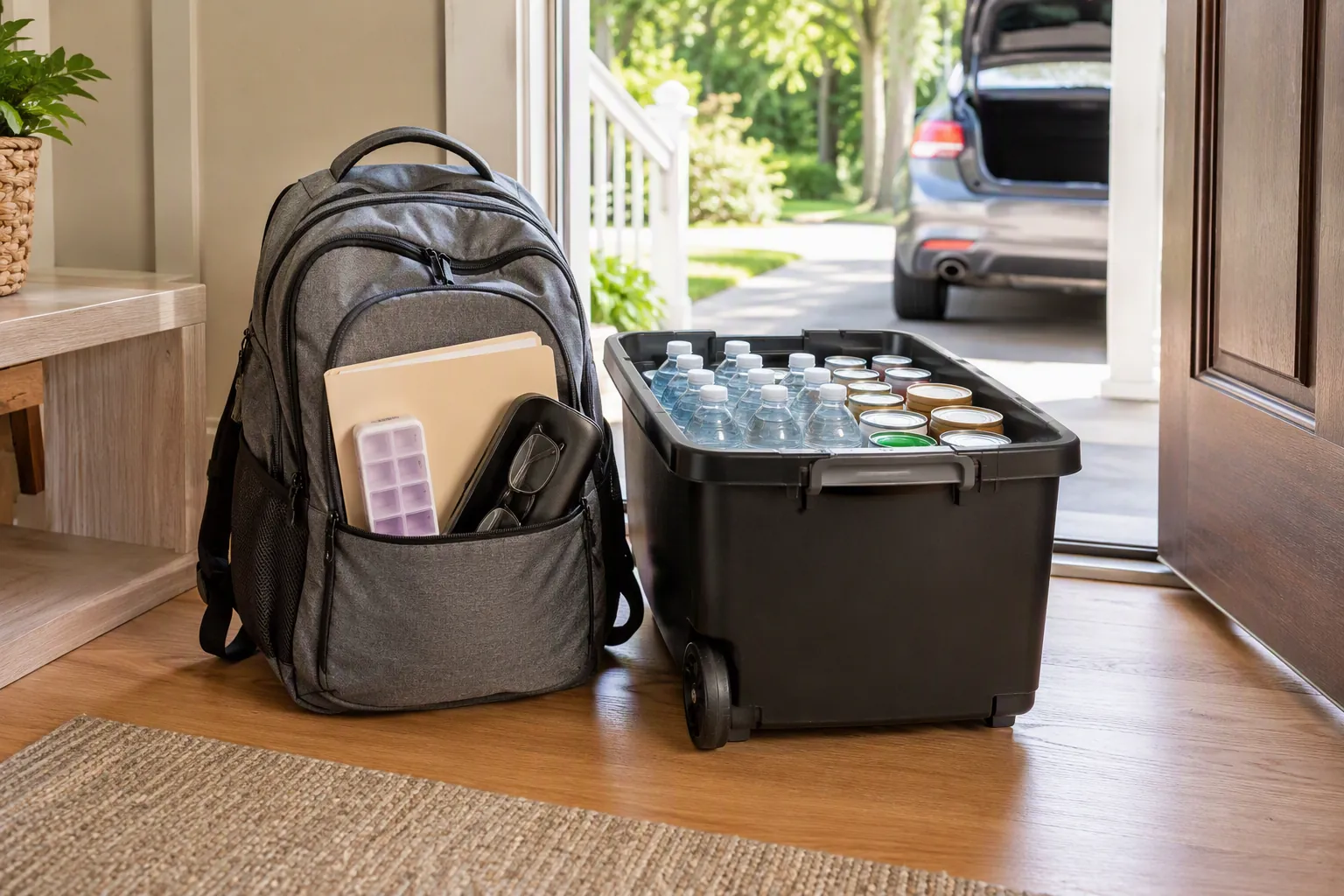
Use a wheeled tub for food and water, not a fantasy backpack
Food and water belong in the plan, but they should not crowd out the medical items in the bag that must stay immediately portable. CAL FIRE recommends non-perishable food for 3 days and 3 gallons of water per person, and it specifically suggests a backpack for essentials plus a plastic tub or trash can on wheels for food and water. The same guidance says the container should be light enough to lift into a vehicle. [1]
That last instruction is not a minor detail. A tub that can roll across a garage may still be impossible for one adult child to lift into a car while also helping a parent transfer from a walker, wheelchair, or porch step. If the container is too heavy, split it into two smaller wheeled containers or reduce the nonessential bulk. The test is not whether the kit looks complete on a shelf; it is whether the likely helper can move it under stress.
- 3-day supply of non-perishable food per person, using items the older adult can actually chew, swallow, and tolerate.
- 3 gallons of water per person, following CAL FIRE’s emergency supply guidance. [1]
- Manual can opener if canned food is included.
- Disposable utensils, wipes, and any diet-specific supplies.
- Pet food and pet medications if an animal is part of the evacuation plan.
- A visible date label so food, water, and perishables can be rotated. Sonoma County advises replacing perishables yearly. [4]
For older adults with swallowing problems, diabetes, kidney disease, heart failure, food allergies, or special diets, the food container should reflect real meals, not generic calorie math. This is another place to ask a clinician or dietitian what is appropriate instead of copying a standard camping list.
Stage the items the older adult depends on every day
Some things should be in the go-bag. Others should be ready beside the bed, chair, or usual exit path because the older adult may need them before reaching the bag. CAL FIRE’s Go! Evacuation Guide notes that power outages, including Public Safety Power Shutoffs, are common and advises learning how to manually open garage doors and gates, keeping at least half a tank of gas, and placing shoes near the bed. [7]
Shoes near the bed matter because evacuation rarely waits for ideal footing. So do a cane, walker, glasses, hearing aids, phone, charger, and medication. If smoke, darkness, or a power outage changes the room, the older adult should not have to cross the house barefoot to find the device that makes walking possible.
- Place sturdy shoes and a flashlight near the bed.
- Keep the usual cane or walker in the same reachable location each night.
- Store spare eyeglasses in the go-bag, not only on the nightstand.
- Keep hearing aids, batteries, and charging equipment in a predictable place.
- If a power wheelchair or scooter is used, identify the manual backup before fire season.
- If oxygen is used, ask the supplier and clinician what backup oxygen and evacuation steps are appropriate.
Ready.gov’s guidance for people with disabilities specifically calls out an extra cane or walker, a lightweight manual chair as a backup to a power wheelchair, backup oxygen supply, extra hearing-aid batteries, and a cooler with chemical ice packs for refrigerated medicines. [5] Those items are not always convenient to pack in the main bag, but they should be assigned a location and included in the load plan.
This is where home setup and fall prevention overlap. A wildfire evacuation route through a hallway full of cords, loose rugs, narrow furniture gaps, or stored boxes can fail before the car ever starts. If you are preparing the home more broadly, pair this kit with a room-by-room review of tripping hazards and exit paths; the same logic appears in CareWise Guide’s earthquake preparedness checklist for seniors, where the hazard is different but the evacuation bottlenecks are familiar.
If the older adult cannot evacuate alone, the kit needs people attached to it
For an older adult who cannot drive, cannot transfer without help, cannot hear alerts reliably, has dementia, uses oxygen, depends on a power wheelchair, or lives alone with limited mobility, a packed bag is not an evacuation plan. It is one object inside a plan that has to name real people.
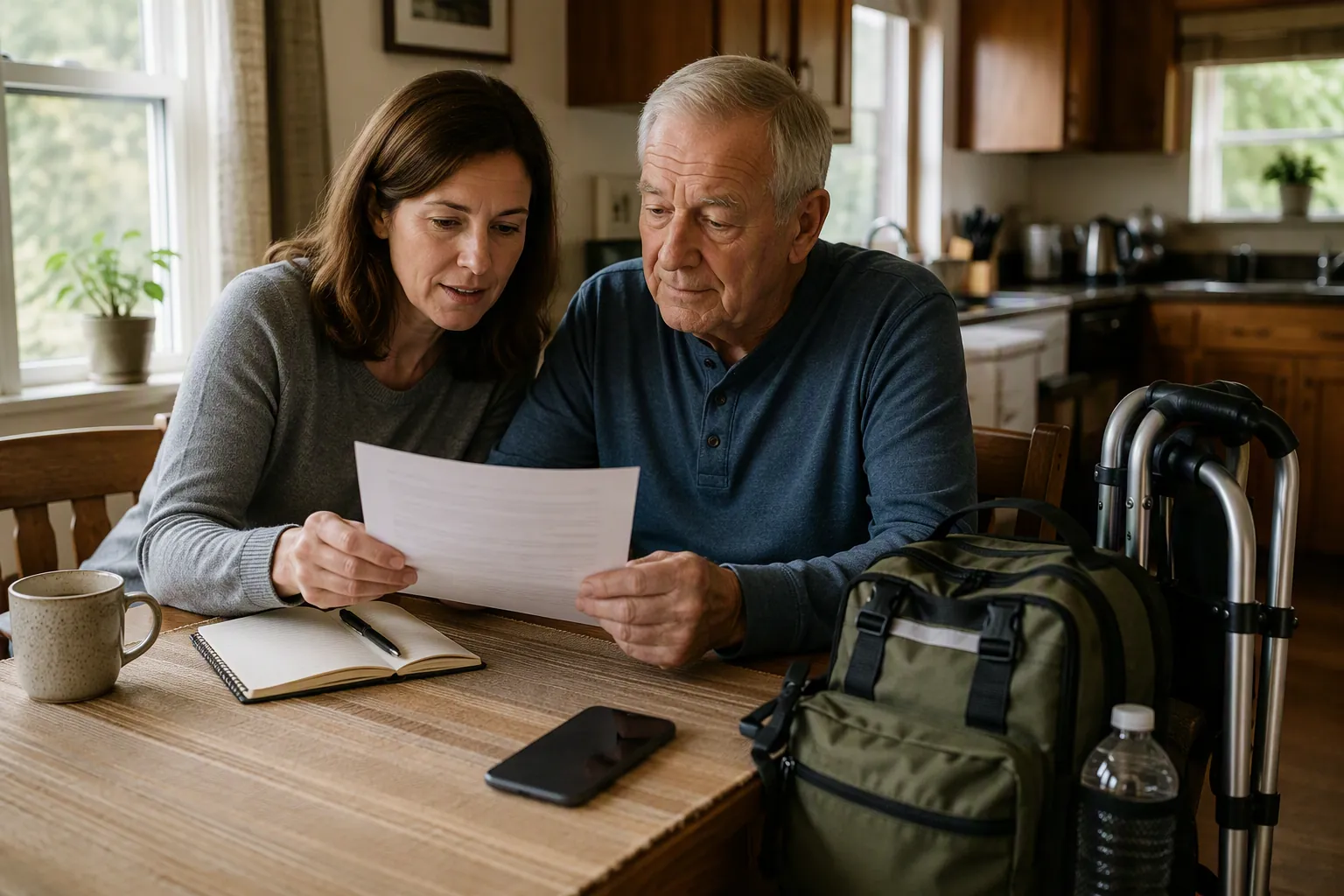
The Red Cross advises older adults to build a support network and make sure someone in that network has an extra key and knows how to use any medical or mobility equipment. [8] That is the standard to use here. “Call me if you need anything” is too vague. The plan should say who checks in, who drives, who can enter the home, who knows the walker or wheelchair setup, who can lift the tub, and who is the backup if the first person is out of town.
The risk is not theoretical. A 2023 scoping review in the International Journal of Environmental Research and Public Health found that older adults who lacked social support were more likely to die during a wildfire because they received inadequate warning or could not self-evacuate. The same review notes that adults 60 and older accounted for 71% of Hurricane Katrina deaths while representing 15% of New Orleans’ population. [9]
Age thresholds differ across sources, and wildfire risk is not created by age alone. The practical issue is functional: can the person receive the warning, understand it, gather essentials, leave the building, enter transportation, and continue essential medical care without help? If any answer is no, the support plan needs to be written down and rehearsed.
| Question | What to write into the plan |
|---|---|
| Who receives alerts? | List the older adult, adult children, neighbors, building manager, or other helpers who should receive local emergency alerts. |
| Who has entry access? | Name at least one nearby person with an extra key, gate code, lockbox code, or building access. |
| Who can transport the older adult? | Name the primary driver and backup driver. Include vehicle type if wheelchair, walker, oxygen, or transfer needs affect transportation. |
| Who knows the equipment? | Write down how to fold the walker, move the wheelchair, handle oxygen equipment, bring chargers, or load the manual chair. |
| Where is the kit? | Use one location for the essentials bag and one for the wheeled food-and-water container. Tell the support network. |
| What if phones fail? | Set a default action, such as the nearby keyholder checking in when a local evacuation warning or order affects the area. |
| What local help exists? | Check whether the county, city, utility, or emergency management office offers voluntary registries or assistance programs for people who may need targeted help. |
Ready.gov notes that some communities offer voluntary registries for people with disabilities so emergency responders can provide targeted assistance. [5] Registration is not a substitute for a personal evacuation plan, and availability varies by location, but it is worth checking before wildfire season. Some utilities and local agencies also have programs related to power-dependent medical equipment; those should be verified locally.
For adult-child caregivers who live at a distance, the support plan should borrow from check-in routines used for other hazards. CareWise Guide’s heat wave safety checklist for elderly parents includes the same kind of practical question: who actually calls, when, and what happens if no one answers? During wildfire season, that check-in script should include alert status, air quality or smoke conditions, transportation, medication supply, and whether the go-bag is still in its assigned place.
Do not wait for the wrong alert phrase
Evacuation wording is not identical everywhere. Some places use evacuation warnings and orders; others use different level systems or local alert language. The safe rule is to learn the alert terms used by the older adult’s county, city, tribe, or state emergency management office before wildfire season and follow those local instructions when they arrive.
There is no universal minute-by-minute evacuation window that applies to every wildfire, road, driveway, mobility level, and weather condition. A person who needs help transferring, gathering oxygen, loading a manual chair, or opening a garage door during a power outage needs earlier action than someone who can walk out independently with keys and a backpack.
That is also why shelter-in-place information should not be confused with an evacuation kit. If the local instruction is to leave, the plan is to leave. If smoke and heat are the immediate concern and local officials have not ordered evacuation, CareWise Guide’s wildfire safety for older adults during a heat dome covers the sheltering counterpart. The decision itself belongs to local emergency instructions and the older adult’s care team when medical needs complicate movement.
Prepare the exit, not just the bag
The bag can be packed perfectly and still fail at the garage. CAL FIRE advises learning manual garage-door and gate operation, keeping at least half a tank of gas, and planning a map with at least two evacuation routes. [7][1] For older adults, each of those items needs a caregiver version.
- Open the garage door manually once, before an outage, and make sure the likely helper can do it.
- If there is an electric gate, learn the manual release or backup access procedure.
- Keep the vehicle at least half full of gas, following CAL FIRE’s evacuation guide. [7]
- Store printed maps with at least two evacuation routes, because phones may lose power or service.
- Check whether the walker, wheelchair, oxygen equipment, and wheeled tub fit in the actual vehicle.
- Keep keys, wallet, phone, charger, and medical folder in predictable locations, not scattered across the house.
Water planning also deserves a realistic look. CAL FIRE’s 3-gallon-per-person guidance is a starting point for the emergency supply container. [1] If the older adult has medical conditions affected by hydration limits or fluid needs, ask the clinician what to do. CareWise Guide’s water crisis and senior fall risk article is useful for thinking through how water disruption affects mobility, toileting, and dehydration risk at home.
Test the kit before wildfire season
A senior wildfire kit should be tested in the home where it will be used. Choose a calm day. Ask the likely helper to move the essentials bag, the wheeled food-and-water container, the walker or manual chair backup, and any oxygen or medical-device supplies to the vehicle. Do not rush. Watch what becomes awkward.
- Can one person lift the essentials bag while assisting the older adult?
- Can the wheeled tub be lifted into the vehicle, or does it need to be split into smaller containers?
- Are spare eyeglasses, hearing-aid batteries, medication information, and prescription copies actually inside the bag?
- Is the walker, cane, or lightweight manual chair backup reachable without moving stored boxes?
- Does someone with an extra key know where the bag is and how to use essential equipment?
- Can the garage door or gate be opened manually during a power outage?
- Is the vehicle kept at least half full of gas?
- Have local alert systems, evacuation terminology, and registry or assistance options been checked?
The right senior wildfire evacuation kit is not a larger generic kit. It is a medically organized, physically movable evacuation system tied to people who can enter the home, use the equipment, load the supplies, and help the older adult leave.
References
- Create Your Go Bag, Ready for Wildfire / CAL FIRE.
- Build A Kit, Ready.gov.
- Survival Kit Supplies, American Red Cross.
- Personal Go-Bags, SoCoEmergency.org.
- People with Disabilities, Ready.gov.
- Disaster Tip Sheets, California Department of Aging.
- Go! Evacuation Guide, Ready for Wildfire / CAL FIRE.
- Older Adults, American Red Cross.
- Wildfire Evacuations and Older Adults: A Scoping Review, International Journal of Environmental Research and Public Health, 2023.
Related reading
Need a professional assessment?
Find a CAPS-credentialed professional or local aging services through our outbound resource list — we never name or rank individual contractors.
Find Local HelpNoticed something outdated or inaccurate on this page? Flag a correction. We review every report against CDC, NIA, and AARP HomeFit guidance before updating a page.