
Room checklist
How to Build a Wildfire Evacuation Checklist for Seniors
Generic wildfire checklists assume an able-bodied adult, so this one is built around a senior's daily needs: medications, medical equipment, mobility aids, documents, and home and vehicle prep. Every supply quantity is attributed to a named authority — American Red Cross, Ready.gov, CAL FIRE, or USFA — so caregivers know how much is actually recommended, not guessed.
- Room
- whole-home
- Reviewed by
- Editorial Team
A useful wildfire evacuation planning checklist for seniors starts in a less dramatic place than flames on a ridge. It starts with the question that decides the first night: can the older adult leave with the medications, charger, walker, glasses, hearing aids, dentures, oxygen supplies, insurance cards, and shoes they actually use?
That gap is not theoretical. AARP reported in 2023 that 60% of adults age 50 and older felt prepared for a natural disaster, while about 1 in 3 had no extra prescription medicine and almost half lacked an emergency phone charger. [1] That is the kind of mismatch a generic checklist can hide: “medications” gets checked off, but the pill organizer is still on the kitchen counter and the refill is still at the pharmacy.
Older adults also carry disproportionate fire risk. The U.S. Fire Administration reported that adults 65 and older had 2.5 times the fire-death risk of the general population in 2023; that figure covers fires generally, not wildfires specifically, but it is enough reason to treat evacuation planning as a daily-needs problem rather than a generic supplies problem. [2]
This guide is for planning and organization, not medical, legal, or financial advice. Medication changes, oxygen use, prescription storage, and insurance questions should be checked with the appropriate clinician, pharmacist, equipment provider, insurer, or benefits office.
Build the checklist around what the senior uses every day
A senior’s go-bag should not be a camping bag with a prescription bottle added at the end. Start with one ordinary day and trace what would be hard to replace during an evacuation: morning medication, glasses, hearing aids, walking device, continence supplies, phone, charger, dentures, medical equipment, insurance card, and the list of people who know how to help.
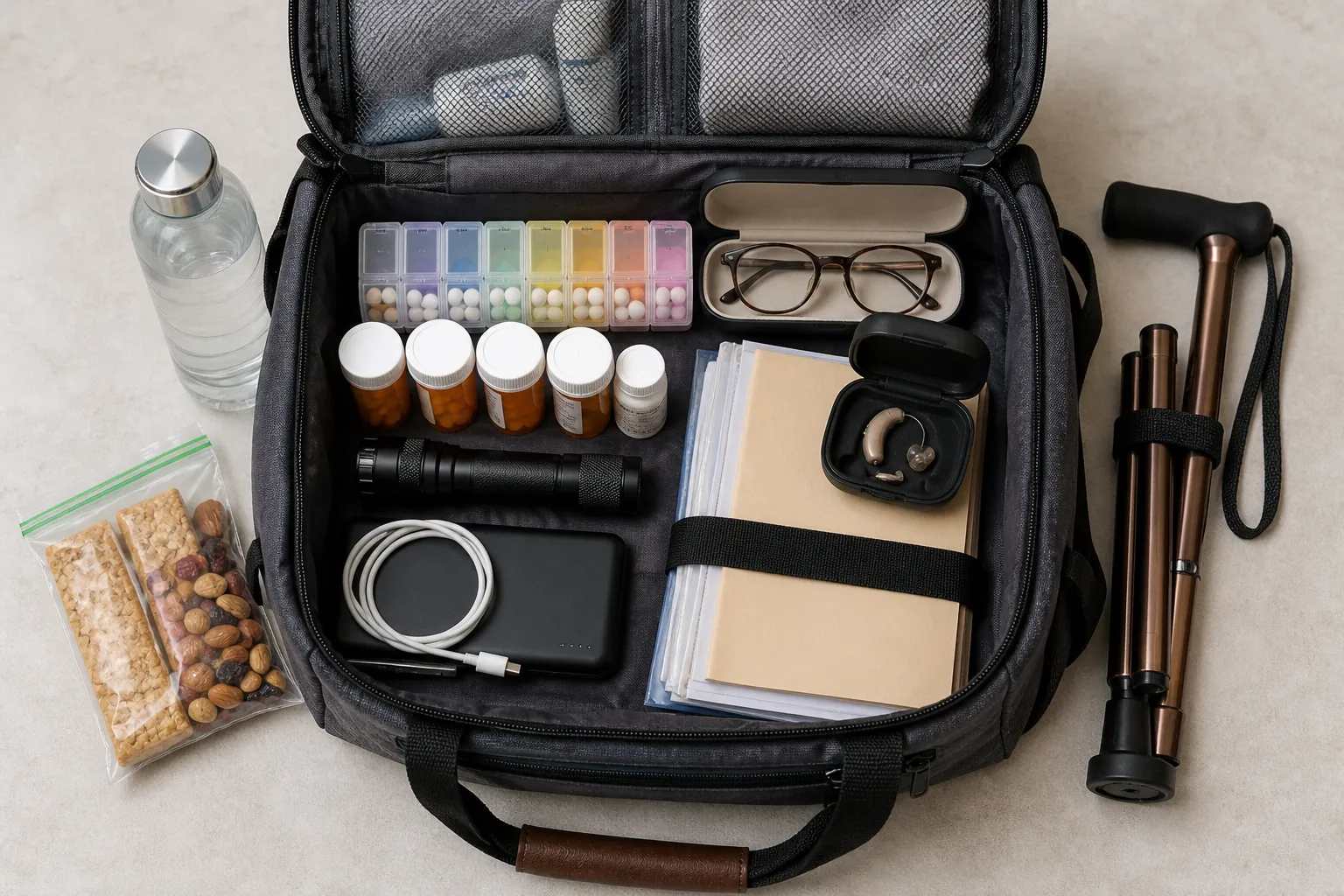
| Daily need | What belongs in the evacuation plan | Quantity guidance to label clearly |
|---|---|---|
| Prescription medications | Evacuation supply, medication list, prescriber and pharmacy contacts, dosing instructions, allergies, and refill plan | Red Cross older-adults guidance: at least 30 days of medications at home; Red Cross survival-kit guidance: 7-day medication supply in the evacuation kit; California Department of Aging: 10-day medication guidance. [3][4][5] |
| Water | Water stored where it can be lifted, reached, and loaded quickly | Red Cross: 1 gallon per person per day and a 3-day food/water supply for evacuation; CAL FIRE: 3 gallons of water per person in the go-bag checklist. [4][6] |
| Food | Nonperishable food that matches chewing, swallowing, diabetes, sodium, or other diet needs | Red Cross: 3-day food/water supply for evacuation; CAL FIRE: 3-day nonperishable food supply. [4][6] |
| Medical equipment | Oxygen, CPAP/BiPAP, nebulizer, glucose supplies, wound-care items, batteries, tubing, masks, adapters, and written setup instructions | Ready.gov says support-network members should know how to use medical equipment and know where emergency supplies are kept. [7] |
| Mobility aids | Cane, walker, wheelchair, rollator, transfer belt if used, spare tips, labeled device, and a plan for stairs or car transfer | Red Cross older-adults guidance includes extra assistive items such as a cane; USFA says walker or wheelchair users should make sure all exits are wide enough and clear. [3][8] |
| Vision, hearing, and dental needs | Extra eyeglasses, hearing aid batteries or charger, labeled hearing aid case, dentures, denture cup, adhesive, and cleaning supplies | Red Cross mentions extra eyeglasses; CAL FIRE includes extra eyeglasses and says to keep sturdy shoes and a flashlight beside the bed. [3][6] |
| Continence and hygiene | Incontinence briefs, wipes, barrier cream, disposal bags, gloves if used, hand sanitizer, and a change of clothing | No single quantity fits every person; pack based on actual daily use plus likely travel and shelter delays. |
| Documents | Copies of Medicare, Medicaid, insurance cards, ID, medication list, medical equipment contacts, advance directives if used, and emergency contacts | Ready.gov specifically recommends copies of Medicare, Medicaid, and insurance cards. [7] |
| Communication and power | Phone, charging cable, wall plug, power bank, hearing aid charger if used, written phone numbers, and backup alert method | AARP found almost half of adults 50+ lacked emergency phone chargers despite many feeling prepared. [1] |
| Support access | Extra house key, gate code, alarm code, supply locations, equipment instructions, and who is allowed to enter | Ready.gov says support-network members should have an extra house key, know where supplies are kept, and know how to use medical equipment. [7] |
Medication quantities are not one universal number
Medication planning is where a senior checklist needs the most honesty. “Pack medications” is not specific enough for a person who takes multiple prescriptions, uses refrigerated medicine, depends on a controlled substance, or cannot safely skip a dose.
The major guidance sources do not all use the same number. The American Red Cross older-adults page recommends keeping at least 30 days of medications at home. [3] Its survival-kit guidance lists a 7-day supply of medications for the evacuation kit. [4] California Department of Aging disaster tip sheets use 10-day medication guidance. [5] The practical way to use those numbers is to label them by purpose: a larger reserve at home if refills and insurance rules allow, and a smaller ready-to-grab supply in the go-bag that is rotated before it expires.
- Keep a printed medication list in the go-bag and in the document folder. Include prescription names, doses, timing, allergies, prescriber, pharmacy, and what each medication is for.
- Ask the pharmacist how early refills, emergency refills, controlled substances, refrigerated medicine, and blister packs should be handled before fire season.
- If the older adult uses a weekly pill organizer, do not rely on memory during an evacuation. Put a note on or near the go-bag that says whether the organizer must be grabbed from the counter, bedside table, or refrigerator area.
- If medication must stay cold, pack a small insulated bag, cold pack plan, and written temperature instructions from the pharmacist or medication label.
- If several family members help, assign one person to medication rotation. Otherwise the bag can quietly fill with expired pills while everyone assumes someone else checked it.
Water and food should be packed in amounts the senior can actually move
Water guidance also needs labels. The Red Cross survival-kit page recommends 1 gallon of water per person per day and a 3-day food and water supply for evacuation. [4] CAL FIRE’s go-bag checklist lists 3 gallons of water per person and 3 days of nonperishable food. [6] Those are compatible if the bag is designed around one person, but the carrying method matters.
For many older adults, one heavy container is the wrong answer. Smaller bottles stored in a rolling bin, a car-ready crate, or divided between the home exit and vehicle may work better. Food should match the person’s real diet: easy-open packaging, foods that do not require cooking, and items that are safe for their chewing, swallowing, glucose, sodium, or kidney restrictions if those apply.
Medical equipment needs a second person who can operate it
If a senior uses oxygen, CPAP, a nebulizer, a suction device, a glucose monitor, wound-care supplies, or mobility equipment, the evacuation plan should assume the regular routine will be interrupted. Ready.gov’s older-adult guidance is direct on this point: support-network members should know where emergency supplies are kept and know how to use medical equipment. [7]
- Tape or store simple setup instructions with the equipment, not in a separate folder that may not leave the house.
- Keep provider phone numbers and model information in the document folder.
- Pack spare tubing, masks, filters, batteries, charging cords, adapters, and cleaning supplies when the equipment requires them.
- If power is required, coordinate this checklist with a backup-power plan before wildfire season, not during a shutoff or evacuation warning.
For power-dependent equipment, use the 72-Hour Power Outage Safety Checklist for Seniors alongside this wildfire list. If the concern is nighttime lighting, tripping hazards, or getting from bed to the exit during an outage, add the room-by-room steps in How to Fall-Proof a Senior's Home Before a Power Outage.
Mobility aids, glasses, hearing aids, and dentures belong near the exit plan
A cane beside the recliner does not help if the evacuation starts at 2 a.m. CAL FIRE includes extra eyeglasses in the emergency supply kit and specifically advises keeping sturdy shoes and a flashlight beside the bed. [6] The Red Cross older-adults guidance also calls out extra assistive items such as a cane and eyeglasses. [3]
The bedside setup should be boring and consistent: shoes, flashlight, glasses, hearing aids or hearing aid case, phone, charger, and the mobility device the person actually uses at night. If dentures are removed overnight, add the denture case and adhesive to the morning grab list or keep spares with the evacuation supplies when that is realistic.
Doorways and exits need to be tested with the actual device, not just looked at. USFA advises people who use a walker or wheelchair to check that all exits are clear and wide enough to move through. [8] For the more detailed work of route testing, doorway clearance, mobility-device handling, and car-transfer rehearsal, use Wildfire Evacuation Plan for Seniors at Fall Risk. This article covers the full daily-needs checklist; that guide goes deeper on falls during the evacuation itself.
Plan for hearing loss and nighttime alerts
For a senior with hearing loss, a phone alert, door knock, or standard alarm may not be enough. USFA identifies alert devices such as bed shakers and strobes for people with hearing loss. [8] The evacuation checklist should name the alert method, where it is located, how it is powered, and who checks that it is working.
Documents and support access are part of the kit
A wildfire evacuation can turn into hours or days of phone calls: pharmacy, doctor, oxygen supplier, insurance, assisted living office, bank, benefits office, or a shelter intake desk. Ready.gov recommends copies of Medicare, Medicaid, and insurance cards for older adults. [7] Keep copies in a waterproof folder in the go-bag, and consider a second copy with the trusted person who may have to help from outside the home.
- Photo ID copy, if appropriate and safely stored
- Medicare, Medicaid, supplemental insurance, prescription plan, and other health insurance cards
- Medication list, allergies, diagnoses the senior wants responders to know, and clinician contacts
- Pharmacy name, phone number, and prescription delivery information if used
- Medical equipment supplier, oxygen supplier, and device model information
- Emergency contacts in priority order, including who has a key
- Copies of advance directive, health care proxy, power of attorney, or POLST/MOLST forms if the older adult uses them and wants them available
- A small amount of cash if safe for the household, because cards and ATMs may not work during outages
Ready.gov also recommends switching federal benefits to direct deposit. [7] That is not a go-bag item, but it matters if a disaster disrupts mail delivery or a temporary move lasts longer than expected.
Give the support network usable access, not just a phone number
A support network is only useful if someone can act while the senior is tired, frightened, unreachable, or already on the road. Ready.gov says support-network members should have an extra house key, know where emergency supplies are kept, and know how to use medical equipment. [7]
- Choose at least one nearby person and one out-of-area contact when possible.
- Write down who has a key, gate code, alarm code, garage code, or building access.
- Show the helper where the go-bag, medication reserve, documents, mobility aids, pet supplies, and medical equipment are kept.
- Agree on who calls, who drives, who checks the house, and who contacts siblings or other relatives.
- If the older adult lives alone, put the plan in writing where the senior and helper will both look for it.
For a broader support-network format, especially when the older adult lives alone, the Severe Weather Safety Checklist for Seniors Living Alone can be adapted to wildfire season.
Prepare the home so leaving takes fewer decisions
Home preparation is not a substitute for leaving when authorities order evacuation. Its value is in reducing the number of small decisions someone must make while smoke, alerts, neighbors, pets, and family calls are all competing for attention.
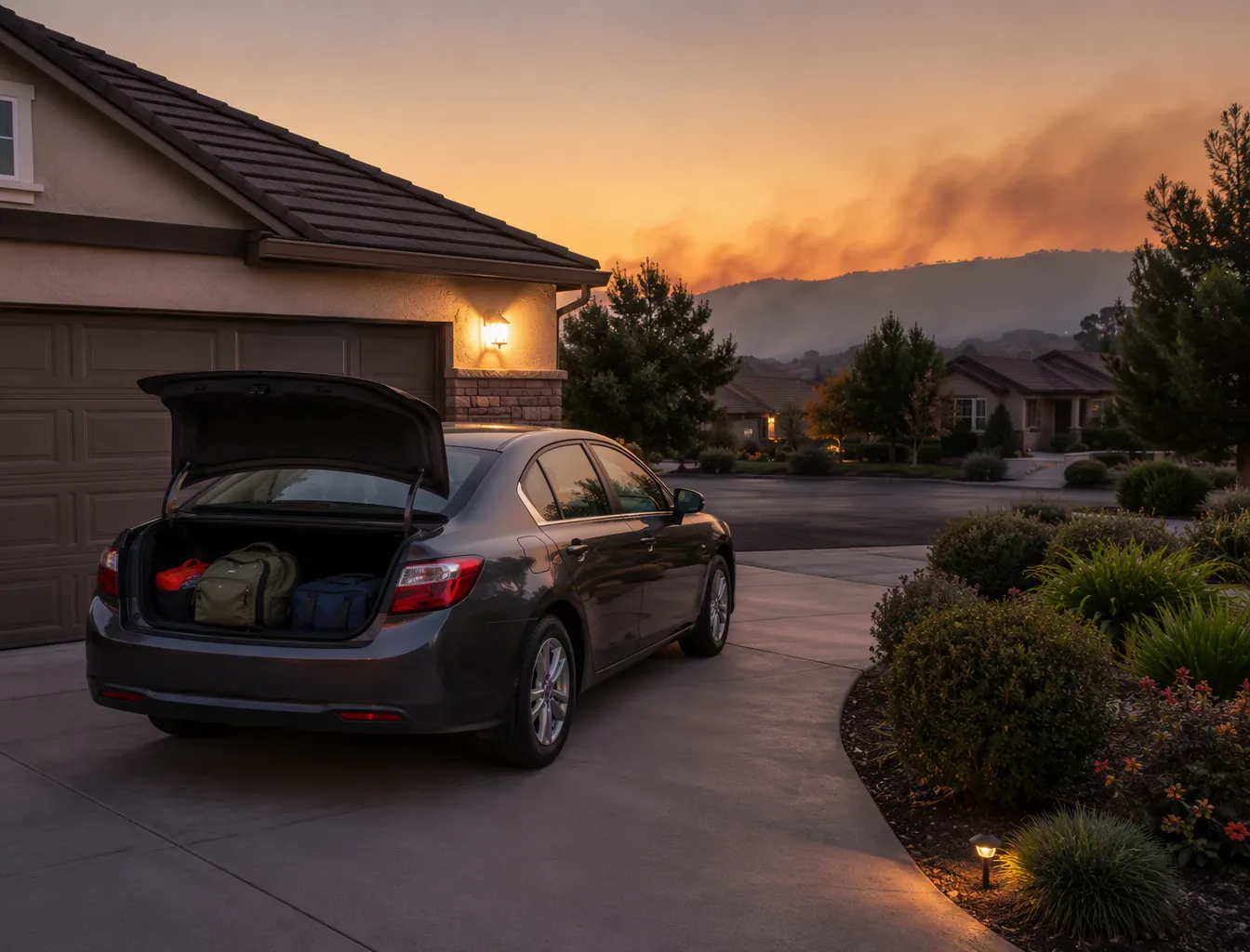
CAL FIRE’s pre-evacuation guidance includes steps such as taking down flammable window treatments, closing windows and doors while leaving them unlocked, leaving lights on, and parking the car facing out with the windows shut. [9] Those tasks should be written into the plan only if the senior can do them safely before leaving; otherwise assign them to a helper or skip them when time is short.
- Keep the go-bag on the exit path, not in a closet behind seasonal storage.
- Keep sturdy shoes, flashlight, glasses, phone, and mobility aid within reach of the bed.
- Place a printed evacuation checklist near the main exit and another copy in the car.
- Label the document folder and medical equipment instructions clearly enough that a neighbor or adult child can find them.
- Make sure exits are not blocked by boxes, rugs, furniture, pet gates, or stored walkers.
- If there is a garage door, gate, stair lift, or elevator dependency, write down the backup plan for a power outage.
Ready for Wildfire advises learning how to manually operate a garage door or gate and keeping the vehicle’s gas tank at least half full. [10] California Department of Aging disaster tip sheets also mention security lights that activate during outages and keeping extra glasses and walking aids near supplies. [5] Those details matter because many evacuations begin with low light, poor visibility, or a power interruption.
Vehicle planning: assume someone else may have to load the car
A senior’s evacuation plan should say who drives, what gets loaded, and where each item goes. If an adult child, neighbor, or home-care aide may be the person at the door, the plan has to be visible and simple enough for that person to execute without searching every room.
- Park facing out when evacuation is possible, following local instructions and CAL FIRE’s pre-evacuation guidance. [9]
- Keep the vehicle at least half full of fuel when fire conditions are elevated, as Ready for Wildfire recommends. [10]
- Store a car copy of the emergency contacts, medication list, and destination options.
- If the senior uses a walker, wheelchair, oxygen, or transfer aid, practice loading it before there is smoke, darkness, or urgency.
- If the older adult no longer drives, write down the primary driver, backup driver, ride service, paratransit option, or community evacuation resource before fire season.
- If pets are part of the household, add carriers, leashes, food, medications, and vet records to the load list.
Do not bury the walker behind the water crate. The first items needed at arrival—mobility device, medication, documents, phone, oxygen or CPAP supplies, continence supplies, glasses, and hearing aids—should be the easiest to reach.
A senior wildfire go-bag checklist
Use this as the working list, then cross out anything that does not apply and add the senior’s real daily items. The finished version should live in the bag, on the exit path, and with the person who may help.
Medications and health information
- Evacuation medication supply, labeled according to the source quantity being followed: Red Cross 7-day go-bag supply, California Department of Aging 10-day guidance, and Red Cross at least 30 days stored at home when possible. [3][4][5]
- Printed medication list with dose, timing, prescriber, pharmacy, allergies, and refill instructions
- Pill organizer grab note if the organizer is not stored inside the bag
- Refrigerated medication plan, if needed
- Glucose meter, test strips, lancets, snacks, sharps container, and diabetes instructions if used
- Wound-care, catheter, ostomy, or injection supplies if used
Medical equipment and power
- Oxygen supplies, CPAP/BiPAP, nebulizer, suction device, or other equipment the senior uses
- Batteries, charging cords, adapters, power bank, extension cord if appropriate, and device-specific backup plan
- Tubing, masks, filters, humidification supplies, and cleaning items
- Written setup instructions for anyone in the support network who may have to help, consistent with Ready.gov’s guidance that helpers know how to use medical equipment. [7]
- Equipment supplier contact information and model numbers
Mobility, vision, hearing, and dental items
- Cane, walker, wheelchair, rollator, transfer belt, or other regular mobility aid
- Spare cane tips, walker glides, wheelchair charger, cushion, or repair items if used
- Extra eyeglasses, as Red Cross and CAL FIRE both include assistive or vision-related extras in older-adult and go-bag guidance. [3][6]
- Hearing aids, labeled case, batteries, charger, and backup alert method
- Dentures, denture case, cleaning supplies, adhesive, and cup
- Sturdy shoes and flashlight kept by the bed, as CAL FIRE recommends. [6]
Food, water, clothing, and hygiene
- Water: Red Cross says 1 gallon per person per day and a 3-day food/water supply for evacuation; CAL FIRE lists 3 gallons per person. [4][6]
- Food: Red Cross and CAL FIRE both use 3-day evacuation food guidance, with CAL FIRE specifying nonperishable food. [4][6]
- Manual can opener, easy-open packages, utensils, and any thickened liquids or special diet items the senior needs
- Incontinence briefs, wipes, disposal bags, gloves if used, barrier cream, and hand sanitizer
- Change of clothing, socks, underwear, warm layer, hat, and rain layer if relevant
- Basic toiletries, toothbrush, toothpaste, soap, towel, tissues, and skin-care items
Documents, money, and contacts
- Copies of Medicare, Medicaid, and insurance cards, as Ready.gov recommends. [7]
- Emergency contact list with names, phone numbers, addresses, and who has keys
- Clinician, pharmacy, equipment provider, insurance, and benefits contacts
- Copies of legal or medical decision documents the older adult wants available
- Cash, spare card if appropriate, and written instructions for benefits or bill-pay issues
- Out-of-area contact and evacuation destination options
Communication and alerts
- Cell phone, wall charger, car charger, charging cable, and power bank
- Written phone numbers in case the phone is lost, dead, or locked
- Local emergency alert sign-up information
- Hearing-loss alert device plan, such as bed shaker or strobe where appropriate, consistent with USFA’s older-adult fire-safety guidance. [8]
- Backup contact method if the senior does not text, does not use apps, or cannot reliably hear calls
Plan for smoke, heat, and breathing conditions without overloading the bag
Wildfire season can bring evacuation warnings, smoke exposure, power shutoffs, and heat at the same time. The go-bag should not become so heavy that it cannot be moved, but the plan should identify what the senior needs if air quality worsens or the power goes out before evacuation.
For overlapping smoke and heat concerns, use Wildfire Safety for Older Adults During a Heat Dome. For COPD, oxygen, and air-quality decisions, use Keep Seniors with COPD Safe During Air Quality Warnings and confirm the medical plan with the senior’s clinician or respiratory equipment provider.
Keep the checklist alive
A wildfire evacuation checklist fails quietly. Medications expire, phone chargers move to another room, eyeglass prescriptions change, the walker gets replaced, a caregiver’s phone number changes, or the car that was supposed to be available is no longer in the driveway.
AARP recommends practicing the evacuation drill every six months and reviewing kit contents every 3 to 6 months. [1] Put those dates on the calendar before fire season, after medication changes, after a fall or hospitalization, after new medical equipment arrives, and whenever the senior’s living situation changes.
- Run the drill from bed, recliner, bathroom, and the most-used exit, because those are the places where evacuation may actually begin.
- Check that the senior can reach shoes, glasses, phone, flashlight, and mobility aid without crossing a dark room.
- Rotate medications, food, water, batteries, and power banks.
- Confirm that support-network members still have keys, codes, and current phone numbers.
- Practice loading the mobility device and medical equipment into the vehicle.
- Update the document folder after insurance, pharmacy, medication, physician, or benefits changes.
If you are building disaster plans across hazards, keep this wildfire checklist beside the Earthquake Preparedness Checklist for Seniors and Earthquake Evacuation Safety Checklist for Elderly Parents. The hazards differ, but the senior-specific failure points are often the same: medication access, mobility, documents, power, transportation, and the person who has the key.
References
- How to Prepare for Emergencies as a Caregiver, AARP
- Older Adult Fire Deaths and Injuries, U.S. Fire Administration
- Older Adults, American Red Cross
- Survival Kit Supplies, American Red Cross
- Disaster Tip Sheets, California Department of Aging
- Emergency Supply Kit, Ready for Wildfire / CAL FIRE
- Older Adults, Ready.gov
- Fire Safety for Older Adults, U.S. Fire Administration
- Go! Evacuation Guide, Ready for Wildfire / CAL FIRE
- Prepare Your Family, Ready for Wildfire / CAL FIRE
Related reading
Need a professional assessment?
Find a CAPS-credentialed professional or local aging services through our outbound resource list — we never name or rank individual contractors.
Find Local HelpNoticed something outdated or inaccurate on this page? Flag a correction. We review every report against CDC, NIA, and AARP HomeFit guidance before updating a page.