
Room checklist
Walk-In Shower vs. Walk-In Tub for Elderly Parents: A Caregiver's Decision Guide
Choosing between a curbless walk-in shower and a walk-in tub is the most consequential decision in a senior's bathroom remodel. This guide provides an evidence-based comparison of safety, cost, accessibility, and hidden trade-offs to help family caregivers make the right choice for their parent's long-term independence.
Why This Decision Matters for Fall Prevention
Every year, approximately 3 million older adults visit emergency departments after a fall, and roughly 1 million are hospitalized, according to the CDC. The bathroom is the most dangerous room in the house — a combination of wet surfaces, hard fixtures, and the need to navigate a high step-over into a tub creates a perfect storm for injury. For family caregivers, the choice between a curbless walk-in shower and a walk-in tub is not a matter of preference; it is the single most consequential decision in a bathroom remodel for an aging parent.
The stakes are backed by research. A 2019 systematic review by Carnemolla and Bridge found that home modifications reduced weekly caregiving hours by 42%, with informal care dropping by 46% and formal care by 16%. Bathroom modifications were identified as one of the most impactful interventions. Choosing the wrong fixture — one that introduces a new tripping hazard or requires the user to sit in cooling water for 15 minutes — can undo those benefits and create new risks.
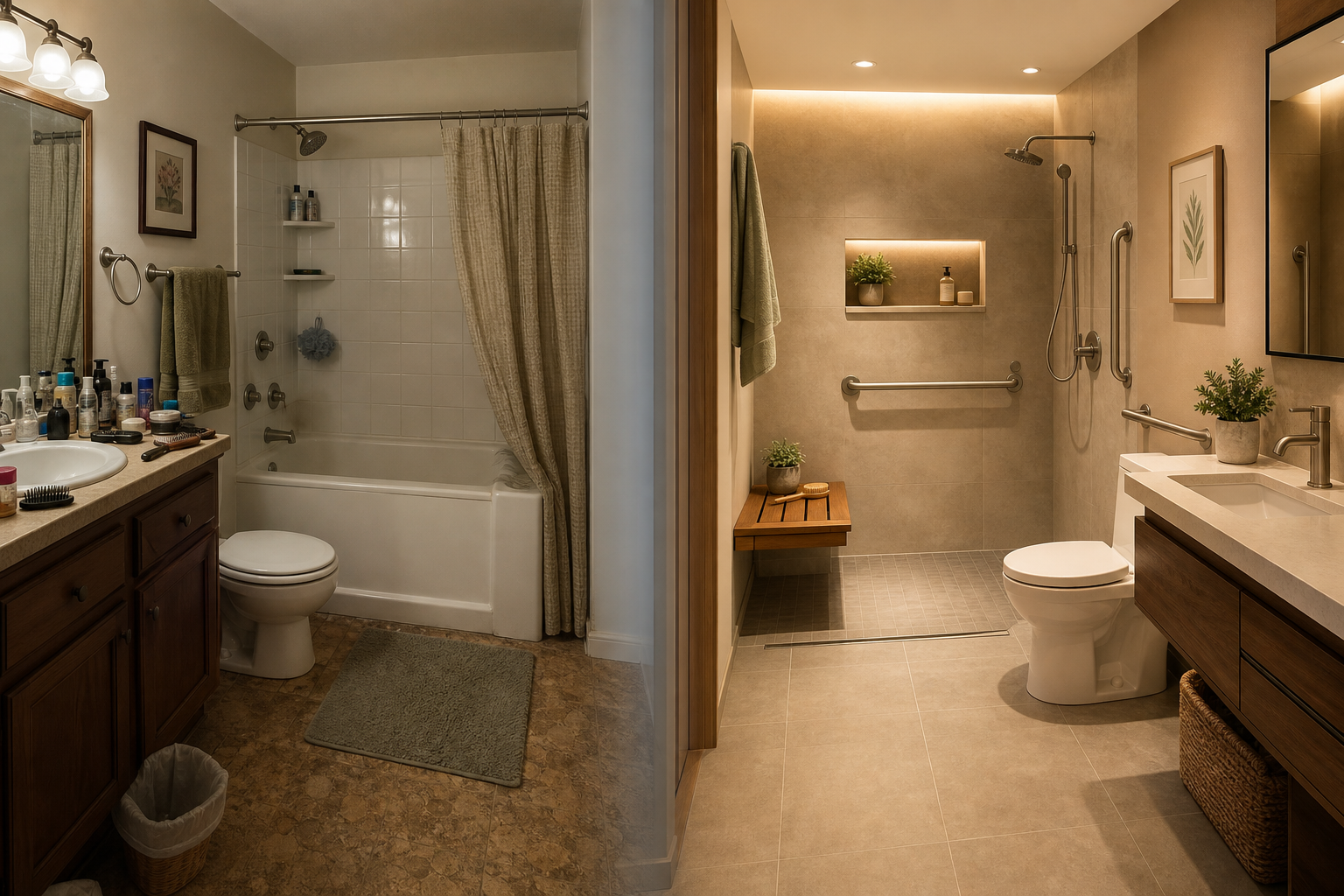
This guide is written for adult children in their 40s and 50s who are navigating this decision after a parent's fall or mobility decline. It provides an evidence-based comparison of the two options, covering safety, cost, accessibility, and the hidden trade-offs that manufacturer marketing often glosses over.
Curbless Walk-In Shower vs. Walk-In Tub: Side-by-Side Comparison
The table below distills the key differences between the two options. Cost figures are drawn from multiple 2026 sources including Porchlight at Home and AARP, and reflect national averages. Actual costs vary significantly by region, contractor availability, and the scope of structural changes required.
| Feature | Curbless Walk-In Shower | Walk-In Tub |
|---|---|---|
| Installed cost range | $3,000 – $8,000 (Porchlight at Home); $6,000 – $10,000 (AARP) | $5,000 – $15,000 (Porchlight at Home); $2,000 – $20,000+ (AARP) |
| Entry barrier height | 0 inches (zero threshold) | 3 – 7 inches (step-in barrier remains) |
| Wheelchair / walker access | Yes — roll-in access with zero threshold | No — requires transfer from wheelchair to tub seat |
| Time to use | Immediate — step in and shower | 10 – 15 minutes to fill and drain |
| Minimum space required | 30 × 60 inches | 30 × 52 inches |
| Resale value impact | Positive — broad universal appeal | Mixed / niche — limited buyer interest |
| Best for | Most seniors, especially those with limited mobility, walker or wheelchair users, budget-conscious families | Seniors who need hydrotherapy, strongly prefer soaking baths, or have a caregiver for transfer assistance |
When a Curbless Walk-In Shower Is the Right Choice
For the vast majority of seniors, a curbless walk-in shower is the safer, more practical, and more cost-effective option. The zero-threshold entry eliminates the need to lift a foot over a barrier — a motion that becomes increasingly difficult and dangerous as balance and leg strength decline. Once inside, the user can sit on a built-in bench or a portable shower chair and bathe immediately, without waiting for water to fill or drain.
A curbless shower is the only option that accommodates a wheelchair or walker. A user can roll directly into the shower area, transfer to a bench, and shower without ever stepping over a threshold. This makes it the clear choice for seniors who already use mobility aids or are likely to need them in the future.
- Zero threshold: No tripping hazard at the entry point.
- Immediate access: No waiting for the tub to fill or drain.
- Wheelchair and walker compatible: Roll-in access without transfer.
- Lower cost: $3,000 – $8,000 installed versus $5,000 – $15,000 for a walk-in tub.
- Better resale value: Universal design appeal attracts a broad range of future buyers.
- Easier to clean and maintain: No seals, pumps, or jets to service.
When a Walk-In Tub Makes Sense
Walk-in tubs serve a real but narrower use case. They are designed for seniors who specifically need or want a soaking bath — typically those with arthritis, chronic pain, or other conditions that benefit from hydrotherapy. The warm water and buoyancy can provide genuine relief for joint and muscle pain that a shower cannot replicate.
A walk-in tub may also be the right choice when the senior has a strong emotional attachment to bathing and is unwilling to give it up. For some older adults, the daily bath is a cherished ritual, and forcing a switch to a shower can feel like a loss of autonomy. In these cases, a walk-in tub — installed with proper safety features — can preserve dignity while reducing some of the risks of a standard tub.
- Hydrotherapy needs: Arthritis, chronic pain, or muscle stiffness that responds to warm water immersion.
- Strong preference for soaking: The senior is unwilling to switch to a shower and may resist the remodel otherwise.
- Caregiver-assisted bathing: A caregiver is available to help with the transfer in and out, and to monitor the fill/drain cycle.
- Adequate budget: The family can absorb the higher cost ($5,000 – $15,000) and the ongoing water and maintenance expenses.
Hidden Costs and Trade-Offs: Water, Maintenance, and Installation
The upfront cost is only part of the financial picture. Walk-in tubs consume significantly more water per use than a shower — a typical fill requires 40 to 60 gallons, compared to 15 to 25 gallons for a 10-minute shower. Over a year of daily use, that difference adds up to roughly 9,000 to 16,000 additional gallons of water, depending on local rates.
Maintenance is another ongoing expense. Walk-in tubs have door seals, pumps, and jets that require regular cleaning and eventual replacement. A failed seal can cause a leak that damages the subfloor. Curbless showers, by contrast, have no moving parts — the linear drain system is the only component that needs periodic cleaning.
- Water usage: Walk-in tubs use 40–60 gallons per fill; curbless showers use 15–25 gallons per shower.
- Maintenance: Walk-in tubs require seal, pump, and jet servicing; curbless showers require only drain cleaning.
- Installation complexity: Curbless showers may require lowering floor joists to create a zero-threshold entry, which adds structural cost. Walk-in tubs need reinforced flooring to support the weight of the filled tub (500–800 lbs).
- Labor costs: Labor accounts for 40% to 65% of the total remodel cost, according to NerdWallet. Complex installations — whether for a curbless shower or a walk-in tub — push toward the higher end of that range.
Contractor Installation Standards for a Senior-Safe Bathroom
Whether you choose a curbless shower or a walk-in tub, the safety of the final installation depends on the contractor's adherence to specific standards. These specifications are not optional — they are the difference between a bathroom that reduces fall risk and one that introduces new hazards.
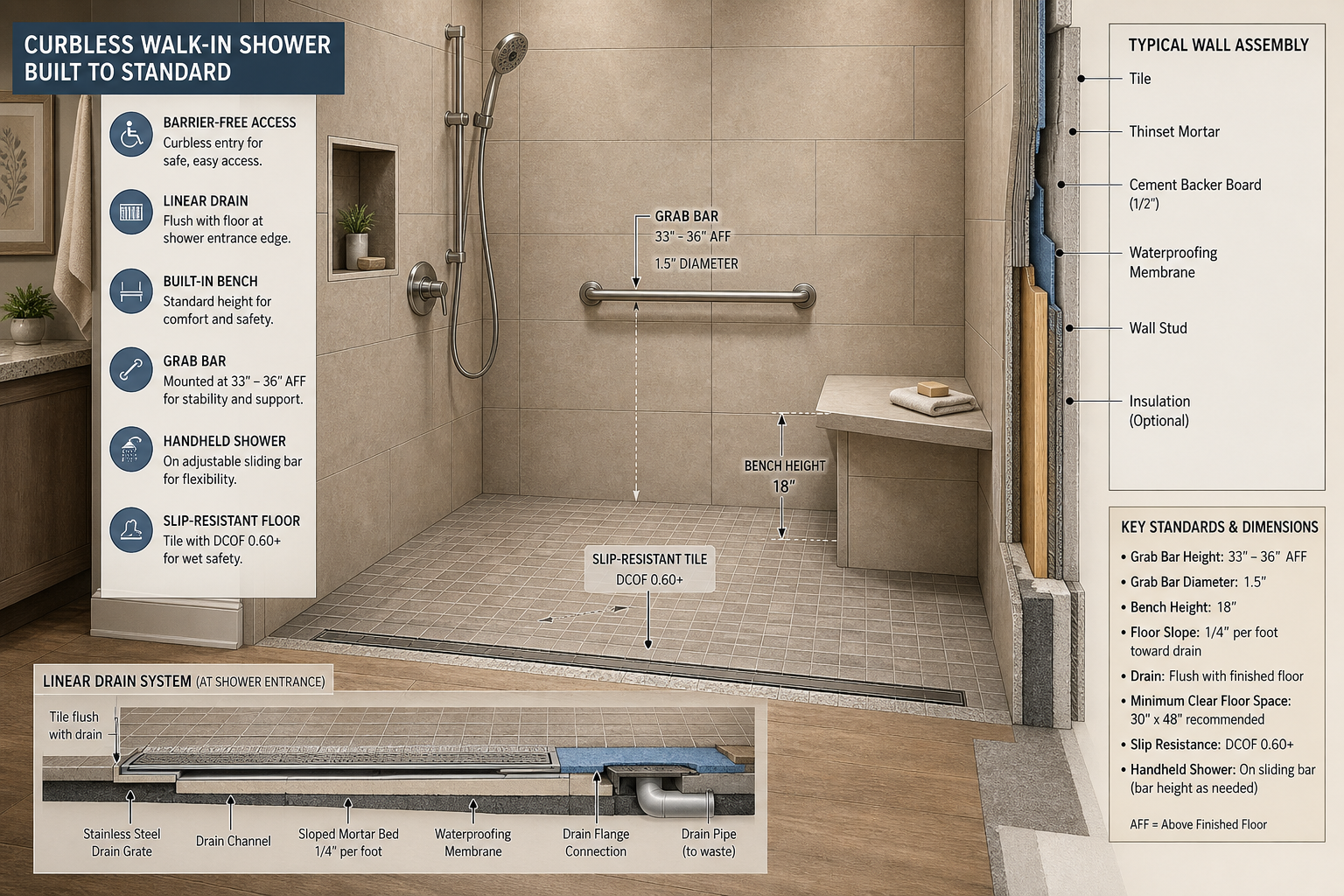
- Linear drain system: For a curbless shower, the floor must slope toward a linear drain that is flush with the surrounding floor. This may require lowering the floor joists to create the necessary slope without a raised threshold.
- Bench height: A built-in or transfer bench should be 17 to 19 inches high — the same height as a standard chair — to make sitting and standing easier.
- Grab bars: Must be anchored into solid wood or blocking — drywall anchors are a safety hazard. The contractor standard is 400-pound-rated bars with a diameter of 1.25 to 1.5 inches, mounted horizontally or at a 45-degree angle. The ADA minimum is 250 pounds, but the higher rating provides a meaningful safety margin.
- Flooring slip resistance: The tile industry's minimum slip resistance (COF) for wet bathroom floors is 0.42, according to AARP. However, Aging Safe Home recommends a DCOF rating of 0.60 or higher for senior-safe wet areas. This is a higher standard and reflects the difference between a commercial minimum and a senior safety recommendation.
- Anti-scald protection: A thermostatic mixing valve set at 102°F prevents scalding and reduces the risk of a fall caused by jerking away from hot water.
- Lighting: A 65-year-old needs approximately four times as much light as a 20-year-old. Install 5000K daylight LED fixtures and consider motion-activated LED tape under vanity toe kicks for nighttime visibility.
Safety Concerns Specific to Walk-In Tubs
Walk-in tubs are often marketed as the ultimate safety solution for senior bathing, but they come with a set of risks that are rarely mentioned in manufacturer brochures. These concerns are significant enough that Aging Safe Home — a contractor-focused resource — recommends curbless showers for most seniors and notes that walk-in tubs have important limitations.
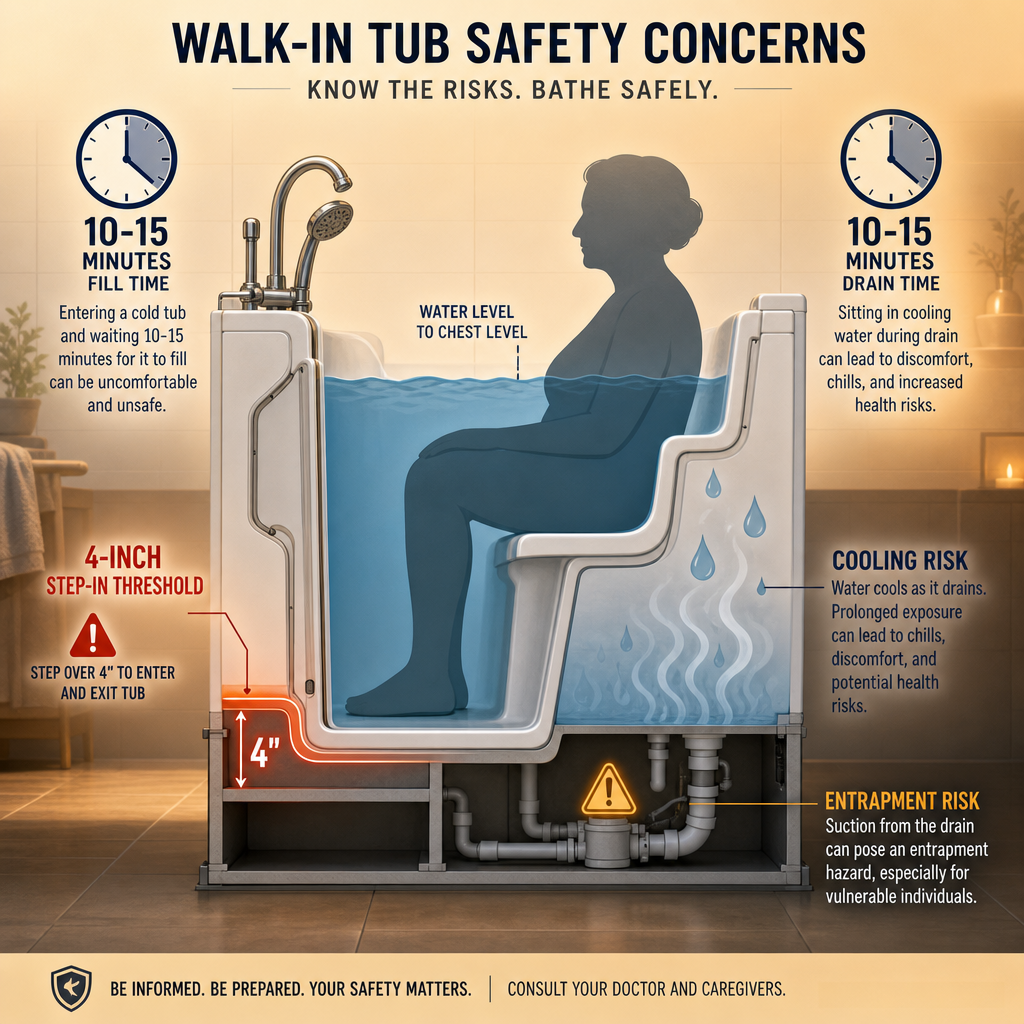
- Chilling during the drain cycle: After the user has been sitting in warm water, the tub must drain completely before the door can be opened. This takes 10 to 15 minutes. During that time, the water cools, and the user sits exposed to the air — a combination that can cause shivering and discomfort, especially for older adults with reduced body temperature regulation.
- Entrapment risk: Walk-in tubs have inward-opening doors that seal against the tub wall. If the user slips or loses balance while the tub is filling or draining, the door cannot be opened until the water level drops. This creates a genuine entrapment scenario that requires a caregiver to be present and ready to intervene.
- Step-in barrier remains a tripping hazard: The 3- to 7-inch threshold that the user must step over to enter and exit the tub is still a fall risk. It is lower than a standard tub wall, but it is not zero. For a senior with reduced leg strength or balance, that small step can be enough to cause a fall.
- Wet exit surface: After the tub drains, the user steps out onto a wet floor. The combination of wet feet, a wet bathroom floor, and the need to step over the threshold creates a high-risk moment that occurs every time the tub is used.
- Extended exposure on wet surfaces: The user sits on a wet seat for the entire fill, soak, and drain cycle — potentially 20 to 30 minutes total. Prolonged contact with wet surfaces increases the risk of skin maceration and pressure sores for seniors with fragile skin.
Decision Flowchart for Caregivers
Use the following decision framework to work through the key questions with your parent and their healthcare provider. Each answer narrows the options and leads toward the choice that best fits their specific situation.
- Does your parent use a wheelchair or walker, or are they likely to need one in the next 2–3 years? Yes → A curbless walk-in shower is the only safe option. Walk-in tubs do not accommodate wheeled mobility aids. No → Proceed to question 2.
- Does your parent have arthritis, chronic pain, or another condition that responds to warm water immersion (hydrotherapy)? Yes → A walk-in tub may provide therapeutic benefit. Proceed to question 3. No → A curbless shower is the better choice. Proceed to question 5.
- Is a caregiver available to assist with every bath — including the transfer in and out, and monitoring the fill/drain cycle? Yes → A walk-in tub is feasible with proper safety planning. Proceed to question 4. No → A curbless shower is safer. The walk-in tub's fill/drain cycle and entrapment risk require supervision.
- Does your family's budget accommodate the higher cost of a walk-in tub ($5,000 – $15,000) plus ongoing water and maintenance expenses? Yes → A walk-in tub may be a reasonable choice if the senior strongly prefers soaking and understands the safety limitations. No → A curbless shower provides better value and lower long-term costs.
- Is resale value a concern? Do you plan to sell the home within the next 5–10 years? Yes → A curbless shower adds resale value; a walk-in tub may reduce buyer interest. No → Resale value is less of a factor, but the curbless shower still offers better long-term usability.
For families weighing the broader decision of whether to modify the home or move to a care facility, our guide on aging in place vs. assisted living provides a structured framework for that conversation.
Related reading
Need a professional assessment?
Find a CAPS-credentialed professional or local aging services through our outbound resource list — we never name or rank individual contractors.
Find Local HelpNoticed something outdated or inaccurate on this page? Flag a correction. We review every report against CDC, NIA, and AARP HomeFit guidance before updating a page.