
Room checklist
Is CAPS Certification Worth It? A Complete Guide for Professionals Considering the Credential
This guide helps remodelers, occupational therapists, interior designers, and other professionals evaluate whether the Certified Aging-in-Place Specialist (CAPS) credential is worth their time and money. It covers the curriculum, costs, competing certifications, earning potential, and a decision framework tailored to different professional backgrounds.
What CAPS Is and Why It Matters for Your Career
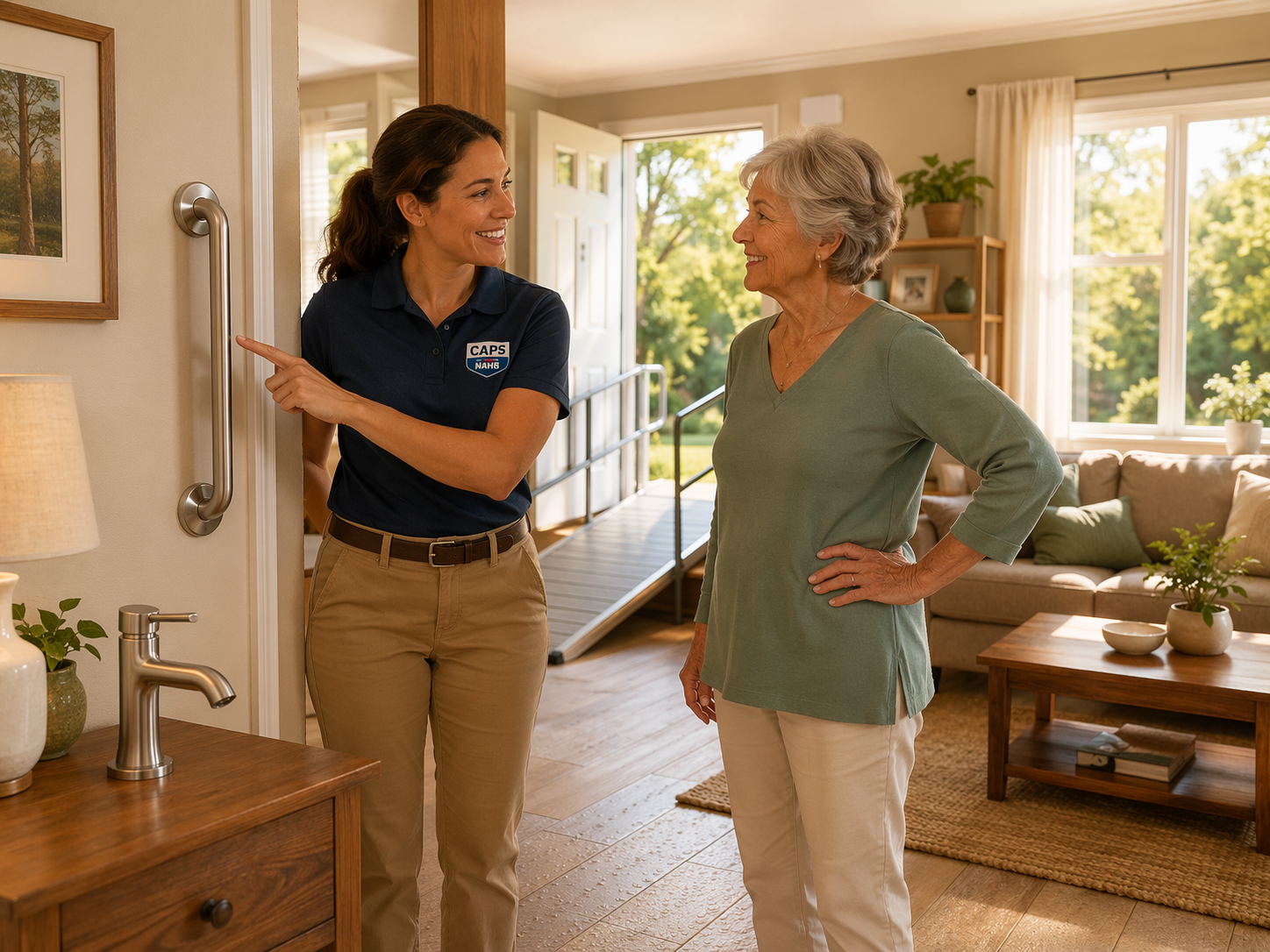
The Certified Aging-in-Place Specialist (CAPS) designation was established in 2002 through a joint program between the National Association of Home Builders (NAHB) and AARP. It is the most widely recognized aging-in-place credential in the home remodeling community, recognized across the United States, Canada, and many other nations. For professionals in construction, healthcare, design, and real estate, CAPS represents a structured entry into the fastest-growing segment of residential remodeling.
The market demand is driven by demographic reality. According to the CDC, more than one out of four older adults (65+) falls each year, and falls are the most common cause of traumatic brain injuries. Meanwhile, the University of Michigan National Poll on Healthy Aging (2022) found that 88% of seniors prefer to age in place. Yet Census Bureau data indicates that fewer than 10% of U.S. homes are ready to accommodate an aging adult. This gap between preference and readiness is the core opportunity for CAPS professionals.
For family caregivers and older adults researching providers, the CAPS designation is a trust signal — it indicates that a professional has completed specific training in aging-in-place design and construction. That consumer-facing perspective is covered in detail in our separate guide: What Is a CAPS-Certified Aging-in-Place Specialist? A Complete Guide for Families. This article, by contrast, focuses on the professional's decision to pursue the credential.
The Three-Course CAPS Curriculum: What You Actually Learn
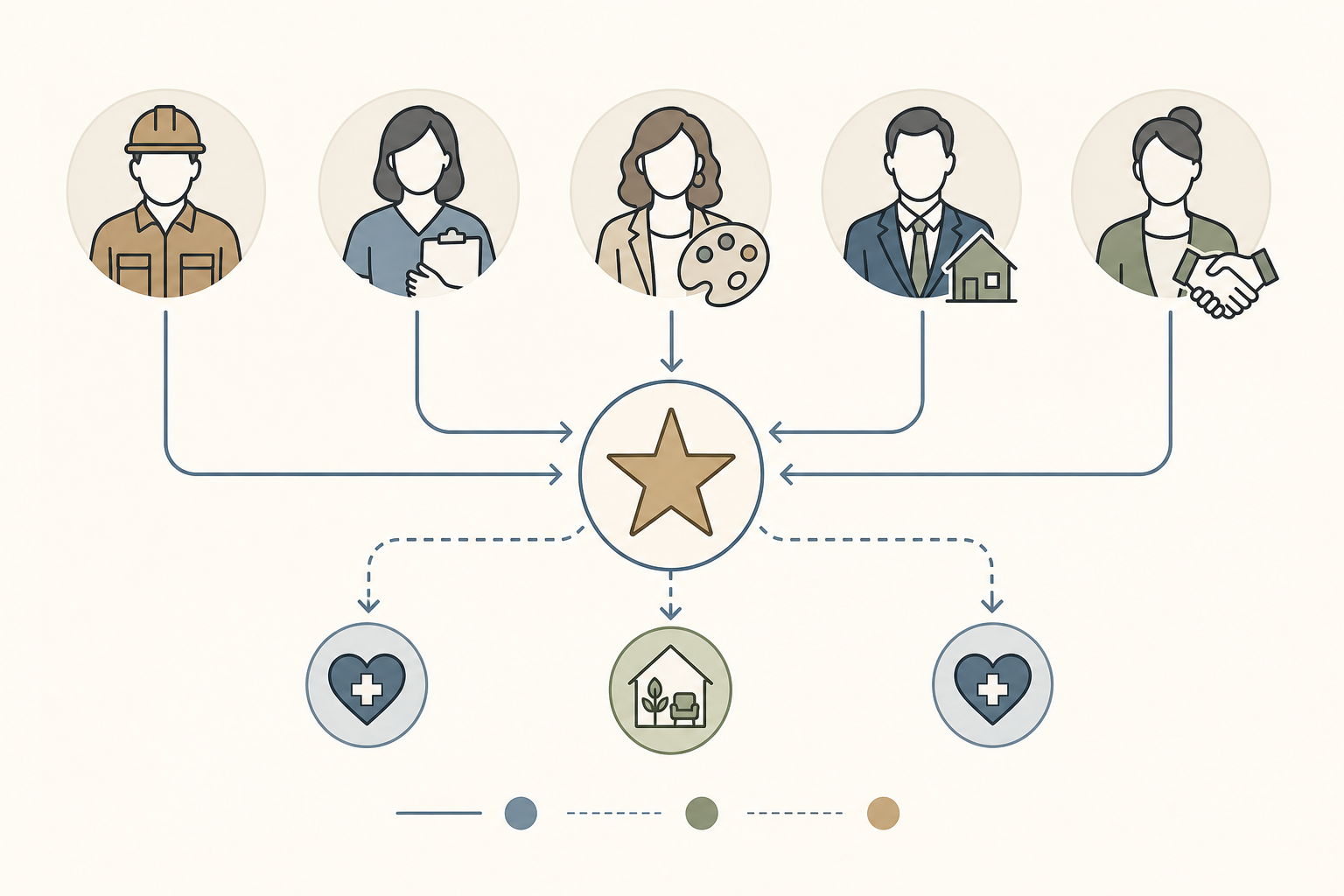
The CAPS program consists of three required courses. No prerequisites are needed — no industry experience, education, licensing, or prior certification is required to enroll. Students come from construction and trades (general contractors, remodelers, electricians), healthcare (occupational therapists, physical therapists, nurses, social workers), design and real estate (interior designers, architects, real estate agents), and public services (nonprofits, aging services, financial planners).
- CAPS I: Marketing and Communicating with the Aging in Place Client — Focuses on understanding the aging client's needs, effective communication strategies, and how to market aging-in-place services. This course is particularly valuable for professionals who are new to serving an older adult clientele.
- CAPS II: Design Concepts for Aging in Place — Covers universal design principles, barrier-free design, and the specific design considerations that make a home safe and accessible for aging adults. This course builds the conceptual foundation for the technical details that follow.
- CAPS III: Details and Solutions for Aging in Place — The most technical course, covering specific construction details, product selection, and installation solutions for grab bars, ramps, stair lifts, walk-in tubs, widened doorways, and other modifications. This is where the design concepts from CAPS II become actionable construction knowledge.
The three courses build sequentially. A contractor who already knows how to install grab bars will still benefit from CAPS I and II because the value of the credential lies not just in technical skill but in understanding the client's perspective and the design philosophy behind aging-in-place work. An occupational therapist who already understands client assessment will gain the construction vocabulary and product knowledge that bridges clinical recommendations to actual home modifications.
CAPS Certification Costs: Courses, Application, and Renewal
The total investment for CAPS certification depends on NAHB membership status and the graduation kit you choose. The following table breaks down the official national fees from the NAHB's "How to Earn Your CAPS" page.
| Fee Category | NAHB Members | Non-Members |
|---|---|---|
| Per course (national fee) | $299 | $399 |
| Three courses total | $897 | $1,197 |
| Application — standard kit (online certificate only) | $95 | $145 |
| Application — premium kit (plaque, lapel pin, ribbon, brochure) | $195 | $245 |
| Annual renewal | $65 | $95 |
| Reinstatement fee (lapsed >1 year) | $50 | $50 |
For a non-member choosing the standard kit, the total first-year cost is approximately $1,342 ($1,197 for courses + $145 for application). For an NAHB member choosing the standard kit, the total is approximately $992 ($897 + $95). The premium kit adds $100 for members and $100 for non-members. These are national base fees; local Home Builders Association (HBA) chapters may set their own course fees, which can differ from the national rates.
Credential holders must complete 4 hours of continuing education per year to maintain their certification. If a credential lapses for more than one year, a $50 reinstatement fee applies. If lapsed for more than three years, the holder must retake CAPS III.
Who Should Pursue CAPS? No Prerequisites, But Some Gain More
Because CAPS has no prerequisites, anyone can enroll. But the value of the credential varies significantly by professional background. The table below summarizes which professionals benefit most and why.
| Professional Background | Primary Benefit of CAPS | Why It Works |
|---|---|---|
| General contractors and remodelers | Market differentiation and client trust | CAPS is the most recognized credential in home remodeling; it signals specialized expertise to families researching providers. |
| Occupational therapists and physical therapists | Bridges clinical assessment to construction solutions | OTs already understand client needs and functional limitations; CAPS adds the construction vocabulary and product knowledge to specify and recommend modifications. |
| Interior designers | Expands service offering into universal design | Designers can add aging-in-place as a specialty, combining aesthetic sensitivity with accessibility requirements. |
| Real estate agents | Advises clients on home readiness and modifications | Agents can help buyers and sellers understand what modifications a home needs and what they cost, adding value beyond the transaction. |
| Social workers and aging services professionals | Provides technical credibility when recommending modifications | Social workers often coordinate home safety assessments; CAPS gives them the technical knowledge to make specific, credible recommendations. |
The thesis that non-construction professionals gain disproportionate value from CAPS is worth emphasizing. An occupational therapist who adds CAPS training combines clinical assessment skills with design and construction knowledge — a combination that neither a general contractor nor a clinician alone can offer. Similarly, an interior designer with CAPS can create spaces that are both beautiful and genuinely accessible, which is a distinct market position.
CAPS vs. Competing Credentials: CEAC, ECHM, CLIPP, Age Safe America, UDCP
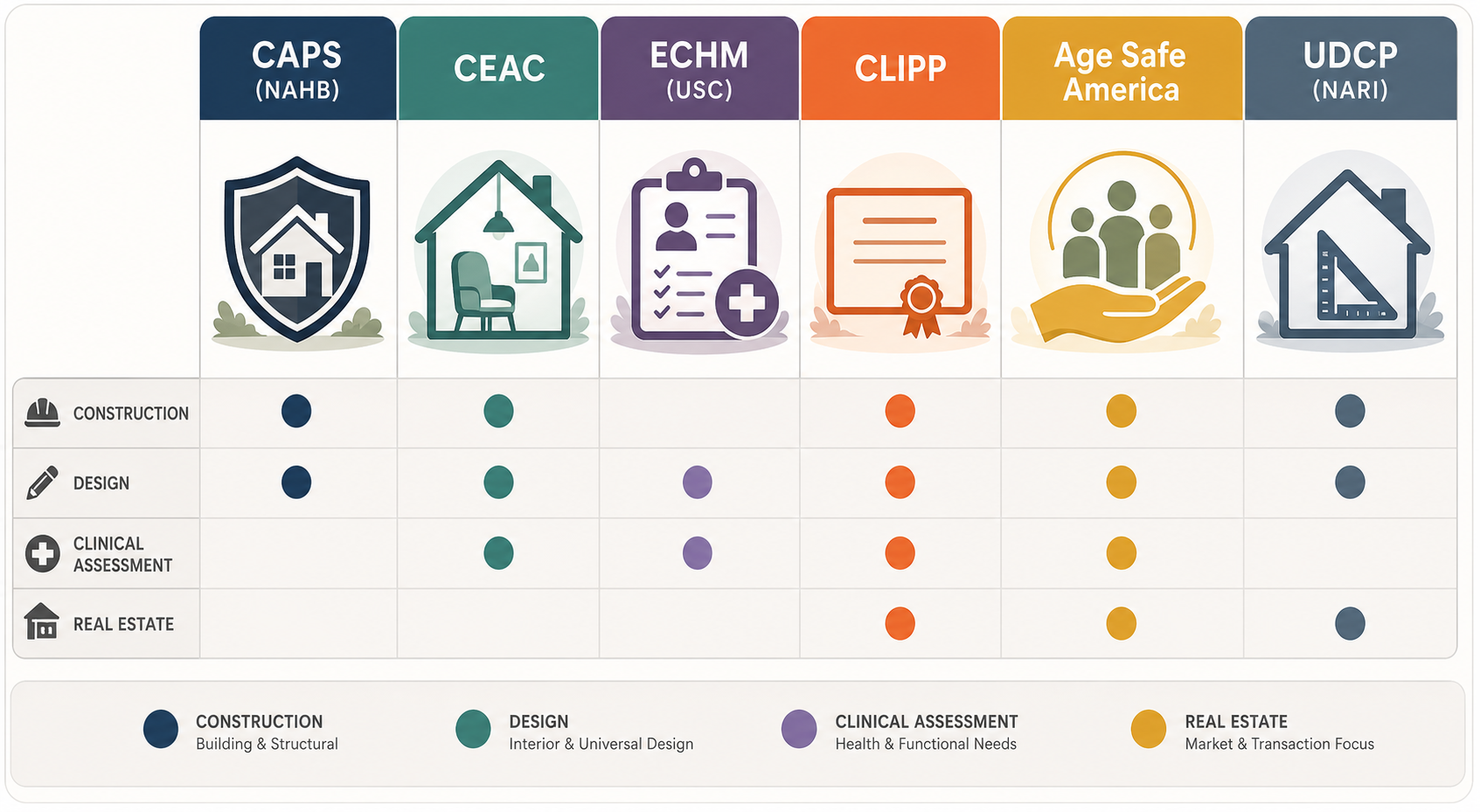
CAPS is not the only aging-in-place credential available. Depending on your professional background and goals, one of the alternatives may be a better fit. The following table compares the main options.
| Credential | Issuing Organization | Emphasis | Format | Target Audience |
|---|---|---|---|---|
| CAPS | NAHB + AARP | Construction, design, client communication | In-person or online courses (3 courses) | Remodelers, contractors, healthcare, design, real estate |
| CEAC (Certified Environmental Access Consultant) | VGM Live at Home | Home safety assessments, product evaluation | Self-study (6 units) | Home safety professionals, contractors |
| ECHM (Executive Certificate in Home Modification) | University of Southern California | Home modifications, client assessment, funding | Online courses | Healthcare providers, housing professionals, policymakers |
| CLIPP (Certified Living in Place Professional) | Living in Place Institute | Universal design, home safety, accessibility for all ages | Online training | Designers, remodelers, healthcare professionals, builders |
| Age Safe America | Age Safe America | Home safety, fall prevention, accessibility | Online training | Home safety professionals, caregivers, healthcare providers |
| UDCP (Universal Design Certified Professional) | NARI | Universal design principles for remodeling | In-person or online courses | Remodeling professionals |
For contractors and remodelers, CAPS remains the most widely recognized credential in the home remodeling community. For healthcare professionals who want a deeper focus on clinical assessment and funding sources, the USC Executive Certificate in Home Modification may be a stronger complement. For designers who prioritize universal design principles over construction details, CLIPP or UDCP may be more aligned with their practice.
Earning Potential: What CAPS Professionals Charge
Earning potential for CAPS professionals varies significantly by geography, business model, and experience. The following ranges are indicative, drawn from industry sources and interviews with practicing CAPS professionals.
- Consulting and assessment fees: CAPS professionals typically charge $75–$200 per hour for consulting work. Initial home assessments range from $199 to $500, depending on location and scope. One CAPS professional quoted in a Care.com article charges $250 for an initial assessment and $150 per hour thereafter.
- Occupational therapists with CAPS: OTs who add the CAPS credential can command salaries in the $80,000–$150,000 range, according to industry sources. The combination of clinical assessment skills and construction knowledge is rare and valued.
- Add-on services: Beyond assessments and modifications, CAPS professionals can offer decluttering, simple home improvements (rearranging furniture, removing fall hazards), switching to motion-sensored lighting, and installing grab bars. These lower-cost services can generate recurring revenue and build client relationships.
For context on the types of projects a CAPS would price and the market rates for specific modifications, see our detailed cost guide: How Much Does a CAPS Home Modification Cost? Full Breakdown with Budget Planning. That article breaks down the cost of individual modifications — grab bars, ramps, stair lifts, walk-in tubs — which helps professionals understand the revenue opportunity per project.
Real-World Utility: Insurance, Licensing, and the NAHB Directory
The CAPS credential provides practical utility beyond the training itself. Here is what it actually means in practice for different professionals.
- For contractors and remodelers: To earn the CAPS designation, you must provide proof of liability insurance and workers' compensation, and a valid business license if required by your state or locality. These are standard requirements for any contracting business, but the CAPS application formalizes them. The credential signals to clients that you carry proper insurance and operate a legitimate business.
- For non-construction professionals: OTs, designers, real estate agents, and social workers do not need to provide proof of licensing or insurance to earn the CAPS designation. The credential is available to anyone who completes the courses and pays the application fee, regardless of professional background.
- NAHB directory listing: All CAPS holders are listed in the NAHB's searchable directory, which is a primary channel for families researching providers. This directory is a client-finding tool that comes with the credential — no additional marketing spend required.
- Credibility with families: For families researching providers, the CAPS designation is a recognized trust signal. It indicates that the professional has completed specific training in aging-in-place design and construction, and has committed to a code of ethics. This is particularly important for adult children who are making decisions for aging parents and need to feel confident in their choice.
Decision Framework: Which Professionals Benefit Most and How to Choose a Path
The decision to pursue CAPS — or an alternative credential — depends on your professional background, your target clients, and the services you want to offer. The following framework summarizes the key trade-offs.
| If You Are a... | Best Credential Path | Why |
|---|---|---|
| General contractor or remodeler | CAPS (or UDCP if focused on universal design) | CAPS is the most recognized credential in home remodeling and directly signals aging-in-place expertise to clients. UDCP is a strong alternative if universal design is your primary focus. |
| Occupational therapist or physical therapist | CAPS + ECHM (USC) | CAPS bridges clinical assessment to construction solutions. ECHM adds depth in client assessment and funding sources, which is valuable for healthcare professionals. |
| Interior designer | CAPS or CLIPP | CAPS provides construction-focused knowledge that complements design skills. CLIPP emphasizes universal design for all ages, which may align better with a design practice. |
| Real estate agent | CAPS | CAPS provides enough technical knowledge to advise clients on home readiness and modifications without requiring deep construction expertise. |
| Social worker or aging services professional | CAPS or Age Safe America | CAPS provides technical credibility. Age Safe America offers a lower-cost, online-only option focused on home safety and fall prevention. |
If you are still uncertain, consider these questions:
- Do you want to perform hands-on construction and installation work? If yes, CAPS or UDCP is the right path. If no, consider CLIPP or Age Safe America.
- Do you already have clinical assessment skills (OT, PT, nursing)? If yes, CAPS adds the construction vocabulary and product knowledge that makes your clinical recommendations actionable. ECHM is a strong complement.
- Is your primary goal to advise clients rather than perform modifications? If yes, CAPS or Age Safe America provides enough technical knowledge without requiring deep construction expertise.
- What is your budget? CAPS costs approximately $900–$1,500 for the first year. Age Safe America and CLIPP are typically lower-cost, online-only options. ECHM from USC is a university program with higher tuition.
Related reading
Need a professional assessment?
Find a CAPS-credentialed professional or local aging services through our outbound resource list — we never name or rank individual contractors.
Find Local HelpNoticed something outdated or inaccurate on this page? Flag a correction. We review every report against CDC, NIA, and AARP HomeFit guidance before updating a page.