
Caring for a Parent with Dementia at Home: What Changes at Each Stage and How to Prepare
A stage-by-stage guide for adult children whose parent has received an Alzheimer's or dementia diagnosis. Learn how care needs evolve from early-stage planning through advanced care, backed by the latest national data on the distinct demands of dementia caregiving.

Why Dementia Caregiving Is Fundamentally Different
If you have recently become responsible for a parent with Alzheimer's or another dementia, you have likely already sensed that this is not the same as helping an aging relative who is physically frail but cognitively intact. The data confirms that intuition — and the gap is stark.
According to a 2025 study by Wolff and colleagues published in Health Affairs, family caregivers for a person with dementia spend an average of 31 hours per week providing care — more than double the 14 hours per week that caregivers of older adults without dementia spend. To put that in context, the general average for all family caregivers of older adults is about 22 hours per week, as reported in the Merck Manual. Dementia caregiving is not a slightly harder version of the same job; it is a fundamentally different undertaking in terms of time, intensity, and emotional demand.
The structural changes in how families respond to dementia are equally striking. Between 2011 and 2022, the share of dementia caregivers who live with the care recipient jumped from 39.4% to 51.7%. Over the same period, employment among dementia caregivers dropped from 42.5% to 34.6%. These are not abstract statistics — they reflect real decisions that families are making every day, often with little preparation for what each stage of the disease will demand.
Early Stage: Planning Ahead While Your Parent Can Still Participate
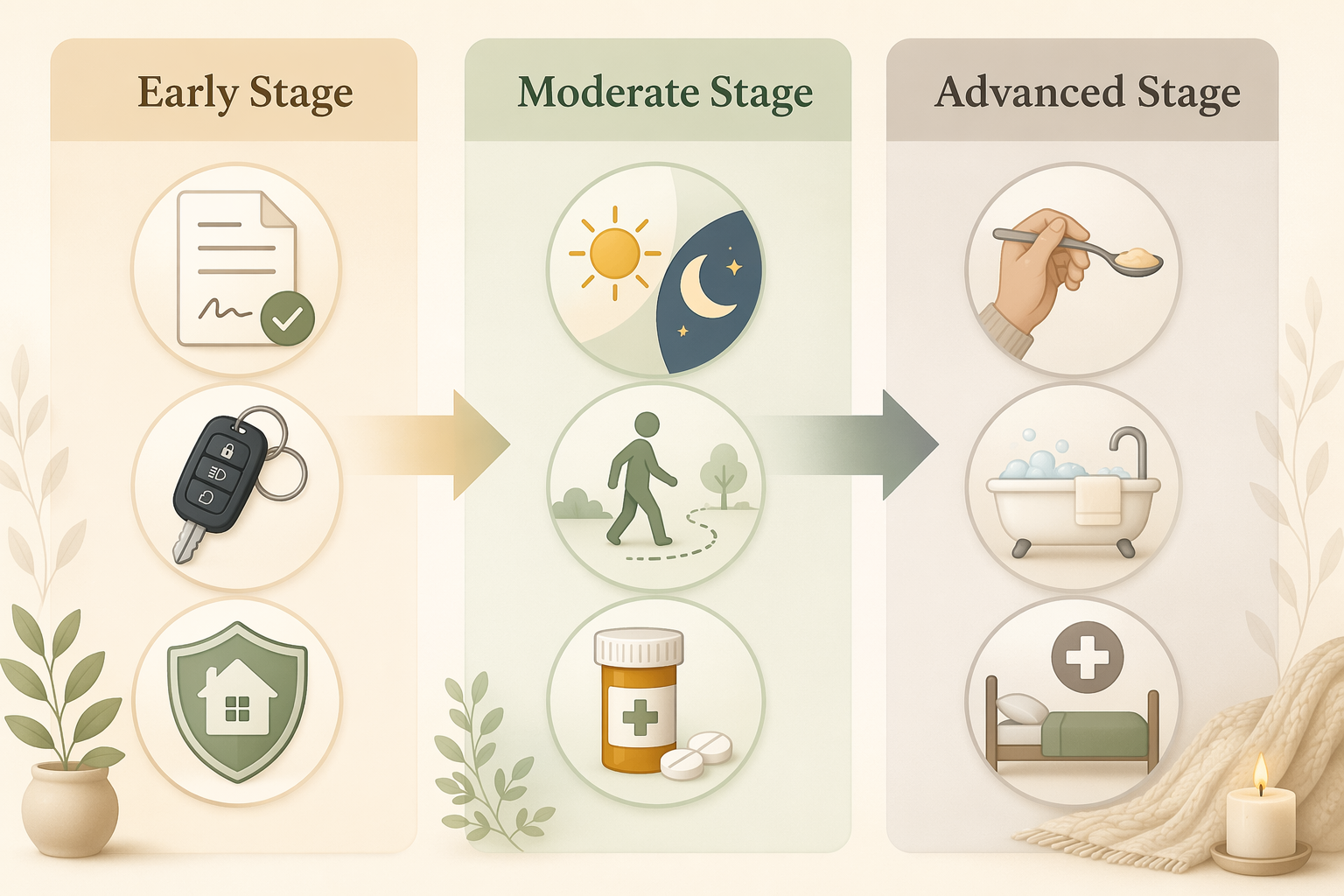
In the early stage of dementia, your parent may still be able to drive, manage their own finances, and hold a coherent conversation. This is the window of opportunity — the time to make decisions together while they can still express their wishes. Waiting until the moderate or advanced stage means making those decisions alone, which adds an enormous emotional burden to an already difficult situation.
Legal and Financial Planning
The most urgent early-stage task is completing legal documents that authorize you to make decisions on your parent's behalf. Without these in place before your parent loses the capacity to sign them, you may need to pursue guardianship through the courts — a process that is expensive, time-consuming, and emotionally draining.
- Durable Power of Attorney (POA): Grants you authority to manage your parent's financial and legal affairs. Without it, you may not be able to pay bills, file taxes, or manage investments on their behalf.
- Advance Directive (Living Will): Documents your parent's preferences for end-of-life medical care, including life support and artificial nutrition. This prevents family conflict later and ensures your parent's values guide treatment decisions.
- Healthcare Power of Attorney (DPAHC): Designates who will make medical decisions when your parent cannot. This is separate from the financial POA and should name someone who can handle emotionally charged conversations with doctors.
- HIPAA Authorization: Allows healthcare providers to share medical information with you. Without it, doctors may refuse to discuss your parent's condition, even if you are the primary caregiver.
The Driving Conversation
Talking to a parent about stopping driving is one of the hardest conversations you will have as a caregiver. In the early stage, your parent may still be a safe driver, but the window of safety is narrowing. The Alzheimer's Association recommends having this conversation early, while your parent can still participate in the decision and help plan alternative transportation.
Rather than framing it as a loss of independence, position it as a proactive safety measure. Offer to help arrange alternatives — ride services, family members, or community transportation programs. If your parent resists, a driving evaluation by an occupational therapist who specializes in older drivers can provide an objective assessment that takes the decision out of your hands.
Home Safety Audit and Technology Adaptation
The early stage is also the time to make the home safer and introduce technology that your parent can still learn to use. Waiting until the moderate stage, when confusion and memory loss are more pronounced, makes adaptation much harder.
- Conduct a room-by-room fall prevention audit: Remove tripping hazards, improve lighting, install grab bars in the bathroom, and ensure clear pathways. The CDC STEADI model provides a structured framework for this assessment.
- Introduce monitoring technology gradually: A personal emergency response system (PERS) or a simple medication reminder device can be learned in the early stage. If you wait until your parent is confused by new devices, adoption becomes nearly impossible. See our guide on helping an older adult with technology for practical strategies.
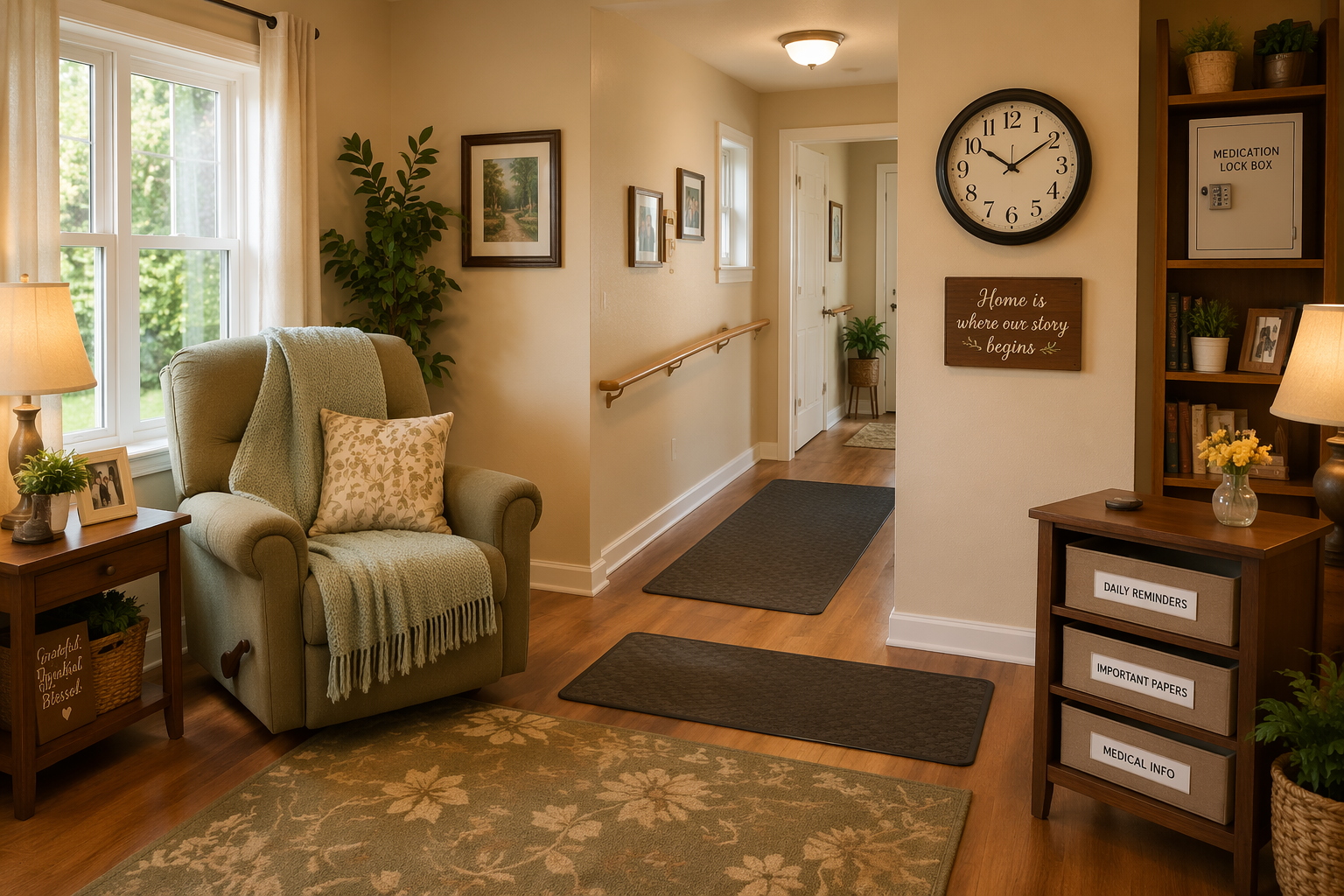
- Simplify the environment: Reduce clutter, label drawers and cabinets, and use a large-print calendar to track appointments and daily routines. These small changes reduce confusion and support independence longer.
Moderate Stage: Navigating Behavioral Changes and Building a Support System
The moderate stage is where dementia caregiving becomes most demanding. Memory loss deepens, and behavioral symptoms — known clinically as Behavioral and Psychological Symptoms of Dementia (BPSD) — begin to emerge. These can include sundowning, agitation, wandering, repetitive questioning, and sleep disturbances. Unlike the early stage, where your parent could still participate in planning, the moderate stage requires you to take the lead on nearly every aspect of daily life.
Understanding and Responding to Behavioral Changes
Behavioral changes in dementia are not random. They are usually triggered by something — pain, hunger, fatigue, overstimulation, or a change in routine. The NCCDP recommends a calm, investigative approach: speak slowly, maintain eye contact, use simple language, and look for the underlying cause before reacting.
| Behavior | Common Triggers | Non-Pharmacological Response |
|---|---|---|
| Sundowning (increased agitation in late afternoon/evening) | Fatigue, low lighting, disruption of circadian rhythm | Increase daytime activity, maintain consistent bedtime routine, use bright light therapy in the morning |
| Repetitive questioning | Anxiety, memory loss, unmet need (hunger, bathroom) | Answer calmly each time, redirect to a comforting activity, post written reminders in visible locations |
| Agitation or aggression | Pain, overstimulation, frustration with communication | Remove yourself from the situation if unsafe, speak calmly, identify and remove the trigger |
| Wandering | Restlessness, disorientation, searching for something familiar | Install door alarms and locks, ensure the person wears ID, create safe wandering paths indoors |
| Sleep disturbances | Circadian rhythm disruption, daytime napping, medication side effects | Limit caffeine and naps, increase daytime physical activity, maintain a consistent sleep schedule |
For specific challenges like bathing resistance, which is a common manifestation of agitation in moderate dementia, our detailed guide on bathing a parent with dementia provides step-by-step strategies for reducing resistance and maintaining dignity.
Medication Management Systems
As the disease progresses, medication management becomes a critical safety concern. Your parent may forget whether they have taken their pills, take double doses, or refuse medication altogether. A structured system is essential.
- Use a pill organizer with daily compartments: Fill it yourself or use a pharmacy that offers blister packaging. This eliminates the need for your parent to remember which pills to take.
- Set up automatic refills and reminders: Most pharmacies offer automatic refill programs. Pair this with a medication reminder app or device that alerts your parent when it is time to take each dose.
- Lock up all medications: In the moderate stage, your parent may accidentally take the wrong medication or an extra dose. Keep all prescription and over-the-counter medications in a locked cabinet.
- Review medications with the doctor regularly: Some medications can worsen confusion or increase fall risk. Ask the prescribing physician to review the full list at each visit and discontinue any that are no longer necessary.
Building a Support System
The moderate stage is also when you need to start accepting help — even if you have been managing on your own until now. The data shows that most dementia caregivers do not use the support systems that exist. According to the Wolff et al. study, only 2.5% of dementia caregivers use support groups and only 9.3% use respite services. These numbers have actually declined since 2011, even as caregiver strain has increased.
The Area Agencies on Aging (AAAs) are a critical resource for coordinating dementia care services. They can help you find in-home help, adult day programs, meal delivery, and caregiver support groups in your area. The ARCH National Respite Locator (703-256-2084) and the National Adult Day Services Association (877-745-1440) are also excellent starting points for finding local respite options.
Advanced Stage: 24/7 Care, Feeding and Hygiene, and Hospice Considerations
In the advanced stage of dementia, your parent will likely need round-the-clock assistance with all activities of daily living (ADLs): bathing, dressing, toileting, eating, and moving around. Communication may be limited to a few words or nonverbal cues. This stage is physically and emotionally exhausting, and it is the point at which many caregivers reach their own limits.
Personal Care and Hygiene
Bathing, toileting, and dressing become complex tasks that require patience, creativity, and a focus on preserving dignity. Your parent may resist care due to fear, confusion, or discomfort. The NCCDP recommends identifying potential causes of resistance — pain, cold, embarrassment, or environmental factors — and addressing them before attempting care.
- Bathing: Use a shower chair, handheld showerhead, and non-slip mat. Keep the room warm. Offer a sponge bath if a full shower is too distressing. Some caregivers find that a scheduled routine reduces resistance.
- Toileting: Establish a regular toileting schedule (every two hours during the day). Use absorbent briefs or pads to manage incontinence. A raised toilet seat and grab bars make transfers safer.
- Feeding: Serve soft, easy-to-swallow foods. Cut food into small pieces. Allow plenty of time for meals. If your parent has difficulty swallowing, consult a speech therapist and ask about thickened liquids to prevent aspiration.
- Mobility: Use a walker or wheelchair as needed. Keep pathways clear. Consider a hospital bed with side rails to prevent falls at night. An occupational therapist can recommend the right equipment.
When to Consider Hospice and Palliative Care
Hospice care is appropriate when a person with dementia is expected to live six months or less, as determined by a physician. In the advanced stage, common hospice-qualifying criteria include: significant weight loss, recurrent infections, inability to walk or dress without assistance, and limited verbal communication. Hospice provides comfort-focused care, pain management, and emotional support for both the patient and the family — often in the home.
Palliative care, which focuses on symptom management and quality of life, can begin at any stage and does not require a six-month prognosis. Many families find that a palliative care consultation helps them navigate complex decisions about feeding tubes, hydration, and medication management long before hospice becomes appropriate.
The Employment Dilemma: Balancing Work with Dementia Caregiving
The Wolff et al. study found that only 34.6% of dementia caregivers remain employed, down from 42.5% in 2011. This means that nearly two-thirds of dementia caregivers have had to reduce their work hours, take a leave of absence, or leave the workforce entirely. The financial implications are severe — lost income, reduced retirement savings, and lost health insurance coverage — and they compound the out-of-pocket costs of caregiving, which average about $7,000 annually according to AARP.
If you are still working, here are steps you can take to protect your employment and your income:
- Understand your rights under the Family and Medical Leave Act (FMLA): FMLA provides up to 12 weeks of unpaid, job-protected leave per year for eligible employees to care for a parent with a serious health condition. Your parent's dementia diagnosis qualifies. Check with your HR department about eligibility and documentation requirements.
- Talk to your employer about flexible arrangements: Many employers are willing to offer flexible hours, remote work, or reduced schedules to retain valued employees. Frame the conversation around how you can continue to contribute while managing your caregiving responsibilities.
- Explore state paid family leave programs: Several states (including California, New York, Massachusetts, Washington, and others) offer paid family leave that provides partial wage replacement while you care for a parent. These programs are separate from FMLA and may offer additional weeks of leave.
- Consider the long-term financial impact: Leaving the workforce has consequences that extend far beyond the caregiving years — reduced Social Security benefits, lower retirement savings, and lost career advancement. If you are considering leaving your job, consult a financial planner who understands caregiving scenarios.
Support That Exists but Is Underused: Why You Should Reach Out Now
One of the most troubling findings from the Wolff et al. study is that the use of support services among dementia caregivers has actually declined over the past decade, even as caregiver strain has increased. Support group participation dropped from 4.1% to 2.5%, and respite service use fell from 12.9% to 9.3%. This means that at a time when caregivers need more help, they are accessing less of it.
Why does this happen? Caregivers often report feeling that they should be able to handle everything themselves, or that asking for help is a sign of failure. Others do not know what services are available or how to access them. Some worry about the cost or quality of care provided by someone else.
Here is the reality: using support services does not make you a lesser caregiver. It makes you a smarter one. The data shows that caregivers who use respite services and support groups report lower stress levels, better physical health, and the ability to provide care for longer before reaching burnout.
- Support groups: The Alzheimer's Association offers both in-person and online support groups for dementia caregivers. These groups provide emotional validation, practical tips, and a sense of community that can reduce isolation. Many caregivers report that their support group is the single most valuable resource they have.
- Respite care: Respite can mean a few hours of in-home care, a day at an adult day center, or a short stay in a residential facility. The adult day care respite guide explains how day programs can provide social engagement for your parent and a much-needed break for you.
- In-home help: A home health aide can assist with bathing, dressing, and meal preparation for a few hours a day or week. Even two afternoons per week can make a significant difference in your ability to rest, work, or attend to your own health.
- Care coordination: Your local Area Agency on Aging can help you navigate the complex web of services, from Medicaid waivers to meal delivery programs. They can also connect you with a care manager who can assess your parent's needs and coordinate services.
When Home Care Is No Longer Enough: Signals It's Time for Facility-Based Care
For many families, the question is not whether home care will eventually become unsustainable, but when. The decision to move a parent to assisted living, memory care, or a skilled nursing facility is one of the most emotionally difficult choices a caregiver will face. It is also one of the most important.
Here are the signals that it may be time to consider facility-based care:
| Signal | What It Looks Like | Why It Matters |
|---|---|---|
| Safety risks that cannot be managed at home | Your parent has wandered outside, left the stove on, or fallen repeatedly despite safety measures | A single serious fall or wandering episode can be life-threatening. If home modifications and monitoring are no longer sufficient, a secured memory care unit may be the safest option |
| Caregiver burnout or health decline | You are experiencing exhaustion, depression, anxiety, or physical health problems related to caregiving | Your health matters too. If you cannot provide safe care, your parent is not safe either. About 40% of family caregivers report high stress levels, and 38% suffer from depression or anxiety |
| 24/7 care needs exceed your capacity | Your parent needs help with toileting, feeding, and mobility throughout the night as well as the day | Sleep deprivation is dangerous for both of you. Professional care facilities have staff available around the clock |
| Behavioral symptoms that require professional management | Aggression, severe agitation, or psychosis that does not respond to non-pharmacological strategies | Memory care units are designed and staffed to manage these behaviors safely. At home, they can become dangerous for both the caregiver and the person with dementia |
| Inability to provide adequate medical care | Your parent has complex medical needs — feeding tube, wound care, frequent infections — that require nursing expertise | Skilled nursing facilities have registered nurses on staff 24/7. Home health nursing is limited in scope and availability |
Making this decision does not mean you have failed. It means you have recognized that your parent's needs have exceeded what one person — even a devoted, exhausted family caregiver — can provide. Our long-term care decision framework provides a structured approach to evaluating options, and the live-in caregiver vs. assisted living guide can help you weigh the trade-offs between in-home professional care and a residential setting.
Related reading
Noticed something outdated or inaccurate on this page? Flag a correction. We review every report against CDC, NIA, and AARP HomeFit guidance before updating a page.
Part of the Fall Prevention section.