
Caregiver decision guide
Long-Term Care for Elderly Parents: A 5-Step Decision Framework for Adult Children
A step-by-step guide for adult children navigating the long-term care decision after a parent's decline. This framework helps families assess functional needs, caregiving capacity, finances, facility options, and family consensus — avoiding panic-driven choices and costly mistakes.

When to Start the Long-Term Care Conversation
Most families wait until a crisis — a fall that results in a broken hip, a hospitalization for pneumonia, or a dementia-related wandering episode — before they begin discussing long-term care. By then, decisions are made under time pressure, emotions are running high, and the range of available options has already narrowed. The data suggests this is a near-universal pattern: according to AARP's Public Policy Institute, 56% of adults turning 65 between 2021 and 2025 will need some form of long-term services and supports (LTSS), yet the vast majority of families have no plan in place when the need first appears.
The question is not whether your parent will need care — the lifetime risk for someone turning 65 today is 70%, according to SingleCare's 2026 analysis — but when and in what form. The right time to begin a structured assessment is when you notice any of the following signs:
- A recent fall or series of near-falls that suggest mobility or balance problems
- A new or worsening dementia diagnosis that raises questions about safety at home
- A hospitalization or surgery from which recovery is slow or incomplete
- Noticeable weight loss, missed meals, or a refrigerator full of spoiled food
- Unpaid bills, missed appointments, or confusion about medications
- A spouse or primary caregiver showing signs of burnout or declining health themselves
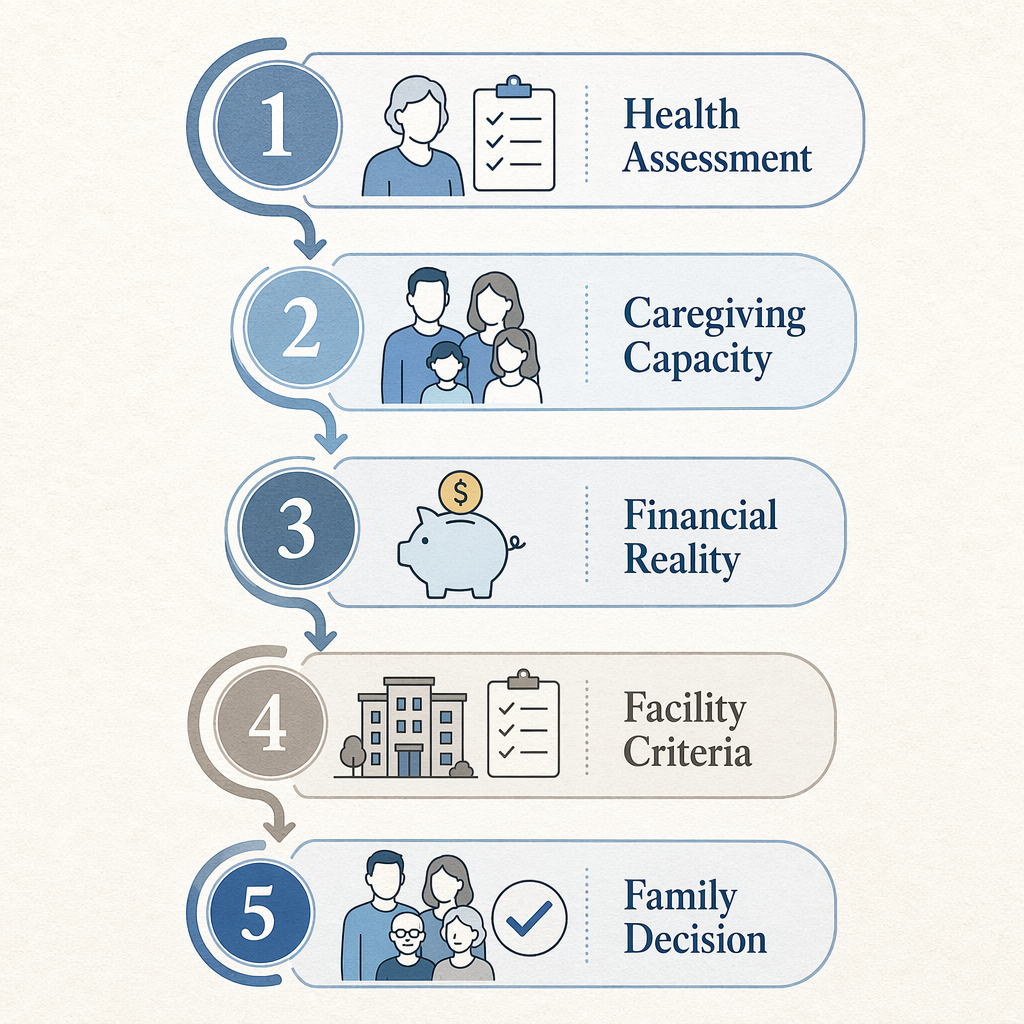
If you recognize two or more of these signs in your parent, it is time to move from observation to assessment. The five-step framework that follows is designed to be worked through sequentially — each step builds on the one before it, and skipping steps is the most common source of costly mistakes.
Step 1: Assess Your Parent's Functional Needs
Before you can evaluate any care option — home care, assisted living, or a nursing home — you need an objective picture of what your parent can and cannot do independently. This is where the Activities of Daily Living (ADLs) and Instrumental Activities of Daily Living (IADLs) frameworks become essential tools. These are not clinical abstractions; they are the same assessment criteria that healthcare providers, insurance companies, and facility admissions teams use to determine care levels.
The ADLs: Basic Self-Care Tasks
ADLs are the fundamental activities required for daily survival. According to SingleCare's 2026 analysis, 75% of older adults who need long-term care require help with bathing, and 71% need help with ambulation (walking or moving around). The full ADL checklist includes:
- Bathing and showering
- Dressing (selecting and putting on clothes)
- Eating and feeding oneself
- Transferring (getting in and out of bed or a chair)
- Toileting (using the bathroom and cleaning oneself)
- Continence (controlling bladder and bowel functions)
The IADLs: Complex Daily Living Skills
IADLs are the higher-order skills needed to live independently in the community. Difficulty with IADLs often appears before ADL deficits and is an early warning sign that a parent may need support:
- Managing medications (remembering doses, refilling prescriptions)
- Preparing meals and following recipes safely
- Housekeeping and home maintenance
- Managing finances (paying bills, tracking accounts)
- Using transportation (driving, using public transit, arranging rides)
- Using the telephone or other communication devices
- Shopping for groceries and household necessities
For each item, rate your parent's ability as independent, needs supervision, needs physical assistance, or completely dependent. The pattern that emerges will tell you which care setting is appropriate. A person who needs help with three or more ADLs, for example, is likely to require the level of support found in assisted living or a nursing home, while someone who struggles primarily with IADLs may be well-served by in-home care services.
Step 2: Evaluate Your Family's Caregiving Bandwidth
Once you know what your parent needs, the next question is whether your family can provide it. This is the step that most families skip, and it is the one that leads most directly to caregiver burnout. The numbers are sobering: there are 63 million family caregivers in the United States — nearly one in four adults — according to SingleCare's 2026 analysis. Of those, 55% perform medical or nursing tasks (wound care, medication management, operating medical equipment) without any formal training, a statistic cited by the Center to Advance Palliative Care (CAPC) and reported by both SingleCare and Amplify Life.
The emotional toll is equally significant. The same sources report that 64% of family caregivers experience high emotional stress, and nearly half report major financial impacts — including taking on debt, depleting savings, or reducing work hours. These are not signs of weakness; they are predictable consequences of taking on a role that most people are neither trained nor resourced to handle.
The Honest Capacity Inventory
Before committing to a care plan, each family member who expects to be involved should answer these questions honestly:
- How many hours per week can I realistically dedicate to caregiving, given my job, my own family, and my health?
- Do I live close enough to provide hands-on care, or would I be a long-distance caregiver relying on coordination and monitoring?
- Do I have the skills to perform the specific tasks my parent needs — or am I willing to learn them through formal training?
- What is my emotional capacity to handle the daily realities of caregiving, including witnessing a parent's decline?
- What financial contribution can I make without jeopardizing my own retirement or my children's education?
If your family's honest assessment reveals that you cannot provide the level of care your parent needs — or that doing so would cause unsustainable stress or financial harm — that is not a failure. It is a signal that you need to look at paid care options, which is exactly what the next step addresses.
Step 3: Run a Financial Reality Check
Long-term care is expensive, and the gap between what most families expect and what they actually face is wide. A 2026 survey cited by SingleCare found that 56% of respondents believed assisted living costs less than $4,000 per month — the actual national median is closer to $6,000 per month. This misperception leads families to make decisions based on outdated or wishful assumptions.
The table below presents current national median cost data from multiple sources. Note that methodologies differ — CareScout (cited by AARP and Amplify Life) calculates home care costs based on 44 hours per week, while LTC News uses full-time 24/7 care for nursing home estimates. The ranges are more important than the exact numbers.
| Care Type | Monthly Cost (Median) | Annual Cost (Median) | Source |
|---|---|---|---|
| Home care (homemaker services) | $6,481 | $77,769 | Genworth 2025 (via SeniorLiving.org) |
| Home care (home health aide) | $6,677 | $80,126 | Genworth 2025 (via SeniorLiving.org) |
| Home care (hourly rate) | $35/hr | $80,080 (44 hrs/wk) | CareScout (via AARP/Amplify Life) |
| Adult day care | $1,930 | $22,997 | LTC News 2026 |
| Assisted living | $5,005 – $6,077 | $59,591 – $72,924 | LTC News / Genworth 2025 |
| Nursing home (semiprivate room) | $9,555 – $10,824 | $114,665 – $128,834 | LTC News / Genworth 2025 |
| Nursing home (private room) | $10,965 – $10,798 | $129,575 – $131,583 | LTC News / SingleCare 2026 |
To put these numbers in context: the median annual household income for Americans aged 65 and older is approximately $60,000, according to AARP's 2026 report. The median financial assets for households headed by someone 75 or older is roughly $50,000. A single year of nursing home care at $129,000 can exhaust a lifetime of savings in months, not years.
What Medicare Actually Covers
This is the single most misunderstood aspect of long-term care financing. Medicare does not cover custodial long-term care — the kind of help with ADLs that most older adults need. What Medicare covers is limited to:
- Up to 100 days of skilled nursing facility care following a qualifying hospital stay (at least three days inpatient). Days 1–20 are covered at 100%; days 21–100 require a daily copay that in 2026 is approximately $200 per day. After day 100, Medicare pays nothing.
- Home health care only if the person is homebound and needs skilled nursing or therapy on a part-time or intermittent basis. Medicare does not pay for 24-hour-a-day care at home, meal delivery, or custodial personal care.
- Hospice care for people with a terminal illness and a life expectancy of six months or less.
Medicaid, by contrast, does cover long-term custodial care, but eligibility requires that the individual's income and assets fall below state-specific thresholds — in many states, assets must be $2,000 or less. This means that middle-income families who do not qualify for Medicaid but cannot afford years of out-of-pocket care are the hardest hit. AARP's 2026 report specifically identifies this group as facing the greatest affordability challenges.
For a more detailed breakdown of payment options — including long-term care insurance, VA benefits, and Medicaid planning — see the complete guide to paying for elderly care and the 2026 cost comparison guide.
Step 4: Evaluate Facilities Using a Structured Checklist
If your assessment in Steps 1–3 indicates that a residential facility is the right option — or if you want to compare facilities against home care — you need a systematic way to evaluate them. The National Institute on Aging (NIA) provides a step-by-step guide for choosing a nursing home or long-term care facility that covers the essential criteria. Below is a condensed evaluation framework based on that guidance, organized into the categories that matter most.
| Evaluation Category | Key Questions to Ask | Red Flags |
|---|---|---|
| Care provider ratios and staffing | What is the ratio of nurses to residents on each shift? How many certified nursing assistants (CNAs) are on duty at night? | Facility cannot provide specific ratios; high turnover; reliance on agency staff |
| Staff training and qualifications | Do staff receive dementia-specific training? Is there a licensed nurse on site 24/7? | Staff cannot answer basic questions about care plans; no evidence of ongoing training |
| Dementia and memory care units | Is there a dedicated memory care unit? Is it locked or secured? What activities are offered for residents with cognitive impairment? | Residents with dementia are mixed with general population without additional supervision |
| Infection control and cleanliness | How does the facility handle infection outbreaks? When was the last state inspection? Are there any current violations? | Visible odors, unclean common areas, staff not following hand hygiene protocols |
| Costs, contracts, and payment | What is included in the base rate? What services cost extra? Does the facility accept Medicare and Medicaid? | Contract includes hidden fees; facility requires private pay for a minimum period before accepting Medicaid |
| Activities and social engagement | What activities are offered daily? Can residents choose their own schedules? Are there outdoor spaces? | Activity calendar is sparse or identical every day; residents are left in front of televisions |
The NIA recommends visiting at least two facilities and making an unannounced second visit on a different day of the week or time of day. A facility that looks good during a scheduled tour at 10 AM on a Tuesday may look very different during a weekend afternoon or evening shift. Bring the Medicare Nursing Home Checklist (available through Medicare's Care Compare tool) and take notes on your impressions immediately after each visit.
For a broader view of the full continuum of care — from independent living and CCRCs to skilled nursing and memory care — the complete spectrum of senior care options provides a visual map that can help you understand how different levels of care relate to each other.
Step 5: Make the Family Decision and Plan the Transition
By this point, you have gathered the four inputs that should drive the decision: a clear picture of your parent's functional needs, an honest assessment of your family's caregiving capacity, a realistic understanding of the financial landscape, and specific evaluations of the available facilities or home care agencies. The final step is to bring these inputs together in a family meeting that includes the older adult to the greatest extent possible.
How to Structure the Decision Meeting
- Start with the functional assessment (Step 1). Present the ADL/IADL findings as objective data, not opinions. This grounds the conversation in what your parent needs, not in what anyone wants.
- Review the caregiving capacity assessment (Step 2). Each family member shares their honest availability. This is often the hardest part of the conversation, but it prevents resentment and burnout later.
- Walk through the financial reality (Step 3). Show the cost comparison table. Discuss what resources are available — savings, long-term care insurance, VA benefits, potential Medicaid eligibility.
- Present the facility or home care options (Step 4). Share your evaluation notes from visits. If possible, have the older adult visit the top two options with a family member.
- Make a provisional decision and assign responsibilities. Who will handle the facility application? Who will manage the move? Who will coordinate with the primary care provider? Who will handle financial paperwork?
- Set a timeline. When will the transition happen? What needs to be done in the first week, the first month, the first three months?
Common Mistakes Families Make (And How to Avoid Them)
Even with a structured framework, families fall into predictable traps. The three most costly mistakes — each of which can be avoided with advance planning — are described below.
Resources and Next Steps
The five-step framework gives you a process, but you do not have to navigate it alone. The following resources provide direct support for families at every stage of the decision:
- Eldercare Locator: 1-800-677-1116. A public service of the U.S. Administration on Aging that connects families to local aging resources, including Area Agencies on Aging, legal assistance, and transportation services. Available Monday through Friday.
- LongTermCare.gov: The federal government's official resource for long-term care planning, including information on paying for care, state-specific resources, and the National Family Caregiver Support Program.
- Area Agency on Aging (AAA): Your local AAA can provide in-home assessments, caregiver support groups, respite care referrals, and guidance on Medicaid and other benefits. Find yours through the Eldercare Locator.
- Medicare's Care Compare Tool: An online tool that allows you to compare nursing homes, home health agencies, and hospice providers based on star ratings, health inspection results, and staffing data.
- The Joint Commission's Quality Check: An independent accreditation database that lets you verify whether a facility meets specific quality standards.
For a deeper dive into specific aspects of the decision, the following articles on this site provide complementary guidance:
- The complete spectrum of senior care options provides a visual map of the full continuum from independent living to skilled nursing.
- The 2026 cost comparison guide breaks down the cost differences between home care, assisted living, and nursing homes with state-by-state data.
- The guide to paying for short-term elder care explains Medicare, Medicaid, VA benefits, and out-of-pocket options for immediate care needs.
- The action plan for setting up home assistance walks through the logistics of arranging in-home care services.
- The guide to getting help caring for elderly parents addresses the family dynamics and coordination challenges that arise when multiple siblings are involved.
The long-term care decision is one of the most consequential choices a family will make. It is also one of the most emotionally and financially complex. By working through the five-step framework — assessing functional needs, evaluating caregiving capacity, running a financial reality check, evaluating facilities systematically, and making the decision as a family — you replace panic with process and hope with a plan.
Questions to bring to a clinician or OT
This is not medical, legal, or a family's final decision — only a framework. Bring these questions to a clinician, occupational therapist, or your local Area Agency on Aging.
Find Local HelpRelated reading
Noticed something outdated or inaccurate on this page? Flag a correction. We review every report against CDC, NIA, and AARP HomeFit guidance before updating a page.