Memory Care vs. Assisted Living vs. Nursing Home: How to Choose the Right Place for a Parent with Dementia
stage guideearly, middle, late stageReviewed: 2026-06-20
Memory Care vs. Assisted Living vs. Nursing Home: How to Choose the Right Place for a Parent with Dementia
For adult children navigating a parent's dementia diagnosis, this guide compares memory care, assisted living, and nursing homes. It explains which facility type matches each stage of cognitive decline, the critical role of skilled nursing needs, and how to avoid costly mistakes by understanding what each setting can and cannot provide.
By Editorial Team
memory care
assisted living
nursing home
dementia care
Alzheimer's care
senior living decision
facility comparison
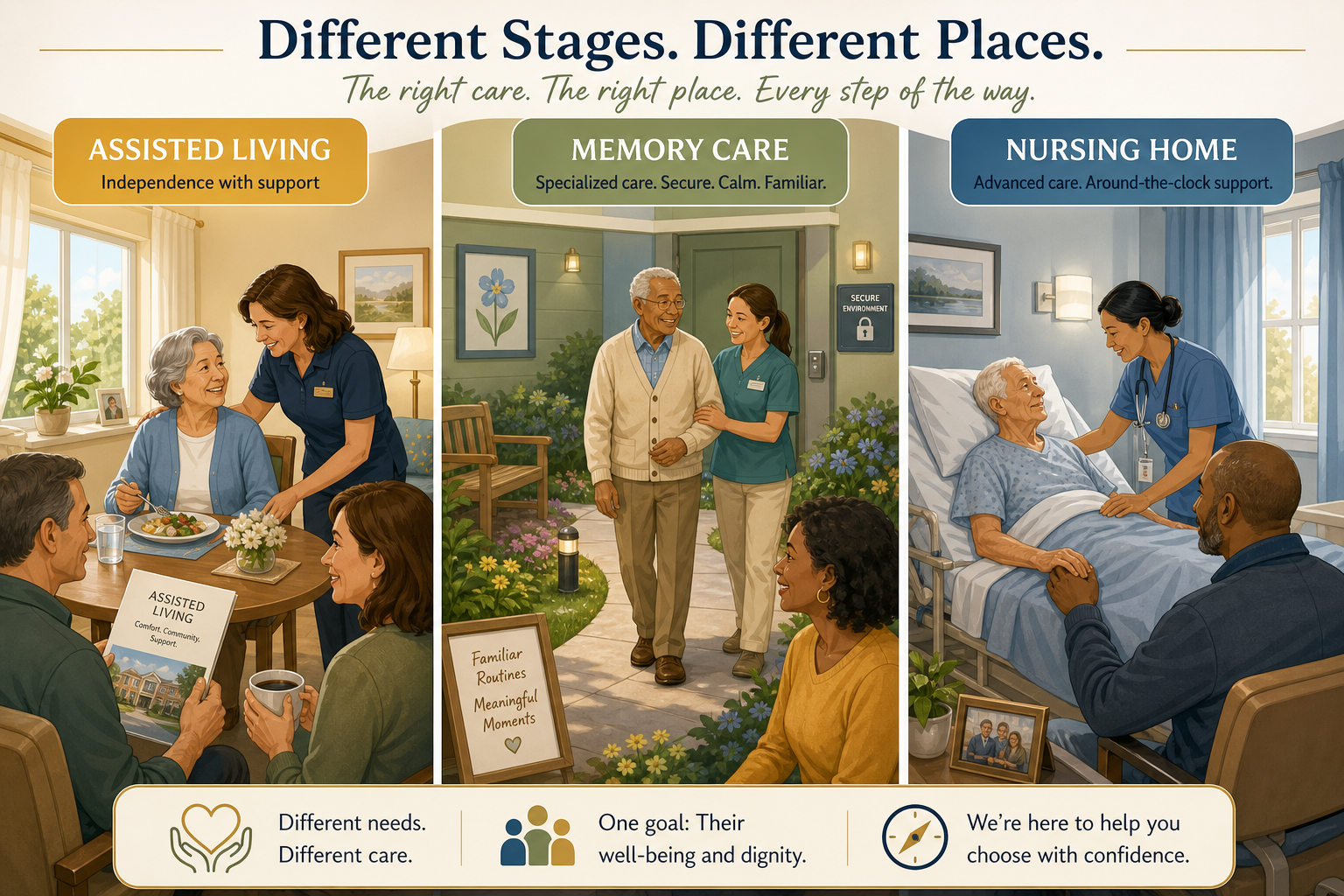
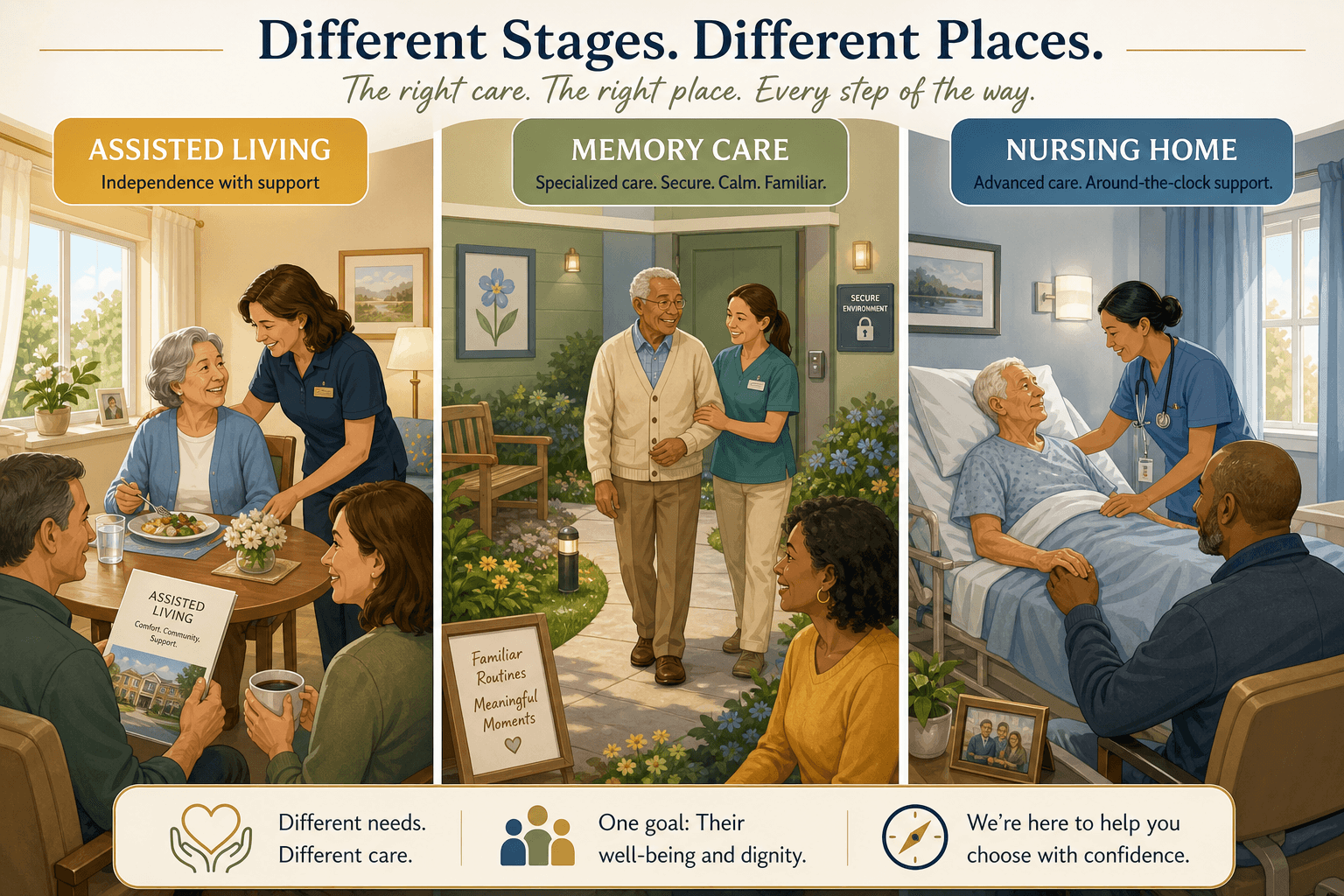
Different stages of dementia require different levels of care. Understanding what each facility type can and cannot provide is the first step toward making the right choice.
The Three-Way Dilemma: Assisted Living, Memory Care, or a Nursing Home for a Parent with Dementia?
When a parent has Alzheimer's or another dementia, the question of where they should live rarely has a simple answer. Families often assume that any senior living community can accommodate a person with memory loss, or that a nursing home is the only option once a diagnosis is given. Both assumptions lead to costly, emotionally draining moves that could have been avoided.
The reality is that assisted living, memory care, and nursing homes serve fundamentally different populations. Choosing the wrong one — even temporarily — can mean a parent is moved twice in six months, loses access to the specialized care they need, or exhausts their savings on services they do not yet require. The right choice depends on three factors: the stage of cognitive decline, the presence of co-occurring medical conditions that require skilled nursing, and the parent's safety and wandering risk.
This guide compares only these three residential facility types for dementia. If you are also weighing in-home care against a facility move, see our separate guide on home care vs. assisted living vs. memory care for a broader continuum perspective.
When Assisted Living Works: The Right Fit for Early-Stage Dementia
Assisted living is often the first facility type families consider, and for good reason: it is the least expensive residential option, with a national median cost of $5,419 per month (A Place for Mom, 2026). It provides help with activities of daily living — medication reminders, meals, housekeeping, and social activities — in a home-like setting. For a parent in the early stages of dementia who is still mobile, socially engaged, and not prone to wandering, assisted living can be an appropriate and comfortable choice.
However, assisted living has clear limits that families must understand before signing a lease. Most assisted living communities are not designed to manage the behavioral and safety challenges that emerge as dementia progresses. They typically lack:
Secured entrances and exits to prevent wandering
Staff with specialized dementia training in managing agitation, aggression, and sundowning
A lower staff-to-resident ratio needed for close supervision
Skilled nursing services such as wound care, IV therapy, or feeding tube management
If your parent is still able to feed themselves, use the bathroom independently, and participate in group activities without becoming agitated, assisted living may work for a period of months or even a year or two. But the median length of stay in assisted living is only 22 months (A Place for Mom), and for a person with dementia, that timeline is often shorter. When the disease progresses to the point where your parent begins wandering, experiencing significant behavioral changes, or needing help with transfers, assisted living will no longer be sufficient.
When Memory Care Is Needed: The Specialized Environment for Mid-Stage Dementia
Memory care is a distinct type of residential care designed specifically for people with Alzheimer's disease and other dementias. It is not simply a wing of an assisted living community with a locked door. True memory care communities are built from the ground up around the needs of someone with cognitive decline.
Memory care becomes the right choice when your parent reaches the mid-stage of dementia, characterized by:
Wandering or attempting to leave the home unsupervised
Behavioral changes such as agitation, aggression, or sundowning
Needing supervision with most activities of daily living
Difficulty recognizing familiar people or places
Poor judgment that creates safety risks (e.g., leaving the stove on)
Memory care communities provide a secured environment — doors with locks or alarms, enclosed outdoor areas, and sometimes tracking bracelets — so residents have the freedom to move safely within the facility (Harvard Health). They also use design features such as color-coded walls and personalized memory boxes to help residents navigate and feel oriented.
The staffing model in memory care is fundamentally different from assisted living. A common caregiver ratio is one caregiver to five or six residents, and all staff should be trained in dementia care, including how to manage distress, anger, and aggression (Alzheimer's Foundation of America). Most memory care communities have at least one registered nurse or licensed nurse practitioner on the floor 24/7. Activities are tailored to the cognitive abilities of residents and may include reminiscence therapy, art sessions, sensory stimulation, gardening, music, and cognitive games (Harvard Health).
This specialized environment comes at a premium. Memory care costs 15 to 25 percent more than standard assisted living (SeniorLiving.org). The national median cost is approximately $8,019 per month (SeniorLiving.org, May 2026), though some sources report a lower median of $6,450 per month (A Place for Mom, 2025), reflecting differences in methodology and geographic coverage.
When a Nursing Home Is Required: Advanced Dementia with Medical Complications
A nursing home — also called a skilled nursing facility — becomes necessary when advanced dementia is accompanied by medical complications that require 24/7 skilled nursing care. This is not a matter of preference; it is a matter of what memory care communities are legally and structurally equipped to provide.
The specific conditions that signal a need for nursing home level of care include:
Inability to feed oneself, requiring feeding tube placement or full assistance with eating
Swallowing difficulties (dysphagia) that increase the risk of aspiration pneumonia
Bedbound status or complete dependence on others for all transfers and repositioning
Chronic wounds or pressure ulcers that require regular wound care
IV therapies, respiratory therapy, or other skilled medical treatments
Rehabilitative therapies — speech, occupational, or physical — following a hospitalization
Nursing homes are the only residential facility type that is federally regulated and required to have licensed nurses on staff 24 hours a day. They provide medication management and administration, wound care, IV therapies, respiratory therapy, and rehabilitative therapies that most memory care communities cannot legally provide (A Place for Mom).
The cost of a nursing home reflects this higher level of medical care. The national median cost is $9,277 per month for a semi-private room and $10,646 per month for a private room (CareScout/Genworth, cited by A Place for Mom, 2025–2026). The Alzheimer's Association reports average annual costs of $116,800 for a private room and $104,025 for a semi-private room in nursing homes that provide memory care (Harvard Health).
Moving a parent to a nursing home is often the most difficult transition for families. It signals that the disease has progressed to a point where the family can no longer provide the necessary care at home or in a memory care setting. This is not a failure — it is a recognition that your parent's medical needs have exceeded what any non-medical setting can provide.
Cost Comparison: Assisted Living vs. Memory Care vs. Nursing Home
The table below summarizes the national median monthly costs for each facility type. These figures are drawn from multiple sources with different collection methodologies and timeframes, so ranges rather than single figures provide the most accurate picture.
National median monthly costs for assisted living, memory care, and nursing homes. Costs vary significantly by state and region.
Facility Type
National Median Monthly Cost
Source and Year
Assisted Living
$5,419
A Place for Mom, 2026
Memory Care
$6,450 – $8,019
A Place for Mom, 2025 / SeniorLiving.org, May 2026
Nursing Home (Semi-Private Room)
$9,277
CareScout/Genworth, cited by A Place for Mom, 2025–2026
Nursing Home (Private Room)
$10,646
CareScout/Genworth, cited by A Place for Mom, 2025–2026
Memory care costs 15–25% more than standard assisted living (SeniorLiving.org), but remains less expensive than a nursing home. However, the cost gap between memory care and nursing homes narrows significantly in states with high memory care costs — seven of the most expensive states for memory care are in the Northeast, while five of the least expensive are in the Southeast (SeniorLiving.org).
Decision Flowchart: Which Facility Type Matches Your Parent's Needs?
Use the following decision tree to narrow down which facility type is most appropriate for your parent's current situation. Start at the top and follow the questions in order.
Does your parent need skilled nursing care — wound care, IV therapy, respiratory therapy, feeding tube management, or 24/7 licensed nursing supervision? If yes, a nursing home is required. If no, proceed to question 2.
Can your parent feed themselves without assistance? If no, a nursing home is required. If yes, proceed to question 3.
Does your parent wander, attempt to leave the home, or have significant behavioral changes such as agitation, aggression, or sundowning? If yes, memory care is the appropriate choice. If no, proceed to question 4.
Is your parent mobile and able to participate in social activities with minimal supervision? If yes, and they are in the early stages of dementia, assisted living may be appropriate. If no — if they need significant help with daily activities or are at risk of wandering — memory care is the safer choice.
This flowchart is a starting point, not a substitute for a professional assessment. An elder law attorney, geriatric care manager, or your parent's primary care physician can provide individualized guidance based on your parent's specific medical and cognitive status.
10 Questions to Ask on Facility Tours
When you tour assisted living, memory care, or nursing home facilities, the questions you ask can mean the difference between finding a good fit and making an expensive mistake. The Alzheimer's Foundation of America's 10 Questions to Ask When Considering a Memory Care Community provides an excellent framework. Below are the most critical questions, adapted for all three facility types.
What specific dementia training does your staff receive, and how is it updated? All staff — not just nurses — should be trained in dementia care, including how to manage distress, anger, and aggression (Alzheimer's Foundation of America).
What is your staff-to-resident ratio during the day and overnight? In memory care, a common ratio is 1:5–6 (AFA). In assisted living, ratios are typically higher. In nursing homes, federal regulations require specific minimum staffing levels.
Is there a registered nurse or licensed nurse on the floor 24/7? Most memory care communities have at least one RN or LPN on site at all times (AFA). Assisted living may not. Nursing homes are federally required to have licensed nurses 24/7.
How do you handle wandering, agitation, and sundowning? Look for specific non-pharmacological approaches, not just medication. Memory care should have secured doors, alarms, and enclosed outdoor areas (Harvard Health).
What medical services can you provide on-site, and what requires a transfer to a hospital or nursing home? Memory care communities cannot legally provide wound care, IV therapy, or feeding tube management (A Place for Mom). Know the limits before you need them.
What happens when a resident's needs exceed what you can provide? Does the facility have a transfer agreement with a nursing home? How much notice do families get before a move is required?
Can you accommodate companion rooms (two residents sharing a room)? Companion rooms can significantly reduce costs, especially in nursing homes where semi-private rooms are common (AFA).
What is your current occupancy rate and do you have a waiting list? High-quality memory care communities often have waiting lists. The AFA recommends starting the search early to avoid being forced into a less suitable facility.
What is included in the base monthly fee, and what services cost extra? Pricing models vary — all-inclusive, a la carte, or tiered (A Place for Mom). Ask about move-in fees, second-person fees for couples, and charges for additional care hours.
Does the facility accept Medicaid, and if so, what is the process for transitioning from private pay to Medicaid? Many families exhaust their savings over time. Knowing whether a facility accepts Medicaid can prevent a forced move later (AFA).
Take these questions with you on every tour. Write down the answers. If a staff member cannot answer clearly or seems evasive, consider it a red flag.
Resources for Your Decision
The following authoritative resources can help you continue your research and make an informed decision:
Alzheimer's Association: Offers a 24/7 helpline (800-272-3900), local chapter support, and online tools for finding and evaluating care options.
Choosing the right place for a parent with dementia is one of the most consequential decisions a family caregiver will make. By understanding what each facility type can and cannot provide — and matching that to your parent's current stage of cognitive decline and medical needs — you can avoid costly mistakes and ensure your parent receives the care and safety they deserve.

Comments
Join the discussion with an anonymous comment.