
Caregiver decision guide
10 signs your aging parent needs in-home assistance — and how to start the conversation
Wondering if your aging parent needs in-home help? This guide uses the ADL/IADL framework to identify 10 observable signs that assistance may be needed and provides a step-by-step conversation script to start the discussion with a resistant loved one.
Ask most adult children how they knew their parent needed help at home, and the answer is almost always the same: after the fall. That single event becomes the threshold. But by the time a fall happens, the functional decline has been going on for months, sometimes years.
The Caregiving in the US 2025 survey shows just how far along families are before they ever call a professional. Nearly two-thirds of family caregivers (65 percent) now assist with at least one activity of daily living (ADL). More than 8 in 10 help with three or more instrumental activities of daily living (IADLs) — up from 77 percent in 2015. On average, family caregivers spend 27 hours per week providing care, and nearly a quarter provide 40 hours or more.
That means the help is already happening. The only missing piece is the structure to decide whether it is enough, and the conversation to bring in paid support before the family caregiver burns out.
A better yardstick: ADLs and IADLs explained
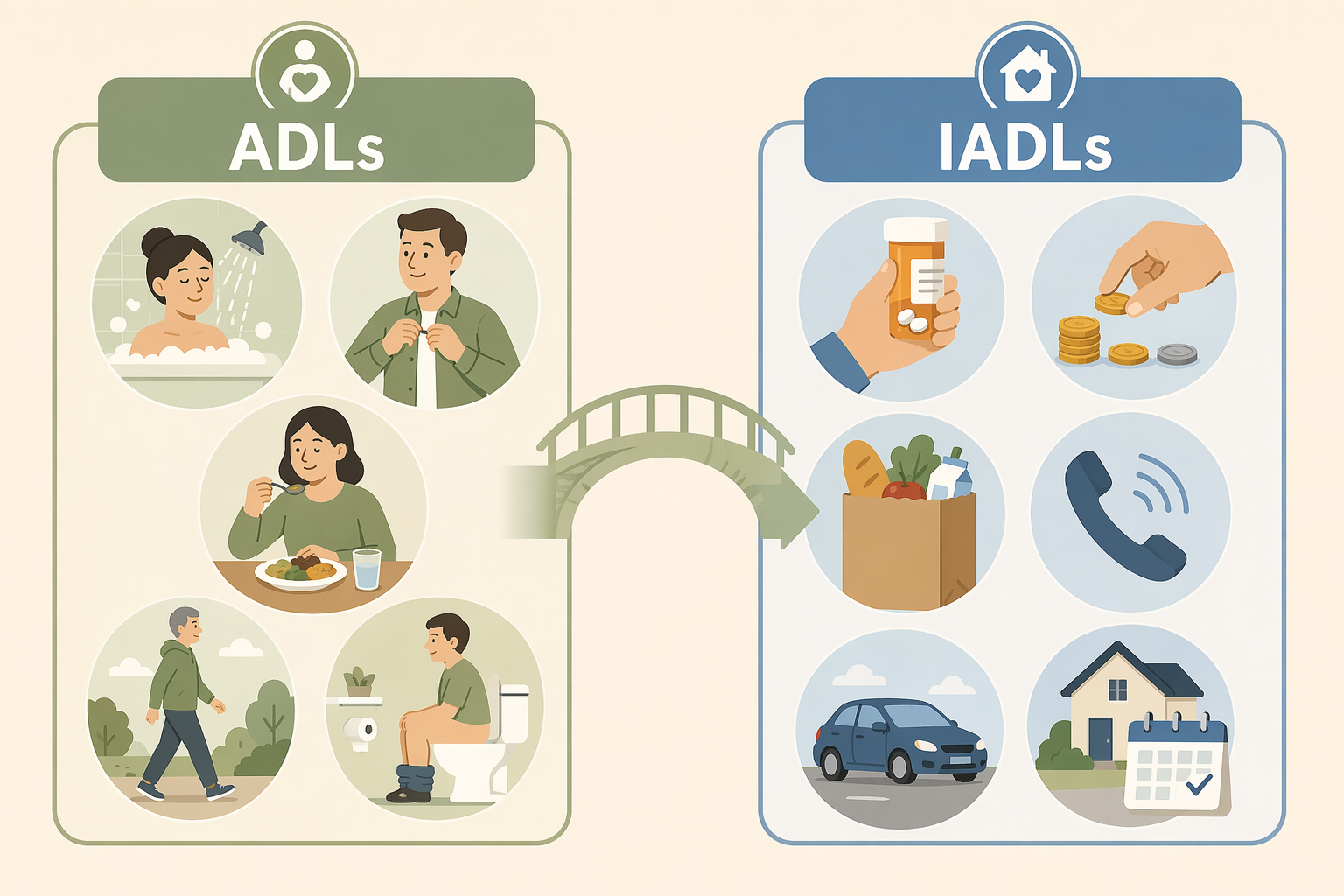
If you have never heard the terms, here is the short version: ADLs (activities of daily living) are the basics — bathing, dressing, eating, walking, toileting. IADLs (instrumental activities of daily living) are the skills you need to live alone — managing medications, handling finances, shopping, using the phone, arranging transportation, keeping the house. IADL decline almost always comes before ADL decline. That means you have an early warning system if you know what to look for.
I am not a clinician, and this article is not a diagnosis. The framework is a lens — a way to organize what you are already seeing. The National Institute on Aging notes that home health services charge by the hour and that even small amounts of in-home care, as home care expert Vicki Demirozu puts it, can extend their independence. That is the point of using a yardstick: to catch the decline early enough that a small intervention still works.
10 signs you can actually observe
Each sign below is tied to an ADL or IADL. You do not need a medical background to spot them — just a willingness to look honestly.
1. Expired food and an empty pantry (IADL: meal preparation)
Spoiled milk, freezer-burned packages, cabinets with nothing but stale crackers. Your parent might be skipping meals or eating the same thing every day because it is easier. Meal preparation is an IADL — when it slips, nutrition declines, and that affects everything else.
2. Missed medications or confused dosing (IADL: medication management)
Pill bottles with different dates, refills not picked up, a blood pressure reading that makes no sense. Medication management is one of the first IADLs to unravel. It is also one of the most dangerous to ignore.
3. Decline in personal hygiene or unkempt home (ADL: bathing, dressing; IADL: housekeeping)
Clothes that are stained or worn repeatedly, a noticeable body odor, dust accumulating, dishes piling up. These are not laziness — they are signs that the energy or physical ability to keep up with basic self-care and home maintenance is declining.
4. Unpaid bills and unusual financial transactions (IADL: finances)
Collection notices, overdue utility bills, checks written to unfamiliar companies, or a sudden inability to explain a bank statement. Financial management is an IADL that often declines earlier than families realize. It is also a sensitive topic — which is why it often goes unmentioned until a crisis.
5. Frequent close calls — falls, burns, near misses (IADL/ADL: mobility, safety awareness)
A burn on the arm from the stove, a stumble on the stairs that they dismiss as a trip, a fender bender that was really a judgment error. These events are the body and brain sending signals that the margin is shrinking. For detailed fall-prevention strategies, see our guide on building a home safety system.
6. Social withdrawal and isolation (IADL: social engagement)
Declining invitations, staying home more often, not answering the phone. One in three older adults reports isolation, and it is not just an emotional issue — it is a functional decline in the ability to maintain social connections, which is an IADL. Isolation also increases the risk of depression and further decline.
7. Difficulty with mobility — getting up from chairs, climbing stairs, walking to the mailbox (ADL: walking, transferring)
If your parent uses furniture to steady themselves, avoids stairs, or says they are too tired to go to the mailbox, that is a mobility issue. It affects everything from bathing to grocery shopping. An occupational therapist can evaluate the home environment and recommend simple modifications.
8. Forgetfulness that affects safety (IADL: memory/safety awareness)
Stove left on, front door unlocked, pots forgotten on the burner. These are not just annoying — they are safety risks. Forgetfulness that affects daily tasks is a red flag for an IADL decline in executive function. It may or may not be dementia, but it warrants an assessment.
9. Recent hospital discharge without a recovery plan (IADL: care coordination)
A hospitalization is a turning point. If your parent is discharged without clear instructions for follow-up care, medication changes, or physical therapy, the likelihood of a readmission is high. See our triage plan for the first 72 hours after a crisis for immediate next steps.
10. Caregiver burnout — when you are the one struggling (IADL: caregiver health)
You are irritable, exhausted, snapping at your spouse or your kids. You are spending so much time helping your parent that you have stopped seeing friends or exercising. Caregiver burnout is a sign that the current setup is not sustainable. Use our self-assessment checklist to recognize the symptoms before they become serious.
The “it’s not bad enough yet” objection — and why it is wrong
I hear this constantly: “She’s still managing. It’s not that bad.” But the data says otherwise. Families wait until they are already doing the work — 65 percent are already helping with ADLs and 84 percent with three or more IADLs. That is not “not bad enough.” That is already doing the job without calling it that.
That is Vicki Demirozu at A Place for Mom. She also recommends talking about in-home care before it is needed so that when changes occur, the senior is already used to having help and it is not an abrupt change. Early introduction normalizes it. Waiting turns a gradual transition into a crisis.
How to start the conversation — a script you can actually use

The key is to tie help to your parent’s own goals. Most older adults want to stay at home. Use that.
- “I know you want to stay in this house. To make that possible, we need someone to help with the stairs so you don’t fall.”
- “The doctor said we need to be careful about your blood pressure. What if we had someone come by twice a week to check your meds and make sure you’re eating well?”
- “I’m worried I’m not doing a good enough job for you. Let’s get some help so I can be your daughter again instead of your nurse.”
- “If we try this for a month and you hate it, we can stop. But let’s at least try.”
If the conversation brings up guilt or resistance, our guide on recognizing the signs and overcoming caregiver guilt offers additional strategies.
Match each sign to the right type of help
Not every sign needs a full-time home health aide. The table below maps each observable sign to a specific service type. Costs are national medians from A Place for Mom (2026): $34 per hour, with state ranges from $25 to $44. At 30 hours per week, that runs about $4,416 per month. Many families start with far fewer hours.
| Sign | Observable Behavior | ADL / IADL | Recommended Service Type |
|---|---|---|---|
| 1. Nutrition | Expired food, empty pantry | IADL: meal preparation | Meal preparation service or Meals on Wheels |
| 2. Medications | Missed pills, confused dosing | IADL: medication management | Medication reminder system or home health aide |
| 3. Hygiene / home | Unkempt appearance, dirty home | ADL: bathing/dressing; IADL: housekeeping | Personal care aide for bathing; housekeeping service |
| 4. Finances | Unpaid bills, unusual checks | IADL: finances | Bill-pay assistance or money management program |
| 5. Falls / close calls | Burns, stumbles, near-miss accidents | ADL: mobility/safety | Fall prevention assessment; grab bars, alert system |
| 6. Social withdrawal | Declining outings, isolation | IADL: social engagement | Companion service or adult day program |
| 7. Mobility | Trouble getting up, climbing stairs | ADL: walking/transferring | Occupational therapy evaluation; mobility aids |
| 8. Forgetfulness (safety) | Stove left on, unlocked doors | IADL: safety awareness | Home monitoring sensors or memory care consultation |
| 9. Recent hospitalization | No follow-up plan, high readmission risk | IADL: care coordination | Transitional care service or home health nursing |
| 10. Caregiver burnout | Exhaustion, irritability, neglect of self | IADL: caregiver health | Respite care (in-home or adult day), caregiver support group |
For a detailed breakdown of each service type, see Senior Health Services by Care Need.
Your next step: a printable assessment checklist
Print this article’s sign list, or create a simple notebook page with two columns. Write the sign on the left, date and frequency on the right. Observe for one week. Then ask yourself: Which sign is happening more than once a week? That is your starting point.
If you are still unsure, share this article with a sibling or a trusted friend. Sometimes the hardest part is deciding to look.
Questions to bring to a clinician or OT
This is not medical, legal, or a family's final decision — only a framework. Bring these questions to a clinician, occupational therapist, or your local Area Agency on Aging.
Find Local HelpRelated reading
- Home Care vs. Assisted Living: How to Decide Which Type of Living Assistance Your Aging Parent Actually Needs
- Is It Time for Home Help? Recognizing When Your Aging Parent Needs Assistance and How to Start the Conversation
- Senior Home Services: A Practical Decision Framework for When to Hire Help, What It Costs, and How to Start
Noticed something outdated or inaccurate on this page? Flag a correction. We review every report against CDC, NIA, and AARP HomeFit guidance before updating a page.