
Caregiver decision guide
Why Bathing Difficulty Is a Warning Sign: A Data-Driven Guide for Family Caregivers
Bathing difficulty is not just a hygiene issue—peer-reviewed research identifies it as a sentinel event that statistically precedes decline in other daily activities. This guide helps adult children understand why acting early matters and what to do next.
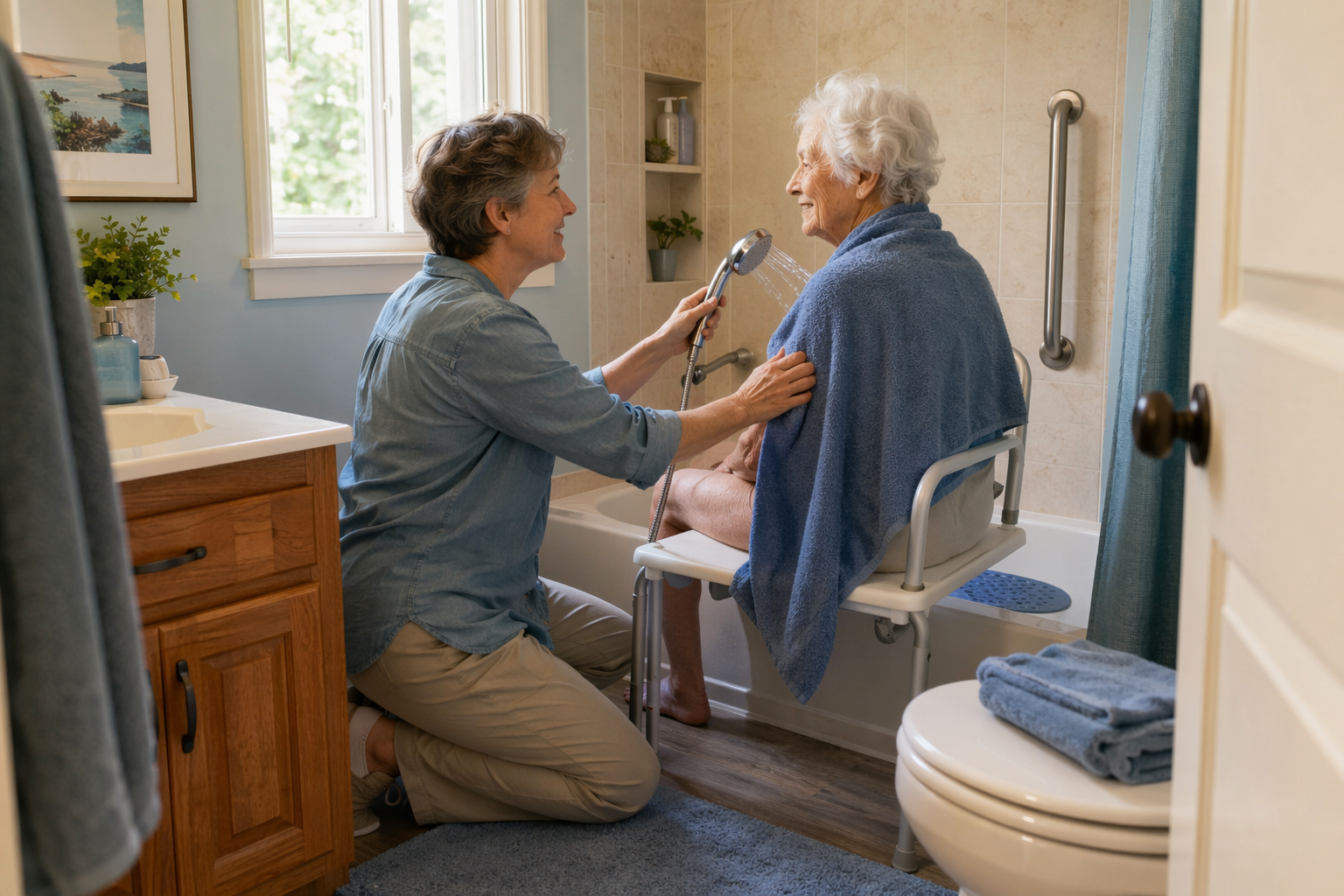
Bathing Trouble Is More Than a Cleanliness Problem
When an older adult begins to struggle with bathing, it is easy to dismiss it as a preference for privacy, a temporary lack of energy, or a simple dislike of the activity. Many family caregivers assume the solution is a better shower chair, a handheld sprayer, or a gentle nudge to bathe more often. But the research tells a different story — one that demands a more serious response.
A landmark prospective cohort study published in the Journal of the American Geriatrics Society followed 754 community-living adults aged 70 and older for up to six years. The findings were striking: 58.4% of participants experienced at least one episode of bathing disability during the study period, and 34% had multiple episodes. The average episode lasted roughly six months. Among the oldest-old — those aged 90 and above — the annual incidence of bathing disability reached 14.9% per year, the highest rate of any activity of daily living (ADL) measured.
These numbers are not merely academic. They reveal that bathing difficulty is one of the most common and earliest signs that an older adult's body is beginning to lose the capacity to manage daily life independently. Recognizing this pattern early gives families a window of opportunity — a chance to intervene before a single problem cascades into multiple ones.
What the Research Says: Bathing Disability as a Sentinel Event
The Yale research team led by Dr. Thomas Gill did not just document how common bathing disability is. They asked a more important question: Does bathing difficulty predict other problems? The answer, published in 2006, reshaped how geriatricians think about functional decline.
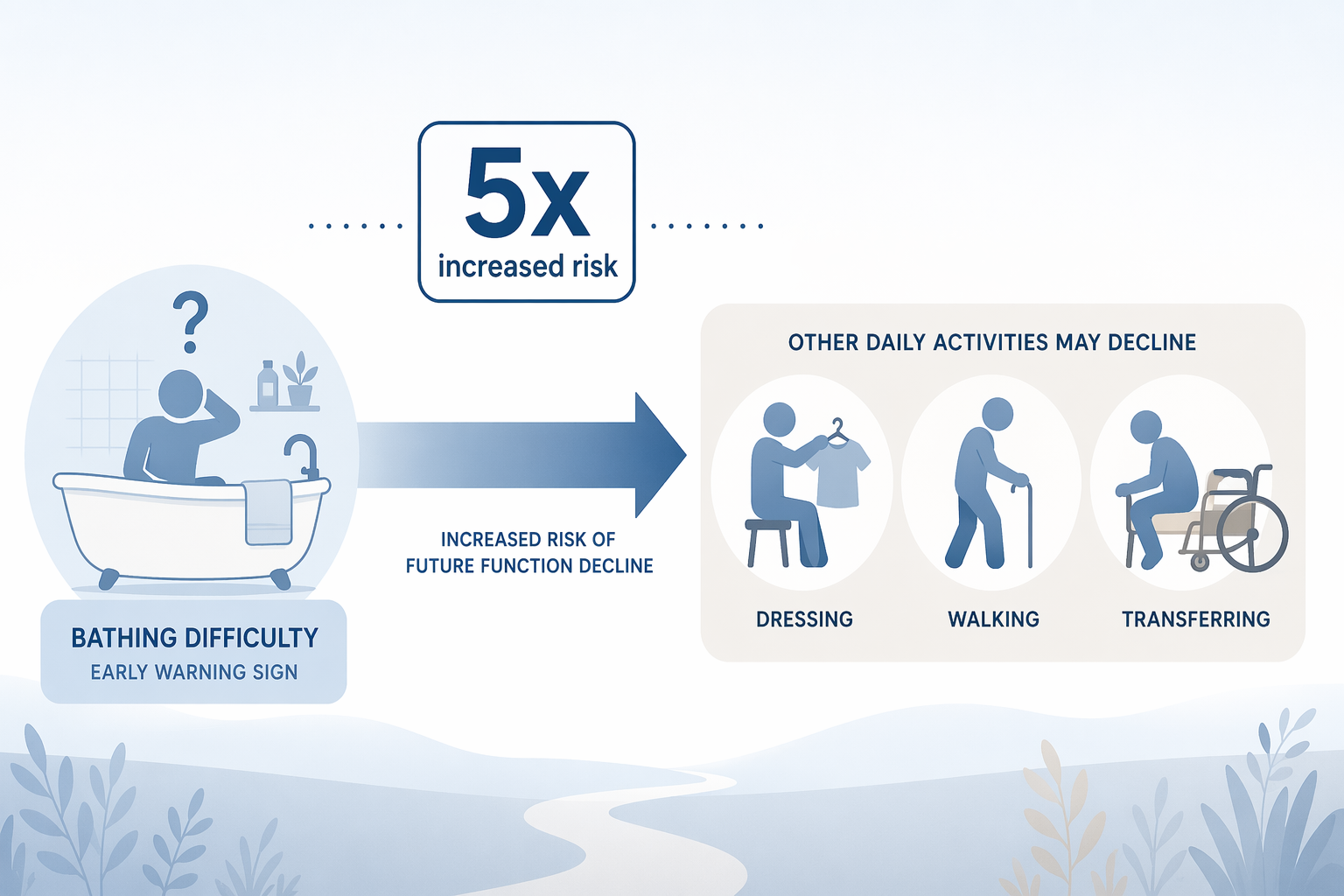
The study found that 86.1% of bathing disability episodes were not preceded in the prior month by disability in dressing, transferring, or walking. In other words, bathing trouble typically appears first — before an older adult has trouble getting dressed, moving from a chair to a bed, or walking across a room. Nearly half (48.3%) of bathing disability episodes occurred without any simultaneous disability in those other activities.
"Disability in bathing may serve as a sentinel event in the disabling process." — Gill et al., Journal of the American Geriatrics Society, 2006
The most clinically significant finding was the hazard ratio: onset of bathing disability increased the likelihood of developing disability in other essential ADLs the following month fivefold (HR = 5.1, 95% CI = 4.1–6.4). This means that when an older adult begins to struggle with bathing, the risk of soon struggling with dressing, walking, or transferring is not slightly elevated — it is dramatically higher.
This sentinel-event framework changes the caregiver's task. Instead of asking, "How do I make bathing easier?" the more urgent question becomes, "What else might be starting to decline, and how can I prepare?" Bathing difficulty is not the problem — it is the early warning system.
The Bathroom Fall Connection: Why the Bathroom Is the Most Dangerous Room
The bathroom is where bathing difficulty and fall risk converge — and the data is sobering. According to the CDC, more than one in four older adults (age 65+) falls each year, and falls are the leading cause of both fatal and nonfatal injuries in this population. Each year, there are approximately 3 million emergency department visits due to older adult falls and about 1 million fall-related hospitalizations.
But the bathroom is disproportionately dangerous. Research consistently shows that bathroom falls are 2.4 times more likely to result in injury than falls occurring in other rooms. An estimated 234,000 emergency department visits each year are for bathroom-related injuries among older adults. The combination of wet surfaces, hard fixtures, confined spaces, and the complex physical movements required for bathing — stepping over a tub edge, standing on one leg to dry off, reaching for a towel — creates a perfect storm for injury.
- Falls are the most common cause of traumatic brain injuries in older adults.
- In 2019, 83% of hip fracture deaths and 88% of emergency department visits for hip fractures were caused by falls.
- About 37% of older adults who fall report an injury requiring medical treatment or activity restriction.
- Falling once doubles the chances of falling again.
When an older adult is already struggling with bathing — perhaps feeling unsteady on their feet, unable to lift a leg over the tub wall, or relying on a towel rack for support — the fall risk escalates further. The sentinel event of bathing difficulty and the high-injury environment of the bathroom form a dangerous feedback loop.
The Underutilization Gap: Why Most Homes Aren't Ready
Given the strength of the evidence — that bathing difficulty is common, that it predicts broader decline, and that the bathroom is a high-risk environment — one would expect most families to install basic safety adaptations as soon as trouble appears. But the data shows the opposite.
A cross-sectional study by Naik and Gill (2005) examined 566 community-living adults aged 73 and older in the same New Haven cohort. The researchers assessed the prevalence of environmental adaptations for bathing — grab bars, shower chairs, non-slip mats, handheld showerheads, and transfer benches. The findings were stark: the prevalence of most adaptations was less than 50%, even among participants who already had bathing difficulty.
| Adaptation | Prevalence in those with bathing difficulty | Prevalence in those without difficulty |
|---|---|---|
| Grab bars | 6–54% (range across types) | 2–44% |
| Shower chair or bench | Modestly higher, but still <50% | Lower |
| Non-slip mats | Most common, but still underutilized | Moderate |
| Transfer aids | 59% in those with difficulty | Lower |
Even more concerning: participants who had difficulty bathing (but were not yet dependent on another person) were significantly less likely to have adaptations than those who already needed personal assistance. For bathing transfers specifically, 59% of those with difficulty had adaptations compared to 88% of those with dependence (p < 0.001). In other words, families tend to wait until a crisis — until the older adult can no longer bathe alone — before making changes.
Why does this gap persist? Multiple factors are at play: the cost of modifications, lack of awareness about what is available, reluctance on the part of the older adult to accept help or admit difficulty, and the absence of a routine occupational therapy assessment that could identify needs before a crisis occurs. The Naik & Gill study concluded that "assessment and remediation strategies should be better targeted to bathing function across the continuum of disability" — meaning interventions should begin at the first sign of difficulty, not after dependence is established.
Action Thresholds: When to Move From Observation to Intervention
The sentinel-event framework is not meant to cause alarm. Its purpose is to give caregivers a clear, evidence-based rationale for acting early — and a set of observable thresholds that signal when it is time to move from watching to doing.
Consider these thresholds as prompts for action, not predictions of inevitable decline. Many older adults who develop bathing difficulty recover or stabilize with the right support. The goal is to catch the signal early enough to make a difference.
- After a bathroom fall or near-fall: Any fall in the bathroom — even one where no injury occurred — is a red flag. The combination of bathing difficulty and a fall history significantly elevates risk for a more serious injury next time.
- When the older adult expresses fear of bathing: Fear of falling in the shower or tub is a common early symptom of declining balance or strength. If your parent says they are "nervous" or "don't feel steady" in the bathroom, take it seriously.
- When you notice skipped baths or visible difficulty: Bathing less frequently than usual, avoiding the shower, or taking much longer to complete a bath can all indicate underlying difficulty. Visible signs include struggling to step into the tub, holding onto unstable surfaces (towel racks, sink edges) for support, or appearing exhausted after bathing.
- When the older adult relies on furniture or fixtures for balance: Using a towel rack, toilet tank, or door frame to lower into or rise from the tub is a sign that the person lacks the lower-body strength or balance to perform the transfer safely. Towel racks are not designed to bear body weight and can pull out of the wall.
- When bathing assistance ranks among the top caregiver challenges: Caregiver surveys consistently rank bathing assistance among the three most difficult daily activities, alongside toileting and transferring. If you find yourself dreading bath time or feeling physically strained while helping, that is a signal that the current setup is not working.
What to Do Next: Practical First Steps
If any of the action thresholds above describe your parent's situation, here is a short checklist of evidence-informed first steps. Each item links to a detailed guide on this site for deeper reading.
- Schedule an occupational therapy (OT) assessment. An OT can evaluate your parent's specific functional limitations and recommend personalized adaptations — from grab bar placement to transfer techniques. This is the single most impactful step you can take.
- Install grab bars and non-slip mats immediately. Do not wait for a formal assessment to address the most obvious hazards. Use our Bathroom Safety Checklist for Seniors to identify and prioritize changes room by room.
- Consider a shower chair or transfer bench. Seated bathing eliminates the most dangerous part of the task — standing on a wet surface. Our Shower Chair and Bath Seat Selection Guide helps match the seat type to your parent's mobility level.
- Explore home health aide coverage under Medicare. Medicare covers part-time home health aide services (including help with bathing) only when the patient is also receiving skilled nursing care, physical therapy, speech-language pathology, or occupational therapy. The patient must be homebound. After the Part B deductible is met, beneficiaries pay 20% of the Medicare-approved amount for durable medical equipment. Medicare does not cover custodial or personal care when that is the only care needed.
- Read the companion practical guide. Our Bathing Assistance for Elderly: A Fall Prevention and Equipment Guide covers hands-on techniques, equipment selection, and step-by-step safety protocols for family caregivers.
- Plan for broader home modifications. If your parent's mobility is likely to continue changing, consider a room-by-room upgrade plan. Our Aging-in-Place Home Modifications Guide covers cost ranges, funding sources, and contractor considerations for structural changes beyond the bathroom.
Questions to bring to a clinician or OT
This is not medical, legal, or a family's final decision — only a framework. Bring these questions to a clinician, occupational therapist, or your local Area Agency on Aging.
Find Local HelpRelated reading
Noticed something outdated or inaccurate on this page? Flag a correction. We review every report against CDC, NIA, and AARP HomeFit guidance before updating a page.