
Caregiver decision guide
Bathing Resistance in Older Adults: 5 Root Causes and What Actually Works
If your elderly parent or spouse refuses to bathe, it's rarely about stubbornness. This guide breaks down the five most common underlying causes—fear of falling, loss of control, sensory changes, depression, and dementia—with matched strategies to reduce conflict and restore hygiene.
Your mother hasn't bathed in a week. You've asked, pleaded, argued. It's probably not stubbornness, and it's probably not your fault.
According to the Caregiver Action Network, bathing assistance ranks among the top three most difficult daily caregiving tasks. That's not because the mechanics are complicated—it's because the resistance feels personal. Treating it as a behavioral problem usually makes it worse, because the resistance is a symptom with specific drivers. In my reading of the available research and clinical guidance, five causes explain most cases. Each requires a different response. The caregiver's job is not to win a battle of wills—it's to figure out which cause is at work.
This article is a diagnostic framework. It is not a general bathing guide—you can find that in our companion piece, Why Your Elderly Parent Refuses to Bathe. Here I want to help you match the resistance pattern to the right intervention.
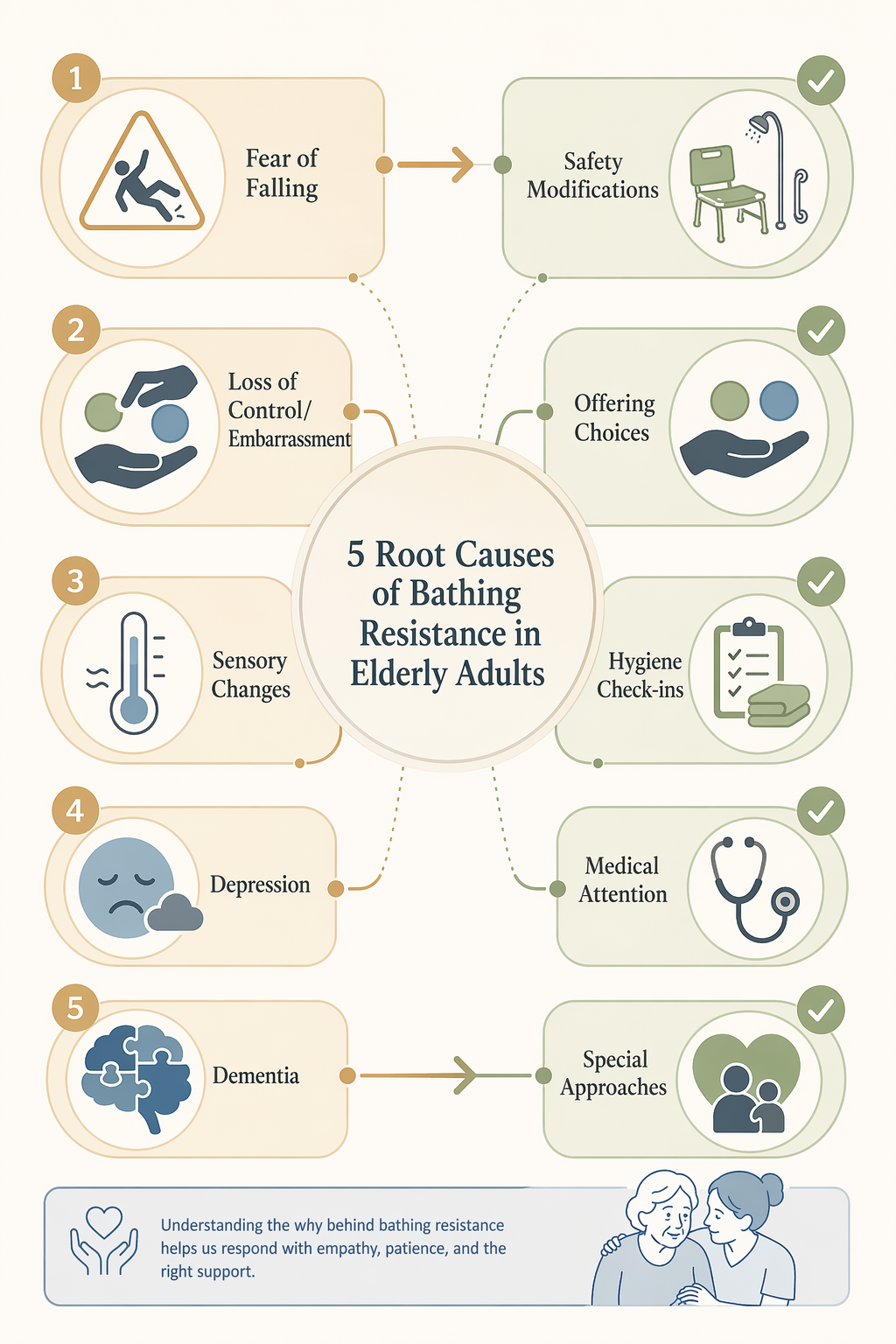
Fear of Falling: The Most Rational Reason
When a person who is steady on dry ground becomes rigid and anxious at the bathroom door, the most likely cause is fear of falling. That fear is not irrational. The CDC's 2008 study of bathroom injuries—still the most comprehensive national data we have—found that 81.1% of bathroom injuries among adults 15 and older are caused by falls. For adults aged 85 and older, the injury rate was 515 per 100,000, and 13.7% of bathroom injuries resulted in hospitalization.
Those numbers are fourteen years old now, but nothing I've seen suggests the risk has decreased. The National Council on Aging estimates the total health care cost of older adult falls at $80 billion per year as of 2020, with 67% paid by Medicare. So your mother or father has good reason to be afraid.
The fix is environmental. One survey found that only 19% of U.S. homes had grab bars installed in bathrooms, despite 63% having bathtub mats. Grab bars, a shower chair, a non-slip mat, and a handheld showerhead turn the bathroom from a hazard into a safe space. Our guide to bathroom modifications for elderly safety covers exactly what to install and how to talk a reluctant older adult into accepting them. The distressing part is how few repeat fallers actually make these changes—you can read about that gap in Why 40% of Repeat Fallers Still Have No Bathroom Modifications.
Loss of Control: When Bathing Feels Like an Invasion
Some older adults resist not because they're afraid of falling, but because the act of being helped with intimate care feels like a loss of dignity. The Alzheimer's Association notes that people with dementia may perceive bathing as threatening partly due to loss of control. But the same dynamic occurs with cognitively intact older adults: needing someone else to wash your body is humiliating, and resistance is a way to reclaim autonomy.
The intervention here is choice. The Alzheimer's Association recommends offering simple options: "Do you want to bathe now or in 15 minutes?" or "Would you prefer a bath or a shower?" The specific answer matters less than the fact that the person retains control over something. You can also invite participation—letting them hold the washcloth, wash their own face, or choose the water temperature—so they remain an active participant, not a passive subject.
This cause often overlaps with fear of falling, especially in someone who has had a near-miss. If you see both anxiety and a bristling at being directed, address both: provide safety modifications first, then layer in choices.
Sensory Changes: They Genuinely May Not Notice
A different kind of resistance occurs when an older adult genuinely doesn't notice they need bathing. Reduced ability to smell body odor and decreased temperature sensitivity are common with aging. The Caregiver Action Network recommends setting the water heater to a maximum of 120°F to prevent scalding—a direct acknowledgment that older adults may not feel dangerously hot water.
I should be straightforward: the evidence for sensory changes as a root cause of bathing refusal is thinner than for the other four causes. Beyond the water temperature note, there isn't much research. But the mechanism is plausible, and many experienced caregivers describe it. If your parent seems genuinely unaware of body odor or doesn't flinch at very hot water, sensory changes may be the issue. The solution is low-key: routine hygiene check-ins at regular intervals, not confrontation. Use visual cues—"Let's freshen up before your daughter visits"—rather than arguments about smell.
Depression: When the Will to Care Fades
Depression looks different from the other causes. It is not active resistance or fear; it is apathy. The person stops bathing because they have lost interest in self-care entirely. The Caregiver Action Network lists depression among the underlying causes of bathing resistance, but the evidence base is slim—it's mentioned briefly, and no dedicated studies quantify how often depression drives refusal.
That doesn't mean depression should be ignored. If the person seems sad, withdrawn, irritable, or has lost interest in activities they once enjoyed, the right response is not a new bathing technique—it is a medical evaluation by a primary care physician or geriatric psychiatrist. Do not try to diagnose depression yourself. The line between depression and early dementia can be very thin, and misapplying behavioral strategies can frustrate everyone involved.
Dementia: When the Bathroom Becomes Threatening
For people with Alzheimer's or other dementias, bathing can feel like an attack. The Alzheimer's Association explains that depth perception problems, a cold environment, and loss of control combine to make the bath or shower seem frightening. This is not stubbornness; it's a misperception of reality.
The recommended approach is specific: prepare the environment before announcing bath time—warm the room, have supplies ready. Use simple one-step commands. Try the "watch-me" technique: demonstrate squeezing shampoo onto your own hand, then hand the bottle to them. For many, sponge baths, no-rinse soap, and washing one body part per day cause less distress than a full shower. The Alzheimer's Association also notes that same-gender caregivers and draping a towel over the person's shoulders for modesty can reduce resistance.
This section is deliberately concise because we have a dedicated article on bathing a parent with dementia that covers the topic in depth. For the diagnostic framework, the key point is that dementia is one of five equal causes—not the default explanation.
When Causes Overlap: Depression vs. Early Dementia
The hardest distinction is between depression and early dementia, because both can present as withdrawal and loss of interest in hygiene. Here are some clues that can help you start the conversation with a professional:
- Onset: Depression tends to have a more sudden onset (weeks to months), while dementia's changes are gradual (years).
- Awareness: People with depression often recognize they are neglecting hygiene but lack the energy to act; people with dementia may not recognize the issue at all.
- Emotion: Depression typically includes sadness or low mood; early dementia may show frustration, confusion, or anxiety.
These are not diagnostic rules. They are starting points. If you are unsure, the safest path is to ask the primary care clinician for a cognitive screening and a depression screening. Arriving with specific observations ("She hasn't bathed in two weeks and seems sad, not angry") is far more helpful than a general complaint about resistance.
What to Say and Do Now: Practical Scripts and Compromises
Regardless of the cause, these immediate strategies can reduce conflict:
- Change your language. Instead of "Take a bath," say "Let's wash up." Instead of "You need a shower," say "Let's get you freshened up for lunch." The less the act sounds like an instruction, the less resistance it triggers.
- Offer a choice between two acceptable options. "Do you want to bathe now or after your show?" Not "Do you want to bathe?" which invites a no.
- Split the task. Wash hair one day, body the next. Use a no-rinse shampoo cap on in-between days. The Alzheimer's Association endorses this approach: it maintains hygiene with much less distress.
- Try a bed bath. A warm washcloth, no-rinse soap, and a towel can clean someone thoroughly in bed with minimal disruption. This is especially useful when the person is ill, very tired, or simply refusing to enter the bathroom.
- Set the water heater to 120°F (49°C) as a safety baseline, regardless of cause—this prevents scalding if the person cannot feel temperature or if they flinch and knock the faucet.
When to Bring in Professionals and What It Costs
You do not have to do this alone. Consider professional help in these situations:
- Falls or near-falls have occurred in the bathroom.
- You cannot identify the root cause despite several attempts.
- The person shows signs of depression (sadness, withdrawal, loss of appetite).
- You are experiencing caregiver burnout—exhaustion, irritability, or feeling resentful.
An occupational therapist can assess the bathroom and recommend specific equipment or modifications that match the person's mobility level. Home health aides can handle bathing tasks for a few hours a week. Adult day services often include bathing assistance, which can be less stressful than doing it at home.
The cost is not trivial. According to AARP, the median annual cost for a home health aide working 44 hours per week was $77,792 in 2024—roughly $34 per hour. Costs vary significantly by region, and Medicare does not typically cover non-skilled personal care like bathing assistance. Some states offer Medicaid waivers that can help. If you are a veteran, the VA may provide home care grants. This is a financial conversation that deserves its own planning—but the decision to seek help should not be deferred solely because of cost.
The question you started with—"Why won't they bathe?"—has a better answer: because something real is in the way. Your job is to find that thing and remove it, not to defeat the resistance. The framework I've described gives you a place to start. Use it. Adjust it. And when the cause turns out to be something you cannot fix alone, bring in someone who can.
Questions to bring to a clinician or OT
This is not medical, legal, or a family's final decision — only a framework. Bring these questions to a clinician, occupational therapist, or your local Area Agency on Aging.
Find Local HelpRelated reading
Noticed something outdated or inaccurate on this page? Flag a correction. We review every report against CDC, NIA, and AARP HomeFit guidance before updating a page.