
Caregiver decision guide
Elderly Care Options: A Complete Decision Framework for Families
Overwhelmed by the number of care options for an aging parent? This step-by-step framework helps you assess functional needs, match them to the right setting, compare costs, and navigate payment — so you can make a confident, informed decision.

Start Here: The Three Trigger Questions
Before you dive into facility brochures or cost calculators, pause and answer three questions. These will tell you whether you are in a crisis that demands immediate action or in a planning window where you can methodically evaluate options. Most families delay this conversation until a fall, a hospitalization, or a frightening episode forces the issue — and that rush often leads to decisions that cost more emotionally and financially than a planned transition would have.
1. Is your parent safe in their current living situation right now?
Safety is the non-negotiable starting point. Ask about recent falls, burns or kitchen accidents, missed medications, wandering, or unexplained bruises. If the answer to any of these is yes, you may need to prioritize a setting with 24/7 supervision or immediate safety modifications before you complete a full assessment.
2. Can you — and your caregiving team — sustain the current level of help?
Be honest about your own capacity. Are you missing work, losing sleep, or feeling resentful? Is the primary caregiver a spouse who is also elderly and frail? If the caregiving arrangement depends on one person who is burning out, that arrangement is not sustainable, regardless of how well it is working today.
3. Is the care need likely to be short-term or long-term?
A parent recovering from hip replacement surgery has a fundamentally different care trajectory than one with progressive Alzheimer's disease. Distinguishing between short-term rehabilitation and long-term custodial care early will save you from choosing a setting that cannot adapt as needs evolve.
Assess Functional Needs: The ADL/IADL Checklist
The single most useful tool for matching a senior to the right care setting is a functional assessment using Activities of Daily Living (ADLs) and Instrumental Activities of Daily Living (IADLs). These are the standardized measures that doctors, social workers, and facility admissions teams use to determine level of care. You can use them at home to get a clear picture before you ever talk to a facility.
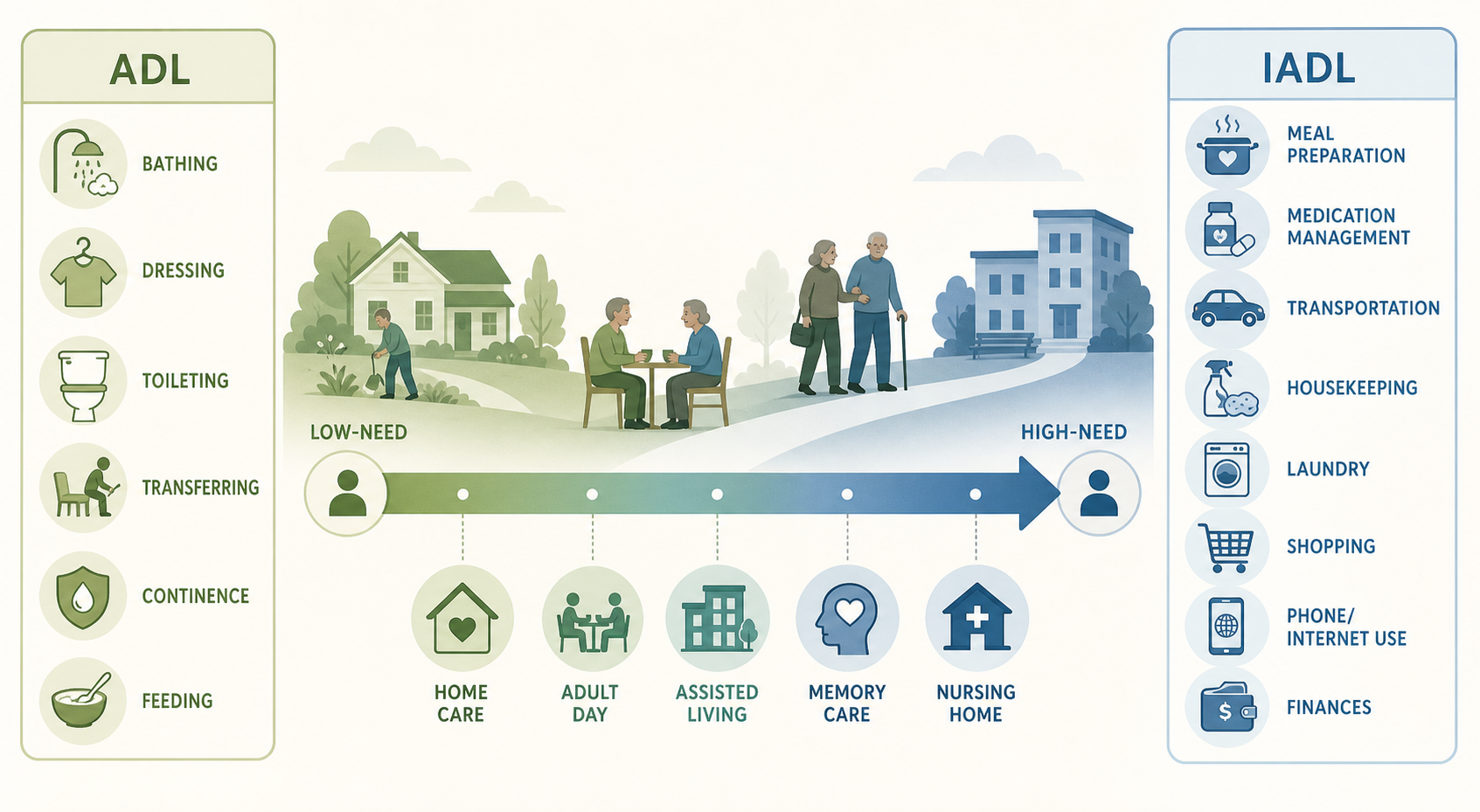
Activities of Daily Living (ADLs)
These are the fundamental self-care tasks. For each one, ask: can your parent do this independently, with supervision, or not at all?
- Bathing — getting in and out of the tub or shower, washing all body areas
- Dressing — selecting clothes, buttoning, zipping, managing fasteners
- Toileting — getting to and from the toilet, cleaning, managing clothing
- Transferring — moving from bed to chair, standing from a seated position
- Continence — controlling bladder and bowel function
- Feeding — getting food from plate to mouth, chewing, swallowing
Instrumental Activities of Daily Living (IADLs)
These are the higher-level tasks needed to live independently in the community. Deficits in IADLs often appear before ADL deficits and signal the need for supportive services rather than full personal care.
- Meal preparation — planning and cooking nutritious meals
- Medication management — obtaining, organizing, and taking correct doses
- Transportation — driving or using public transit for errands and appointments
- Housekeeping — cleaning, laundry, maintaining a safe home environment
- Shopping — buying groceries and household necessities
- Telephone use — dialing numbers, answering calls, using a mobile device
- Financial management — paying bills, tracking expenses, avoiding scams
Match Deficits to Care Options: The Decision Matrix
Once you have a clear picture of your parent's functional deficits, you can map them directly to the care settings that address those specific needs. The matrix below uses ADL/IADL deficits as the organizing principle — not facility names or marketing categories.
| Care Option | Best For (ADL/IADL Profile) | Key Features | Typical Monthly Cost (2026) |
|---|---|---|---|
| Home Care (non-medical) | 0–1 ADL deficits; 2–4 IADL deficits; safe home environment; family caregiver needs relief | Hourly aide for bathing, dressing, meal prep, light housekeeping; companion services; no 24/7 supervision | $6,478 (44 hrs/week) |
| Adult Day Services | 0–1 ADL deficits; 2–3 IADL deficits; caregiver works during the day; senior needs social engagement | Structured daytime program with meals, activities, supervision; no overnight care | $95 per day |
| Assisted Living | 1–2 ADL deficits; 3–4 IADL deficits; needs help with daily tasks but not skilled nursing | Private apartment with meals, housekeeping, 24/7 staff, medication reminders; social activities | $6,200 |
| Memory Care | Dementia diagnosis; 2+ ADL deficits; wandering, agitation, or safety risks from cognitive decline | Secure unit within assisted living or nursing home; specialized staff training; structured routines | $7,645 |
| Nursing Home (Skilled Nursing) | 3+ ADL deficits; complex medical needs; post-hospital rehabilitation; 24/7 nursing care required | 24/7 licensed nursing; on-site therapy; full personal care; Medicare covers short-term stays | $9,842 (semi-private) / $11,294 (private) |
| Continuing Care Retirement Community (CCRC) | Currently independent or low-need but wants guaranteed access to higher care levels on same campus | Independent living, assisted living, and nursing home on one campus; entrance fee + monthly fee; life-care contracts available | $100K–$2M entrance fee + $3,000–$8,000/month |
For a deeper look at how these three most common options compare, see our guide on Home Care vs. Assisted Living vs. Nursing Home: How to Match Senior Living Assistance to Your Parent's Actual Needs. For a broader catalog of all six options with descriptive detail, read Beyond 'Senior Citizen Home': A Family Guide to 6 Senior Living Options in 2026.
2026 Cost Comparison: What Each Option Really Costs
Cost is often the deciding factor, but comparing prices across care settings is not straightforward. Home care charges by the hour and excludes housing and meals. Assisted living bundles rent, meals, and basic services but charges extra for higher care levels. Nursing homes are all-inclusive but carry the highest base price. The table below uses 2026 national median data from multiple sources to give you an apples-to-apples starting point.
| Care Option | National Median Cost (2026) | What's Included | Source |
|---|---|---|---|
| Home Care (44 hrs/week) | $6,478/month | Hourly aide; no housing, meals, or utilities | CareScout via A Place for Mom |
| Adult Day Services | $95/day | Daytime supervision, meals, activities | CareScout via U.S. News |
| Assisted Living | $6,200–$6,313/month | Rent, meals, housekeeping, 24/7 staff, basic ADL assistance | CareScout / Genworth |
| Memory Care | $7,645/month | Secure unit, specialized dementia programming, higher staff ratio | CareScout via U.S. News |
| Nursing Home (Semi-Private) | $9,842/month | Room, board, 24/7 nursing, therapy, full personal care | SeniorLiving.org |
| Nursing Home (Private) | $11,294/month | Same as semi-private but private room | SeniorLiving.org |
| CCRC (Entrance Fee + Monthly) | $100K–$2M + $3K–$8K/month | Independent living + guaranteed access to higher care levels | CareScout via U.S. News |
For a deeper state-by-state cost comparison of home care, assisted living, and nursing homes, see our dedicated guide: Home Care vs. Assisted Living vs. Nursing Home: Which Is Actually Cheaper in 2026?.
Payment Pathways: Which Funding Source Fits Which Setting
Understanding how to pay for care is not about memorizing government program rules — it is about knowing which funding source applies to which care setting. The wrong assumption (for example, that Medicare will pay for assisted living) can derail an otherwise sound plan. Here is how the major funding sources map to the care options in this framework.
| Funding Source | Best For This Care Setting | Key Limitation |
|---|---|---|
| Medicare (Part A) | Short-term skilled nursing facility (up to 100 days after a 3-day hospital stay); home health (limited, short-term) | Does not cover custodial care, assisted living, or long-term nursing home stays. 2026 Part A deductible: $1,736. |
| Medicaid | Long-term nursing home care (primary payer nationally, covering 82 cents per dollar); home and community-based services waivers in some states | Strict income and asset limits (~$2,000 in most states); eligibility rules vary by state; not all assisted living facilities accept Medicaid. |
| PACE (Program of All-Inclusive Care for the Elderly) | Frail seniors who qualify for nursing home level of care but want to remain in the community; covers medical and long-term care comprehensively | Available in only 33 states + D.C.; 194 programs serving 87,750 participants; waitlists exist in many areas. Average cost for non-Medicare/Medicaid enrollees: $4,000–$5,000/month. |
| VA Aid & Attendance | Veterans or surviving spouses needing help with ADLs; can be used for home care, assisted living, or nursing home | 2026 maximum: $2,424/month for single veteran, $2,874/month for married veteran, $1,558/month for surviving spouse. Requires VA medical exam and application. |
| Long-Term Care Insurance | Varies by policy — may cover home care, assisted living, nursing home, or adult day services | Must have purchased policy before care was needed; many policies have elimination periods and daily benefit caps. Not a solution for families in crisis. |
| Private Pay (Out-of-Pocket) | Any setting; most common payment method for assisted living and home care | The median American household cannot sustain $6,000+/month for more than a few years. Most families transition to Medicaid after depleting assets. |
For a complete walkthrough of each funding source — including application steps, eligibility details, and state-by-state variations — see our comprehensive guide: How to Pay for Senior Health Care Services: A Family Guide to Medicare, Medicaid, Private Pay, and Everything in Between.
Step-by-Step Action Plan: How to Tour and Evaluate Facilities
Once you have narrowed your options to one or two care settings, the real work begins: evaluating specific facilities. A facility's marketing materials and website will always present the best version of itself. Your job is to see the reality. Use this ordered action plan to conduct thorough, informed evaluations.

Before You Visit
- Check Medicare's Care Compare tool and the National Consumer Voice for Quality Long-Term Care for inspection reports, complaint histories, and staffing data.
- Download the NIA's Medicare Nursing Home Checklist (PDF) and bring it with you — it covers everything from cleanliness to staff interaction to safety.
- Call the facility and ask for the current staff-to-resident ratio during the day and overnight. High turnover is a red flag; ask what the annual turnover rate is for direct-care staff.
- Ask about dementia-specific training for all staff, not just those on a memory care unit. Even in assisted living, staff should know how to respond to confusion, sundowning, and wandering.
During the Visit
- Make an unannounced visit at a different time of day than the scheduled tour. Visit during a meal time to see the quality of food and how staff interact with residents who need feeding assistance.
- Observe social activities. Are residents engaged? Are activities appropriate for the cognitive level of the residents? A bingo game may not serve someone with advanced dementia.
- Talk to residents and family members you encounter in the hallways or common areas. Ask them: What do you wish you had known before moving here? How responsive is staff to call lights?
- Use your senses. Does the facility smell clean? Are residents dressed and groomed appropriately? Is the temperature comfortable? Are outdoor areas accessible and used?
- Check for safety features: grab bars in bathrooms, non-slip flooring, well-lit hallways, handrails, emergency call systems in every room.
Before You Sign
- Read the contract carefully. Look for binding arbitration clauses that waive the right to sue in court. Ask if the facility has an ombudsman and how to contact them.
- Clarify what happens if your parent's care needs increase. Can they remain in the same facility? Is there an additional fee for higher care levels? Can they move to a different unit within the same campus?
- Ask about discharge policies. Under what circumstances can the facility ask a resident to leave? This is especially important for memory care units if challenging behaviors emerge.
- Review the fee schedule for additional services: medication management, laundry, transportation to appointments, special diets. These add-ons can increase the monthly bill by 20–30%.
At-a-Glance Decision Tree
Use this quick-reference decision tree to identify the most likely care option based on your answers to the trigger questions and ADL/IADL assessment. This is not a substitute for the full framework — it is a starting point for discussion.
- Is your parent safe at home right now? → No → Prioritize settings with 24/7 supervision (assisted living, memory care, or nursing home). → Yes → Proceed to ADL/IADL assessment.
- How many ADL deficits? → 0–1 → Consider home care or adult day services. → 2 → Consider assisted living or memory care (if dementia is present). → 3+ → Consider nursing home or memory care.
- Is dementia a factor? → Yes → Prioritize memory care or a facility with a dedicated dementia unit and specialized staff training. → No → Standard assisted living or nursing home is appropriate.
- Is the need short-term (rehabilitation) or long-term (custodial)? → Short-term → Medicare may cover a skilled nursing facility stay. → Long-term → Plan for private pay, Medicaid, or long-term care insurance.
- Can you afford the monthly cost? → No → Check Medicaid eligibility, VA benefits, or PACE programs. Consider adult day services as a lower-cost alternative to full-time care.
- Do you want a single solution that adapts as needs change? → Yes → Consider a CCRC if you can afford the entrance fee and want guaranteed access to higher care levels on the same campus.
For a deeper look at one of the most overlooked options in senior care — residential care homes (also called board and care homes) — see our FAQ: Residential Care Homes: The 'Hidden' Senior Housing Option Explained.
Questions to bring to a clinician or OT
This is not medical, legal, or a family's final decision — only a framework. Bring these questions to a clinician, occupational therapist, or your local Area Agency on Aging.
Find Local HelpRelated reading
Noticed something outdated or inaccurate on this page? Flag a correction. We review every report against CDC, NIA, and AARP HomeFit guidance before updating a page.