
Caregiver decision guide
Why Your Elderly Parent Refuses to Bathe: Understanding and Overcoming Bathing Resistance
Learn why many older adults resist bathing and how to identify the underlying cause—fear of falling, sensory discomfort, loss of dignity, or dementia-related confusion—with evidence-based strategies to make bath time safer, calmer, and more respectful.
Your mother is standing in the bathroom doorway, arms crossed. The water is running. You have the shower chair ready, the non-slip mat down, the warm towel waiting. She won't step in. She says the water is too hot, then too cold, then she doesn't need a bath, then she just had one three days ago. You know she hasn't had one in six. You feel frustration rising — and then guilt for feeling frustrated.
This is not stubbornness. It is a symptom of an underlying cause — and that cause is diagnosable.
In nursing homes, 20% to 40% of residents with dementia hit, kick, or scream during bathing (source: Gozalo et al., PMC). At home the rates are not as well measured, but the dynamic is the same: bathing is one of the top three most difficult activities of daily living for family caregivers, alongside toileting and transferring (source: caregiveraction.org). That 20–40% range comes from institutional studies — the effect at home may differ, but the core problem of aggressive resistance triggered by bathing is not limited to those settings. The instinct is to push harder. The evidence says to stop and diagnose.
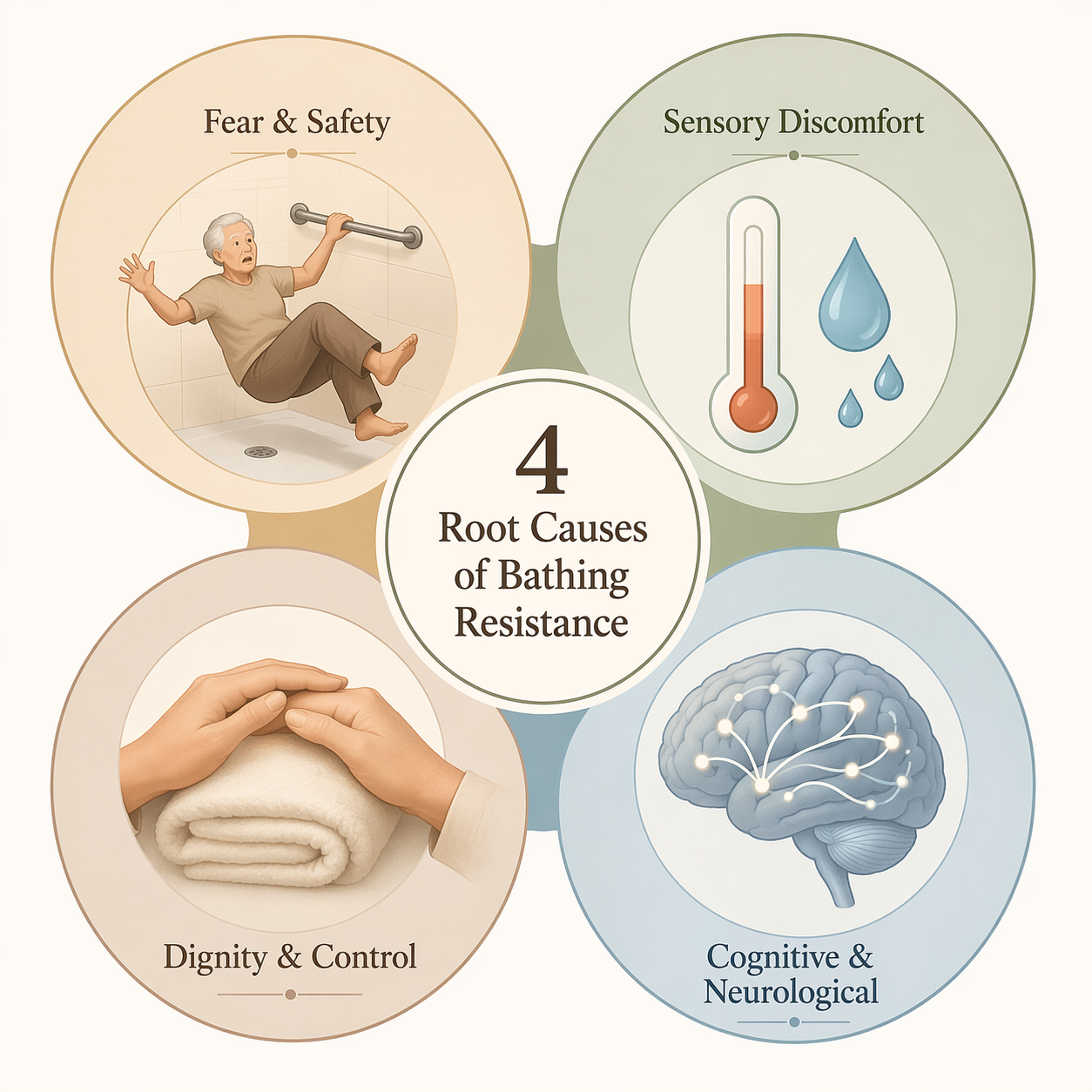
Four Causes, One Diagnosis
Generic advice — "be patient," "use a shower chair," "try a sponge bath" — fails because it treats all resistance as the same problem. It isn't. Four distinct causes drive bathing refusal, and each requires a different intervention.
What to Watch For
You cannot treat what you have not identified. The diagnostic step is simple but requires a shift in perspective: instead of thinking "how do I get them to bathe," start asking "what happens right before the resistance peaks?"
- If they grip the sink, refuse to step in, or flinch when water touches their skin, the driver is likely fear of falling or sensory discomfort.
- If they cover their body, demand privacy, or say things like "I can do it myself" while clearly unable, the driver is loss of dignity and control.
- If they look confused, ask why they are undressing, or become suddenly agitated without a clear trigger, the driver is dementia-related confusion and threat perception.
Fear: Make the Bathroom Safe
Two common reasons people do not want to shower: fear of falling and being uncomfortably cold (source: Baker Rehab Group). Fear is the louder of the two. Over 30% of senior falls happen in bathrooms or during bathroom activities (source: All Seniors Foundation). The body remembers the loss of balance even if the conscious mind does not.
Bathroom safety modifications can reduce fall risk by up to 40% (source: Amedisys). The most impactful changes are simple equipment: grab bars, a shower chair or transfer bench, a handheld showerhead, and non-slip mats. Research suggests people are 75.8% more likely to regain lost balance when a grab bar is available (source: Amedisys). I treat that number as an occupational therapist's practical observation rather than a precisely measured effect, but the direction is clear: grab bars work.

Yet many homes lack these tools. A study of Medicare beneficiaries who had repeated falls (two or more) found that 40.2% had no bathroom modifications at all — representing 1.9 million older adults (source: Ng et al., PMC). If fear is the primary cause, start here. A short checklist:
- Install grab bars in the shower and near the toilet, securely anchored to wall studs.
- Provide a shower chair or transfer bench so the person does not have to stand on a wet surface.
- Use a handheld showerhead so the water can be directed where it is needed without forcing posture changes.
- Place non-slip mats both inside and outside the shower or tub.
Sensory: Warmth and Quiet
Cold is a surprisingly common reason for refusal. The skin thins with age, circulation slows, and a room that feels neutral to you may feel freezing to your parent. The Baker Rehab Group notes that many older adults avoid showering simply because they are "uncomfortably cold."
The fix is cheap and fast: warm the room and the towels beforehand. Set the water heater to a maximum of 120°F (49°C) to prevent scalding (source: caregiveraction.org), but make sure the water is warm enough for comfort. If loud water spray or harsh lighting triggers sensitivity, use soft music or silence, dim the lights, and switch to fragrance-free products. These are low-cost changes, but they remove a sensory barrier that many caregivers never think to look for.
Dignity: Give Control Back
Bathing is the first activity of daily living in which older adults become disabled (source: Khayatzadeh-Mahani et al., PMC). The loss of independence is humiliating. When your mother covers her body and says she can do it herself, she is not being difficult — she is signaling that the loss of control is the problem.
Offer choices that restore a sense of agency. Shower versus sponge bath. Morning versus evening. Which towel to use. A randomized controlled trial of bathing skills training showed that even partial independence — letting the person wash what they can — produced significant improvements in both independence (Modified Barthel Index effect size: partial η² = 0.34) and satisfaction (COPM-Satisfaction: partial η² = 0.36) (source: same RCT). The effect persisted at follow-up. Small choices produce measurable improvements.
- Use a same-gender caregiver if possible, or cover the person with a towel during transfers to reduce exposure.
- Let them wash whatever part of their body they can manage. Even one arm is a win.
- Offer choices explicitly — "Would you like to sit on this chair or that one?" — not "Time to bathe."
Dementia: When the Brain Says No
Dementia adds a layer of cognitive confusion that overrides all other causes. The person may not perceive a need to bathe, may misinterpret the water as a threat, or may feel attacked by the help (source: Alzheimer's Association). The National Institute on Aging puts it plainly: being pushed to bathe when Alzheimer's has made the activity very hard or impossible can cause agitation and aggression (source: NIA).
The strongest evidence here comes from a program called Bathing Without a Battle (BWAB). A controlled trial found that a person-centered showering approach reduced aggressive behaviors by 53%, and a towel-bath approach reduced them by 60% (source: Sloane et al., 2004). These are nursing home studies, but the principles translate directly to home care. After BWAB training, nursing homes saw verbal aggression decline by 17.8% and antipsychotic medication use drop by 30% (source: Gozalo et al., 2014). The average bath duration also decreased by 1.5 minutes, which is meaningful when every minute is a potential trigger.
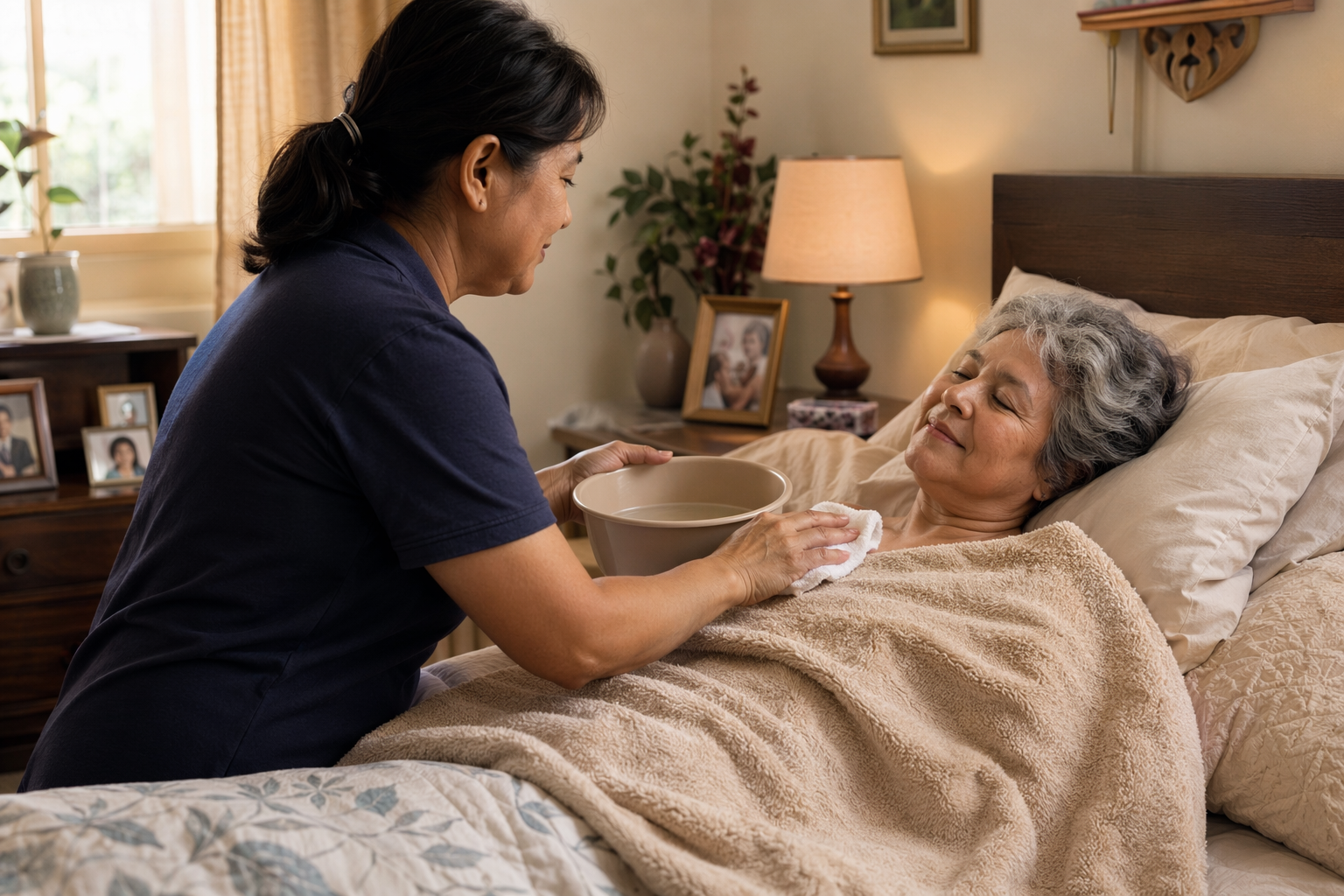
The in-bed towel bath is a key technique: warm towels with a no-rinse soap product, applied while the person stays in bed. Research shows this method is equally effective for cleanliness (source: Alzheimer's Association) and reduces the trauma of forced transfers. Use the following approach:
- Use warm, wet towels with a no-rinse soap. Wipe one section at a time, keeping the rest covered.
- Simplify cues: hand the person a washcloth instead of saying "let's wash your arms."
- Distract with a familiar song or a running commentary about something pleasant.
- Keep the bath short. The evidence shows that even a few minutes' reduction lowers agitation risk.
If these strategies are not enough — if aggression continues or worsens — it may be time to consider a more supportive environment. The sign-based decision guide for memory care can help you evaluate whether home-based approaches are still viable or whether a facility with trained dementia staff is the safer option.
Good Enough Is Fine
The pressure to give a full bath every day is self-imposed and unnecessary. The ideal bathing routine for older adults is two or three full baths per week (source: caregiveraction.org). Daily full baths dry out aging skin and can increase sensitivity and resistance.
Accept alternatives: sponge baths, no-rinse products, washing one body part per day. The Alzheimer's Association confirms that regular use of a no-rinse soap with warm towels is equally effective for cleanliness. Forcing a full bath when the person is terrified or confused causes more harm than skipping it. The bathing skills training RCT showed that even partial independence — letting the person wash their own face and arms — significantly improved satisfaction. If you can get that, you are already ahead.
If you need a break or want to explore other care options, dementia-capable adult day programs can provide respite and professional bathing assistance in a structured setting.
When to Stop
Sometimes the resistance escalates. If the person is swinging, kicking, threatening, or has already hit you, stop the bath immediately. Step away. Do not re-engage until the person has calmed down — which may take 20 minutes or two hours.
The National Institute on Aging offers concrete de-escalation steps: speak calmly, listen to concerns, reassure safety, distract with another activity. Protect yourself by hiding dangerous items and calling 911 in emergencies. These are not abstract tips; they are the threshold for when care at home may no longer be safe.
If aggression persists despite all the strategies above, it may be time to consider around-the-clock professional support. Our decision guide for 24-hour home care can help you recognize when the situation has moved beyond what one person can handle.
Questions to bring to a clinician or OT
This is not medical, legal, or a family's final decision — only a framework. Bring these questions to a clinician, occupational therapist, or your local Area Agency on Aging.
Find Local HelpRelated reading
Noticed something outdated or inaccurate on this page? Flag a correction. We review every report against CDC, NIA, and AARP HomeFit guidance before updating a page.