
Caregiver decision guide
How birdwatching benefits seniors' mental health and balance
Recent research shows that birdwatching measurably improves mood, cognitive function, and social connection in older adults — and its gentle weight-bearing movement may support balance and reduce fall risk. This article reviews the evidence and explains why birdwatching is a uniquely practical, low-cost activity for aging safely at home.
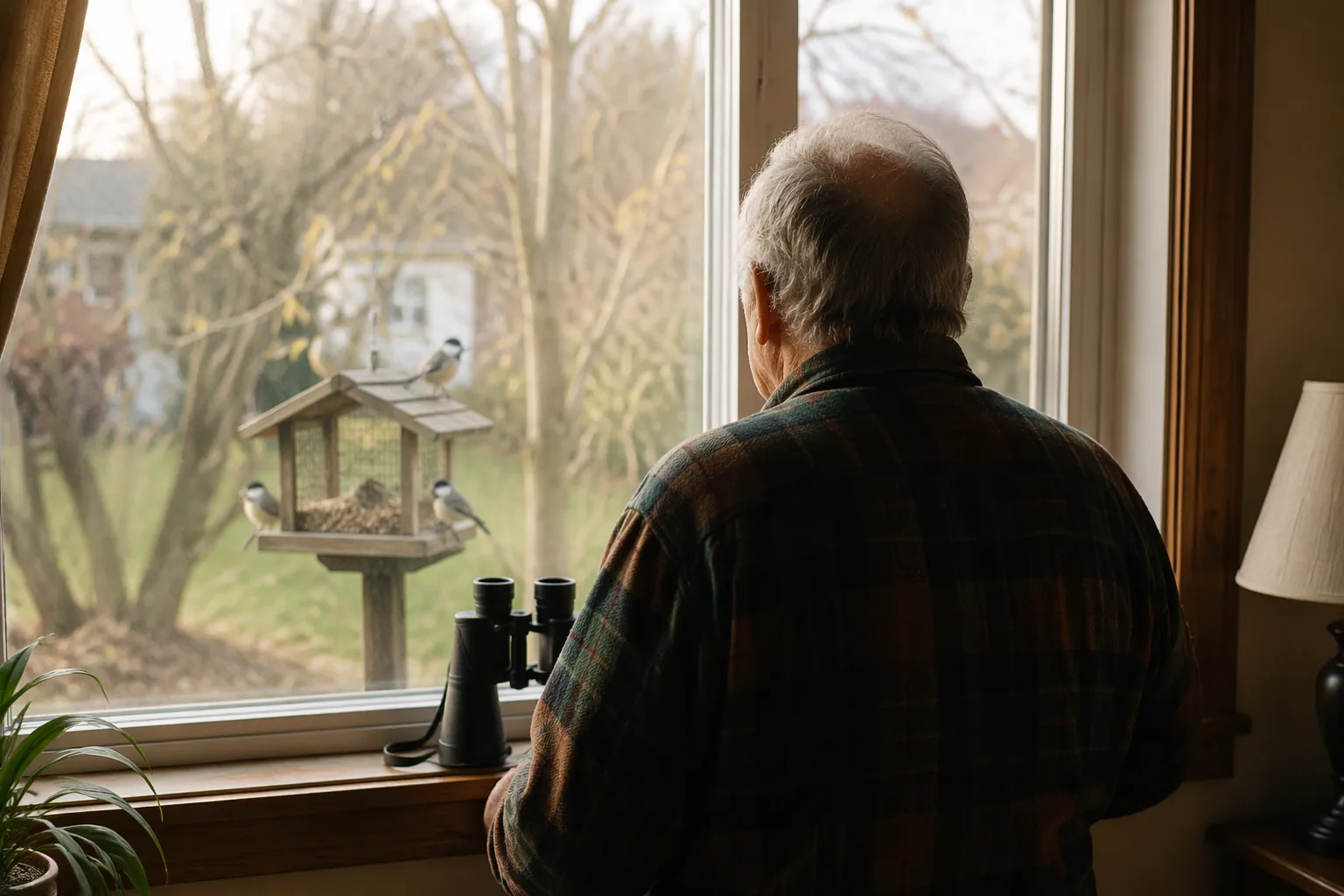
The best case for birdwatching does not begin with a marsh trail, a spotting scope, or a retired person suddenly becoming outdoorsy. It begins at a window. An older adult notices a bird land on the feeder, waits to see whether it comes back, listens for the call later in the day, and maybe tells someone, “I saw the red one again.” For a caregiver wondering whether birdwatching’s mental health benefits for seniors are real or just a pleasant hobby dressed up as health advice, that modest beginning matters.
Birdwatching is worth suggesting because it asks for very little at the start and can still do several useful things at once: lift mood, challenge attention and memory, create a reason to stand or walk gently, and give a person something specific to share with another human being. The evidence is strongest for mood and cognitive engagement. The evidence for balance and fall prevention is more conditional: birdwatching can support mobility-relevant movement, but it has not been shown to reduce falls or fall injuries directly.
The mood benefit is unusually immediate
Mood is the simplest place to start because the effect does not depend on becoming an expert. In a 2022 Scientific Reports study involving 1,300 participants, seeing or hearing birds was associated with improved mental wellbeing for up to eight hours afterward.[1] That time window is important. A short, ordinary encounter with birdlife was not merely described as “nice”; it was linked with measurable wellbeing that lasted into the day.
A later study reported in 2024 found that 30-minute birdwatching sessions improved mood more than general nature walks alone.[2] That does not mean walking in nature is unhelpful. It suggests that the focused act of looking for, identifying, and following birds may add something beyond simply being outdoors.
For an older adult who has become cautious after a fall, has stopped driving much, or has drifted out of former routines, this is a practical advantage. “Go exercise more” can sound like a reprimand. “Let’s see what comes to the feeder this week” sounds like an invitation.
Why birdwatching is different from passive relaxation
The most interesting recent evidence is not just that birds are calming. It is that birdwatching appears to train a particular kind of attention: patient, repeated, detail-sensitive perception. A February 2026 Journal of Neuroscience study by Wing and colleagues compared 58 people: 29 expert birders ages 24 to 75 and 29 age-matched novices ages 22 to 79. Using diffusion-weighted MRI, the researchers found that expert birders had structurally more compact brain tissue in frontoparietal and posterior cortical regions, areas involved in attention and perception.[3]
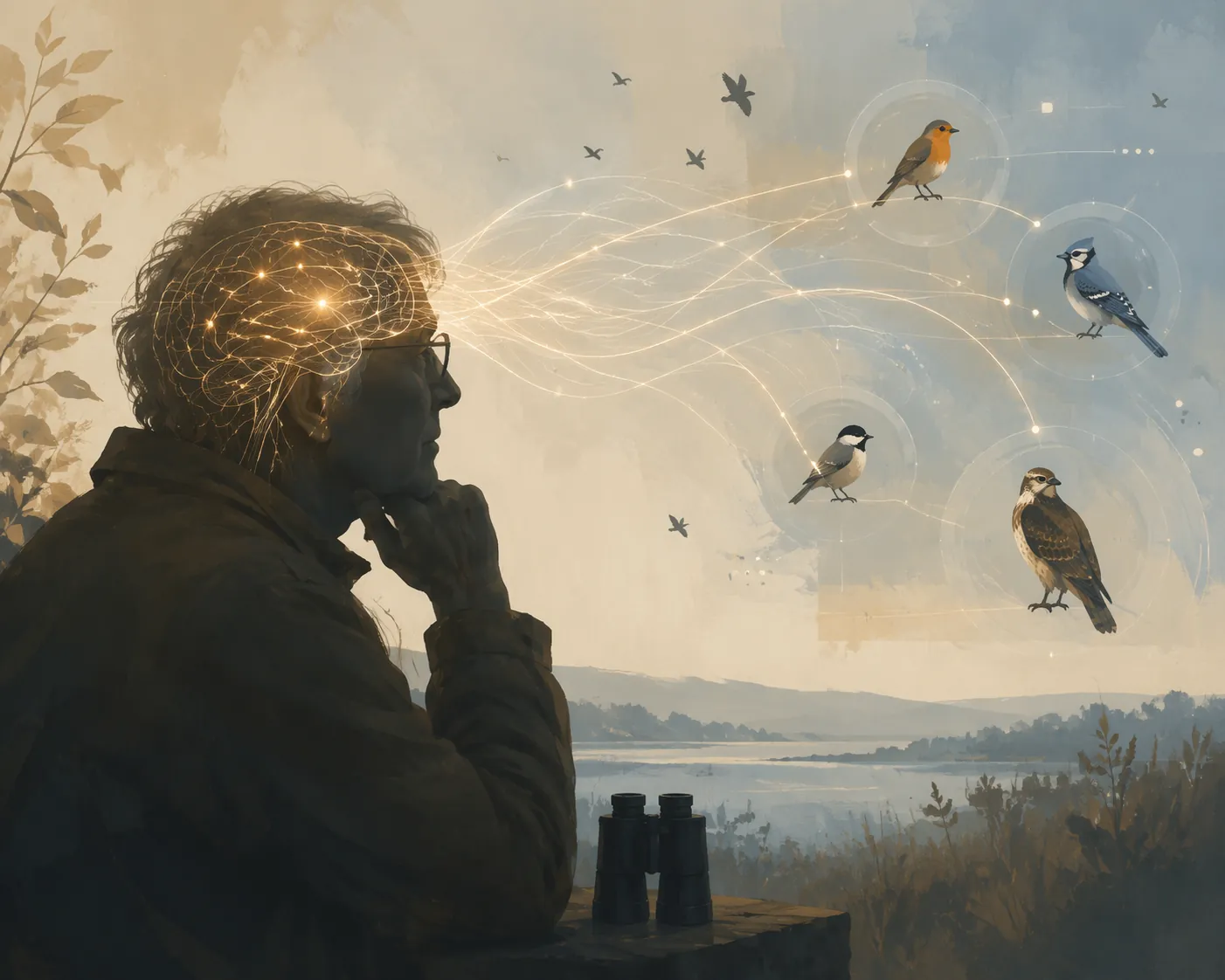
The older expert birders in that study retained this structural advantage compared with age-matched novices, and they also performed better on cross-domain memory tasks, including face recognition.[3] That last point is what makes the finding more than a hobby story. The advantage was not limited to naming birds. It appeared on a memory task outside bird identification.
The study cannot prove that birdwatching caused the brain differences. It was cross-sectional, which means expert birders and novices were compared at one point in time. People who become serious birders may already have stronger attention, memory, vision, patience, or motivation before they ever pick up binoculars. That caveat is not a technical footnote; it is the line between a promising brain-health activity and an overblown claim.
Still, the mechanism is plausible and unusually concrete. Birdwatching asks a person to notice small differences: a wing bar, a posture, a tail flick, a call repeated from a hidden branch. It asks the brain to hold a possibility in mind, compare it with memory, revise it, and try again. As Prof. Martin Sliwinski of the Penn State Center for Healthy Aging put it, birdwatching “places sustained demands on your perception, attention and memory, so you can never fully run on autopilot.”[4]
That is a useful distinction for families. A television program may be enjoyable. Sitting outside may be soothing. Birdwatching can be enjoyable and soothing, but it also gives the mind a job. The job is small enough not to feel like a test and absorbing enough to be repeated.
Cognitive reserve is a fair hope, not a dementia-prevention promise
It is tempting to leap from these findings to a simple promise: birdwatching prevents dementia. The evidence does not justify that. A 2026 Neurology finding reported a 38% lower Alzheimer’s risk and an average five-year delay in diagnosis among people engaged in cognitively enriching activities, but that figure applies to enriching activities broadly, not birdwatching specifically.[4]
Birdwatching belongs in that larger conversation because it combines learning, recall, attention, and sensory discrimination. But it should be described as a cognitively enriching activity that may help build or maintain cognitive reserve, not as a proven shield against Alzheimer’s disease.
The balance question: useful movement, not proven fall reduction
Balance is where birdwatching becomes especially attractive and especially easy to oversell. The activity can involve standing, turning the head, shifting weight, walking slowly, stopping, scanning, and restarting. Those are all movements that matter for real-world mobility. But no cited study here shows that birdwatching reduces fall incidence or fall-related injuries.
The strongest direct evidence for older adults and mobility comes from a 2023 longitudinal study by Zieris and colleagues in the Journal of Environmental Psychology. The study followed 1,684 nursing home residents across 65 facilities in Bavaria and found that regular birdwatching increased cognitive resources, mobility, and social wellbeing, including among residents with significant mobility impairments.[5] That is meaningful evidence for function and engagement in a population where small changes can matter.
It is not the same as U.S. fall-prevention data. The study setting was Bavarian nursing homes, and the outcomes were not fall counts or injury rates. So the careful translation is this: birdwatching may support balance-relevant movement and mobility, especially when it gives an older adult a reason to move a little more often, but it should not be treated as a substitute for balance assessment, medication review, vision care, or home hazard reduction.
A graded path matters more than enthusiasm
The practical strength of birdwatching is that it can be scaled down without becoming meaningless. Many activities recommended to older adults quietly assume a person can already drive, walk confidently, tolerate a group class, and accept being corrected. Birdwatching can begin before any of that is true.
| Mobility level | Birdwatching version | What it supports |
|---|---|---|
| Mostly seated or chair-bound | Watch a feeder, tree, balcony, or courtyard from a favorite chair | Mood, sensory engagement, attention, conversation, and no added outdoor walking exposure |
| Able to stand briefly | Stand at a window or doorway for short viewing periods | Weight-bearing tolerance, posture, gentle head and eye movement |
| Comfortable stepping outside | Move from chair to porch, patio, or garden bench | Transitions, confidence, routine exposure to daylight and outdoor cues |
| Able to walk short distances | Walk slowly between two or three familiar viewing spots | Gait adaptability, pacing, stopping and starting, environmental awareness |
| Interested in company | Join a local bird walk, Audubon outing, or accessible citizen-science count | Social connection, shared purpose, and a reason to keep the routine going |
For someone with a recent fall, the seated version is not a consolation prize. It is the safest starting point. A feeder visible from a kitchen table or living room chair can provide the attention and mood benefits without adding outdoor walking risk. If standing is appropriate, the next step might be two minutes at the window after breakfast. If that becomes comfortable, the next step might be the porch with a stable chair already in place.
That slow progression also helps with fear of falling. After a fall, many older adults begin avoiding movement, and avoidance can gradually weaken strength, balance, and confidence. Birdwatching gives movement a purpose that is not framed as therapy. For families dealing with that spiral, it pairs naturally with a broader plan for addressing the fear-of-falling cycle rather than trying to solve it with reassurance alone.
The surroundings still matter. A person should not be encouraged to rush to a window cluttered with cords, step onto a slick patio, or carry binoculars down uneven steps just because birds are present. If a family has been delaying practical safety changes, a bird feeder can even be a gentle way to reveal where the home setup helps or gets in the way: Is there a safe chair by the window? Is the path to the porch clear? Is the threshold easy to cross? Those are the same small observations that often open the door to closing the home safety gap.
Why people may actually keep doing it
Adherence is the unglamorous problem behind many good aging recommendations. Strength exercises help only if they are done. Walking plans help only if the person feels safe enough and interested enough to go. Birdwatching has a built-in advantage: the reward is variable. The same window is not quite the same window every morning.
That small uncertainty keeps attention alive. A senior does not need to memorize a field guide. A free bird identification app such as Merlin Bird ID can help with sound or photo identification. A basic feeder and seed can bring the activity closer to the home. Binoculars may help, but they are not required for the first step. The point is not to buy a hobby; it is to lower the friction until looking becomes routine.
There is also a social bridge that does not require a person to become socially bold overnight. A bird sighting gives an older adult something specific to text, mention to a neighbor, or compare with a grandchild. Citizen-science projects such as eBird and the Great Backyard Bird Count give that observation a destination. Local Audubon groups can add in-person connection when mobility, transportation, and temperament allow.
That matters because loneliness and social isolation in later life are associated with serious health risks, and many older adults do not respond well to vague encouragement to “get out more.”[6] A shared interest is often easier to accept than a social prescription. The same logic appears in other aging-in-place routines, including companion-based approaches such as pet adoption for seniors living alone: the activity works partly because it gives the day a reason to unfold.
How to suggest birdwatching without making it sound medical
The wording matters. Many older adults can hear a health agenda from across the room, especially after a fall. “This will help your balance and brain” may be true enough to interest a caregiver, but it can land badly with the person being helped. Better to begin with the smallest shared action.
- Put a chair where the view is comfortable before suggesting a routine.
- Start with one reliable viewing time, such as morning coffee or late afternoon.
- Use a feeder only if it can be filled safely by someone who is steady, or by a family member, neighbor, or aide.
- Try identification apps only if they add pleasure rather than frustration.
- Treat outdoor walking as optional and gradual, not as the price of participation.
A caregiver might say, “I put the feeder where you can see it from the table. Let me know what shows up.” That leaves dignity intact. It also allows the older adult to take ownership. The activity can remain a pleasure first, with health benefits following behind it.
Where birdwatching fits in a safer aging-at-home plan
Birdwatching is unusually practical because it sits at the intersection of several needs that often get handled separately. It can improve mood in the short term, demand attention and memory without feeling like a drill, encourage gentle movement across a wide range of ability levels, and create low-pressure social contact.
Its limits are just as important. It should not replace a clinical balance evaluation after a fall, a medication review, physical therapy when prescribed, vision care, footwear changes, nutrition work, or home modifications. Lifestyle habits can contribute to fall resilience, just as diet, hydration, and strength routines can; birdwatching belongs beside those efforts, not above them. Families looking at broader lifestyle supports can also consider how nutrition connects with fall prevention through anti-aging diet tips for seniors.
The practical recommendation is simple: suggest birdwatching because it is low-cost, low-pressure, and supported by specific evidence for mood and cognitive engagement, with promising support for mobility and social wellbeing. Do not promise that it will prevent dementia or stop falls. Let it begin at the window, where the barrier is lowest and the habit has room to grow.
References
- Birdwatching Has Big Mental Health Benefits. How to Start — Time, 2022
- Birding Benefits: How Nature Improves Our Mental Mindsets — Audubon
- The Tuned Cortex — Journal of Neuroscience, February 2026
- What Birdwatching Does for Your Brain — Psychology Today, March 2026
- Zieris et al. 2023 — Journal of Environmental Psychology — Journal of Environmental Psychology, 2023
- Social isolation, loneliness in older people pose health risks — National Institute on Aging
Questions to bring to a clinician or OT
This is not medical, legal, or a family's final decision — only a framework. Bring these questions to a clinician, occupational therapist, or your local Area Agency on Aging.
Find Local HelpRelated reading
Noticed something outdated or inaccurate on this page? Flag a correction. We review every report against CDC, NIA, and AARP HomeFit guidance before updating a page.