
Caregiver decision guide
How Senior Golf Tournament Play Prevents Falls
Older adults can use tournament-level golf as a structured fall prevention regimen. This article explains how the physical demands of competitive play—walking uneven terrain, rotational swings, sustained alertness—map directly to the balance, strength, and gait training the CDC STEADI model recommends, and provides a phased readiness pathway for safe participation.
For older golfers, the most useful senior golf tournament updates are not just tee times, pairings, and results. The real update is whether the body is ready for the demands of tournament play: walking for hours, reading uneven ground, rotating under control, shifting weight over and over, and staying alert while fatigue quietly changes posture. An 18-hole round can mean roughly 5–7 miles of walking, with one commonly cited course-length example estimating about 6.6 miles for a course near 6,800 yards, and that distance is not covered on a smooth clinic floor.[1]
That is why tournament golf deserves a more serious look in fall prevention than casual “golf is good for seniors” advice usually gives it. The CDC’s STEADI framework treats fall risk as something to screen, assess, and address through modifiable factors, including exercise that challenges balance, strength, and gait.[2] Tournament-level golf can touch all three at once. It can also be the wrong activity on the wrong day for the wrong person.
The safety guardrail belongs beside the promise from the start: postpone tournament play and get medical or physical therapy guidance if there has been a recent fall, a new medication that affects alertness or blood pressure, dizziness when turning, or uncontrolled blood pressure. The point is not to prove toughness. The point is to build enough capacity that the course becomes functional training instead of an avoidable hazard.
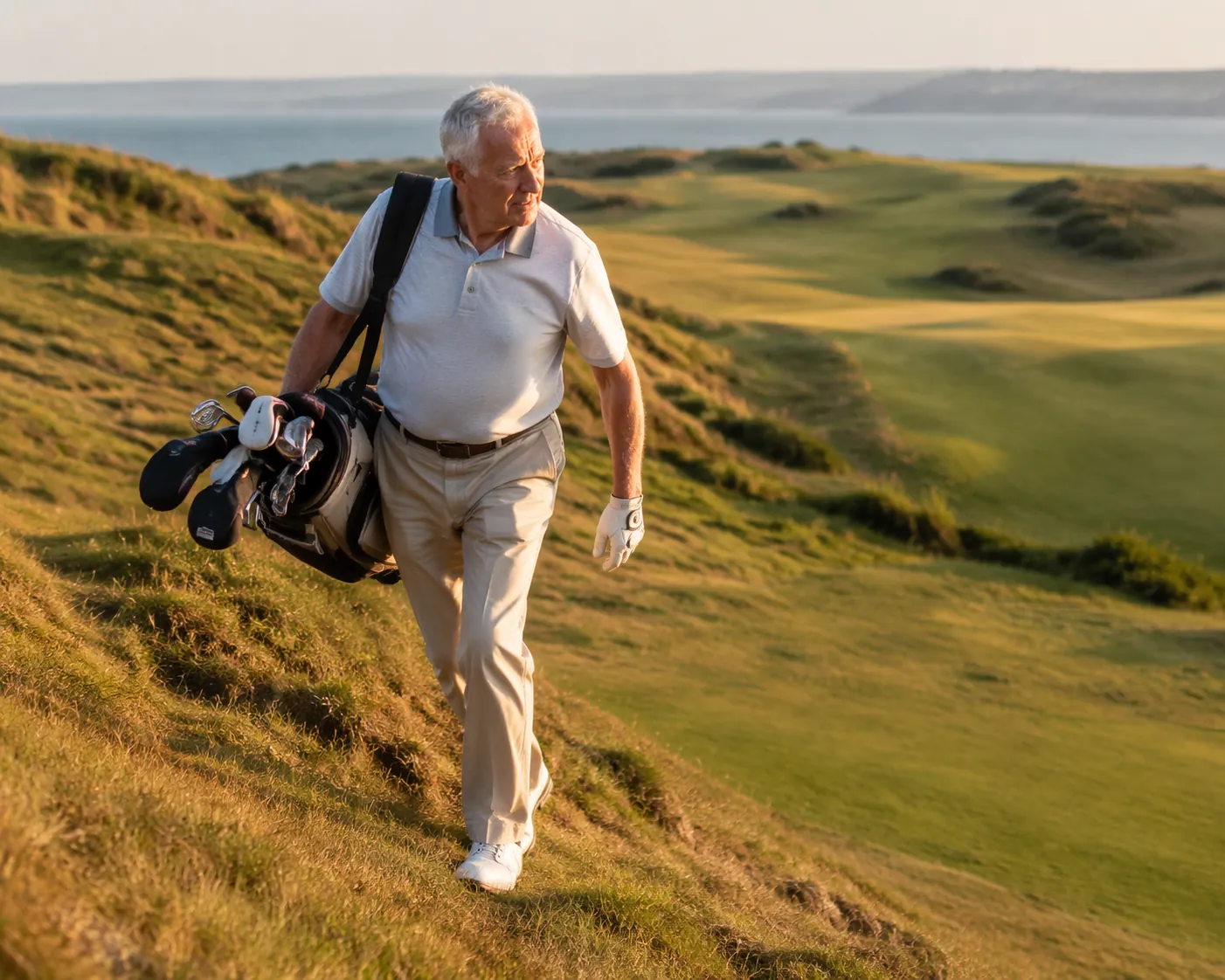
Tournament golf looks like fall-prevention training because the body cannot stay on autopilot
A flat balance pad can be useful, but daily life rarely behaves like a flat balance pad. People fall while turning toward a sound, stepping across grass, carrying something, hurrying, misjudging a slope, or recovering from a small stumble. Tournament golf puts many of those problems into a structured game: walk, stop, rotate, transfer weight, recover, choose a target, walk again.
That does not make every golf round therapeutic. A cart-only scramble with long waits and minimal walking is a different load from a competitive walking round. A relaxed nine holes with generous mulligans is different from a tournament where each shot matters and attention has to be maintained. The fall-prevention argument is strongest when golf includes repeated walking, uneven lies, controlled trunk rotation, and enough duration to expose fatigue before it becomes dangerous.
| Tournament demand | Fall-prevention domain it trains | Why it matters |
|---|---|---|
| Walking long distances across fairways, slopes, rough, paths, and greens | Gait | The golfer must adjust step length, foot placement, speed, and attention as the ground changes. |
| Setting up to the ball, turning the trunk, shifting weight, and finishing balanced | Balance and strength | The swing requires the body to prepare, rotate, transfer load, and recover posture. |
| Playing for 4+ hours with scoring pressure, distractions, and fatigue | Balance, gait, and cognitive-motor control | The golfer must keep moving accurately after the easy early-hole freshness has faded. |
| Managing side-hill, uphill, and downhill lies | Dynamic balance | The body must solve real-world balance problems before and after a purposeful movement. |
For readers building a formal safety plan, the cleanest starting point is a structured CDC STEADI fall-prevention action plan. Golf can be one activity inside that plan. It should not replace screening, medication review, vision checks, footwear decisions, or individualized therapy when those are needed.
The swing is a balance task before it is a golf skill
The part of golf most articles admire is ball flight. The part that matters for fall prevention happens earlier and lasts longer: the body organizes itself before the club moves, rotates through the trunk, transfers weight, and then has to arrive somewhere stable after impact.

Bliss and Church describe the golf swing in terms that matter to balance clinicians: anticipatory postural adjustments, axial rotation, and weight shift.[3] In plain language, the golfer has to prepare the body for a movement that will disturb balance. At address, the feet create a base. During the backswing, the trunk rotates and load moves toward the trail side. Through the downswing and follow-through, weight transfers toward the lead side while the head, trunk, hips, knees, and feet all have to negotiate speed without letting the body spill out of control.
That sequence is relevant because many falls start with poor preparation for movement. Turning too quickly in the kitchen, stepping while reaching, pivoting to answer someone, or changing direction in a hallway all require the nervous system to set posture before and during motion. Golf repeats that problem with a clear purpose. The golfer is not doing balance drills because someone handed out a worksheet; the golfer is trying to hit the next shot.
Older golfers also appear to differ from non-golfers on balance measures. Tsang and Hui-Chan reported that golfers aged 65 and older had better static and dynamic balance control than age-matched non-golfers.[4] That finding should be read carefully. It does not prove that golf alone caused the better balance, and it does not say a deconditioned older adult can safely jump into tournament play. It does support the more modest and useful point: the balance qualities used in golf are the same qualities worth preserving.
There is one detail I would not gloss over with an older golfer: the finish. A swing that ends with a step, a wobble, or a grab for the cart is information. It may be a technique issue, a fatigue issue, a strength issue, or a vestibular issue. In a readiness pathway, the ball result matters less than whether the golfer can rotate, shift, and recover repeatedly without feeling disoriented.
Strength in golf is repeated control, not just force
Fall-prevention strength is not only the ability to lift a heavy load once. It is the ability to stand from a chair, climb a slope, brake on a downhill step, carry or pull equipment, and keep the hips and trunk organized after two or three hours of activity. Tournament golf gives those muscles a long job.
The R&A-supported University of Southampton research reported that 152 participants aged 65 and older who golfed had significantly better strength and balance than sedentary non-golfers.[1] The comparison is useful, but it is not a free pass. Golfers may already be healthier, more mobile, and more confident before they ever join a tournament. Still, the pattern lines up with what a mobility coach sees on the course: repeated squats to place or retrieve a ball, hip and ankle work on slopes, trunk control during rotation, and step-after-step endurance.
A 12-week golf intervention led through USC’s Division of Biokinesiology found that older military veterans improved in walking ability, standing balance, strength, and cognitive processing.[5] That matters because it moves the discussion beyond “active people play golf.” Intervention evidence is still not the same as saying tournaments are safe for everyone, but it suggests that a golf-based program can train functions tied to fall risk.
For a person who hates being told to “exercise for fall prevention,” the identity piece is not trivial. Some older adults will skip a balance class but arrive early for a tee time, warm up because they want the first hole to go well, and practice because they dislike losing to a friend. That is adherence wearing a collared shirt. If resistance to formal programming is part of the family conversation, the article on why older adults avoid fall-prevention programs is a useful companion, because motivation often determines whether a good plan actually happens.
Gait training is built into the course
Walking a golf course is gait training with consequences. The ground changes underfoot. The golfer moves from short grass to rough, from path to turf, from shade to glare, from level stance to slope. Step length changes. Cadence changes. The body has to decide when to slow down, when to widen the stance, when to plant the foot more carefully, and when to stop talking long enough to read the ground.
Uneven terrain is not a bonus feature in fall prevention; it is the point. Many older adults can look steady in a hallway but become less reliable on grass, gravel, curbs, or slopes. Tournament play asks for walking under those conditions while also tracking score, distance, club choice, weather, and pace of play. That combination resembles real life more than a single-task clinic drill.
The USC veteran intervention is helpful here because its reported improvements included walking ability and cognitive processing, not only isolated strength or balance.[5] On a course, walking and thinking are rarely separated. The golfer has to keep moving while judging distance, remembering rules, managing frustration, and planning the next shot. That dual-task demand is one reason tournament golf can be functionally rich, and also one reason readiness matters.
A tired golfer who starts dragging a toe on hole 14 is giving different information from a fresh golfer who looked smooth on the practice green. A player who becomes dizzy after turning to follow the ball is not “just rusty.” A spouse, physical therapist, physician, or activity director should treat those signs as data, not embarrassment.
What the research supports—and what it does not
The strongest case for tournament golf is cumulative. Biomechanics explains why the swing trains posture and weight transfer. Observational balance research shows older golfers performing better than non-golfers on balance-related measures. Intervention evidence suggests golf practice can improve walking, balance, strength, and cognitive processing. None of that turns golf into a universal prescription.
The Parkinson’s comparison is a good example of useful but bounded evidence. Johnson and colleagues reported that golf was associated with greater improvements in balance and mobility than Tai Chi among people with moderate Parkinson’s disease; the same report notes that people with Parkinson’s are nine times more likely to fall than age-matched peers.[6] That is striking, but it does not mean golf is automatically better than Tai Chi for all older adults. It does show that, even in a population with serious balance vulnerability, golf can be studied as a mobility intervention rather than dismissed as mere recreation.
The Finnish study adds a different kind of support. In 25 healthy golfers aged 65 and older, researchers compared 18 holes of golf with Nordic walking and regular walking, finding that golf had lower per-minute intensity but longer duration and higher total energy expenditure, with more positive acute effects on lipid profile and glucose metabolism.[7] The sample was small, and the outcomes were metabolic rather than fall-specific. It is supporting context, not the backbone of the fall-prevention argument.
Taken together, golf participation is associated with several qualities that matter for fall prevention, and golf-based programs have shown promising functional improvements. Tournament participation adds duration, terrain, pressure, and repetition. Those same features can train capacity or expose risk, depending on the player’s current status.
A phased pathway from practice swings to tournament play
Readiness is built in layers. The older golfer does not need to begin with an 18-hole tournament to benefit from tournament-style preparation. The safer path is progressive exposure: rehearse the movement, add ball contact, add walking, add duration, then add competitive pressure.
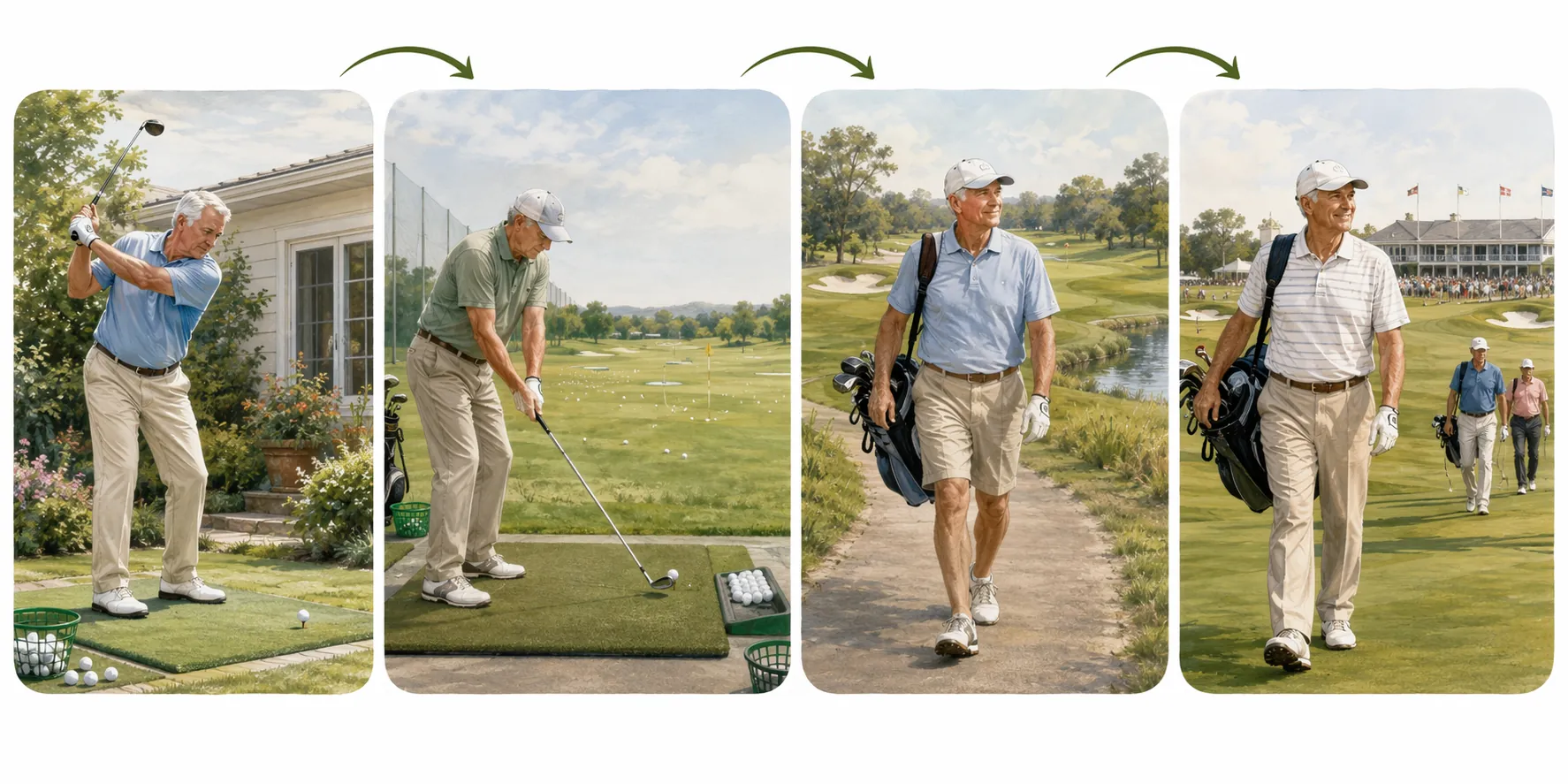
Bliss and Church discuss a practical dose of hitting 100 golf balls, 3–5 times per week.[3] That should not be copied blindly by every older adult. For someone with shoulder pain, spinal stenosis, dizziness, poor endurance, or a long break from activity, 100 full swings may be too much. The useful idea is the structure: frequent, repeated, purposeful practice with enough rest and observation to notice when form breaks down.
| Phase | Main purpose | Readiness signs | Pause signs |
|---|---|---|---|
| At-home swing practice | Rebuild balance, rotation, and weight shift without course pressure | Can make slow practice swings without dizziness, stepping to catch balance, or pain escalation | Dizziness when turning, new unsteadiness, chest symptoms, sharp pain, or needing furniture for support |
| Driving range | Add ball contact, repetition, and mild fatigue | Can keep posture through repeated swings and walk safely to and from the hitting area | Balance worsens as the bucket continues, or the finish becomes uncontrolled |
| 9-hole walking or mixed walking/cart round | Add terrain, pacing, club selection, and real walking distance | Can finish with stable gait, clear thinking, and no near-falls | Toe dragging, stumbling on slopes, confusion from fatigue, or dizziness after tracking ball flight |
| 18-hole tournament | Add full duration, scoring pressure, waiting, distractions, and late-round fatigue | Can manage uneven lies, sustained walking, and decision-making without warning signs | Recent fall, new medication effects, uncontrolled blood pressure, dizziness, or repeated balance recovery steps |
Phase 1: make the swing boringly safe before making it powerful
At home, the first goal is not distance. It is a stable setup, a controlled turn, a smooth weight shift, and a finish the golfer can hold. Practice can begin with partial swings or slow-motion rehearsals. If the golfer cannot turn the head and trunk without dizziness, or cannot finish without stepping out of balance, tournament talk is premature.
This is also where a spouse or adult child can watch without becoming the swing coach. The observations that matter are simple: Does the golfer hold the finish? Does one foot repeatedly slide? Does the golfer look disoriented after rotation? Does fatigue change posture after a few minutes? These answers are more useful for readiness than a beautiful backswing.
Phase 2: the driving range adds repetition and fatigue
The range is where enthusiasm often outruns capacity. A returning golfer may feel fine for the first few swings and then lose posture as the bucket shrinks. Use the range to test whether the golfer can repeat the movement with rest breaks, hydration, and attention to the finish. A smaller bucket with good control teaches more than a large bucket that ends in sloppy balance.
If the golfer is already working with a physical therapist, the range can become a practical field test. The therapist does not need to care about the scorecard to care about the movement: stance width, hip control, trunk rotation, ankle strategy, recovery after follow-through, and walking between stations.
Phase 3: nine holes tells the truth about terrain
A nine-hole round is the first real test of golf as gait training. The golfer has to manage grass, slopes, cart paths, standing waits, and the small rush that happens when the group behind is visible. This is where forward tees, planned rest, and a cart used strategically can preserve training value without pretending the player is 40 again.
For general recreational safety details—hydration, warmups, footwear, and pacing—the broader guide on how golf helps seniors prevent falls and stay safe is the better companion. This tournament-focused pathway is narrower: it asks whether the golfer can tolerate progressive balance, gait, and attention demands.
Phase 4: the tournament adds pressure, not just more holes
An 18-hole tournament is not only a longer walk. It changes behavior. Players may hurry after a poor shot, stand longer during delays, forget to drink, choose a risky stance to avoid a penalty, or push through symptoms because the round “counts.” Those are exactly the moments when a capable older adult can make a poor safety decision.
Activity directors and family members should be especially careful here. A senior living golf outing can be excellent programming when the course, format, transportation, rest points, and screening match the participants. It becomes poor programming when tournament language pressures people to ignore warning signs. A printable fall-prevention handout for seniors and caregivers can help families keep the safety conversation concrete before the event.
Who should delay tournament play
Delay does not mean defeat. It means the course is giving more demand than the body is ready to solve. A golfer should pause tournament plans and seek medical or therapy guidance when any of these are present:
- A recent fall, near-fall, or unexplained stumble
- A new medication or dose change that affects alertness, blood pressure, balance, or reaction time
- Dizziness, lightheadedness, or visual disturbance when turning, bending, or following ball flight
- Uncontrolled blood pressure or symptoms such as chest pain, unusual shortness of breath, or faintness
- Repeated need to grab a cart, club, partner, wall, or furniture to recover balance
- Late-round gait changes such as toe dragging, shuffling, veering, or shortened steps
A quick-reference fall prevention FAQ can help families separate normal exertion from warning signs that deserve a formal check. When in doubt, use the STEADI-style question: what changed, when did it change, and does that change raise fall risk before the next round?
The readiness decision
Senior tournament golf can be a serious, enjoyable form of functional fall-prevention training when the golfer has earned the load gradually. The useful parts are not the trophies or the culture around the game. The useful parts are the repeated balance challenges, controlled rotation, weight transfer, uneven-terrain walking, endurance, and attention under mild pressure.
The decision is conditional. If an older golfer can progress from safe practice swings to range work, then to nine holes, then to full tournament conditions without red flags, tournament play may support the same balance, strength, and gait capacities that fall-prevention programs try to build. If warning signs appear, the smart move is to pause, assess, and rebuild—not to force one more round.
References
- New study reveals the many health benefits of playing golf for older people — GOLF.com — 2020
- STEADI: Older Adult Fall Prevention — Centers for Disease Control and Prevention
- Golf as a Physical Activity to Potentially Reduce the Risk of Falls in Older Adults — Sports — 2021
- Comparison of muscle torque, balance, and confidence in older golfers and non-golfers — Journal of Aging and Physical Activity — 2010
- Golf’s unexpected health benefits for seniors — USC Today
- Golf Beats Tai Chi for Improving Balance and Mobility in Parkinson’s Disease — American Academy of Neurology — 2021
- Acute effects of 18 holes of golf, 6 km of Nordic walking and 6 km of walking on blood glucose and lipid profile in healthy older adults: a randomised cross-over study — BMJ Open Sport & Exercise Medicine — 2023
Questions to bring to a clinician or OT
This is not medical, legal, or a family's final decision — only a framework. Bring these questions to a clinician, occupational therapist, or your local Area Agency on Aging.
Find Local HelpRelated reading
Noticed something outdated or inaccurate on this page? Flag a correction. We review every report against CDC, NIA, and AARP HomeFit guidance before updating a page.