
Fall-Proof Tornado Safety Tips for Elderly Loved Ones
Learn how to create a tornado shelter plan that prioritizes preventing falls for older adults, because the rushed, dark path to shelter is often riskier than the storm itself.
The instruction sounds clean until someone has to carry it out: “Go to the basement.” A tornado warning arrives, the lights flicker, the dog is barking, and an older adult is supposed to move quickly across a hallway, find shoes, manage a walker or cane, open a heavy door, and descend stairs they already avoid on ordinary days.
For an older loved one, the first question is not simply “Where is the lowest place in the house?” It is “What is the safest place this person can reliably reach without falling?” The CDC reports that over 1 in 4 older adults falls each year; that statistic is not tornado-specific, but it is enough to treat a rushed, dim, obstacle-filled route to shelter as part of the hazard, not a side note.[1]
Tornado warnings often leave little time for debate, sometimes under 15 minutes. That is why the shelter decision belongs in daylight, before tornado season, with the walker where it actually sits, the slippers your parent actually wears, and the basement steps everyone has been politely ignoring.
Start With the Place They Can Actually Reach
Basements still matter. In many homes, they offer strong protection from wind and flying debris. The mistake is treating the basement as automatically usable for every older adult. A shelter that requires unsafe stairs, poor lighting, a narrow turn, or hurried transfer from a mobility device can create a fall risk before the storm risk is reduced.
For older adults with disabilities or mobility limitations, disaster planning has to account for access, not just the building’s ideal shelter location. United Spinal Association cites the Partnership for Inclusive Disaster Strategies in noting that people with disabilities are two to four times more likely to die or be injured in a disaster than nondisabled people.[2] That does not make every older adult “disabled,” and it does not mean every basement is wrong. It means generic instructions fail when they skip the route, the equipment, and the person’s actual movement.
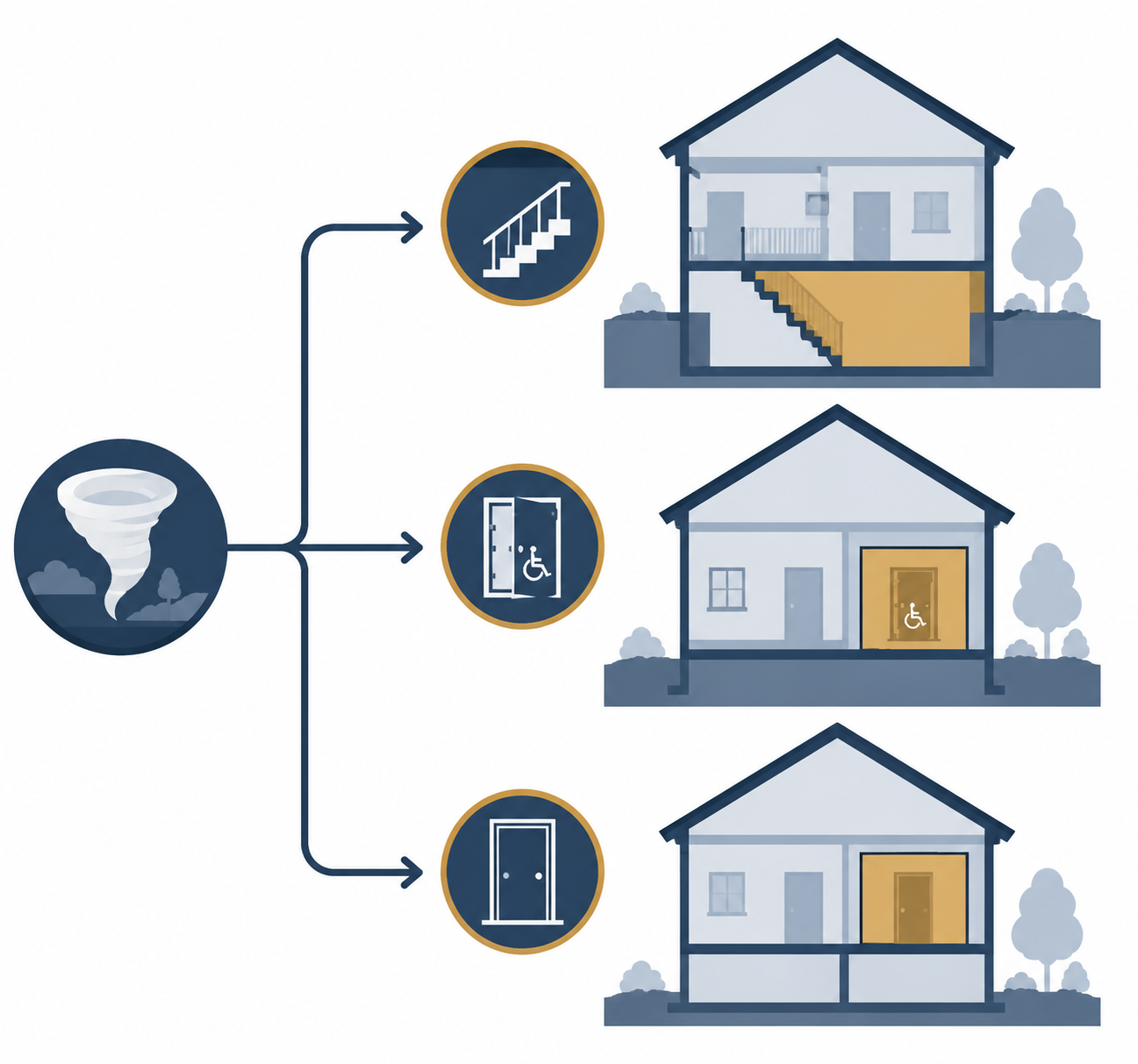
Use this order when choosing the shelter location:
- Use the basement if the older adult can reach it safely, with the needed mobility aid, lighting, footwear, handrails, and realistic time.
- Use a FEMA/ICC 500-compliant safe room if one is available and accessible; United Spinal Association describes this as the best option for wheelchair users because it can be easier to access than a basement.[2]
- If stairs create more danger than protection, choose an interior, windowless room on the lowest accessible floor, such as a bathroom, closet, or hallway away from exterior walls and windows.
That third option is not a casual downgrade. It is the practical answer when “better shelter” exists only on paper because the person cannot reach it safely. TornadoSimulator.net makes the same access point in senior tornado guidance: for older adults with mobility limitations, standard basement advice may be impossible or more dangerous than sheltering in place.[3]
Walk the Route Before You Choose the Room
Do not choose the shelter from a floor plan. Walk it. Start where the older adult is most likely to be when a warning arrives: bed, recliner, kitchen table, bathroom. Then move to the shelter at the pace they actually move, using the cane, walker, rollator, wheelchair, oxygen tubing, glasses, hearing aids, and shoes they actually use.
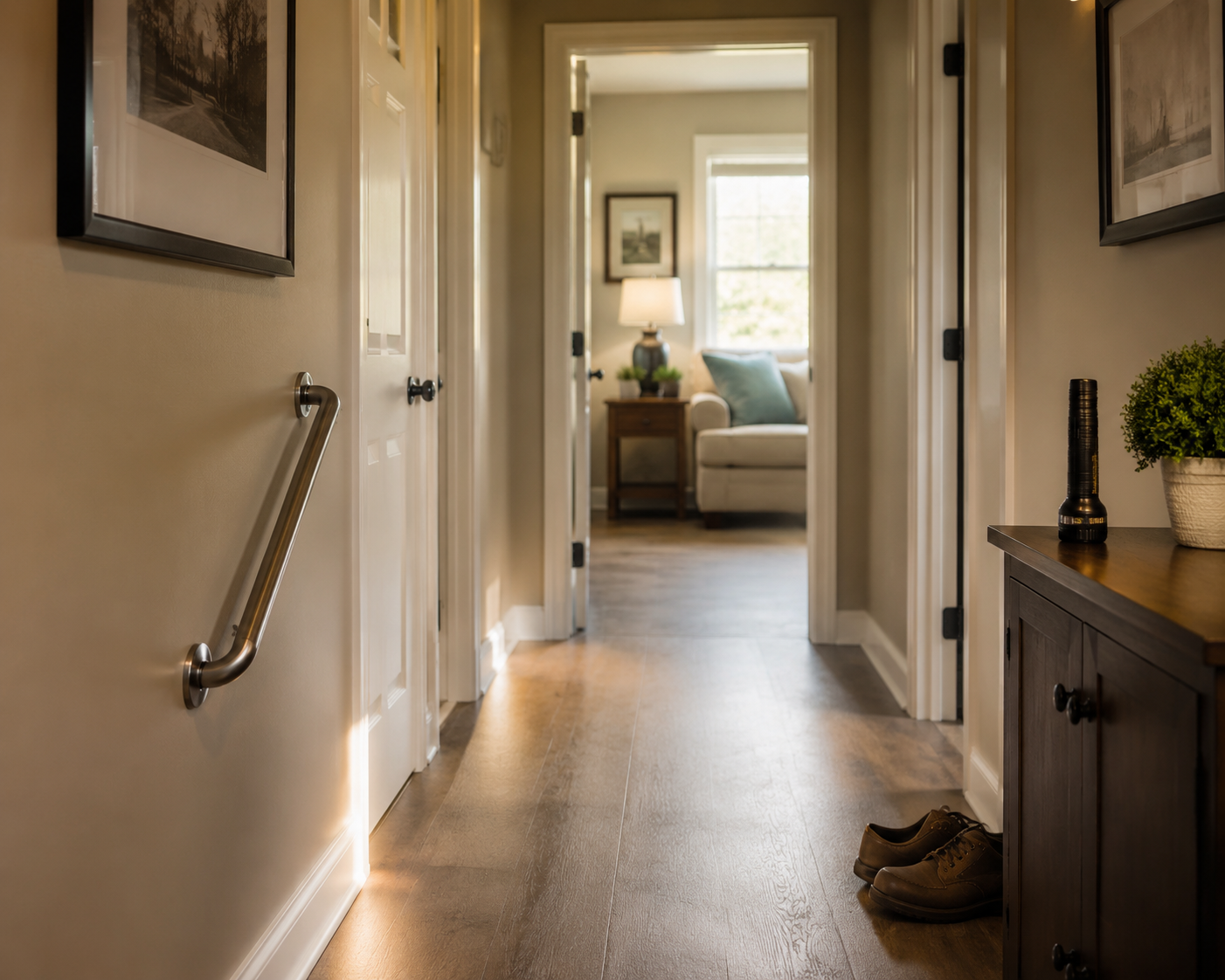
This is where a caregiver usually finds the real plan. The walker is on the wrong side of the bed. A throw rug catches the toe near the hallway. The flashlight is in a drawer, not on the route. The basement door swings against a basket of laundry. The safest room has a stack of storage bins where a chair should go.
If you need a broader room-by-room fall baseline before adapting the house for tornado sheltering, use a general CDC STEADI home fall prevention checklist. The tornado-specific version is narrower: remove the exact hazards between the older adult and the selected shelter.
| Route Problem | Pre-Season Fix |
|---|---|
| Loose rug, bath mat, or hallway runner | Remove it or secure it so it cannot slide, curl, or catch a foot or walker. |
| Dark hallway or stairwell | Add plug-in night-lights, battery lanterns, or motion lighting that does not depend on a single overhead bulb. |
| No stable handhold | Install grab bars or railings where appropriate; do not rely on towel bars, door trim, or furniture. |
| Slippers or bare feet | Keep closed-toe, non-slip shoes beside the bed or main chair. |
| Clutter near the shelter door | Clear a wide path and keep storage out of the doorway and turning space. |
| Mobility aid stored elsewhere | Park the cane, walker, rollator, or wheelchair where the person can reach it without standing unsupported. |
If tornadoes are already in the forecast, the work changes from remodeling the route to clearing it quickly. That shorter watch-window routine belongs in Fall-Proof the Shelter Path During a Tornado Watch. The pre-season job is more durable: make the safest route the easiest route before anyone is frightened.
Set Up the Shelter for Someone Who May Be Shaken
A shelter space is not just a destination. It has to receive a person who may be short of breath, unsteady, disoriented, or embarrassed that they needed help. Put stable seating in the shelter if space allows. A low stool that tips or a folding chair that slides is not useful. A chair with arms gives many older adults a safer way to sit and stand.
If the shelter is a bathroom, check the floor when it is dry and when it is damp. If it is a closet, make sure the floor is not full of shoes. If it is a hallway, decide where the person will sit or brace without blocking others. If a wheelchair or rollator must enter, test the turn with the door open and closed.
The Red Cross Scientific Advisory Council identified chronic conditions, cognitive impairment, dependence on assistive devices, social isolation, and caregiver preparedness gaps as factors that increase older adults’ vulnerability in disasters.[4] In a house, those factors show up as ordinary details: a person who cannot hear a siren without hearing aids, cannot safely kneel in a tub, cannot remember where the flashlight is kept, or cannot move an oxygen concentrator without help.
Stock the shelter for those realities, not for a generic emergency-kit photo. Ready.gov’s older adult preparedness guidance includes planning around medications, assistive devices, medical supplies, communication needs, and support networks.[5] For a tornado shelter route, the grab bag should be close enough that no one has to leave the safe area to retrieve it.
- Flashlight or battery lantern with working batteries
- Whistle to signal for help if the person falls or becomes trapped
- Current medications in child-resistant containers, plus a written medication list
- Backup glasses, hearing aid batteries, and other small items the person cannot function without
- Phone charger or charged power bank
- Closed-toe shoes if the person may arrive barefoot from bed
For older adults with oxygen, powered mobility, refrigerated medications, or other medical needs, the shelter plan should connect to a broader severe-weather medical needs plan. If power loss is common during storms, also plan for fall prevention during outages, because darkness turns a familiar hallway into a different room.
Decide Who Does What When the Warning Comes
The plan should not depend on the older adult making several new decisions under stress. Write down the shelter location, the route, where shoes are kept, where the mobility aid should be parked, and who calls whom. If the person lives alone, the plan needs a check-in system that does not assume cell service will be perfect.
For an adult child, this may feel intrusive. It helps to frame it as reducing decisions, not reducing independence. “If there is a warning, you go to this bathroom, sit in this chair, put on these shoes, and keep your phone with you” is less patronizing than a vague promise to “be careful.”
Keep emergency contacts, medication lists, physician names, pharmacy information, insurance details, and neighbor contacts in one place. A printed binder is old-fashioned until the phone is dead or someone else has to speak for your parent. If that part is missing, build an emergency contact binder for aging parents before storm season.
When the Basement Is Right, Make the Stairs Part of the Plan
If the basement is reachable, do not stop at “use the basement.” Test the descent. Are there sturdy handrails on both sides? Does the older adult need one hand for the rail and one for a cane? Is there a landing where they can pause? Does the light switch require stepping into the stairwell first? Is the basement floor dry, clear, and free of cords?
A caregiver should also decide whether help must be present. Some older adults can use basement stairs in daylight but not safely at night, during vertigo, after taking sedating medication, or while carrying a pet. The plan can say: basement only if a helper is already in the home; otherwise use the interior first-floor shelter. That is not indecision. It is a realistic threshold.
If the home needs wider storm preparation beyond tornado sheltering, use a broader storm-prep falls checklist for elderly adults or a phased senior storm safety checklist. The tornado route still deserves its own walk-through because speed, fear, and stairs change the risk.
Rehearse Without Turning It Into a Drill
A formal drill may embarrass an older parent, especially one who is already aware that balance has changed. A quiet walk-through often works better. Pick a calm day. Say, “Let’s make sure this route still works.” Time matters less than observing what makes the person hesitate.
Watch for hand placement, turns, thresholds, rugs, pets, cords, and lighting. Ask whether the person feels rushed, dizzy, or unsure. If they reach for a wall, furniture, or towel bar, that is information. If they leave the walker behind because the hallway is narrow, that is information too.
Repeat the route when something changes: a new walker, a medication that affects balance, cataract surgery, a fall, a new oxygen setup, a moved bedroom, or a caregiver schedule change. Tornado plans age quickly because mobility changes quietly.
A Practical Pre-Season Frame
The best tornado plan for an older adult is not always the most theoretically protective location. It is the safest protective location the person can reach without creating a preventable fall risk.
- Walk the route in daylight from the bed, chair, bathroom, and kitchen.
- Choose the shelter based on both storm protection and accessibility.
- Remove loose rugs, clutter, cords, poor lighting, and unstable seating before warnings exist.
- Place shoes, lighting, mobility aids, medications, communication tools, and a whistle where they will actually be used.
- Revisit the plan whenever balance, vision, hearing, medication, mobility equipment, or caregiver availability changes.
References
- Falls Data and Research: Facts About Older Adult Falls, CDC
- Tornado Preparedness for the Disability Community, United Spinal Association
- Tornado Safety for Elderly: Essential Tips to Protect Senior Citizens, TornadoSimulator.net
- Tornado Safety, American Red Cross
- Older Adults, Ready.gov
Related reading
Noticed something outdated or inaccurate on this page? Flag a correction. We review every report against CDC, NIA, and AARP HomeFit guidance before updating a page.
Part of the Fall Prevention section.