
Caregiver decision guide
Is Loneliness Behind Your Parent's Fall Risk?
Loneliness and social isolation are consistently associated with higher fall risk and poorer physical performance in older adults. This guide shows caregivers how to turn a parent's social withdrawal into a practical connection plan — clearing transportation, mobility, hearing, and fear-of-falling barriers and pairing each outing with movement — starting with one small weekly commitment.
It often starts as a small, uneasy pattern. Your parent skips church because the parking lot feels too far. Lunch with a friend sounds nice, but the restaurant is loud and the walker feels embarrassing. Cards are “too much trouble.” A neighbor stops asking after two polite refusals. Pretty soon, “Mom should get out more” is sitting on the family to-do list with no ride, no plan, and no next date.
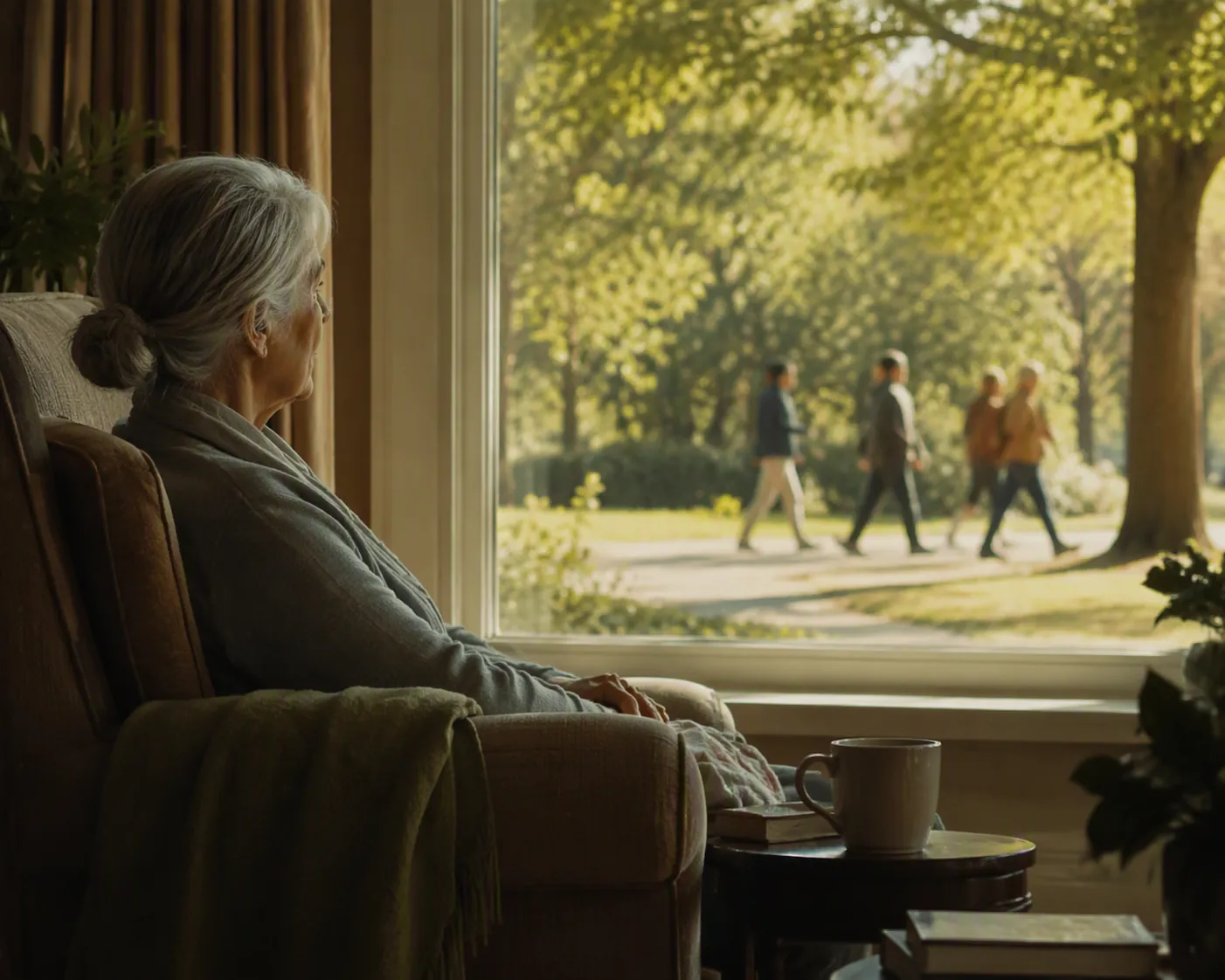
That withdrawal is worth taking seriously for more than mood. The evidence does not show that loneliness directly causes falls. It does show, consistently enough to change how caregivers plan, that social disconnection is associated with fall risk and poorer physical performance in older adults.
In a longitudinal analysis using the U.S. Health and Retirement Study, perceived social isolation was associated with a 33% higher risk of falls, and depression helped explain part of that relationship. [1] In another cohort analysis, each 1-point increase on the 3-item UCLA loneliness scale was associated with about 11% higher odds of reporting a fall five years later, independent of other fall risk factors. [2] In the English Longitudinal Study of Ageing, loneliness, domestic isolation, and social disengagement were longitudinally associated with poorer physical performance, including sit-to-stand, balance, and gait speed; socially disengaged adults were about 10% more likely to fall below a physical-performance threshold tied to disability and mortality risk. [3]
For a caregiver trying to understand how seniors can stay socially connected and avoid loneliness, the practical question is not whether one more phone call can prevent a fall. The better question is: what has stopped this parent from safely moving through the world with other people, and which one barrier can be removed this week?
The isolation–mobility–falls loop
A shrinking social life can become a shrinking movement life. If there is no regular reason to leave home, there is less walking to the mailbox, fewer stairs, fewer parking lots, fewer curbs, fewer chances to practice balance in ordinary ways. Then an awkward step, a near-fall, or a tiring outing makes the next invitation feel risky. The parent waits for a ride. The caregiver gets busy. Friends stop asking. The world contracts by one missed event at a time.
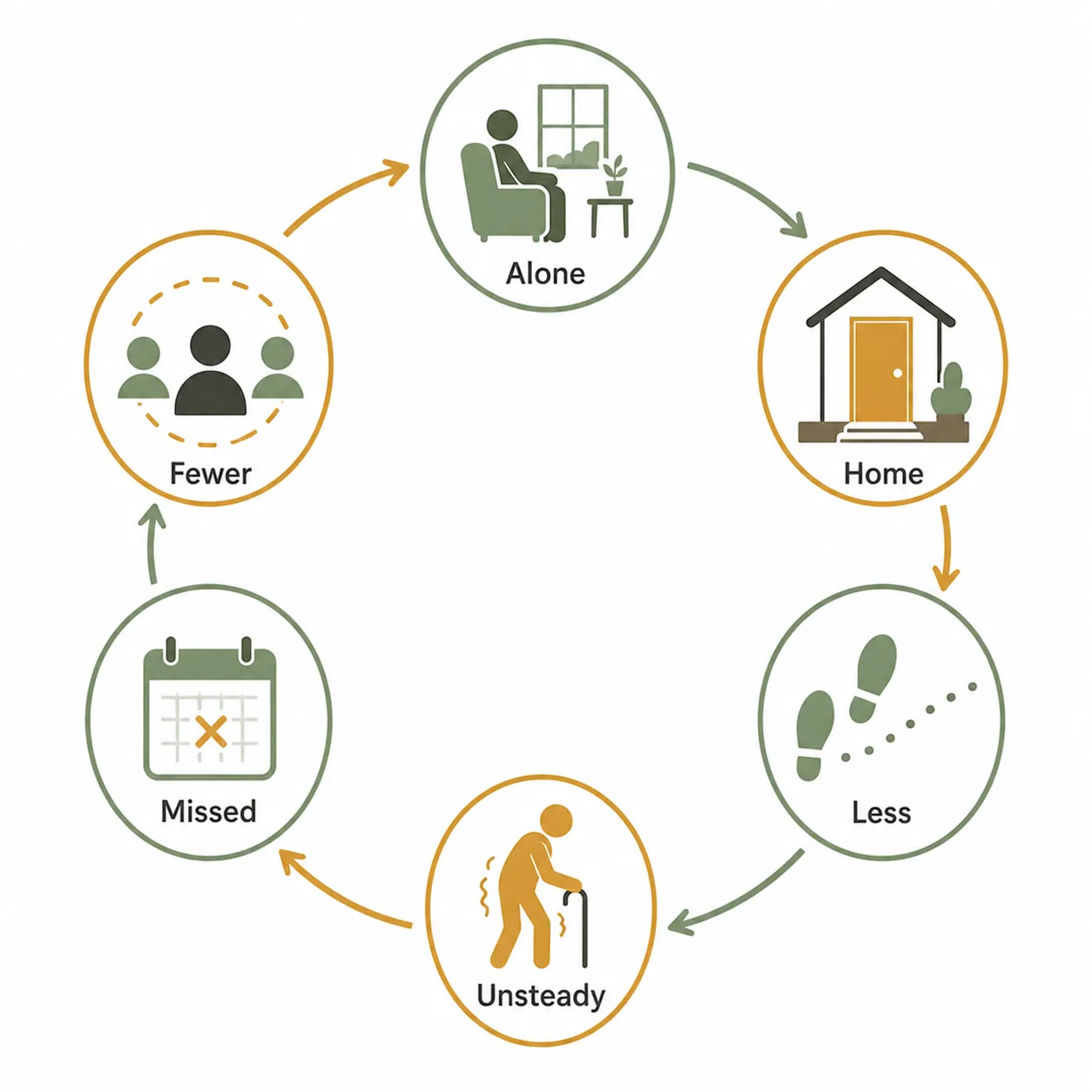
A small Belgian qualitative study gives this pattern a useful name: older adults with reduced mobility described “living in a shrinking world.” The study included 15 participants ages 75 to 92, so it should not be used to claim how most older adults feel. Its value is more intimate than statistical. Participants described avoiding events because they did not want to become a burden, which is exactly the sentence many adult children hear in softer forms: “Don’t go to any trouble.” [4]
The caregiver’s job is not to argue the parent into cheerfulness. It is to notice the mechanics of the loop. A parent may be lonely because friends have died, because transportation has become unreliable, because hearing loss makes conversation exhausting, because continence worries make outings tense, because a mobility aid feels like a public announcement of frailty, or because fear of falling has become the quiet manager of the calendar.
The national context matters, but it should not swallow the household-level work. The CDC lists factors that can raise risk for social disconnection, including living alone, chronic disease, long-term disability, limited transportation, rural location, and loss of a loved one. [5] A 2020 National Academies consensus report estimated that about 24% of community-dwelling Americans age 65 and older were socially isolated, and that 35% of adults age 45 and older reported loneliness. [6] In the 2024 National Poll on Healthy Aging analysis published in JAMA, 33.4% of adults ages 50 to 80 reported lack of companionship, with higher percentages among those reporting fair or poor physical or mental health. [7]
Build the plan around the barrier, not the activity
“Join a club” is not a plan if the club meets after dark, the room echoes, the entrance has two steps, and nobody knows whether your parent can get there. Start with the block in front of the activity. One recurring commitment that actually happens is more useful than five pleasant suggestions.
| What may be blocking connection | What to change before choosing the activity | A better first commitment |
|---|---|---|
| No reliable ride | Schedule transportation before the invitation is accepted; pick a daytime event with easy drop-off. | Weekly library group, senior center lunch, or faith-community coffee hour with the ride arranged every time. |
| Fear of falling | Choose a familiar, well-lit place; arrive early; use an escort for the first visit; avoid crowded entrances. | A short walking group, seated exercise class, tai chi, or a gentle movement class with a known instructor. |
| Mobility aid embarrassment | Treat the cane, walker, or rollator as the tool that makes the outing possible; practice using it before the event. | A park walk with one trusted friend where the mobility aid is expected, not explained. |
| Hearing difficulty | Pick a quieter room, smaller group, and seat with the parent’s better-hearing side toward the conversation. | Two-person lunch, small art class, book discussion, or volunteer role with predictable conversation. |
| Fatigue | Shorten the event, protect rest time, and avoid stacking errands onto the outing. | A 45-minute visit, morning class, or brief volunteer shift that ends before exhaustion sets in. |
| Not wanting to be a burden | Make the support specific and limited: who drives, where they park, when they leave, and what happens if the parent gets tired. | A standing Tuesday outing with a planned exit, so accepting help does not feel like negotiating every time. |
The activity itself can be ordinary. The important upgrade is that it has a date, a route, a ride, a backup plan, and a reason to move. A weekly lunch that requires a short, safe walk from the car may do more for confidence than a vague promise to “be more social.” A volunteer shift that includes standing, greeting, sorting, or light walking may offer both purpose and physical practice. A small arts group may be the right answer if hearing, fatigue, or embarrassment make larger gatherings feel punishing.
Pair connection with movement whenever it is safe
Social connection helps most when it gives the parent a safe reason to use the body they still have. The National Council on Aging describes social activities such as walking groups, tai chi, yoga, dance, volunteering, arts groups, and intergenerational programs as ways older adults can support movement, confidence, and reduced fear of falling. [8]
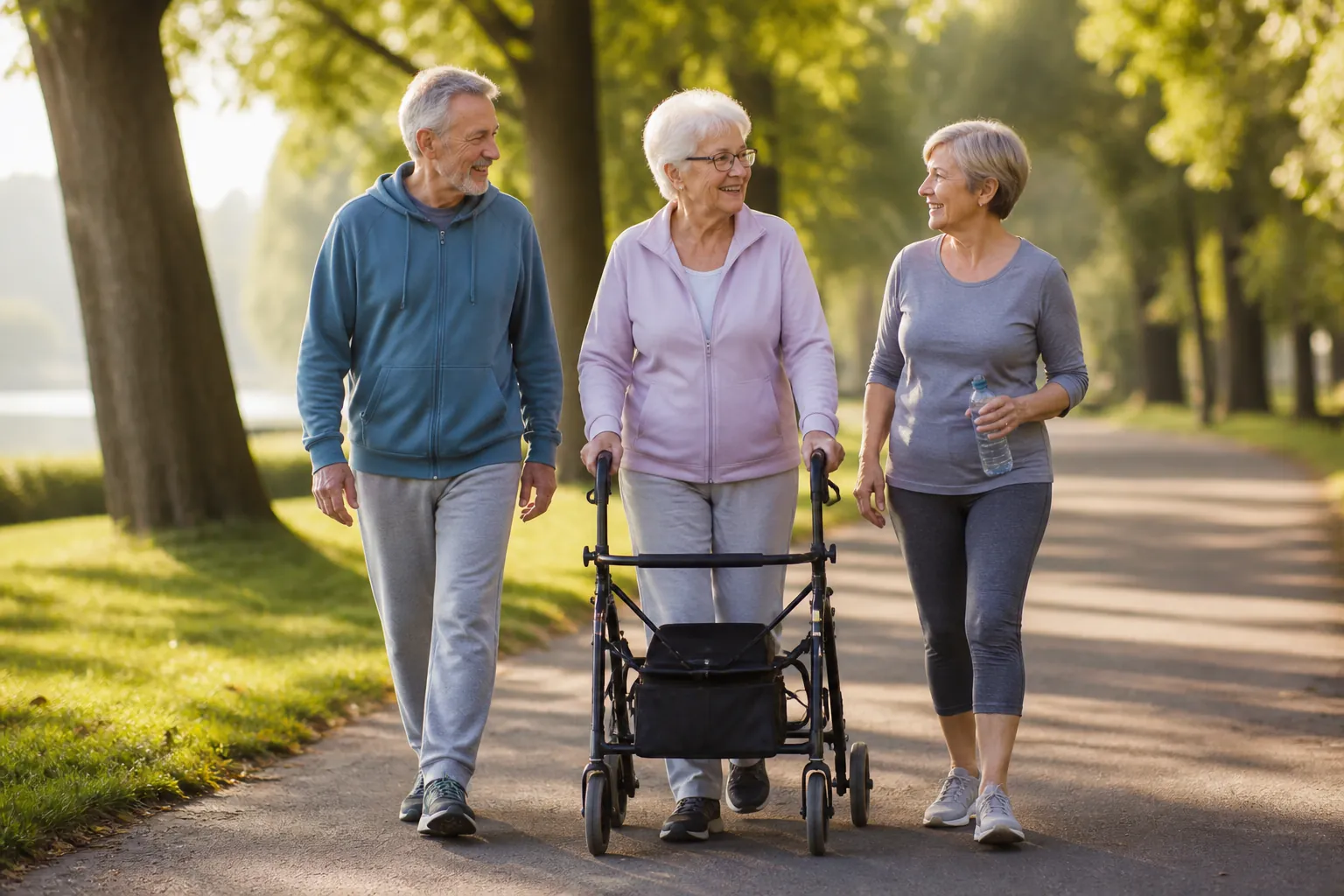
For a parent who has been mostly homebound, begin smaller than pride wants. A walk to the end of the block with a neighbor may be the first social-mobility commitment. A ten-minute lap inside a community center before chair yoga may be enough. If walking is the chosen entry point, use a safe route rather than a pretty but uneven one; a caregiver can borrow the same thinking used in a safe walking route checklist: lighting, shade, benches, bathrooms, traffic crossings, surface quality, and a realistic turn-back point.
Short walks count. A parent who cannot manage a long outing may still benefit from a brief, repeatable walk that does not create dread. If the choice is between one ambitious walk that wipes them out and three shorter walks that they are willing to repeat, the repeatable version is usually the better building block. For more on choosing the right dose, see short versus long walks for heart health.
Technology can help, but it should not become another homework assignment. A video call may preserve a relationship when weather, illness, or distance interfere. A shared calendar may help siblings avoid the familiar “I thought you were driving” failure. A simple reminder may keep the weekly plan from depending on memory. Keep the tool boring, reliable, and acceptable to the person who has to use it.
Pets sometimes enter this conversation because they can create routine, companionship, and a reason to walk. They also introduce fall hazards: leashes, food bowls, toys, sudden movement underfoot, and nighttime care. If the family is considering that route, treat it as a separate safety decision, not a quick loneliness fix; this companion-pet guide for seniors living alone is the more appropriate place to weigh that trade-off.
Do the unglamorous setup
Most social plans fail in the gap between the idea and the door. The caregiver hears “I might go,” and the parent is quietly thinking about the step into the garage, the battery in the hearing aid, the bathroom at the destination, and whether anyone will be annoyed if they need to leave early.
Before the first outing, walk through the ordinary details:
- Confirm the ride, including pickup time, drop-off location, and who helps at the door.
- Check the mobility aid, shoes, glasses, hearing aids, batteries, phone, and any needed medications.
- Call ahead if access is uncertain: steps, elevator, bathroom location, seating, noise level, and parking.
- Choose a seat that makes hearing and standing easier.
- Plan the exit before fatigue or embarrassment takes over.
- Tell one person at the activity what would help: a quiet greeting, a saved chair, or walking in together.
This is not overprotective if it allows the parent to participate with less drama. Independence often depends on invisible scaffolding. The parent gets to have the social experience; the caregiver quietly removes the reasons it would collapse.
Know when the plan needs clinical backup
Some barriers should not be solved by family logistics alone. If your parent has fallen, nearly fallen, become newly unsteady, stopped walking because of fear, or changed activity sharply after an illness or medication change, their clinician should know. The same is true when sadness, anxiety, memory changes, hearing problems, dizziness, pain, or vision issues seem to be driving withdrawal.
The National Academies report recommends that health care providers periodically assess older adults who may be at increased risk for social isolation or loneliness using validated tools. [6] That matters because “lonely,” “depressed,” “afraid of falling,” “can’t hear in groups,” and “too tired to go” can look similar from across the kitchen table. A good assessment can separate what the family can arrange from what needs treatment, rehabilitation, hearing care, mental health support, medication review, or a fall-risk evaluation.
General staying-connected advice still has a place once the barriers are named. The NIH MedlinePlus Magazine summary of National Institute on Aging tips includes checking in regularly by phone, email, or video; meeting people with shared interests; trying a new activity or returning to a hobby; and getting involved in the community. [9] Those are useful starting points only after they become specific enough to survive Tuesday afternoon.
Start with one repeatable week
Pick one activity for the next seven days. Not a new social life. One activity.
- Choose the activity: a short walk with a neighbor, coffee after a service, a beginner tai chi class, a library group, a volunteer shift, a small lunch, or an arts program.
- Name the main barrier: ride, fear of falling, hearing, fatigue, mobility aid discomfort, embarrassment, or not wanting to be a burden.
- Remove that one barrier before the day arrives.
- Pair the outing with safe movement, even if that only means walking from the car to the entrance slowly and confidently.
- Afterward, ask four plain questions: Did you feel steady? Could you hear? Did you feel welcomed? Would you do it again next week?
The answer may be no. That is information, not failure. If the room was too loud, choose a smaller setting. If the walk from the car was too far, change the entrance or the destination. If the parent felt exposed using a walker, begin with one trusted companion instead of a group. If fatigue ruined the afternoon, shorten the commitment.
A connection plan is a fall-prevention plan when it gives an older adult safe reasons to move, practice confidence, accept useful support, and keep their world from contracting one declined invitation at a time.
References
- Perceived social isolation, social disconnectedness and falls: the mediating role of depression, Aging & Mental Health, 2020
- Association of Loneliness With Falls: A Study of Older US Adults Using the National Social Life, Health, and Aging Project, 2021
- Social isolation, loneliness and physical performance in older-adults: fixed effects analyses of a cohort study, Scientific Reports, 2020
- Living in a shrinking world—the experience of older persons with reduced mobility: a qualitative study, BMC Geriatrics, 2022
- Risk Factors for Social Isolation and Loneliness, Centers for Disease Control and Prevention
- Social Isolation and Loneliness in Older Adults: Opportunities for the Health Care System, National Academies of Sciences, Engineering, and Medicine, 2020
- Prevalence of Loneliness Among US Adults Aged 50 to 80 Years, JAMA, 2024
- How Do Social Activities Prevent Falls in Older Adults?, National Council on Aging
- Stay connected: Tips from the National Institute on Aging for combating social isolation and loneliness, NIH MedlinePlus Magazine
Questions to bring to a clinician or OT
This is not medical, legal, or a family's final decision — only a framework. Bring these questions to a clinician, occupational therapist, or your local Area Agency on Aging.
Find Local HelpRelated reading
Noticed something outdated or inaccurate on this page? Flag a correction. We review every report against CDC, NIA, and AARP HomeFit guidance before updating a page.