
Caregiver decision guide
Choosing a Safe Companion Pet for Seniors Living Alone
Weighing the real loneliness and cognitive benefits of a companion pet against CDC pet-related fall injury data helps a senior living alone — or their adult child — decide whether a pet is safe. This guide matches pet size, age, and temperament to the person's mobility and adds the home-proofing and backup-care steps that keep a pet from becoming a fall hazard.
A companion pet can be one of the most useful daily supports for a senior living alone. It can also be the soft, moving obstacle that catches a foot at the worst possible moment. That is the real decision behind companion pets for seniors living alone: not whether animals are “good,” but whether this particular animal fits this particular person’s mobility, balance, home, budget, and backup-care reality.
The companionship evidence is not trivial. In a study of 830 primary care patients age 60 and older, pet owners were 36% less likely to report loneliness, and older adults living alone without a pet had the highest odds of loneliness in the study group.[1] A JAMA Network Open analysis found pet ownership was associated with slower cognitive decline among older adults living alone, especially in verbal memory and fluency, though that finding is observational and does not prove that pets caused the slower decline.[2] In the Baltimore Longitudinal Study of Aging, pet ownership was associated with slower decline over a mean 7.5 years in physical performance, gait speed, 400-meter walk time, and physical well-being; dog walking itself was not independently related, so the observed association was not limited to people who walked dogs.[3]
The day-to-day answers from older pet owners are just as important. In the Michigan National Poll on Healthy Aging, older pet owners who lived alone were more likely than pet owners living with others to say their pet helped them feel loved, stick to a routine, and have a sense of purpose. The same poll also found more budget strain and more cases where pet needs took priority over the owner’s own needs among those living alone.[4] That is the whole picture: love, routine, purpose — and also food, vet bills, bending, lifting, walking, and someone needing keys if the owner ends up in the hospital.
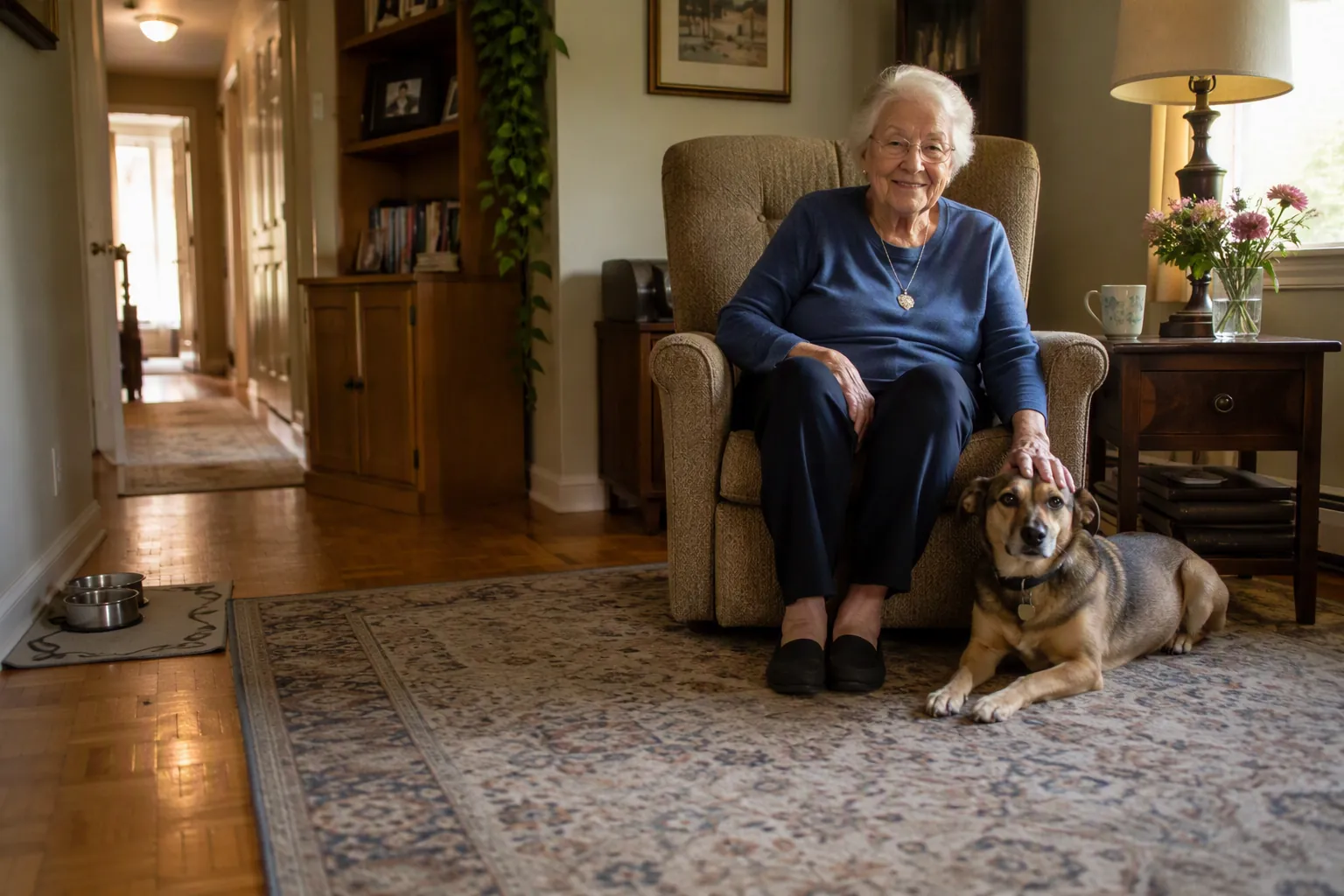
The fall data explains why the match has to be practical before it is sentimental. CDC analysis of emergency department data from 2001–2006 estimated 86,629 pet-related fall injuries per year, with dogs involved in 88% and cats in 11.7%. Among dog-related falls, 31.3% involved tripping over the dog, 21.2% involved being pushed or pulled, 8.8% involved pet items, and 26% occurred while walking the dog. Most dog-related and cat-related falls happened in or around the home.[5]
Newer leash-specific research keeps the dog-walking risk in view. Johns Hopkins researchers estimated that 422,659 adults were treated in emergency departments for leash-dependent dog-walking injuries from 2001 through 2020. Adults 65 and older were more than three times as likely to fall, more than twice as likely to fracture, and 60% more likely to sustain a traumatic brain injury than younger adults in that analysis.[6]
This guide is educational and is not a substitute for medical advice. If there has been a recent fall, new dizziness, changing cognition, neuropathy, vision loss, medication changes, or trouble rising from a chair, the pet decision belongs in the same conversation as fall risk: with a clinician, physical therapist, occupational therapist, or a fall-prevention review.
Start with the person’s mobility, not the pet
A “best pet” list usually starts with species or breed. That is backwards for an older adult living alone. The first question is whether the person can move safely while another living creature moves unpredictably nearby.
Before choosing an animal, watch the ordinary moments: standing from a chair, turning in a hallway, carrying a bowl of water, opening a door while holding a leash, stepping into the bathroom at night, reaching a shelf, bending to pick something up, and recovering balance after a bump. A pet that is perfectly sweet can still be wrong for a person who cannot safely bend, grip, react, or see the animal near their feet.
| What to assess first | Why it matters for pet choice |
|---|---|
| Gait and balance | A person who shuffles, furniture-walks, or turns unsteadily is more vulnerable to a pet crossing their path. |
| Grip strength and arm strength | Leash control, lifting food bags, opening cans, grooming, and carrying carriers all depend on usable strength. |
| Vision and contrast sensitivity | A dark cat on a dark rug, a small dog near a chair leg, or a clear water bowl in a hallway can disappear visually. |
| Cognition and routine reliability | Feeding, medications, litter cleaning, door safety, and vet appointments require memory and sequencing. |
| Stairs, thresholds, and outdoor route | A dog that must be walked several times a day changes the risk picture if stairs, ice, curbs, or poor lighting are involved. |
| Backup care | Living alone means someone else must be able to feed, transport, and temporarily house or visit the pet if the owner is ill or hospitalized. |
If you need a formal place to begin, a fall-risk screening during a Medicare Annual Wellness Visit or primary care visit can help clarify whether balance, medications, vision, or prior falls should change the pet plan. CareWise Guide’s Medicare wellness and fall-prevention guide explains how that conversation can be used before a household decision becomes an emergency.
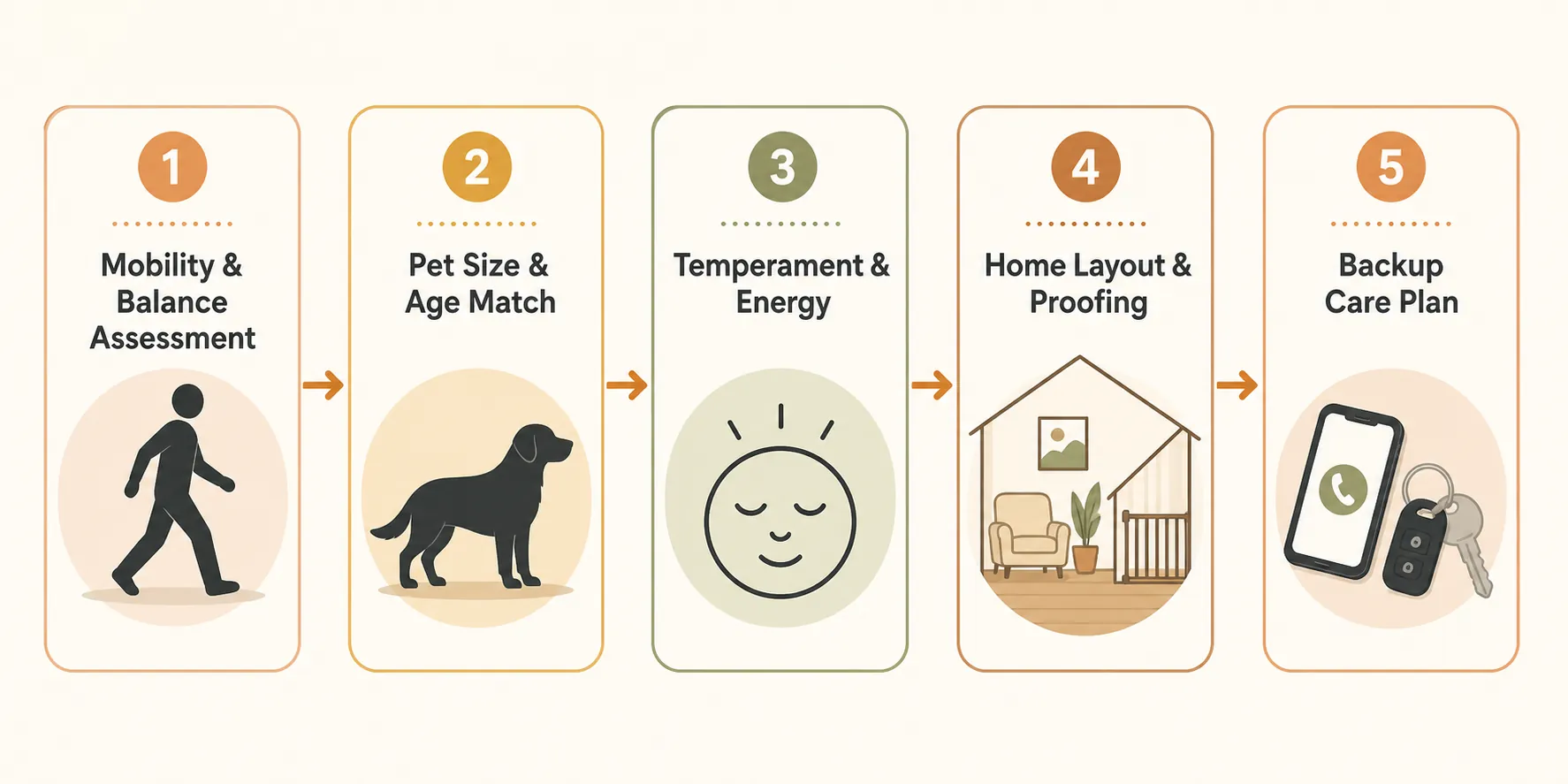
Match the animal to the job the person can safely do
The right companion pet is not the smallest pet, the calmest-looking pet, or the pet the family had 30 years ago. It is the animal whose daily needs can be met without asking the owner to operate at the edge of their physical ability.
Size: small is not automatically safer
A small dog can be easy to lift and less likely to overpower someone on a leash, but it can also disappear underfoot. UCI Health geriatrician Dr. Lisa Gibbs warns that a small dog running around an older adult’s feet can become a tripping hazard, while a large dog can pull a person off balance.[7] That is the size question in plain form: can the owner see the animal, predict its movement, and recover if it bumps, darts, or pulls?
A larger, calm, leash-trained adult dog may be safer for one steady walker than a tiny, fast, excitable dog that sleeps in walkways. A large, strong dog that lunges at squirrels may be unsafe even for a relatively active older adult. The animal’s weight matters, but its movement pattern matters more.
Age: an adult animal is often the safer starting point
Puppies and kittens are charming because they are small and new. They are also fast, messy, untrained, and demanding. For a senior living alone, that combination can mean more bending, more night disruption, more surprise movement, more floor cleanup, and more chances to rush.
An adult animal with a known temperament gives everyone more information. AgingCare notes that adult dogs around ages 3 to 5 often have more defined personalities and may already be house-trained, which can reduce some of the uncertainty that comes with a young animal.[8] The same logic applies more broadly: known habits are safer than hopeful guesses.
Temperament and training matter more than breed labels
There is no breed-level evidence in the materials here that supports naming “safe breeds” for seniors. Breed debates also hide the practical issue. A senior does not trip over a breed category; they trip over an animal that darts, crowds, jumps, blocks a doorway, tangles a leash, or sleeps where feet need to land.
- Look for calm recovery after noise or movement, not just calm behavior in a kennel or carrier.
- Watch whether the animal crowds feet, jumps on legs, bolts through doors, or follows so closely that it becomes a moving trip hazard.
- Ask whether the animal has lived with older adults, mobility aids, visiting nurses, walkers, canes, or grandchildren.
- Favor animals whose toileting, feeding, and sleep routines are already predictable.
- Be honest about whether the owner has the energy and cognition to maintain training, not just start it.
Walking demands can make or break the decision
A dog that requires outdoor walking several times a day changes the household schedule and the fall-risk exposure. The question is not whether walking is healthy in theory. It is whether this owner can manage this dog on this route in this weather with this lighting, these stairs, this sidewalk, this grip strength, and this reaction time.
If leash control is questionable, the choices are limited and practical: choose a different animal, choose a dog whose exercise needs are reliably lower, arrange a dog walker, use a fenced area that does not require stairs or uneven ground, or decide that a live dog is not the safe companion right now. A dog walker is not a luxury if the alternative is an older adult being pulled toward the curb.
Cats reduce leash risk, but they do not remove fall risk
A cat can be a good fit for someone who should not be outside on a leash route in bad weather or poor light. But a cat still moves underfoot, sleeps in chairs and hallways, and brings litter-box logistics into the home. A litter box in the basement is not a small inconvenience for someone with knee pain, neuropathy, low vision, or a history of falls. A covered box that requires awkward bending may be just as unrealistic.
For a cat to work safely, the owner needs a box location on the main living level, a cleaning routine that does not require unsafe bending, and supplies stored where they can be reached without climbing, stretching, or hauling heavy bags across the room.
Grooming and toileting are safety tasks, not extras
Heavy grooming needs can exceed limited arm strength, and Dr. Gibbs specifically points to grooming as part of the physical match between pet and owner.[7] Long coats, frequent bathing, nail trimming struggles, litter tracking, accidents, and repeated floor cleanup all add bending and reaching. Those tasks may be manageable with scheduled grooming help, but they should be priced and planned before the adoption.
The same goes for toileting. If a dog cannot wait, the owner may rush. If a cat’s box is hard to reach, the owner may delay cleaning and then try to do too much at once. If pet waste cleanup requires kneeling or carrying water across a slick floor, that is a fall-prevention issue.
Costs are part of safety
A pet that strains the budget can indirectly strain health. The Michigan poll found older pet owners living alone reported more budget strain than pet owners living with others, and they were also more likely to say their pet’s needs took priority over their own.[4] If a senior skips medications, groceries, transportation, dental care, or home repairs to cover pet costs, the companionship has become too expensive in a way that matters.
Food, litter, grooming, vaccines, routine veterinary visits, emergency care, boarding, pet deposits, transportation, and dog-walking help belong in the first-year budget. AgingCare identifies veterinary and emergency costs as among the most expensive recurring burdens of pet ownership for older adults.[8] Adoption-fee assistance may help with the front door, but it does not cover the whole hallway.
One possible adoption-cost resource is Pets for the Elderly Foundation, which reports that it was founded in 1992 and works with 53 shelters in 31 states, with more than 100,000 adoptions supported for adults age 60 and older.[9] That can make adoption more reachable, but the monthly and emergency costs still need a separate plan.
Proof the home around the pet’s real movements
Pet-proofing for fall prevention is not just hiding cords and buying a cute bed. The CDC data names the common triggers clearly: tripping over the animal, being pushed or pulled, pet items in walking paths, dog-walking falls, and in-home movement by dogs and cats.[5] The home setup should answer those triggers one by one.
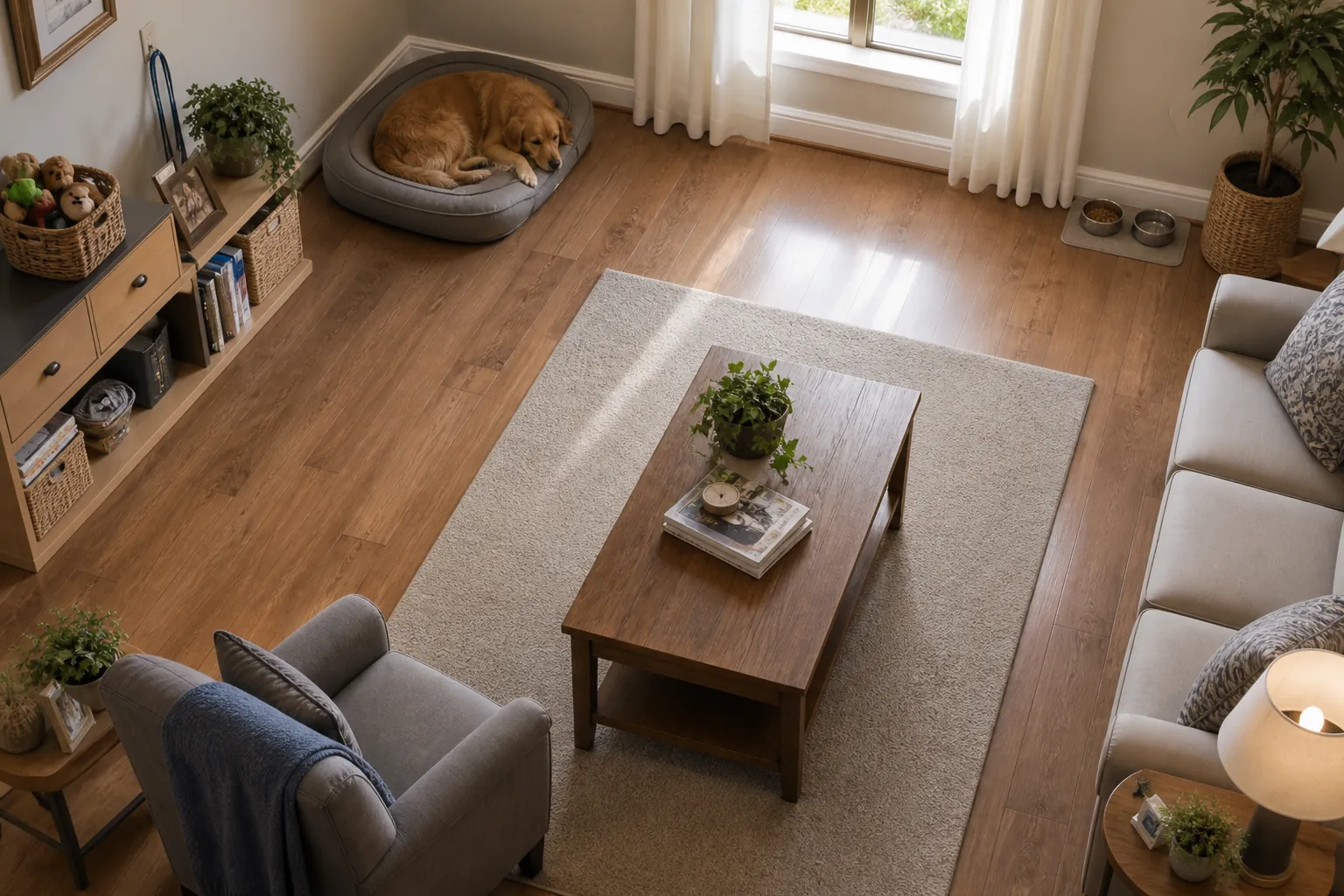
Put food, water, toys, and beds out of traffic lanes
Food and water bowls should sit against a wall, not between the chair and the bathroom, not beside the kitchen sink where water already lands, and not in the path from bedroom to hallway. If the owner uses a walker, cane, rollator, or oxygen tubing, the pet station needs to be placed after watching that equipment move through the room.
- Store leashes on a hook or shelf, not coiled on the floor.
- Keep toys in a basket that the owner does not have to step over.
- Place pet beds in corners or along walls, not beside the owner’s usual chair path.
- Use stable bowls that do not slide into the walking path.
- Avoid rugs that bunch under pet movement unless they are secured and truly non-slip.
For the broader home setup, use a fall-prevention checklist rather than guessing room by room. The CDC STEADI home checklist is a good starting point, and CareWise Guide’s room-by-room fall-prevention checklist can help you notice the pet-specific hazards that show up only after you trace the owner’s normal walking routes.
Do not make stepping over the pet a household habit
A senior should not have to step over a sleeping dog to reach the bathroom, lift a cat off the stairs while carrying laundry, or squeeze around a pet bed to answer the door. If the animal routinely blocks a passage, the answer is not “be careful.” The answer is a new bed location, a gate, training, a closed door, or a different pet arrangement.
This is where a certified aging-in-place specialist or occupational therapist can be especially useful. A family member may see a pleasant living room; a trained eye may see the exact turn where the dog, the rug edge, and the walker will meet. For deeper home modifications, see the CareWise Guide CAPS room-by-room guide.
Make dog walking boring on purpose
Safe dog walking for an older adult is not an athletic event. It is predictable, short enough, well lit, and controlled. The dog should not be learning leash manners on the same sidewalk where the owner is trying to protect a replaced hip.
- Use a route with the fewest curbs, cracks, stairs, loose gravel, and poorly lit stretches.
- Avoid walking during ice, heavy rain, high heat, or low visibility when another option exists.
- Do not wrap the leash around the wrist or hand.
- Arrange dog-walker help for high-energy walks, bad-weather days, illness, and recovery after procedures.
- Revisit the plan after any fall, near fall, new medication, new dizziness, or change in strength.
If the owner needs a formal risk-reduction plan, the CareWise Guide STEADI fall-prevention action plan can help turn concerns into assigned tasks instead of vague reminders.
The backup-care plan is part of the pet choice
A senior living alone should not bring home a pet unless someone can answer four ordinary questions without scrambling: who has keys, who can feed the pet, who can transport the pet, and who takes over temporarily if the owner is hospitalized or sent to rehab.
This is not pessimism. It is what keeps a fall from becoming two emergencies: one human and one animal. If the owner is in the emergency department, the neighbor should not be guessing which food is safe, whether the cat is indoor-only, where the leash is, which vet to call, or whether the dog bites when frightened.
- Give at least one trusted person a key or lockbox access.
- Keep written feeding, medication, litter, walking, and vet instructions in one visible place.
- Name a temporary caregiver and a backup temporary caregiver.
- Keep a carrier, leash, vaccination records, and emergency contact information easy to find.
- Decide in advance whether the pet can stay in the home with visits, move to a family member’s house, go to boarding, or require another arrangement.
If a fall has already happened, the pet plan should be part of the same response as the medical and home-safety plan. CareWise Guide’s article on activating senior health services after a fall is a useful place to organize those next steps.
When a robotic pet is the kinder answer
There are situations where the no-live-pet answer is not cold; it is protective. Severe balance problems, repeated recent falls, unsafe wandering, inability to feed or toilet an animal reliably, uncontrolled allergies, major budget strain, or no backup caregiver can make a live pet unfair to both the owner and the animal.
Robotic companion animals belong in the decision set for those cases. AARP reports that VA and hospice programs have distributed thousands of animatronic pets, and describes use in dementia care to reduce loneliness and agitation. The same AARP overview gives approximate retail ranges of about $100–$140 for a robotic dog, $125–$140 for a cat, and about $47 for a bird.[10]
A robotic pet does not need a midnight walk, cannot bolt under a walker, does not create vet bills, and will not be left unfed if the owner is admitted to the hospital. It is not the same as a living animal. For some people, that is exactly why it works.
A practical go/no-go test
A live pet is a reasonable fit when the companionship need is real, the owner’s mobility risks are manageable, the animal’s size and movement do not create a predictable fall hazard, daily care can be done without unsafe bending or rushing, costs are realistic, the home has been proofed, and backup care is named.
A live pet is a poor fit, at least for now, when the owner cannot safely walk, feed, toilet, groom, or supervise the animal; when the pet’s movement or pulling is already causing near falls; when supplies must sit in walking paths; when the budget depends on sacrificing the owner’s own care; or when no one can take over in an emergency.
When mobility, balance, cognition, or recent falls are in question, pause the adoption and ask for a fall-risk or functional assessment. A clinician, PT, or OT can help decide whether the safer answer is a different animal, a different home setup, a dog-walking arrangement, a robotic companion, or waiting.
References
- Pet Ownership May Attenuate Loneliness Among Older Adult Primary Care Patients, Aging & Mental Health, 2013.
- Pet Ownership, Living Alone, and Cognitive Decline Among Adults 50 Years and Older, JAMA Network Open, 2023.
- Pet Ownership and Maintenance of Physical Function in Older Adults—Evidence from the Baltimore Longitudinal Study of Aging, Innovation in Aging, 2022.
- The Role of Pets in the Lives of Older Adults: A National Poll on Healthy Aging, National Poll on Healthy Aging, 2018.
- Nonfatal Fall-Related Injuries Associated with Dogs and Cats — United States, 2001–2006, CDC MMWR, 2009.
- Walking a Leashed Dog Associated with Risk of Traumatic Brain Injury Among Adults, Johns Hopkins Medicine, 2023.
- The power of pets for older adults, UCI Health, 2025.
- How to Pick a Pet for an Elderly Person, AgingCare.
- Our Work, Pets for the Elderly Foundation.
- Robotic Companion Animals Help Ease Loneliness, AARP.
Questions to bring to a clinician or OT
This is not medical, legal, or a family's final decision — only a framework. Bring these questions to a clinician, occupational therapist, or your local Area Agency on Aging.
Find Local HelpRelated reading
Noticed something outdated or inaccurate on this page? Flag a correction. We review every report against CDC, NIA, and AARP HomeFit guidance before updating a page.