
Caregiver decision guide
Senior Citizen Day Care vs. In-Home Care vs. Assisted Living: The 2026 Cost Comparison Most Families Miss
Adult day care costs roughly $95 per day — about one-third the price of in-home care and one-sixth the cost of assisted living. Yet most families never consider it. This guide breaks down the three-way cost comparison, explains when adult day care is the financially smarter choice, and shows how to pay for it through Medicaid, VA benefits, and tax credits.

The Care Cost Crisis Most Families Don't See Coming
You've just had the conversation. The one where the hospital discharge planner says your parent can't be alone, or the neurologist recommends structured supervision after a dementia diagnosis. Your mind races through the options: quit your job to provide care at home, drain savings for a facility, or piece together a patchwork of paid help. The numbers you've heard — $6,000 a month for assisted living, $35 an hour for a home health aide — feel like a door slamming shut.
But there is a fourth option, one that most families never consider. Adult day care costs a national median of roughly $95 per day, or about $2,058 per month according to CareScout's 2025 Cost of Care Survey. That is roughly one-third the price of in-home care and one-sixth the cost of assisted living. Yet it remains the least-known, least-discussed option in senior care. This guide exists to close that awareness gap.
Side-by-Side Cost Comparison: Adult Day Care vs. In-Home Care vs. Assisted Living (2026)
The table below uses the most recent national median figures from CareScout's 2025 Cost of Care Survey (data collected July through November 2025). These are the numbers you need to see side by side to understand the magnitude of the cost gap.
| Care Option | National Median Cost | Monthly Equivalent | Annual Cost |
|---|---|---|---|
| Adult Day Health Care | $95 / day | $2,058 / month | $24,700 / year |
| In-Home Care (Non-Medical) | $35 / hour | $5,900 / month (44 hrs/wk) | $80,080 / year |
| Assisted Living | N/A (monthly rate) | $6,200 / month | $74,400 / year |
| Nursing Home (Semi-Private) | N/A (monthly rate) | $9,581 / month | $114,972 / year |
| Nursing Home (Private) | N/A (monthly rate) | $10,798 / month | $129,576 / year |
The savings are not marginal. A family using adult day care five days a week instead of in-home care for the same hours saves roughly $3,800 per month. Compared to assisted living, the monthly savings exceed $4,100. Over a year, choosing adult day care over in-home care can preserve more than $55,000 of family resources.
For broader context on how these costs fit into the full senior care landscape, see our Senior Care Options in 2026: A Cost Reality Check for Families article. For a deeper dive into assisted living and nursing home costs specifically, read The True Cost of Assisted Care.
What You Actually Pay For in Each Model
The price tag alone doesn't tell the full story. Each care model includes a different bundle of services, and understanding what is — and isn't — covered is essential to making a fair comparison.
Adult Day Care: What's Included
Adult day centers provide structured programming during daytime hours, typically 6 to 10 hours per day, 5 days per week. The services bundled into the daily rate generally include:
- Social and recreational activities: art, music, exercise classes, cognitive stimulation games, and group outings.
- Health-related services: medication management, health screenings, physical therapy, and assistance with activities of daily living (ADLs) such as toileting, eating, and mobility.
- Meals and snacks: typically a noon meal and morning/afternoon snacks, often with dietary accommodations.
- Caregiver support: some centers offer educational programs, support groups, and individual counseling for family caregivers.
What adult day care does not include: overnight stays, 24/7 supervision, one-on-one personal care (staff-to-participant ratios typically range from 1:4 to 1:10, with 1:6 considered a good ratio), or skilled nursing care for acute medical conditions. Transportation to and from the center is sometimes available for an additional fee.
In-Home Care: What's Included
In-home care offers flexibility and one-on-one attention in the senior's own home. The hourly rate covers a caregiver who assists with ADLs, light housekeeping, meal preparation, and companionship. The major trade-off is that you pay for every hour of service, and most agencies require a minimum shift of 3-4 hours. For a working caregiver needing coverage during the workday, that typically means 8-10 hours per day, five days per week — the 44-hour benchmark used in the comparison table above.
What in-home care does not include: 24/7 supervision (round-the-clock care requires multiple shifts, tripling the daily cost), skilled nursing (medication injections, wound care), or social engagement with peers. The senior spends the day alone with one caregiver, which can lead to social isolation.
Assisted Living: What's Included
Assisted living bundles housing, meals, 24/7 oversight, social activities, and personal care assistance into a single monthly fee. It is the most comprehensive option for someone who cannot live alone safely but does not need round-the-clock skilled nursing. The premium price reflects the all-inclusive nature of the model — rent, utilities, meals, housekeeping, laundry, activities, and basic personal care are all covered.
What assisted living does not include: skilled nursing care (which triggers a move to a nursing home or requires a separate home health agency), private-duty one-on-one care within the facility, or specialized dementia care in a standard assisted living unit (memory care units cost significantly more).
When Adult Day Care Is the Financially Smarter Choice
Adult day care is not the right fit for every situation, but there are specific scenarios where it is clearly the most cost-effective option without sacrificing quality of care.
- Mild-to-moderate dementia with safe evenings: A parent who is safe alone at night but needs structure, supervision, and social engagement during the day is an ideal candidate. Adult day care provides cognitive stimulation and reduces the risk of wandering during peak hours, while the parent returns to their familiar home environment in the evening.
- Working caregiver needing weekday coverage: If you need 3-5 days of care per week during work hours, adult day care almost always beats in-home care on cost. At $95/day, five days of adult day care costs $475/week. Five days of in-home care at 8 hours/day costs $1,400/week — nearly three times as much.
- Long-distance caregiver managing costs from afar: When you are coordinating care from another city or state, adult day care offers a predictable, all-inclusive daily rate that simplifies budgeting. Many centers offer flexible attendance (2-3 days per week), allowing you to scale costs up or down as needs change.
- Parent living with a spouse who needs daytime respite: A spousal caregiver who is themselves elderly may need a break during the day to rest, run errands, or attend medical appointments. Adult day care provides that respite at a fraction of the cost of in-home care.
For a broader decision framework that includes the full range of senior living options, see our Aging in Place vs. Senior Living in 2026: A 5-Factor Decision Framework.
Hidden Costs and Savings: Transportation, Lost Work Hours, and Caregiver Burnout
The published daily or hourly rates don't capture the full financial picture. Families often overlook several hidden costs that can tip the balance toward one option or another.
Transportation
Adult day care requires getting your parent to and from the center. Some centers provide transportation for an additional fee (typically $5-$15 per day). If you are driving, factor in mileage, time, and vehicle wear. In-home care eliminates transportation entirely, but the caregiver must still manage the household and coordinate schedules. Assisted living removes transportation as a family responsibility, but that convenience is baked into the higher monthly fee.
Lost Work Hours and Career Impact
When a family chooses in-home care, the caregiver often remains the primary coordinator — managing schedules, handling emergencies, and filling gaps when a home health aide calls in sick. These coordination tasks eat into work hours. A 2021 AARP report estimated that family caregivers lose an average of $304,000 in wages and benefits over a lifetime due to caregiving responsibilities. Adult day care reduces this burden by providing a predictable, all-inclusive environment where the center handles the coordination.
Caregiver Burnout and Its Financial Toll
Caregiver burnout is not just an emotional cost — it has real financial consequences. Burned-out caregivers are more likely to make errors in medication management, miss work, and experience health problems that require their own medical expenses. Adult day care provides structured respite that has been shown in research to reduce caregiver stress and improve confidence in managing behavioral symptoms, potentially delaying the need for more expensive institutional care.
How to Pay for Adult Day Care: Medicaid, VA Benefits, Insurance, and Tax Credits
The most common question families ask after learning the cost is: "How do we pay for this?" The answer is more complex than for other care options, but several pathways exist.
Medicaid HCBS Waivers (Available in All 50 States)
Medicaid covers adult day care in every state through Home and Community-Based Services (HCBS) waivers, also known as 1915(c) waivers. According to PayingForSeniorCare.com, all 50 states and Washington D.C. offer some form of Medicaid assistance for adult day care. About 15 states also cover it through their regular Medicaid State Plan, which is an entitlement (no waitlist).
The catch: HCBS waiver slots are capped and often have waitlists. Eligibility typically requires:
- A Nursing Facility Level of Care (NFLOC) determination — meaning the person's needs are severe enough to qualify for nursing home admission, even if they don't want to go.
- Income below $2,982 per month (individual, 2026 limit for most states under HCBS waivers).
- Countable assets below $2,000 (individual, 2026 limit).
For a comprehensive guide to navigating Medicaid and other payment sources, see our article Paying for Elderly Home Care in 2026: A Financial Roadmap for Families After a Hospital Discharge.
VA Benefits
The Department of Veterans Affairs offers several programs that may cover adult day care for eligible veterans, including the Aid and Attendance benefit and the Veteran-Directed Care program. Eligibility depends on service-connected disability status, income, and care needs. Contact your local VA medical center or a Veterans Service Officer to determine eligibility.
Long-Term Care Insurance
If your parent has a long-term care insurance policy, check whether it covers adult day care. Many policies include adult day care as a covered service, often with a daily benefit amount that can offset the cost. Policies vary widely, so review the specific terms and benefit triggers.
Medicare and Medicare Advantage
Original Medicare (Parts A and B) does not cover adult day care, with one narrow exception: up to five days of respite care for a person enrolled in hospice. However, some Medicare Advantage (Part C) plans offer limited coverage for adult day care as a supplemental benefit. Check the plan's Summary of Benefits or call the plan directly to confirm.
The Dependent Care Tax Credit
Few families know about this one. The federal Dependent Care Tax Credit allows you to claim qualifying expenses of up to $3,000 for one qualifying adult or up to $6,000 for two or more (2024 tax year figures). The credit is non-refundable, meaning it can reduce your tax bill to zero but won't generate a refund beyond that. To qualify, the adult must be physically or mentally incapable of self-care and must live with you for more than half the year. The credit percentage ranges from 20% to 35% of qualifying expenses, depending on your adjusted gross income.
State-by-State Cost Variation: Why Location Matters
The national median of $2,058 per month masks dramatic variation across states. According to SeniorLiving.org's analysis of state-level median costs, the difference between the most and least expensive states is more than $2,000 per month.
| State | Monthly Median Cost (Adult Day Care) | Relative to National Median |
|---|---|---|
| Maine | $3,467 | 68% above national median |
| North Dakota | $3,327 | 62% above |
| Vermont | $3,315 | 61% above |
| Oregon | $2,990 | 45% above |
| National Median | $2,058 | Baseline |
| North Carolina | $1,506 | 27% below |
| Alabama | $1,517 | 26% below |
| Texas | $1,300 | 37% below |
These differences are driven by several factors: state Medicaid reimbursement rates, local cost of living, labor market conditions, and the availability of HCBS waiver slots. A family in Texas paying $1,300/month has a very different financial picture than a family in Maine paying $3,467/month — though even at the high end, adult day care remains cheaper than in-home care or assisted living in those same states.
When planning long-term, factor in projected cost increases. SeniorLiving.org estimates that national median adult day care costs will rise to approximately $2,320/month in 2026, $2,611 in 2030, and $2,853 in 2033. These projections should inform your multi-year financial planning.
A Decision Framework: Matching Care Needs to the Most Cost-Efficient Option
The right choice depends on the intersection of care needs, financial resources, and family logistics. Use this simple framework as a starting point:
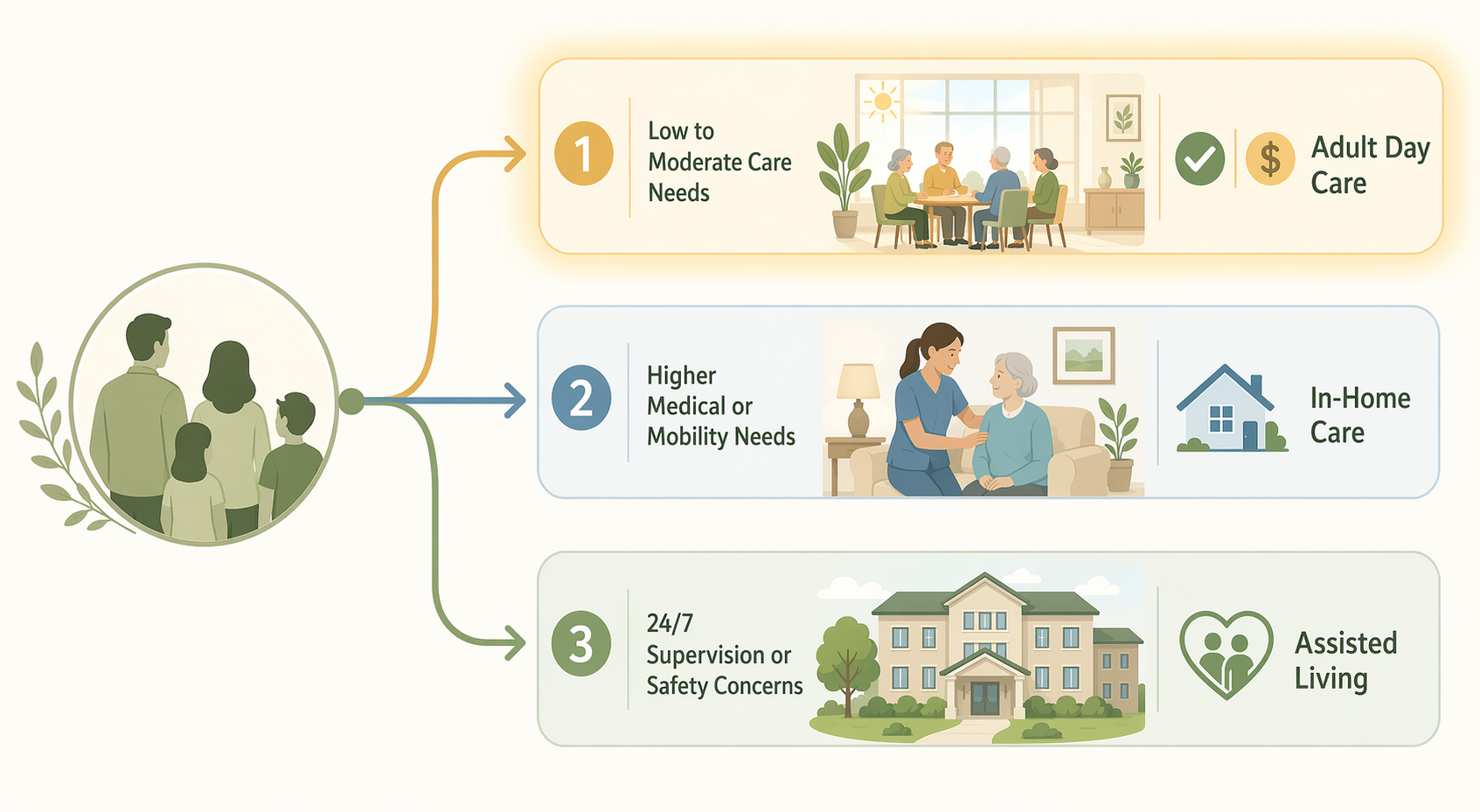
- Low-to-moderate care needs (needs supervision and social engagement during the day, but is safe alone at night and can manage basic mobility): Adult day care is the clear winner on cost and quality of life.
- Higher medical or mobility needs (requires skilled nursing, complex medication management, or hands-on assistance with transfers and toileting throughout the day): In-home care may be necessary, though some adult day health centers can accommodate moderate medical needs.
- 24/7 supervision or safety concerns (wandering risk, fall risk that requires overnight monitoring, or advanced dementia that makes being alone unsafe at any hour): Assisted living or memory care is likely the safest option, despite the higher cost.
For a more detailed exploration of the full range of senior care options and how to choose between them, see our Aging in Place vs. Senior Living in 2026: A 5-Factor Decision Framework and The True Cost of Assisted Care.
The awareness gap around adult day care is real, and it costs families thousands of dollars every month. The option exists. It is covered by Medicaid in every state. It provides meaningful social engagement and supervision. And at roughly $95 per day, it is the most affordable path to maintaining both your parent's independence and your own financial stability.
Questions to bring to a clinician or OT
This is not medical, legal, or a family's final decision — only a framework. Bring these questions to a clinician, occupational therapist, or your local Area Agency on Aging.
Find Local HelpRelated reading
Noticed something outdated or inaccurate on this page? Flag a correction. We review every report against CDC, NIA, and AARP HomeFit guidance before updating a page.