
Aging in Place vs. Senior Living in 2026: A 5-Factor Decision Framework for Families After a Crisis
After a fall, dementia diagnosis, or sudden functional decline, families face an urgent choice: modify the family home or move to a senior living community. This guide provides a structured five-factor framework — ADL dependencies, cognitive status, home safety readiness, social isolation risk, and 3-year cost projection — to help adult children make a confident, informed decision.
Why This Decision Feels Urgent: The Crisis Trigger
If you are reading this, something has likely shifted — a parent fell and spent three days in the hospital, a dementia diagnosis arrived at the neurologist's office, or you noticed that Mom has stopped bathing and lost twelve pounds in two months. You are not alone in this moment. Nearly 90% of adults over 65 say they want to remain in their own homes, yet 70% will need some form of long-term care during retirement, according to SeniorLiving.org. The gap between what families hope for and what actually happens is where this decision lives.
The instinct is to react quickly — hire a home health aide, call a realtor, tour a facility. But a reactive decision made in the first week after a crisis often misses critical factors that surface three to six months later: the parent's cognitive decline accelerates, the home proves unsafe at night, or the cost of in-home care outstrips the family budget. This article provides a structured five-factor framework designed to be used in the weeks after a crisis, not the hours. It will help you evaluate what matters most and match your parent's actual needs to the right environment.
The Five-Factor Decision Framework
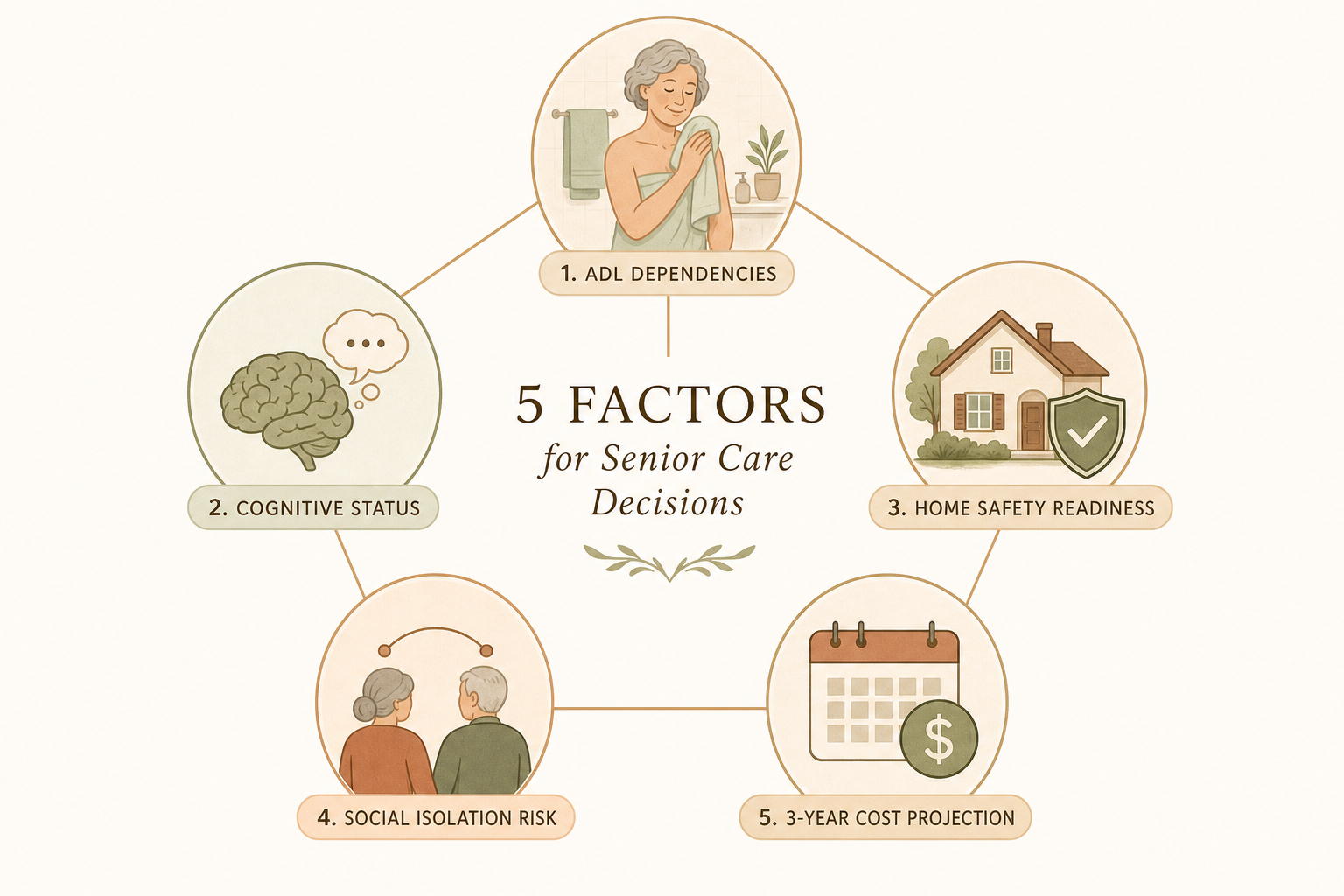
The decision between aging in place and moving to a senior living community in 2026 is not primarily about preference. It is about matching your parent's current and projected care needs to the right environment across five concrete criteria. Each factor below includes what to assess, why it matters, and how it points toward staying home or moving to a facility.
Factor 1: ADL Dependencies
Activities of Daily Living (ADLs) — bathing, dressing, toileting, transferring, continence, and eating — are the most concrete measure of how much hands-on help a person needs. A senior who needs assistance with two or more ADLs typically requires several hours of daily personal care. In-home care can provide this, but the cost scales directly with hours. If your parent needs help with three or more ADLs, the weekly cost of a home health aide at $80,126 per year (2025 Genworth data cited by SeniorLiving.org) often exceeds the fixed monthly fee of an assisted living facility, which averages $74,000 per year according to AHCA/NCAL. When ADL needs are high and predictable, a facility's round-the-clock staffing model becomes more cost-effective and logistically simpler than managing multiple home care shifts.
Factor 2: Cognitive Status
Cognitive decline changes the safety equation entirely. A person with early-stage dementia may do well at home with familiar surroundings reducing stress, as SeniorLiving.org notes. But as the disease progresses, safety risks multiply: wandering, leaving the stove on, forgetting to take medications, and sundowning agitation. Nationally, 42% of assisted living residents have Alzheimer's or another dementia, according to both SeniorLiving.org and AHCA/NCAL data. Memory care units provide secured environments with locked doors, enclosed outdoor areas, and tracking bracelets, as described by Harvard Health. If your parent has a dementia diagnosis, cognitive assessment is not optional — it is the factor that most often determines whether aging in place is safe beyond the early stage.
Factor 3: Home Safety Readiness
A home that was safe five years ago may be hazardous today. The key questions are: can your parent navigate stairs safely? Is there a full bathroom on the main floor? Are doorways wide enough for a walker or wheelchair? Are grab bars installed in the shower and near the toilet? The cost of modifications varies widely — a set of grab bars may cost $50 to $200, while a stair lift runs $3,000 to $10,000, and a full bathroom remodel can exceed $15,000. If the home requires major structural changes and the senior's mobility is declining, the cumulative cost and disruption of modifications may approach or exceed the cost of moving to an accessible facility.
Factor 4: Social Isolation Risk
Social isolation is a serious health risk for older adults, contributing to depression, cognitive decline, and even higher mortality. A senior who lives alone, has limited mobility, and has few nearby relatives or friends is at high risk. Aging in place can work well when there is a strong social network — neighbors who check in, weekly community center visits, or regular family visits. But if your parent is already isolated, moving to a senior living community with built-in social engagement programs, group meals, and activities may be the healthier choice, even if their physical health is relatively stable.
Factor 5: 3-Year Cost Projection
Cost is not just about what you pay this year — it is about how costs change over time. In-home care costs rise as hours increase. If your parent needs 20 hours of care per week now but will likely need 40 hours within two years, the annual cost will nearly double. Assisted living and memory care facilities charge a fixed monthly fee that includes rent, meals, and basic care, making costs more predictable. However, facilities may add tiered care fees as needs increase. A three-year projection should include the cost of home modifications, the potential for increased care hours, and the annual inflation rate for senior care, which Genworth estimates could rise by more than 30% by 2030.
| Factor | What to Assess | Points Toward Aging in Place | Points Toward a Facility |
|---|---|---|---|
| ADL Dependencies | Number of ADLs requiring assistance | 0–1 ADLs, stable or improving | 3+ ADLs, increasing over time |
| Cognitive Status | Dementia diagnosis, stage, safety awareness | Early-stage, no wandering, good judgment | Moderate to late-stage, wandering, unsafe behaviors |
| Home Safety Readiness | Fall hazards, bathroom access, stairs, doorways | Single-level, already modified, low fall risk | Multi-level, major modifications needed, high fall risk |
| Social Isolation Risk | Living alone, social network, mobility to leave home | Strong local network, active social life | Isolated, limited mobility, no nearby family |
| 3-Year Cost Projection | Current vs. projected care hours, modification costs, facility fees | Low care hours, home already modified, stable costs | High projected care hours, major modifications needed, costs escalate |
What Each Care Option Actually Costs in 2026
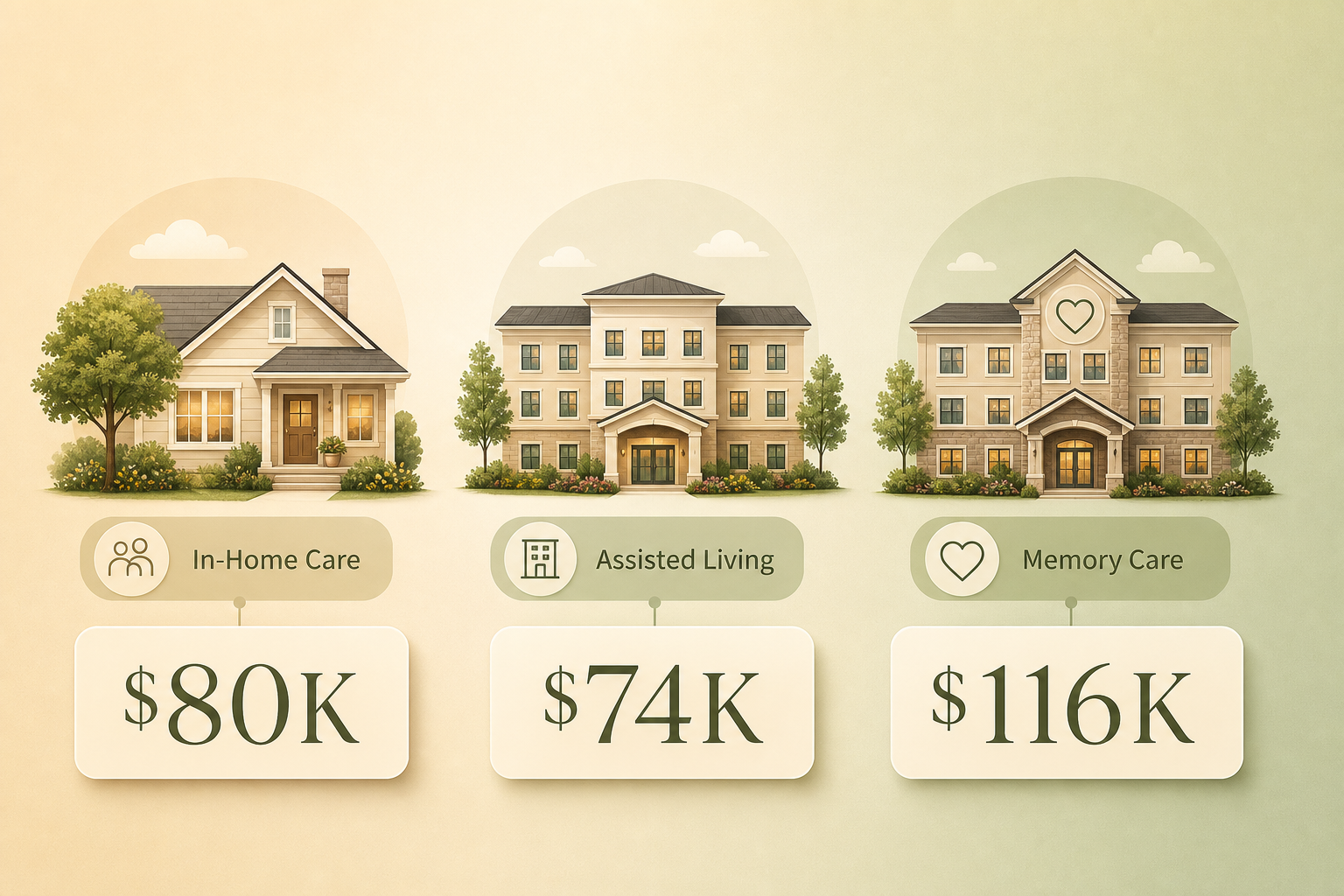
Cost is often the first question families ask, but it should be the fifth factor in your decision — after you understand your parent's care needs. The table below shows the national median annual costs for the three most common care options in 2026. Note that figures vary slightly between sources due to different data collection methodologies.
| Care Option | Annual Median Cost (2025–2026) | Source |
|---|---|---|
| Home Health Aide (44 hours/week) | $80,126 | SeniorLiving.org (Genworth data) |
| Assisted Living | $72,924 – $74,000 | SeniorLiving.org ($72,924) / AHCA/NCAL ($74,000) |
| Memory Care (nursing home, private room) | $116,800 | Harvard Health (Alzheimer's Association data) |
| Nursing Home (private room) | $129,575 – $131,583 | AHCA/NCAL ($129,575) / SeniorLiving.org ($131,583) |
| Nursing Home (semi-private room) | $104,025 – $114,665 | Harvard Health ($104,025) / SeniorLiving.org ($114,665) |
The critical insight is not the absolute numbers but how costs scale differently. In-home care costs rise with hours — if your parent needs 20 hours per week now but 40 hours in two years, the annual cost will approach $80,000. Assisted living has a fixed monthly fee that includes rent, meals, and basic care, making it more predictable. However, memory care is significantly more expensive, averaging $116,800 per year, and Medicare does not cover memory care facilities, though it may cover some in-home skilled nursing services for those who are homebound, according to Harvard Health.
For a deeper dive into cost breakdowns, payment strategies, and Medicaid planning, see our comprehensive guide: The True Cost of Assisted Care: A Financial Roadmap for Families.
How to Assess Home Readiness for Aging in Place
If your parent's ADL needs are low, cognitive status is stable, and social isolation is not a concern, aging in place may be the right path — but only if the home is safe. Use the following checklist to conduct a room-by-room safety audit. Each question addresses a common fall hazard or accessibility barrier.
- Are there grab bars in the shower and next to the toilet? (Not just a towel rack — it must be a properly installed grab bar rated to hold 250+ lbs.)
- Is there a non-slip mat or adhesive strips in the tub or shower?
- Can your parent enter the bathroom with a walker or wheelchair? Doorways should be at least 32 inches wide.
- Is there a bedroom and full bathroom on the main floor? If not, can a stair lift be installed?
- Are all stairs equipped with sturdy handrails on both sides? Are steps free of clutter and in good repair?
- Are throw rugs and loose carpets removed or secured with non-slip backing?
- Is there adequate lighting in hallways, stairways, and the path from bedroom to bathroom at night? Consider motion-sensor night lights.
- Can your parent enter and exit the home safely? Are there steps at the entryway that need a ramp?
- Is the kitchen organized so that frequently used items are within easy reach without bending or using a step stool?
The cost of common modifications ranges from under $100 for grab bars and non-slip mats to $3,000–$10,000 for a stair lift and $15,000+ for a full bathroom remodel. For a complete breakdown of modification costs, funding sources (including VA grants and Medicaid waivers), and guidance on working with CAPS-certified contractors, see our guides: Aging in Place Home Modifications: A Complete Cost Breakdown and Planning Guide for Families and When an Aging-in-Place Remodel Makes Financial Sense vs. Moving.
How to Evaluate a Senior Living Community If Moving Is the Right Choice
If your assessment across the five factors points toward a facility, the next step is evaluating specific communities. The senior living market in 2026 is tight: occupancy reached 88.7% in Q3 2025, the 17th consecutive quarter of increase, according to the National Investment Center for Seniors Housing & Care (NIC). Independent living occupancy climbed above 90% for the first time since 2019, reaching 90.2%, and assisted living occupancy jumped to 87.2%. With less than 1,400 new units opening in Q3 2025 and inventory growth of only 0.7% year-over-year, NIC forecasts average occupancy above 90% by the end of 2026. This means desirable facilities may have waitlists, and you should begin touring early.
When touring a facility, use the following questions to evaluate whether it can meet your parent's current and future needs:
- What level of care is provided? Is this an assisted living facility, a memory care unit, or a skilled nursing facility? Many communities offer multiple levels, but you need to confirm that the specific unit matches your parent's needs.
- What is the staff-to-resident ratio during the day and overnight? Lower ratios mean more individualized attention.
- Is the facility secured? For a parent with dementia, look for locked doors, alarmed exits, enclosed outdoor areas, and tracking bracelets — standard features in memory care units.
- What social and recreational programs are offered? Are there daily activities, group outings, and opportunities for residents to engage with each other?
- What is the full fee structure? Ask about the base monthly fee, any tiered care fees for additional services, entrance fees, and what is not included (e.g., transportation, laundry, special dietary needs).
- What is the policy on Medicaid? Only 17% of assisted living residents rely on Medicaid, according to AHCA/NCAL. If your parent may need Medicaid in the future, confirm whether the facility accepts it.
- Can you speak with current residents or their family members? A facility that is reluctant to arrange this may be hiding concerns.
The Baby Boomer generation is now in their seventies, and as Provider magazine notes, many are delaying entry into senior living until they desire lifestyle benefits rather than care support. This is driving demand for independent living and "Active Adult Plus" models that incorporate infrastructure to layer in home health services as residents age. If your parent is still relatively independent but you anticipate future needs, a continuing care retirement community (CCRC) that offers a full continuum of care on one campus may be worth considering.
Decision Matrix Summary: Matching Your Situation to the Right Path
The following decision matrix maps common combinations of the five factors to the most appropriate care option. Use it as a starting point, then consult with your parent's primary care physician, a geriatric care manager, or an elder law attorney for personalized advice.
| ADL Needs | Cognitive Status | Home Safety | Social Risk | 3-Year Cost Outlook | Recommended Path |
|---|---|---|---|---|---|
| Low (0–1 ADLs) | Stable, no dementia | Safe, single-level | Low | Stable, low care hours | Age in place with monitoring and light support |
| Moderate (2 ADLs) | Early-stage dementia | Minor modifications needed | Moderate | Moderate increase in care hours | Age in place with home modifications and part-time home care |
| High (3+ ADLs) | Stable, no dementia | Major modifications needed | Low | High care hours exceed facility cost | Assisted living facility |
| Moderate (2 ADLs) | Moderate-stage dementia | Unsafe, multi-level | High | High care hours + modifications | Memory care unit |
| High (3+ ADLs) | Moderate to late-stage dementia | Unsafe, any level | High | Very high care hours + modifications | Memory care or skilled nursing facility |
| Low (0–1 ADLs) | Stable, no dementia | Safe, single-level | High | Stable | Independent living or active adult community with social programs |
Your 30-Day Action Plan
The five-factor framework gives you a structure, but a decision this consequential needs a timeline. The following 30-day plan breaks the process into weekly tasks so you can move forward methodically without feeling overwhelmed.
Week 1: Assessment and Data Gathering
- Complete a functional assessment of your parent's ADL dependencies. Use the Katz Index of Independence in Activities of Daily Living or a similar tool. Note which ADLs require assistance and how much time each takes.
- Schedule an appointment with your parent's primary care physician for a cognitive screening if one has not been done recently. Ask specifically about memory, judgment, and safety awareness.
- Gather financial documents: income sources (Social Security, pensions, retirement accounts), assets, long-term care insurance policy, and any existing Medicaid or VA benefits.
- Begin a daily log of care tasks, noting how much time each takes and whether you are managing alone or with help.
Week 2: Home Safety Evaluation and Facility Research
- Conduct the room-by-room home safety audit from the checklist above. Take photos of hazards and estimate the cost of needed modifications.
- Research three to five senior living communities in your parent's preferred area. Check occupancy rates and availability — with occupancy above 88% nationally, waitlists are common.
- Call each facility to ask about current availability, base monthly fees, and whether they accept Medicaid or have a Medicaid spend-down pathway.
- If your parent has a dementia diagnosis, specifically ask about memory care unit availability, security features, and staff training in dementia care.
Week 3: Financial Analysis and Family Discussion
- Build a 3-year cost projection for both paths: aging in place (home modifications + projected home care hours + equipment) vs. facility (monthly fees + tiered care increases + one-time entrance fees). Use the cost data in this article as a starting point.
- Schedule a family meeting with all key decision-makers — siblings, your parent (if cognitively able to participate), and any other involved relatives. Use the five-factor framework as the agenda.
- If your parent has a dementia diagnosis, discuss the conversation about stopping driving and accepting help. See our Caregiver Wellbeing section for guidance on these difficult conversations.
- Consult with an elder law attorney if the financial picture is complex — especially if Medicaid planning, VA benefits, or asset protection is needed.
Week 4: Decision and Initial Implementation
- Make the decision using the five-factor framework and the decision matrix. Write down the key reasons for the choice so you can refer back to them later.
- If the decision is to age in place: schedule home modification contractors for estimates, arrange for a home health aide agency evaluation, and set up a medical alert system or passive monitoring technology.
- If the decision is to move: schedule facility tours for the top two or three choices, prepare a list of questions from the evaluation section above, and begin the application process.
- Take care of yourself. This is an emotionally and logistically exhausting process. If you are feeling overwhelmed, read our guide on recognizing caregiver burnout and accessing respite care.
Related reading
Noticed something outdated or inaccurate on this page? Flag a correction. We review every report against CDC, NIA, and AARP HomeFit guidance before updating a page.
Part of the Fall Prevention section.