
Caregiver decision guide
When Is 24/7 Care Actually Necessary? A Decision Framework for Using Monitoring Technology as a Safe Alternative
Many families assume a parent needs round-the-clock human care after a crisis, but a systematic evaluation of fall risk, wandering, medication needs, and nighttime safety can reveal whether a hybrid approach—combining partial human care with monitoring technology—is safe, sufficient, and dramatically more affordable. This guide provides a clinical decision matrix, technology cost tiers, and a step-by-step assessment for adult children making this high-stakes choice.
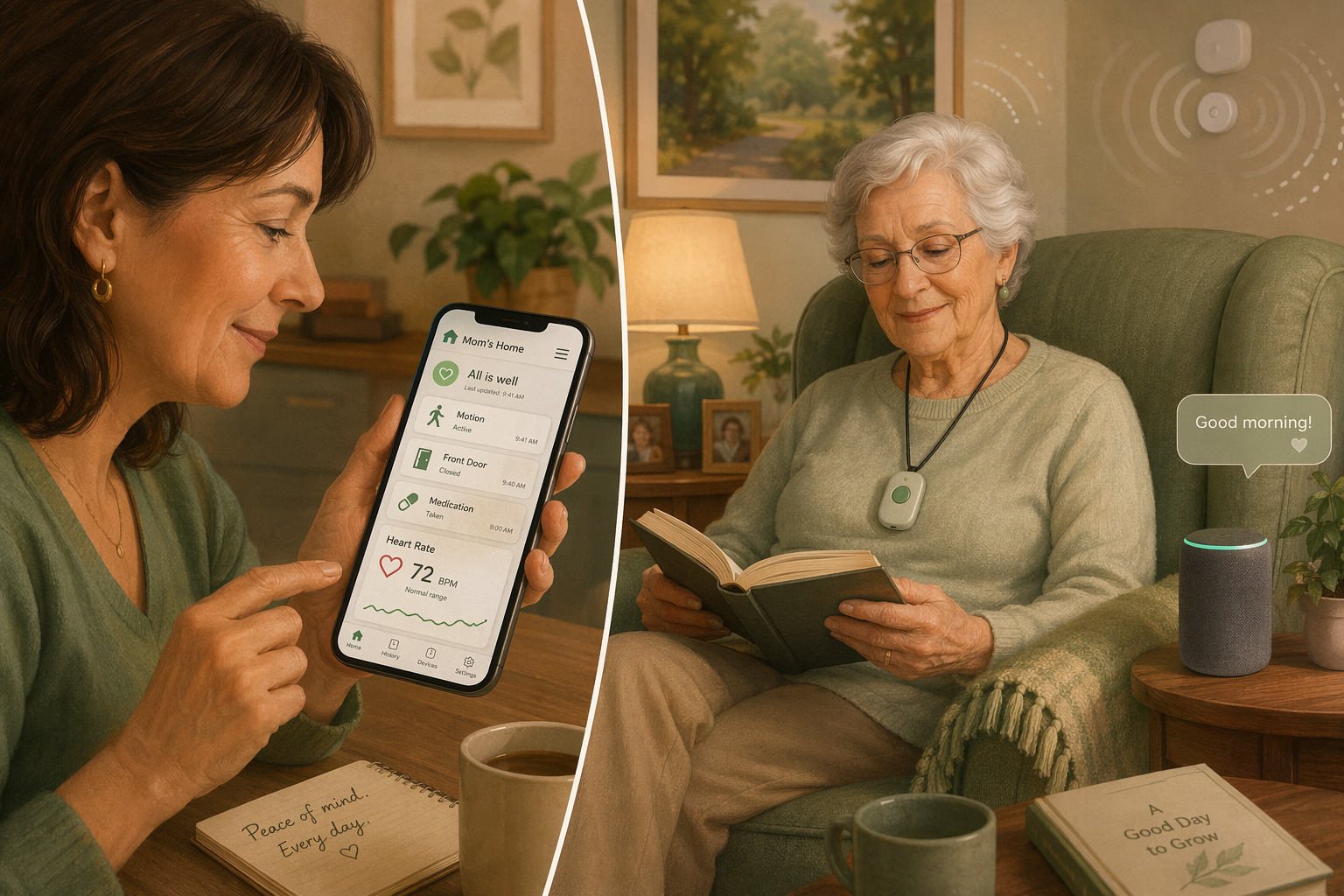
The Cost Shock: Why Families Need to Get This Decision Right
The financial stakes of the 24/7 care decision are staggering. According to A Place for Mom's 2026 Cost of Long-Term Care and Senior Living Report, the national median cost of nonmedical home care is $34 per hour. For round-the-clock care, that translates to roughly $816 per day, $5,712 per week, and $24,733 per month. To put that in perspective, the same report places the national median cost of assisted living at $5,419 per month and a nursing home private room at approximately $9,034 per month.
A family paying for 24/7 home care out of pocket is spending nearly five times what they would for assisted living and more than double the cost of a nursing home. Yet the overwhelming majority of older adults — 75% of Americans aged 50 and older, according to a 2024 AARP report — want to age in place. This creates a painful collision between preference and affordability, one that forces many adult children into a high-stakes calculation: can we keep Mom or Dad safe at home without bankrupting the family?
The urgency is compounded by the fact that neither Medicare nor Medicaid covers long-term 24/7 in-home custodial care. Medicare will pay for short-term skilled nursing care after a hospital stay, but the moment the need shifts to ongoing supervision and assistance with daily activities, the family is on its own financially. A wrong decision — committing to full-time human care when a less expensive alternative would suffice — can drain retirement savings in months, not years.
What Does '24/7 Care' Actually Mean? Live-In vs. Shift Care
One of the most poorly understood distinctions in home care is the difference between live-in care and 24-hour shift care. These two models are not the same, and the difference in cost — and in what they require from the senior — is substantial.
Live-in care involves a single caregiver who resides in the home and provides care during a specified shift, typically eight hours, with breaks for meals and an uninterrupted sleep period. The caregiver must receive at least eight hours of rest per 24-hour period and a bed to sleep in. This model is appropriate when the senior can sleep through the night with minimal assistance and does not require constant supervision to prevent wandering or other safety risks. According to proprietary data from A Place for Mom cited by AgingCare, the national median monthly rate for live-in home care is approximately $10,646.
Twenty-four-hour shift care, by contrast, involves two or more caregivers rotating eight-hour shifts to ensure someone is awake and available at all times. There is no expectation that the senior will sleep through the night. This model is necessary when the senior wanders, is frequently awake and agitated at night, requires repositioning or toileting assistance throughout the night, or has medical needs that demand constant attention. The cost is roughly double that of live-in care: $19,656 to $24,733 per month, depending on the data source.
| Care Model | Monthly Cost (National Median) | Key Requirement | Best For |
|---|---|---|---|
| Live-In Care | ~$10,646 | Senior sleeps through night with minimal assistance | Seniors who need daytime help but are stable overnight |
| 24-Hour Shift Care | $19,656 – $24,733 | Rotating awake caregivers, no overnight break | Seniors with wandering, frequent nighttime needs, or high fall risk |
| Assisted Living | ~$5,419 | Moves to a facility with 24/7 staff | Seniors who need supervision but not one-on-one care |
| Nursing Home (Private) | ~$9,034 | Skilled nursing and custodial care in a facility | Seniors with complex medical needs requiring skilled staff |
The practical implication is clear: if your parent can safely sleep through the night with only occasional check-ins, the live-in model may be appropriate, saving your family roughly $9,000 to $14,000 per month. But determining whether they can safely sleep through the night requires a systematic evaluation — which brings us to the decision matrix.
The Clinical Decision Matrix: When Can Technology Substitute for a Human?
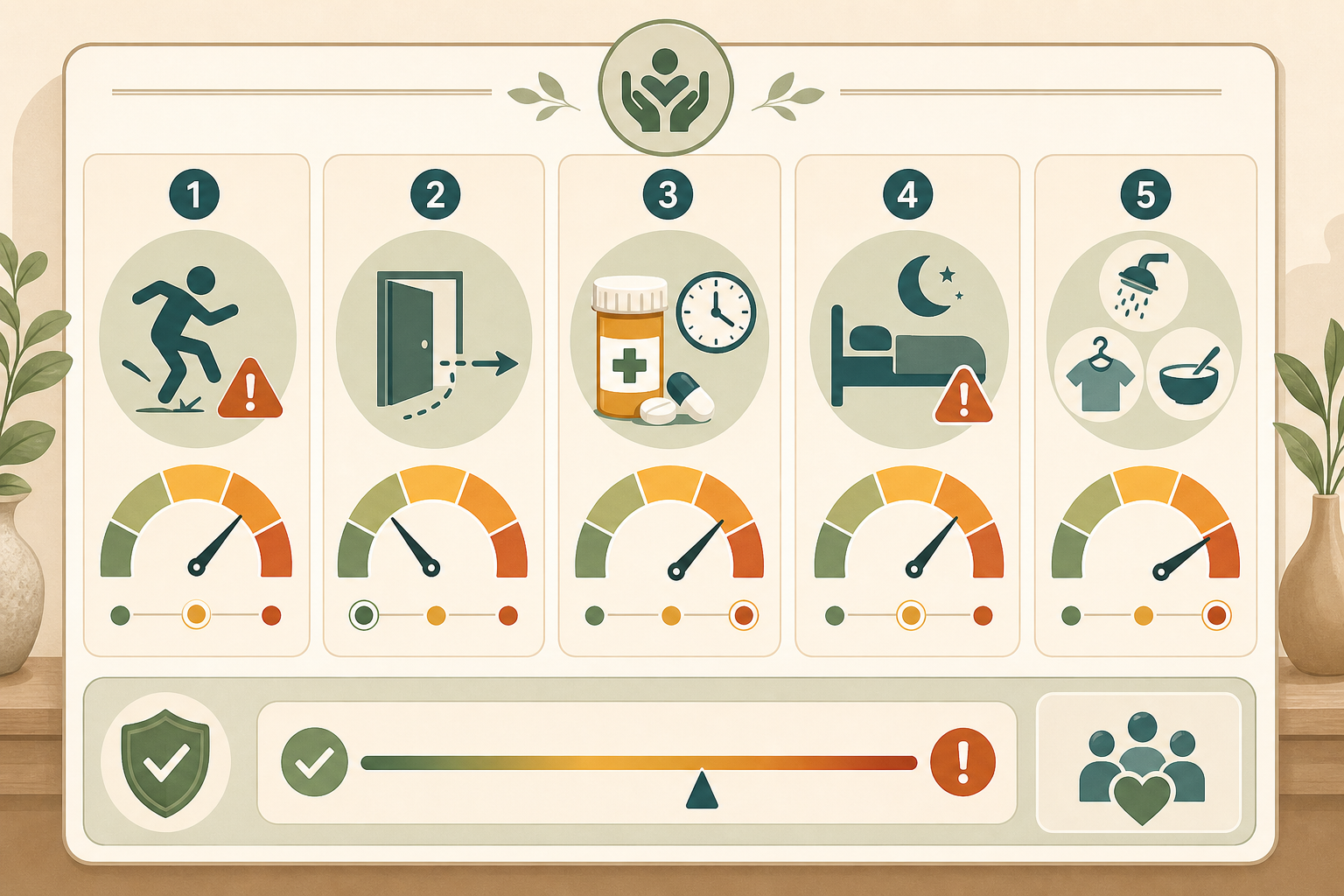
Rather than guessing whether your parent needs 24/7 human care, use this structured risk-profile evaluation. For each of five domains, assess whether the risk level is low, moderate, or high. The scoring framework will guide you toward the appropriate care model.
| Risk Domain | Low Risk (Tech May Suffice) | Moderate Risk (Hybrid Model) | High Risk (Human Care Needed) |
|---|---|---|---|
| Fall Risk | No falls in past 12 months; good balance; no mobility aids needed | 1–2 falls in past year; uses a cane or walker; some unsteadiness | Multiple falls in past 6 months; requires physical assistance to stand; history of fall-related injury |
| Wandering History | No history of wandering; no dementia diagnosis | Mild cognitive impairment; occasionally disoriented but returns home | Active wandering; dementia diagnosis with elopement risk; cannot be redirected verbally |
| Medication Complexity | Takes 1–3 daily medications; no schedule changes; no cognitive issues with adherence | Takes 4–6 medications; occasional missed doses; uses a pill organizer | Takes 7+ medications; complex dosing schedules; requires injection or IV medications; cognitive impairment affecting adherence |
| Nighttime Needs | Sleeps 6–8 hours uninterrupted; may wake once for bathroom but returns to bed independently | Wakes 2–3 times per night; needs minimal assistance (e.g., verbal cueing to use bathroom) | Awake and agitated for hours each night; requires repositioning, toileting, or redirection; sundowning symptoms |
| ADL Dependency | Independent with all ADLs (bathing, dressing, toileting, transferring, eating); needs help only with IADLs (shopping, transportation) | Needs assistance with 1–2 ADLs (e.g., bathing, dressing); can use adaptive equipment | Needs assistance with 3+ ADLs; requires physical transfer assistance; incontinent |
How to use this matrix: If your parent scores low risk across all five domains, monitoring technology alone may be sufficient for safety, with periodic check-ins from family or a paid caregiver for a few hours a day. If they score moderate in one or two domains, a hybrid model — partial human care supplemented by technology — is likely appropriate. If they score high risk in even one domain, particularly wandering or fall risk, 24/7 human care is strongly recommended, though technology can still play a supporting role.
For a deeper dive into assessing fall risk and implementing prevention strategies, see our comprehensive fall prevention guide, which covers the CDC STEADI model, home modifications, and community resources.
Technology Tiers: What Each Option Costs and Does
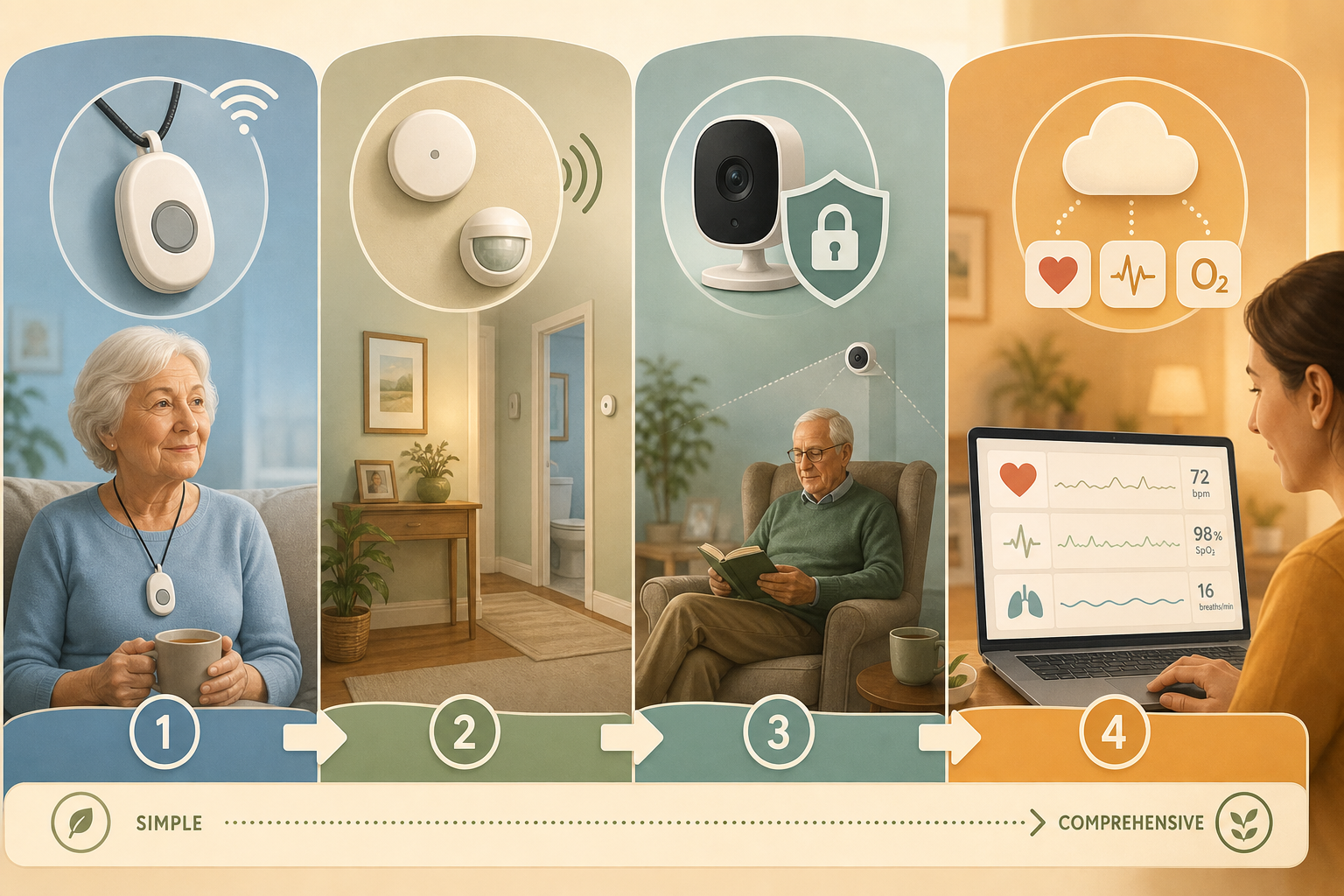
Monitoring technology is not a single product category. It spans a spectrum from simple wearable alert buttons to comprehensive remote patient monitoring (RPM) systems that track vital signs and daily activity patterns. Understanding the four main tiers will help you match the right technology to your parent's specific risk profile.
| Technology Tier | Monthly Cost | Upfront Cost | Key Capabilities | Best Risk Profile | Privacy Considerations |
|---|---|---|---|---|---|
| Wearable PERS (Personal Emergency Response System) | $30 – $80 | $0 – $300 | Fall detection, GPS tracking, two-way voice, SOS button, 24/7 monitoring center | Low fall risk, mobile, cognitively intact | Wearable must be worn consistently; some seniors remove devices; no passive monitoring of daily patterns |
| Passive Motion Sensors | $30 – $50 | $200 – $500 | Motion detection on doors, refrigerators, bedrooms; no camera; alerts on inactivity or unusual patterns | Moderate fall risk, early-stage dementia, lives alone | No video; most acceptable to privacy-conscious seniors; cannot detect falls directly unless combined with other sensors |
| Camera-Based Monitors | $10 – $50 | $50 – $200 | Live video feed, motion alerts, two-way audio, night vision | Moderate to high risk; specific areas of concern (e.g., kitchen, entryway) | Highest privacy concern; many seniors find cameras intrusive; may require consent from cognitively impaired individuals |
| Remote Patient Monitoring (RPM) | $50 – $150 | $100 – $500 | Vital sign tracking (heart rate, blood pressure, oxygen), medication reminders, activity pattern analysis, integration with telehealth | Chronic conditions, post-hospitalization, medication complexity | Requires consistent use of wearable or Bluetooth devices; data shared with healthcare providers; HIPAA considerations |
For a more detailed exploration of passive sensor systems and why they are increasingly preferred over wearables for elderly safety, read our guide on Beyond the Panic Button: Why Passive, Sensor-Based Monitoring Is Replacing Wearables.
Hybrid Care Models: Combining Human Care with Technology
The most practical and cost-effective solution for many families is not an either/or choice between full-time human care and pure technology. It is a hybrid model that combines the strengths of both. The goal is to match the intensity of human care to the periods of highest risk while using technology to cover lower-risk periods.
Consider these hybrid approaches:
- Daytime human care + overnight passive monitoring: A caregiver provides 8–12 hours of coverage during the day (roughly 8:00 AM to 8:00 PM) for meals, medication, bathing, and companionship. Overnight, passive motion sensors and a wearable PERS device provide safety coverage. This model can reduce costs by 40–60% compared to 24/7 shift care.
- Live-in care + daytime sensor backup: A live-in caregiver provides overnight presence and morning assistance, while passive sensors monitor activity patterns during the day when the caregiver is on break. This addresses the key limitation of live-in care — the caregiver's required eight-hour break — without requiring a second caregiver.
- Family caregiver + technology + paid respite: A family member provides primary care during certain hours, supplemented by monitoring technology for safety, with a paid caregiver stepping in for 4–8 hours a day to give the family caregiver a break. This model is particularly relevant for working adult children who provide care before and after work hours.
- Post-hospitalization transitional care: A short-term (2–4 week) period of 24/7 human care immediately after hospital discharge, transitioning to a hybrid model as the senior recovers. Vicki Demirozu, founder of Giving Care with Grace, notes that when a doctor says 'you can't go home without 24/7 care,' they are often referring to the first few days after discharge, not a permanent arrangement.
"When someone's getting out of the hospital and the doctor says 'you can't go home without 24/7 care,' they're usually just referring to the two or three days after they leave the hospital that they need someone with them. It's not 24/7 care forever. Many people can thrive with 16 hours of care."
The key to a successful hybrid model is matching the technology to the specific risk profile. A senior with moderate fall risk but no wandering history may do well with overnight passive sensors and a wearable PERS. A senior with early-stage dementia who is at risk of wandering may need a GPS tracker and door sensors in addition to daytime human care.
The Evidence: What the Research Says About Remote Monitoring
The most compelling evidence for the effectiveness of remote monitoring comes from a 2025 study published in the Journal of the American Medical Directors Association (JAMDA). Salahub and colleagues conducted a propensity score-matched cohort study in Toronto, Canada, comparing outcomes for 1,494 older adults receiving a Remote Care Monitoring (RCM) program against 1,494 matched controls receiving standard home care.
The RCM program included a personal alert device with fall detection, GPS tracking, two-way communication, and an SOS button, along with optional medication dispensers and passive home sensors, all supported by a 24/7 call center. The results were striking:
| Outcome | RCM Group | Control Group | Difference |
|---|---|---|---|
| Days at home over 100 days | 92.3 days | 88.9 days | +3.4 days (95% CI, 1.9–5.0) |
| Days alive over 100 days | 98.6 days | 96.4 days | +2.2 days |
| Probability of death | 3.2% | 6.8% | ~50% lower (RR, 0.48; 95% CI, 0.34–0.67) |
| Total healthcare costs over 100 days | Lower | Higher | Mean difference $2,670 CAD (rate ratio 0.84) |
| Healthcare costs excluding home care | Lower | Higher | Mean difference $1,636 CAD |
The JAMDA study provides strong evidence that remote monitoring, when appropriately matched to the individual's risk profile, can improve outcomes and reduce costs. But it also underscores a critical boundary: for individuals with a history of wandering, monitoring alone is insufficient. This brings us to the red flags that signal when technology is not enough.
When Technology Is NOT Enough: Red Flags Requiring Human Care
Monitoring technology is a powerful tool, but it has limits. There are specific situations where no amount of sensors, cameras, or alert devices can replace the presence of a trained human caregiver. Recognizing these red flags is essential to making a safe decision.
- Advanced dementia with active wandering: The JAMDA study found that participants with a history of wandering did not benefit from remote monitoring alone. If your parent has a dementia diagnosis and has wandered or attempted to leave the home, 24/7 human supervision is strongly recommended. Technology can supplement but not replace human vigilance in this scenario.
- Frequent falls requiring physical lifting: If your parent falls multiple times per week and requires physical assistance to get up, a monitoring system can alert you to the fall but cannot provide the physical help needed. Each fall that goes unattended for hours increases the risk of complications, including dehydration, pressure injuries, and fear of falling that leads to further decline.
- Complex medical needs: Wound care, tube feeding, catheter management, or administration of injectable medications require skilled nursing care that monitoring technology cannot provide. These needs typically qualify for home health care services, which may be covered by Medicare on a short-term basis.
- Severe sundowning with agitation: If your parent becomes agitated, aggressive, or attempts to leave the home during the evening or nighttime hours, a live-in caregiver who is asleep may not be sufficient. Rotating awake caregivers are often necessary to ensure safety during these episodes.
- Inability to use or accept technology: Some seniors refuse to wear alert devices, remove motion sensors, or become confused by two-way communication systems. If your parent cannot or will not use the technology consistently, it cannot provide the safety net you are counting on.
If any of these red flags apply to your parent, consult with their primary care physician or a geriatric care manager before relying on a technology-only or hybrid approach. For those facing the difficult decision to transition to a higher level of care, our crisis-to-plan transition guide for dementia caregivers provides a structured path forward.
How to Make the Transition: A Step-by-Step Assessment Guide
Making the transition from a crisis-driven assumption of 24/7 care to a carefully evaluated hybrid model requires a systematic approach. Use this step-by-step guide to move from panic to a plan.
- Complete the risk matrix. Use the five-domain evaluation in Section 3 to assess your parent's fall risk, wandering history, medication complexity, nighttime needs, and ADL dependency. Be honest about each domain — it is better to overestimate risk initially and adjust downward later than to underestimate and face a crisis.
- Consult with the primary care physician or geriatrician. Share your risk assessment with your parent's doctor. Ask specifically: 'Based on this profile, is it safe for my parent to be alone for [X] hours per day with monitoring technology in place?' The doctor may identify risks you have missed or may recommend a referral to an occupational therapist for a home safety assessment.
- Trial a monitoring system for 2–4 weeks. Choose one technology tier that matches your parent's primary risk (e.g., passive motion sensors for a senior living alone with moderate fall risk). Install the system and use it for at least two weeks before making any decisions about reducing human care hours. This trial period will reveal whether your parent accepts the technology and whether the alerts are actionable.
- Evaluate results and adjust the care plan. After the trial period, review the data: How many alerts were triggered? Were they false alarms or genuine concerns? Did your parent wear the device consistently? Did the system provide peace of mind or create new anxiety? Based on this evaluation, adjust the balance between human care hours and technology coverage.
- Revisit the decision every 3–6 months. Your parent's needs will change over time. A hybrid model that works today may need adjustment as mobility declines, cognitive function changes, or new medical conditions emerge. Set a recurring calendar reminder to reassess the risk matrix and adjust the care plan accordingly.
For readers who are not yet in crisis mode but want to prepare proactively, our preparedness guide for caring for aging parents offers a framework for building a care plan before an emergency forces your hand.
The decision between 24/7 human care and a technology-assisted hybrid model is one of the most consequential financial and emotional choices a family caregiver will make. By approaching it systematically — assessing risk profiles, understanding the true costs of each care model, trialing technology before committing, and revisiting the decision regularly — you can make a choice that keeps your parent safe, preserves their independence, and protects your family's financial future.
Questions to bring to a clinician or OT
This is not medical, legal, or a family's final decision — only a framework. Bring these questions to a clinician, occupational therapist, or your local Area Agency on Aging.
Find Local HelpRelated reading
- The Monitoring Conversation: How to Talk to an Aging Parent About Safety Technology Without Damaging Trust or Autonomy
- Personal Emergency Response Systems (PERS) Explained: Types, Features, and How to Choose One
- A Decision Framework for Choosing an Elderly Monitoring System Based on Your Parent's Needs
Noticed something outdated or inaccurate on this page? Flag a correction. We review every report against CDC, NIA, and AARP HomeFit guidance before updating a page.