
Caregiver decision guide
The Monitoring Conversation: How to Talk to an Aging Parent About Safety Technology Without Damaging Trust or Autonomy
A practical guide for adult children navigating the difficult conversation about introducing monitoring technology to a resistant aging parent. Learn why seniors resist, how to frame the discussion collaboratively, and what to do when the answer is still no.
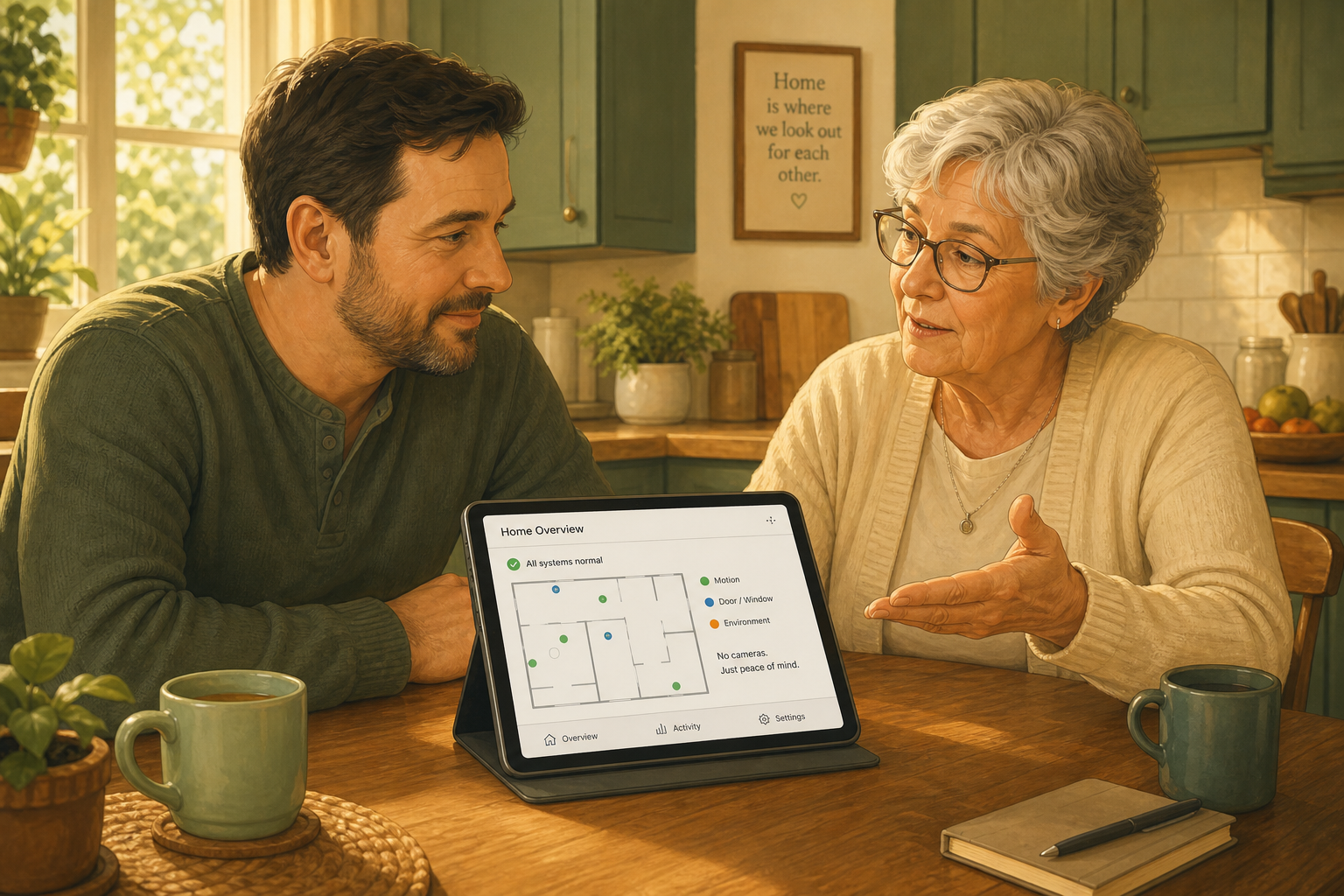
Why Your Parent Says No: Understanding Resistance as a Rational, Identity-Protective Response
When your parent refuses a medical alert pendant, covers the camera you just installed, or tells you they "don't need anyone watching them," it is easy to interpret that as denial, stubbornness, or a lack of concern for their own safety. But the research tells a different story. Resistance to monitoring technology is not irrational. It is an identity-protective response rooted in the same fears that any of us would feel in their position.
In a 2019 study led by Dr. Lee Lindquist, chief of geriatrics at Northwestern University, researchers asked 68 older adults in eight focus groups why they resisted help from family members and professionals. The top reasons were not about disliking the technology itself. They were about what accepting help meant for their identity: fear of losing independence, fear of becoming a burden, fear of being taken advantage of, and fear of relinquishing control.
These concerns map directly onto how older adults perceive monitoring technology. A 2022 scoping review by Chan et al., published in the Journal of Medical Internet Research, analyzed 94 systematic reviews on home health monitoring and found that the most common ethical concerns among older adults were:
- Privacy (raised in 63% of the 19 papers reviewed)
- Autonomy (63%)
- Control (53%)
- Social concerns (47%)
- Stigmatization (26%)
When your parent says "I don't want a camera in my living room," they are not rejecting your concern. They are protecting their sense of self. The home is a refuge, and devices that watch them feel like "an invisible person in the room," as the review's participants described it. Understanding this distinction is the first step toward a conversation that preserves trust rather than erodes it.
The Psychology of Monitoring Acceptance: Why Cameras Fail and Passive Sensors Succeed
Not all monitoring technology is rejected equally. The way a device is perceived — as surveillance or as support — determines whether it will be used consistently or abandoned after a few weeks.
FutureCare Solutions Group, which researches senior monitoring adoption, documents what they call "the camera problem." Indoor cameras have a high initial installation rate but dramatically lower sustained use. Seniors cover them with dish towels, unplug them, or turn them to face the wall. The reason is straightforward: being watched in one's own home feels like a profound violation of privacy and dignity. The technology sends an implicit message: "You are no longer trusted to manage your own life."
Wearable devices — pendants, bracelets, and smartwatches — fail differently. Studies show a dramatic drop-off in consistent use within months. The senior stops wearing the device, the family assumes it is being worn, and nobody knows until something goes wrong. This creates a dangerous form of false confidence.
Passive environmental monitoring — motion sensors placed in hallways, door sensors, stove monitors — achieves dramatically higher acceptance rates. These devices do not require the user to remember to wear or charge anything. They do not visibly signal surveillance. They "disappear into the background," as FutureCare describes it. The technology works without demanding behavior change or compliance.
Communication Scripts for Three Scenarios: Post-Crisis, Proactive, and Dementia-Involved
The right approach depends on the context. A conversation after a fall is different from a proactive discussion about future safety, and both are different from a conversation with a parent who has dementia. Below are scripts tailored to each scenario, grounded in the communication guidance from AARP and geriatric care experts.
Scenario 1: Post-Crisis (After a Fall or Emergency)
A crisis creates a "teachable moment." Your parent has just experienced the very thing you are trying to prevent. The conversation can start from a place of shared concern rather than abstract worry.
Try saying: "That fall scared me, and I know it scared you too. I'm not trying to take away your independence — I want to help you keep it. What if we found a way for you to get help quickly if something like that happens again, without someone having to be here all the time?"
This framing does two things. It acknowledges the shared emotional experience of the crisis, and it positions the technology as a tool for preserving independence — not as a replacement for it.
Scenario 2: Proactive (No Recent Crisis)
Proactive conversations are harder because there is no immediate event to anchor the discussion. Healthcare consultant David Solie, whose work is cited in the AARP guidance, recommends a specific approach: ask rather than tell.
Try saying: "I've been thinking about how we can make sure you're safe here on your own terms. How do you think we should solve the problem of what happens if you fall and can't reach the phone?"
The AARP guidance emphasizes: elicit their priorities, recognize their values, give them choices, and be attuned to unexpressed needs and fears. When your parent feels like the solution is their idea, resistance drops significantly.
Scenario 3: Dementia-Involved
When dementia is a factor, the conversation changes. Your parent may not remember the discussion, may not understand what the technology does, or may become agitated by the idea of being watched. Simplicity and reassurance are critical.
Focus on a single, simple benefit: "This little sensor will let me know if you need me. That's all it does." Avoid explaining the full system. If your parent has dementia, involve their care team — the primary care physician, a neurologist, or a geriatric care manager — in the conversation. A recommendation from a trusted clinician often carries more weight than one from a family member.

The Collaborative Decision-Making Framework: How to Center Your Parent's Autonomy
Wirecutter's experts, who review smart home devices for aging in place, "were adamant that installing indoor security cameras needs to be a collaborative decision — transparency should be obvious; nobody likes to be monitored without knowing," according to Dr. William Dale of City of Hope. This principle applies to all monitoring technology, not just cameras.
The collaborative decision-making framework has five steps:
- Elicit priorities. Ask your parent what matters most to them about staying at home. Is it privacy? Routine? Not being a burden? Their answer tells you what the technology must protect.
- Recognize values. Acknowledge that their resistance comes from a legitimate place. Say: "I understand why you feel that way. I would feel the same."
- Give choices. Present two or three options — a pendant versus a motion sensor versus a smart speaker — and let them choose. The act of choosing restores a sense of control.
- Be transparent. Explain exactly what the device does and does not do. If it has a camera, say so. If it only detects motion, say that. Ambiguity erodes trust.
- Make the decision shared. Frame it as "we" throughout. "We are figuring out what works for this situation." Not "I am getting this for you."
| Approach | What it sounds like | Likely outcome |
|---|---|---|
| Directive | "I'm installing this pendant so you can call for help." | Resistance, resentment, device abandoned |
| Persuasive | "Please just try it for me. It would make me feel better." | Reluctant compliance, device unplugged within weeks |
| Collaborative | "What do you think would help us both feel more confident about you being here alone?" | Shared ownership, higher sustained use |
Start Small: An Incremental Introduction Strategy That Preserves Trust
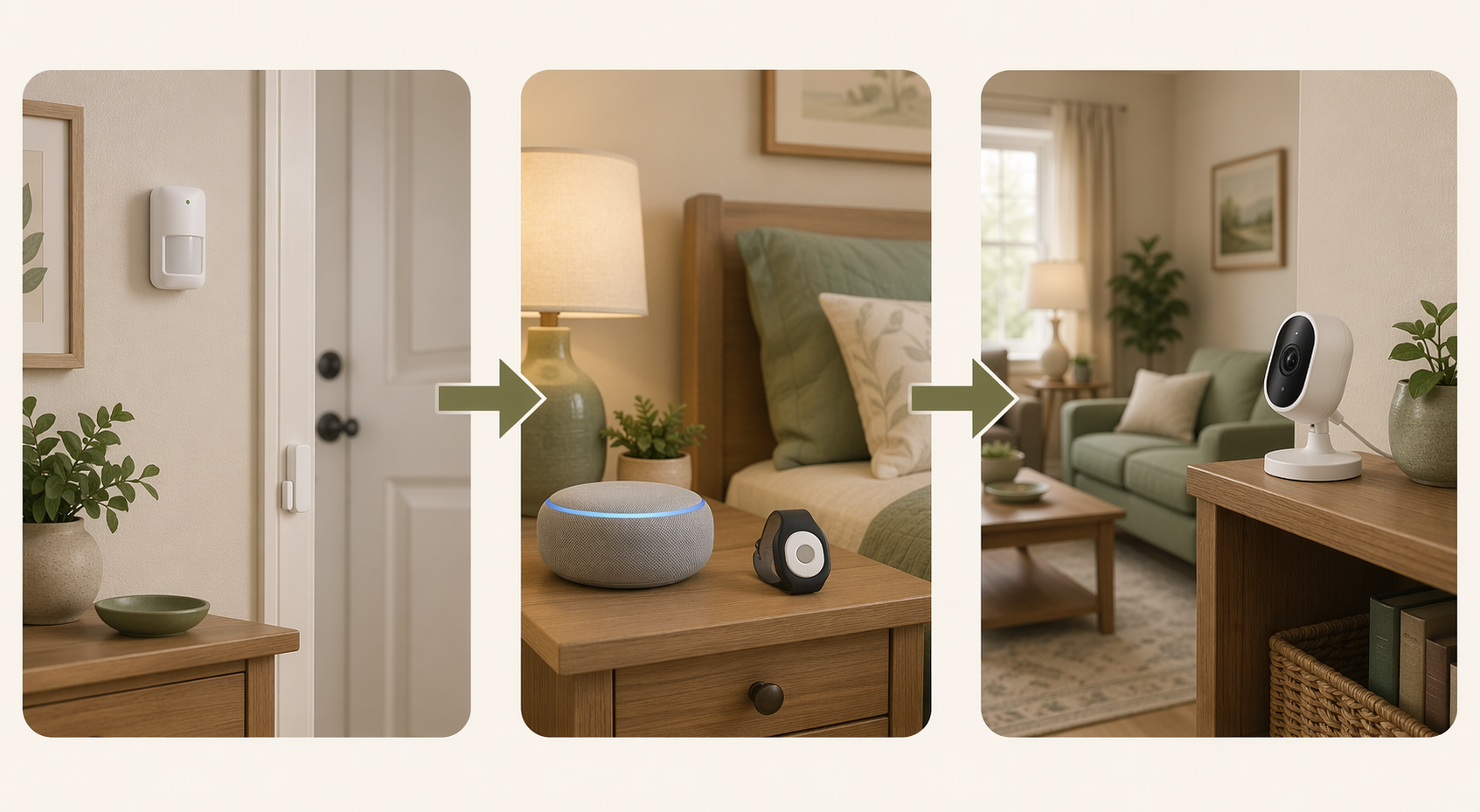
The most effective way to introduce monitoring is not to install a full system at once. It is to start with the least intrusive option and add layers only as needed. This approach respects your parent's comfort level and gives them time to adjust.
Consider this progression:
- Start with passive ambient sensors. A motion sensor in the hallway or a door sensor on the front door requires no action from your parent. It does not feel like surveillance. It simply reports activity patterns.
- Add a smart speaker with voice activation. A device like a smart speaker can be used to make calls hands-free. Your parent does not need to wear anything or press a button. They just need to speak.
- Introduce a wearable only after trust is established. Once your parent has experienced the benefits of passive monitoring — and seen that it does not violate their privacy — they may be more open to a pendant or bracelet.
- Consider cameras only as a last resort. If cameras are necessary, they should be placed in common areas only, never in bedrooms or bathrooms. The decision must be collaborative, as Wirecutter's experts emphasize.
Let your parent control placement and, where possible, the ability to turn the device on and off. This preserves their sense of agency. For long-distance caregivers, our guide on Elder Care Assistance from a Distance provides a framework for assessing and arranging remote monitoring when you are not nearby.
When Your Parent Still Says No: Preserving the Relationship and Waiting for the Teachable Moment
Sometimes, despite your best efforts, your parent will still say no. They may refuse to discuss it further. They may agree to a device and then stop using it. In this scenario, the most important thing you can do is preserve the relationship.
Forcing the issue — installing a camera without consent, hiding a GPS tracker in a bag, or repeatedly pressuring your parent — damages trust in ways that are difficult to repair. The AARP guidance is clear: respect their decision, even when it is frustrating. The relationship is more important than any device.
Instead, wait for the next teachable moment. Many families find that a second fall or a near-miss creates the opening that the first conversation did not. The NCOA reports that approximately 75% of monitoring technology purchases happen after a crisis, though this figure should be attributed with the caveat that the original source could not be independently verified at the time of writing.
While you wait, explore alternative care options. Monitoring technology is not a substitute for human care. If your parent's needs have progressed beyond what monitoring can address, it may be time to consider in-home care, adult day programs, or a move to a senior living community. Our guide on When a Fall Signals It's Time for Help can help you assess whether monitoring alone is sufficient, and our Home Care vs. Assisted Living vs. Nursing Home comparison provides a side-by-side look at care options if the conversation leads to exploring a higher level of support.
Real Stories from Caregivers Who Navigated This Conversation
These stories, drawn from published accounts, illustrate the principles in action.
Anne Madison, 75, lives alone. After a fall, she was able to call for help using an Amazon Echo with Alexa Emergency Assist. She said "Alexa, call for help," a live operator contacted 911, and paramedics arrived within minutes. For Anne, the technology was not surveillance — it was a lifeline that allowed her to remain in her home. The key was that she chose the device herself and controlled how it was used.
Jane Wolf Frances, whose story appears in the AARP article, waited three years before her mother agreed to move to a senior community. During those three years, Jane did not push. She respected her mother's timeline and maintained their relationship. When her mother was finally ready, the transition was smoother because trust had been preserved.
These stories share a common thread: the technology or care arrangement was adopted on the older adult's terms, not imposed by a well-meaning family member. The timeline was longer than the family wanted, but the outcome was more sustainable.
For a broader look at what caregiving responsibilities actually entail day-to-day — beyond the monitoring conversation — see our guide on What Caring for an Aging Parent Looks Like Day-to-Day.
Questions to bring to a clinician or OT
This is not medical, legal, or a family's final decision — only a framework. Bring these questions to a clinician, occupational therapist, or your local Area Agency on Aging.
Find Local HelpRelated reading
Noticed something outdated or inaccurate on this page? Flag a correction. We review every report against CDC, NIA, and AARP HomeFit guidance before updating a page.