
Caregiver decision guide
Wearable vs. Passive Elderly Monitoring Systems: A Decision Framework for Family Caregivers
Choosing between a wearable alert system and passive home monitoring depends on your parent's cognitive status, mobility, living situation, and willingness to wear a device. This guide provides a product-neutral, category-level framework to help you decide which type of monitoring fits your specific care scenario.
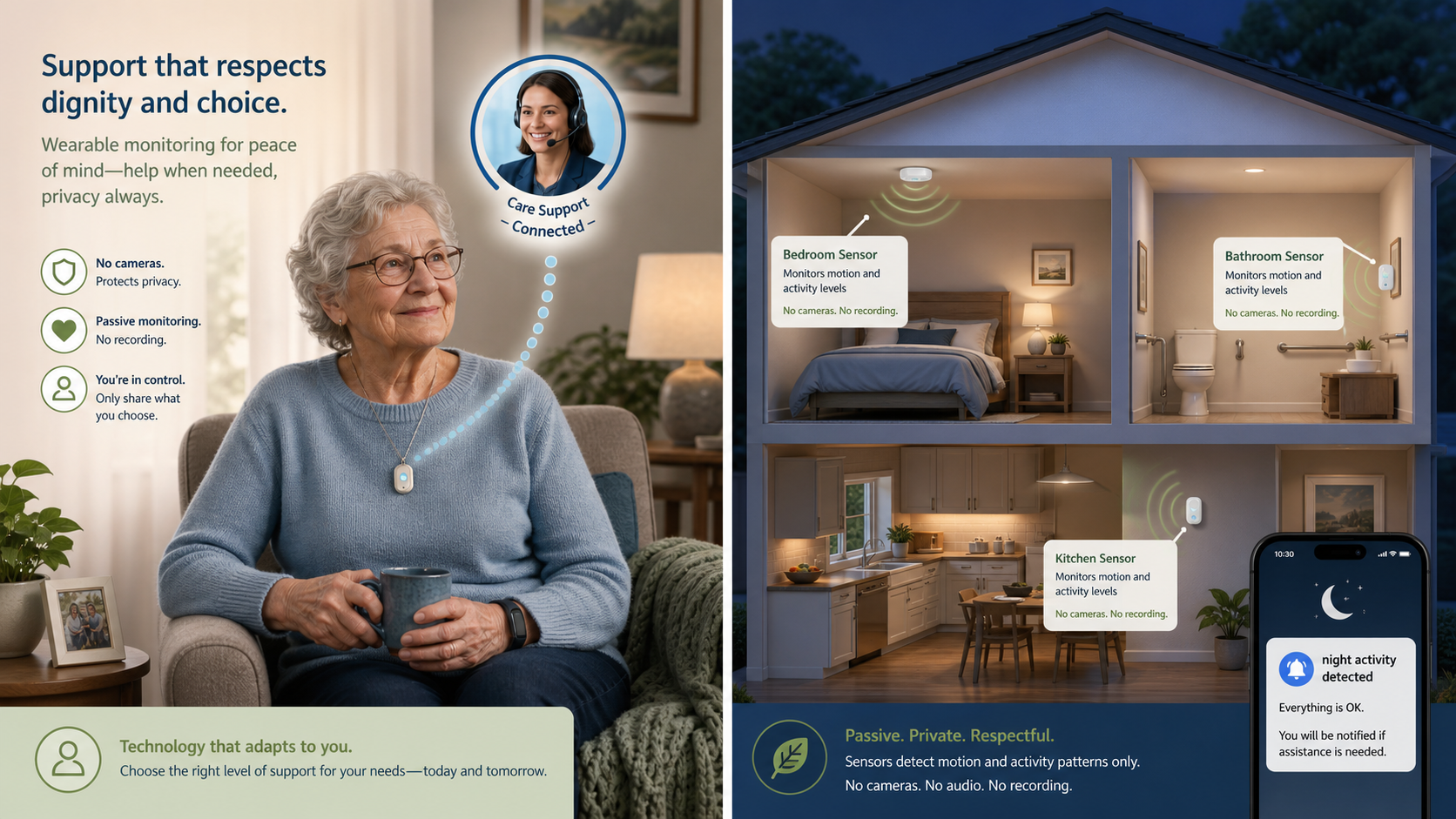
The Legacy of 'I've Fallen and I Can't Get Up' — and Why the Market Has Diversified
For decades, the image of elderly monitoring was a single device: a plastic pendant worn around the neck, ready to summon help with the press of a button. That pendant — the direct descendant of the first medical alert systems from the 1970s — has saved countless lives. But it has also created a dangerous blind spot.
The problem is not the technology. It is the assumption that one category of device fits every older adult. The pendant works perfectly for the person who remembers to wear it, can press the button after a fall, and spends most of their time at home. It fails — sometimes catastrophically — for the person with dementia who takes it off, the person who lies on the floor unable to reach the button, or the active senior who wanders outside the pendant's range.
The elderly monitoring market has responded by splitting into three distinct categories: wearable alert systems (pendants, watches, GPS trackers), passive ambient monitoring (motion sensors, radar, AI-driven behavior tracking), and camera-based systems. Each category solves a different care scenario, and choosing the wrong one creates false reassurance — the feeling of safety without the actual protection.
This guide provides a product-neutral, category-level framework to help you decide which type of monitoring fits your specific care scenario. We will walk through each category's strengths and limitations, then map them to four key factors: cognitive status, fall risk, living situation, and technology compliance.
Category 1: Wearable Alert Systems — Pendants, Watches, and GPS Trackers
Wearable alert systems are the most familiar category. They consist of a device worn on the body — typically a pendant, wristband, belt clip, or smartwatch — that connects to a monitoring center via cellular or landline. When the user presses a help button, or when automatic fall detection triggers, a trained operator speaks through the device's two-way speaker to assess the situation and dispatch emergency services or a family caregiver.
Form Factors and Their Tradeoffs
Not all wearables are created equal. The form factor directly affects fall detection accuracy, battery life, and — most critically — whether the person will actually wear it.
- Neck pendants and belt-worn devices: These are the most accurate for fall detection. The National Council on Aging (NCOA) reports that fall detection devices worn on the wrist are not as accurate as those worn around the neck or on a belt, citing MDPI research. The reason is biomechanical: arms move constantly during daily activities, generating false positives, while the torso remains relatively stable. Battery life on these devices ranges from 2 to 10 days depending on the model and usage.
- Wristbands and smartwatches: More discreet and socially acceptable, but with a meaningful accuracy tradeoff. The NCOA's 2026 testing of 35+ devices found that wrist-worn fall detection generates more false alerts, which can lead to caregiver fatigue and delayed response to real emergencies. Battery life is shorter — typically 2 to 5 days — because the device is smaller and runs more sensors.
- GPS trackers: Designed for active seniors who spend time outdoors. These devices use cellular and GPS signals to track location, often with a fall detection and two-way calling feature. They solve the range limitation of home-based pendants but introduce additional battery management (typically 2 to 5 days) and the same compliance challenge: the device must be worn and charged.
The Compliance Problem
The single greatest weakness of wearable systems is not technical — it is behavioral. A device that is not worn provides zero protection. This is especially acute for individuals with dementia, who may remove the device because it feels unfamiliar, uncomfortable, or simply because they forget its purpose. But it also affects cognitively intact older adults who find the device uncomfortable, dislike its appearance, or forget to put it on after bathing or changing clothes.
The AARP notes that Dr. Warren Wong, a geriatrician, warns that lying on the floor for as little as one hour after a fall can cause rhabdomyolysis — a serious condition where muscle tissue breaks down and releases toxins into the bloodstream. A wearable that is not worn cannot prevent this cascade.
For readers who have already decided on a wearable and want to match it to specific health risks, our guide on How to Match a Wearable Health Monitor to Your Aging Parent's Specific Risks provides a deeper dive into personalization within the wearable category.
Category 2: Passive Ambient Monitoring — Sensors That Watch the Home, Not the Person
Passive ambient monitoring takes the opposite approach: instead of requiring the older adult to wear or interact with a device, it places small sensors throughout the home that track daily routines. These sensors — motion detectors, door and cabinet contact sensors, bed pressure mats, and radar- or Wi-Fi-based fall detectors — create a baseline of normal activity. When the system detects a deviation, such as no motion in the morning, an unusually late bathroom visit, or a missed kitchen activity, it alerts a caregiver.
The key advantage is that passive monitoring requires zero compliance from the older adult. There is nothing to wear, charge, or remember to press. This makes it particularly valuable for individuals with dementia who forget or refuse wearables, and for caregivers who worry about the "what if they don't press the button" scenario.
Beyond Fall Detection: Behavioral Analytics
Modern passive systems do more than detect falls. They use AI-driven behavioral analytics to identify early signs of health decline before a crisis occurs. For example, a sudden increase in nighttime bathroom trips may indicate a urinary tract infection (UTI), which is a common cause of delirium and falls in older adults. A decrease in kitchen activity may signal dehydration or loss of appetite. A change in walking speed detected by radar sensors may indicate declining mobility.
The Atlantic Shores guide describes how ambient AI analyzes patterns like sleep, movement, and bathroom visits to flag early health changes. This predictive capability is a fundamental shift from reactive alert systems to proactive health monitoring.
For a detailed look at the specific types of passive sensors — motion detectors, door sensors, stove monitors, bed pressure mats — and how to place them effectively, see our dedicated guide: Passive Home Monitoring Sensors for Aging Parents: A Guide to Motion, Door, and Stove Safety.
Category 3: Camera-Based Monitoring — The Privacy Tradeoff
Camera-based monitoring represents the third category, and it comes with the most significant ethical and emotional considerations. Indoor cameras, video doorbells, and nanny cams provide real-time visual verification of what is happening in the home. They can confirm a fall, check whether someone has eaten, or see if a person with dementia is wandering.
The tradeoff is obvious but worth stating explicitly: cameras capture everything. They record moments of vulnerability, undressing, confusion, and intimacy. For a cognitively intact older adult, this can feel like a profound violation of dignity and autonomy. For a person with dementia who cannot consent, it raises legal and ethical questions about surveillance of a vulnerable individual.
Camera-based systems are best reserved for specific, time-limited situations where visual confirmation is medically necessary — for example, monitoring a person at very high fall risk who lives alone and has no other alert method. They should never be the default choice, and they should always be discussed with the older adult and, where applicable, their healthcare provider and legal representative.
Decision Matrix: Which Category Fits Your Situation?
The right monitoring category depends on four key factors: the older adult's cognitive status, their fall risk, whether they live alone, and their willingness to wear or interact with technology. The table below maps common scenarios to the recommended category or combination of categories.
| Cognitive Status | Fall Risk | Living Situation | Technology Compliance | Recommended Category |
|---|---|---|---|---|
| Intact | Low | With others | Willing to wear | Wearable (pendant or wristband) |
| Intact | High | Alone | Willing to wear | Wearable with automatic fall detection + passive sensors as backup |
| Mild cognitive impairment | Moderate | Alone | Inconsistent | Passive ambient monitoring (primary) + wearable (if tolerated) |
| Dementia (moderate-severe) | High | With caregiver | Refuses wearables | Passive ambient monitoring (primary); GPS tracker for wandering risk |
| Intact | Low | Alone | Refuses wearables | Passive ambient monitoring |
| Intact | High | Alone | Willing to wear | Wearable with automatic fall detection + passive sensors for behavioral analytics |
| Dementia (early stage) | Moderate | With spouse | Willing to wear | GPS tracker (for wandering) + passive sensors for nighttime monitoring |
A few important notes on the matrix:
- Combination systems are often the best solution. A wearable pendant provides immediate fall alerting, while passive sensors catch the gaps when the wearable is not worn. This layered approach is discussed in our Smart Home Integration Ladder for Senior Safety guide.
- Indoor vs. outdoor needs matter. A home-based pendant is useless if the person gardens, walks the dog, or visits neighbors. For active seniors, a GPS-enabled wearable or a system with a wide-range base station is essential.
- Cognitive status is the most important single factor. A person with dementia who refuses a wearable is not a candidate for a wearable system, regardless of fall risk. Passive monitoring is the only viable option.
Cost Comparison at a Glance
Cost is one decision dimension, but it should not be the primary driver. A cheaper system that does not fit the person's needs is not a bargain. That said, the price ranges across categories are distinct enough to factor into your decision.
| Category | Monthly Fee Range | Typical Equipment Cost | Notes |
|---|---|---|---|
| Wearable (with monitoring center) | $24.95 – $36.95 | $0 – $150 (included or one-time) | Adding automatic fall detection typically costs $8–$12/month extra (NCOA 2026) |
| Wearable (GPS/smartwatch) | $30 – $80 | $200 – $800 | Cellular data plan often included in monthly fee |
| Passive ambient monitoring | $59 – $100 | $200 – $400 (one-time equipment) | envoyatHome: $99/month + $399 equipment; no contracts |
| Camera-only (cloud storage) | $0 – $10 | $30 – $200 per camera | No monitoring center; self-monitoring only; privacy risks |
For a complete breakdown of upfront fees, monthly subscriptions, hidden charges, and potential savings through VA benefits, membership organizations, or tax deductions, see our detailed guide: What Do Elderly Monitoring Systems Actually Cost?. For information on Medicare coverage, visit our FAQ on Medicare and medical alert systems.
Key Evaluation Dimensions Across All Categories
Regardless of which category you choose, these evaluation dimensions apply to every system. Use them as a checklist when comparing options.
- Battery life: Ranges from 2 days (some wrist-worn devices) to 10 days (LifeFone pendant, per NCOA testing). For passive sensors, battery life is measured in months to years, but the hub or bridge device may need to be plugged in.
- Fall detection accuracy: Pendant and belt-worn devices are more accurate than wrist-worn devices (NCOA, citing MDPI research). Ask the provider for their false-positive rate and how they handle false alerts.
- Water resistance: The device must be wearable in the shower or bath, where many falls occur. Look for IP67 or higher rating.
- Caregiver app quality: Can you receive alerts, view activity summaries, and check the system status from your phone? Does the app support multiple caregivers?
- Privacy model: Does the system use cameras? If so, where are they placed and who has access to the footage? Passive systems using radar or motion sensors avoid the privacy concerns of cameras entirely.
- Monitoring center certification: Look for UL Solutions certification or equivalent. This ensures the center meets standards for call handling, response time, and operator training.
- Connectivity: Cellular is more reliable than landline for most homes. Some systems offer both. For passive sensors, ensure the hub has a battery backup for power outages.
- FDA compliance: For medical-grade devices (e.g., those that make clinical claims about fall detection or health monitoring), check whether the device is FDA-registered or cleared. Care.com recommends checking FDA compliance for medical-grade devices.
Practical Checklist: Questions to Ask Before You Buy
Before committing to any monitoring system, work through this checklist with the older adult (if they are able to participate) and any other family members involved in care decisions.
- Is there a trial period? Many providers offer 30-day risk-free trials. Use this time to test whether the older adult will actually wear a wearable, or whether the passive sensors cover the right areas.
- What is the cancellation policy? Some providers require 30–60 days' notice or charge early termination fees. Get this in writing before signing up.
- What happens during a power outage? Does the hub have a battery backup? How long will it last? Does the wearable still work without the hub?
- Does the system work with the older adult's existing technology? If they have a smartphone, can the system's app run on it? If they have a landline, does the system support it?
- How will you involve the older adult in the decision? For cognitively intact individuals, this is a conversation, not a decision to be made for them. Explain why the system is being considered, what it does, and what it does not do. Address their concerns about privacy, dignity, and loss of independence.
- Who will be the primary responder? If the monitoring center calls you, are you available 24/7? If not, designate a backup responder — a neighbor, another family member, or a paid caregiver.
- Can the system grow with changing needs? A system that works for a cognitively intact person today may need to be supplemented with passive sensors if their condition declines. Ask about add-on sensors and upgrade paths.
For caregivers ready to think about combining multiple systems over time — starting with one category and adding layers as needs evolve — our Smart Home Integration Ladder for Senior Safety provides a staged approach from basic fall detection to full-home monitoring.
Questions to bring to a clinician or OT
This is not medical, legal, or a family's final decision — only a framework. Bring these questions to a clinician, occupational therapist, or your local Area Agency on Aging.
Find Local HelpRelated reading
Noticed something outdated or inaccurate on this page? Flag a correction. We review every report against CDC, NIA, and AARP HomeFit guidance before updating a page.