
Caregiver decision guide
Adult Day Care as a Middle-Ground Solution: A Family Caregiver's Decision Framework
This article provides a structured decision framework for adult children (40s-50s) who are primary decision-makers for an aging parent. It positions adult day care as the overlooked middle-ground solution between in-home care and assisted living, offering a visual comparison table, a decision flowchart, and a practical trial strategy to help families determine if adult day care is the right fit.

The Care Decision That Falls Through the Cracks
You have likely run the mental math dozens of times. Your parent needs supervision during the day — they are not safe alone, they forget to eat, they wander the house aimlessly, or they have become profoundly isolated. But they are not so frail that they need a nursing home, and the idea of moving them into assisted living feels premature, even wrenching. Meanwhile, hiring a full-time in-home aide at roughly $200 per day is financially unsustainable for most families.
This is the gap that adult day care fills. It is the most overlooked option in the senior care continuum — a structured, supervised, and socially engaging environment that your parent attends during the day and returns home from each evening. For the roughly 4,100 centers serving more than 257,000 participants across the U.S., the model is straightforward: your loved one gets 4 to 12 hours of professional care, meals, activities, and medical monitoring, while you get the breathing room to work, manage your household, or simply rest.
Where Adult Day Care Sits in the Care Continuum
To understand why adult day care is a middle-ground solution, you need to see how it compares to the other major care options across the dimensions that matter most to families: cost, level of supervision, socialization, medical services, and the ability to age in place.
| Dimension | In-Home Care (Aide) | Adult Day Care | Assisted Living | Nursing Home |
|---|---|---|---|---|
| National median daily cost (2024 Genworth survey) | ~$200/day | ~$100/day | ~$165–$200/day | ~$300/day |
| Supervision level | One-on-one, variable by aide training | Group supervision, 1:6 staff-to-participant ratio on average | 24/7 staff, scheduled check-ins | 24/7 skilled nursing care |
| Socialization | Minimal (one caregiver) | High (group activities, peers) | Moderate (communal dining, activities) | Low to moderate (structured activities) |
| Medical services | Limited to non-skilled tasks | Varies by type: health centers offer nursing, PT, OT | Medication management, basic health monitoring | Full skilled nursing, rehabilitation |
| Ability to age in place | Yes (care comes to the home) | Yes (returns home each evening) | No (residential move required) | No (residential move required) |
| Best suited for | Seniors who need one-on-one assistance but can be alone at night | Seniors who need daytime supervision, structure, and social engagement | Seniors who need 24/7 monitoring but not skilled nursing | Seniors with complex medical needs requiring round-the-clock nursing |
The table reveals a clear pattern. Adult day care is the only option that combines a relatively low daily cost with high socialization and the ability to age in place. It is roughly half the price of in-home care and one-third the price of a nursing home, yet it provides professional supervision and structured activity that in-home care often cannot match. For families whose primary need is daytime supervision — not overnight care or complex medical intervention — adult day care is the most cost-effective choice.
The Three Types of Adult Day Care: Which One Fits Your Parent's Needs?
Not all adult day centers are the same. The services, staffing, and environment vary significantly depending on the type of center. Understanding the three primary categories will help you match your parent's needs to the right setting.
- Social adult day care. Designed for reasonably healthy seniors who need a safe, structured environment and social engagement. These centers provide meals, recreational activities (games, music, gentle exercise), and basic health monitoring. They are ideal for seniors who are physically mobile but isolated, lonely, or unable to structure their own day. Staffing typically includes activity coordinators and aides, but not necessarily registered nurses.
- Adult day health care (ADHC). For seniors with more intensive medical needs. These centers are staffed by registered nurses and other health professionals and provide medical services such as medication management, blood pressure monitoring, physical therapy, occupational therapy, and speech therapy. Many require a health assessment before admission. ADHC is appropriate for seniors who need daily medical supervision but do not require 24/7 skilled nursing.
- Specialized dementia / Alzheimer's day care. Highly secure environments specifically designed for individuals with cognitive impairment. Staff receive specialized training in dementia care, and the physical space is designed to prevent wandering and manage behavioral challenges. Activities are tailored to the cognitive abilities of participants. More than half of all adult day care attendees have some form of cognitive impairment, according to the National Adult Day Services Association (NADSA), making this a critical category for many families.
Many centers offer a blend of these services. When researching options, ask specifically about the staff-to-participant ratio — state regulations vary from 1:4 to 1:10, with the national average around 1:6. A lower ratio generally means more individualized attention.
Is Adult Day Care Right for Your Loved One? A Decision Flowchart
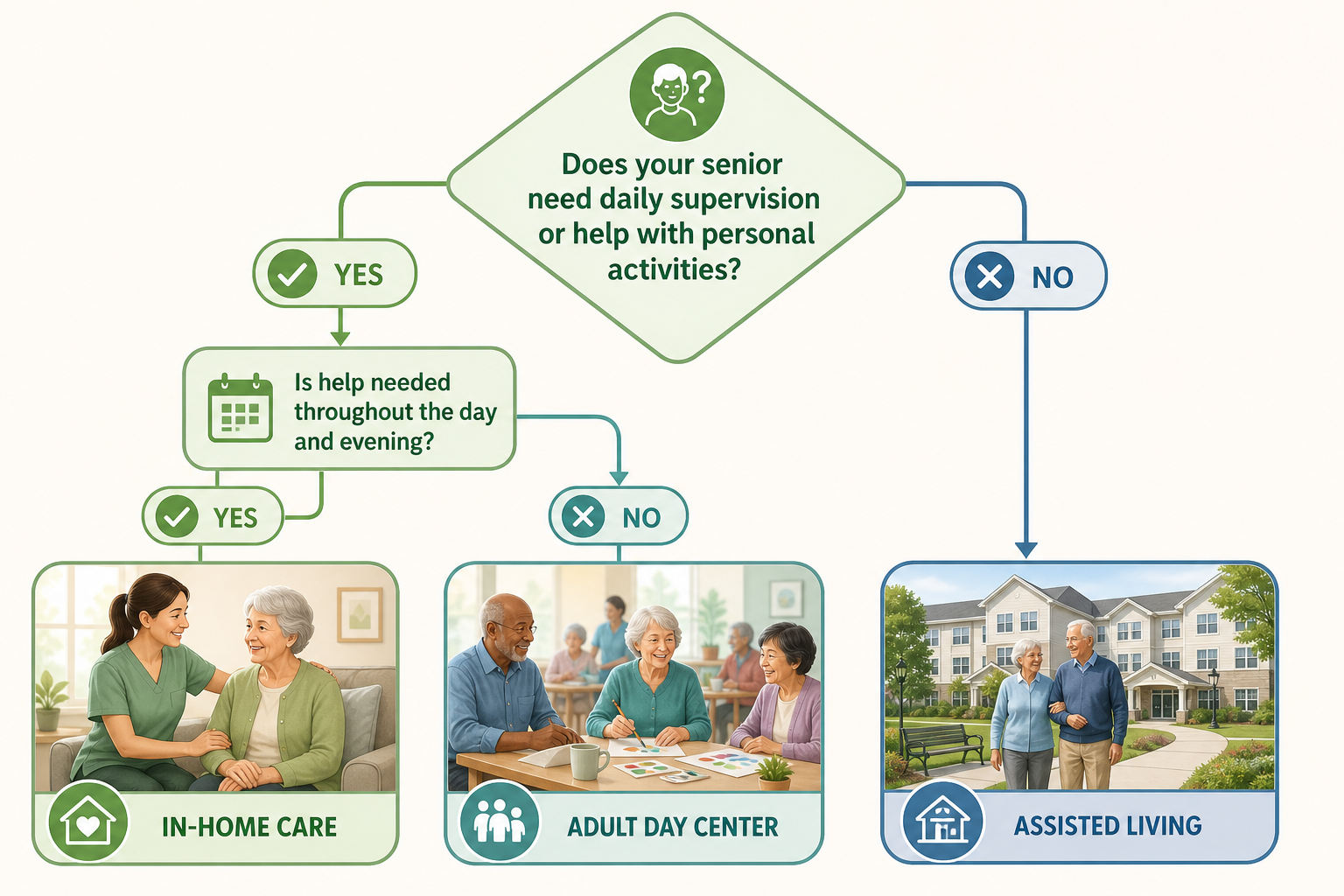
The following questions will guide you through the decision process. Answer each one honestly, based on your parent's current condition and your family's situation.
- Does your parent need supervision during the day? If they are safe and content alone for 4–8 hours, adult day care may not be necessary. If they cannot be left alone due to safety concerns, confusion, or fall risk, proceed to the next question.
- Are they safe to return home each evening? Adult day care is a daytime-only solution. If your parent needs overnight supervision or has significant nighttime wandering, this option may not be sufficient. If they can safely spend evenings and nights at home with minimal assistance, adult day care is a viable option.
- Do they need socialization and structured activity? If your parent is isolated, lonely, or unable to structure their own day, adult day care provides the social engagement and routine that can significantly improve their quality of life. If they are content with their current level of social interaction, in-home care may be a better fit.
- Do they have medical needs that require daily monitoring? If they need medication management, blood pressure checks, or therapy, look for an adult day health care center with nursing staff. If their medical needs are minimal, a social adult day care center may suffice.
- Is caregiver burnout a factor? If you are experiencing chronic stress, fatigue, or declining health due to caregiving responsibilities, adult day care can provide 4–12 hours of daily respite, up to five days per week. This is not a secondary benefit — it is a primary reason to consider adult day care.
Outcome guide:
- If you answered 'yes' to most questions and your parent can safely return home each evening, adult day care is likely a strong fit.
- If your parent needs one-on-one assistance throughout the day and cannot function in a group setting, in-home care may be more appropriate.
- If your parent needs 24/7 supervision or has complex medical needs that cannot be managed in a daytime setting, assisted living or a nursing home may be necessary.
Signs It's Time: Recognizing When Adult Day Care Makes Sense
The National Adult Day Services Association (NADSA) and AARP have identified several key indicators that it may be time to consider adult day care. These signs fall into two categories: changes in your loved one's behavior and changes in your own capacity as a caregiver.
Signs in your loved one
- They are unable to structure their own daily activities and seem aimless or restless.
- They feel isolated and lonely, even when you are present.
- They experience anxiety or depression when left alone.
- They have difficulty starting and focusing on activities, even ones they used to enjoy.
- They seem unsafe when left alone — forgetting to turn off the stove, wandering, or falling.
Signs in yourself (the caregiver)
- You feel chronically overwhelmed, irritable, or exhausted.
- Your work performance is suffering because of caregiving interruptions.
- You have little to no time for your own health, relationships, or hobbies.
- You find yourself dreading the weekends because there is no break.
The research backs up what many caregivers feel intuitively. The Daily Stress and Health (DaSH) Study, which followed 173 caregivers over multiple days, found that on days when their loved one attended adult day services, caregivers reported significantly lower levels of anger and depression. The study also found that caregivers showed better regulation of the stress hormones cortisol and DHEA-S on those days. Over a one-year period, caregivers who used adult day services more frequently were less likely to experience declines in their own functional health.
The Cost Reality: Adult Day Care vs. Other Options
Cost is often the deciding factor for families, and adult day care's affordability is one of its strongest arguments. According to the 2024 Genworth Cost of Care Survey, the national median daily rate for adult day care is $100, which translates to approximately $2,232 per month for five days per week of attendance.
| Care Option | National Median Daily Cost (2024 Genworth Survey) | National Median Monthly Cost (20 days/month) |
|---|---|---|
| Adult day care | $100/day | $2,232/month |
| In-home health aide | ~$200/day | ~$4,000/month |
| Assisted living (private room) | ~$165–$200/day | ~$5,000–$6,000/month |
| Nursing home (semi-private room) | ~$300/day | ~$9,000/month |
These national averages mask significant state-by-state variation. In Alabama, the median monthly cost is approximately $1,300, while in North Dakota it reaches $3,327. Some states, such as Oregon, report costs as high as $4,182 per month. Your local market may differ substantially from the national median.
How to Pay for Adult Day Care: Medicaid, VA Benefits, and Tax Credits
The cost of adult day care is manageable for many families, but financial assistance is available for those who need it. Here are the primary payment pathways.
- Medicaid HCBS waivers. All 50 states and Washington, D.C. offer some form of assistance for adult day care through Home and Community-Based Services (HCBS) waivers, also known as 1915(c) waivers. Eligibility typically requires the applicant to meet a nursing home level of care and have limited income (often below $2,829 per month in 2024) and assets (usually below $2,000). However, waiver programs often have enrollment caps and waiting lists, so early application is critical.
- VA benefits. Veterans who meet clinical criteria may qualify for benefits that cover adult day care through the Department of Veterans Affairs. The Aid and Attendance benefit, in particular, can help offset the cost.
- Dependent Care Credit. For the 2024 tax year, the federal Dependent Care Credit allows you to claim qualifying expenses of up to $3,000 for one qualifying person or up to $6,000 for two or more qualifying persons. Adult day care expenses generally qualify, provided the center is not a residential facility.
- Tax deduction as a medical expense. The cost of adult day care is almost always tax-deductible as a medical expense, provided it exceeds 7.5% of your adjusted gross income.
- PACE programs. Programs of All-Inclusive Care for the Elderly (PACE) are available in some states for individuals who are eligible for both Medicare and Medicaid. PACE programs often include adult day care as a core service.
For a comprehensive overview of all federal and state benefit programs, see our guide: Government Benefit Programs for Seniors: A Categorized Guide for Family Caregivers.
How to Trial an Adult Day Center Before Committing
The idea of leaving your parent at an unfamiliar center for a full day can be anxiety-provoking — for both of you. The Alzheimer's Association recommends a gradual approach that gives everyone time to adjust.
A step-by-step trial strategy
- Start with a short visit. Take your parent to the center for a single activity — lunch, a music session, or a gentle exercise class. Stay with them for the first 30 minutes, then step back and observe. The goal is to let them experience the environment without the pressure of a full day.
- Graduate to a half-day. If the short visit goes well, schedule a half-day visit (3–4 hours) that includes a meal and an activity. Leave your parent at the center and return at the scheduled pickup time. This is the first real test of their comfort level.
- Commit to a trial month. Use the center's services at least twice a week for a full month before making a final decision. The Alzheimer's Association emphasizes that a single visit is not enough to judge whether a center is a good fit. Both you and your parent need time to adjust to the new routine.
- Evaluate the results. After the trial month, ask yourself: Is your parent more engaged and less isolated? Are they sleeping better on nights after they attend? (A 2021 study in Aging & Mental Health found that both dementia patients and their caregivers slept better on nights before patients attended adult day care.) Has your own stress level decreased? If the answers are positive, you have found a sustainable solution.
What to observe during your visits
- Staff interaction. Do staff members greet participants by name? Do they seem patient and engaged? Are they trained to handle the specific needs of your loved one?
- Environment. Is the center clean, well-lit, and welcoming? Are there secure outdoor spaces? Is the noise level comfortable? For dementia-specific centers, are the doors secured to prevent wandering?
- Activities. Are activities varied and appropriate for your parent's cognitive and physical abilities? A typical day might include current events discussion, chair yoga or tai chi, creative arts, and outdoor time.
- Meals. Are nutritious meals and snacks provided? Can the center accommodate dietary restrictions or special needs (e.g., pureed food, diabetic meals)?
- Transportation. Does the center offer transportation? If not, can you reliably arrange drop-off and pickup within the center's operating hours (typically 8 a.m. to 5 p.m., with some centers offering extended hours)?
Adult day care is not the right choice for every family, but it deserves a place in your decision-making process. It occupies a unique middle ground — preserving your parent's ability to age at home while giving you the daytime relief you need to sustain your own health, career, and relationships. The decision framework, comparison table, and trial strategy in this article are designed to help you evaluate this option with clarity and confidence.
For further reading, explore our related guides: Beyond the Binary Choice: The Layered Home Intervention Path to Senior Care, which positions adult day care as one possible intervention in a broader continuum of home-based care; Aging in Place vs. Senior Living in 2026: A 5-Factor Decision Framework for Families After a Crisis, which helps families weigh the overarching decision between staying at home and moving to a residential setting; and The 5-Stage Senior Care Decision Timeline: From First Concern to Move-In, which helps you understand where adult day care fits in the broader care journey.
Questions to bring to a clinician or OT
This is not medical, legal, or a family's final decision — only a framework. Bring these questions to a clinician, occupational therapist, or your local Area Agency on Aging.
Find Local HelpRelated reading
Noticed something outdated or inaccurate on this page? Flag a correction. We review every report against CDC, NIA, and AARP HomeFit guidance before updating a page.