Which Elderly Care Service Is Right for Your Parent?
For: adult childReviewed: 2026-07-09
Which Elderly Care Service Is Right for Your Parent?
A systematic five-domain assessment framework that helps families evaluate an aging parent's needs across daily function, safety, cognition, medical complexity, and caregiver capacity — then match that profile to the appropriate care level, avoiding the costly and risky defaults of home care or nursing home placement.
By Editorial Team
new caregiver
experienced caregiver
long-distance caregiving
spousal caregiver
working caregiver
daily routines
medication management
personal hygiene
care coordination
first steps
ADLs
IADLs
When a parent starts needing help, the first question usually sounds practical: which care services for elderly parents should we look at? Home care, assisted living, memory care, nursing home care, adult day services, respite — every option can sound either reassuring or terrifying depending on what happened last week.
The better first question is narrower: what risks must be covered on an ordinary day? A parent who forgets appointments but cooks safely is in a different situation from a parent who cannot transfer from bed to chair. A parent who needs wound care is not simply “needing more help around the house.” A daughter who can cover evenings but not weekday mornings is not the same resource as a retired spouse who can safely supervise bathing.
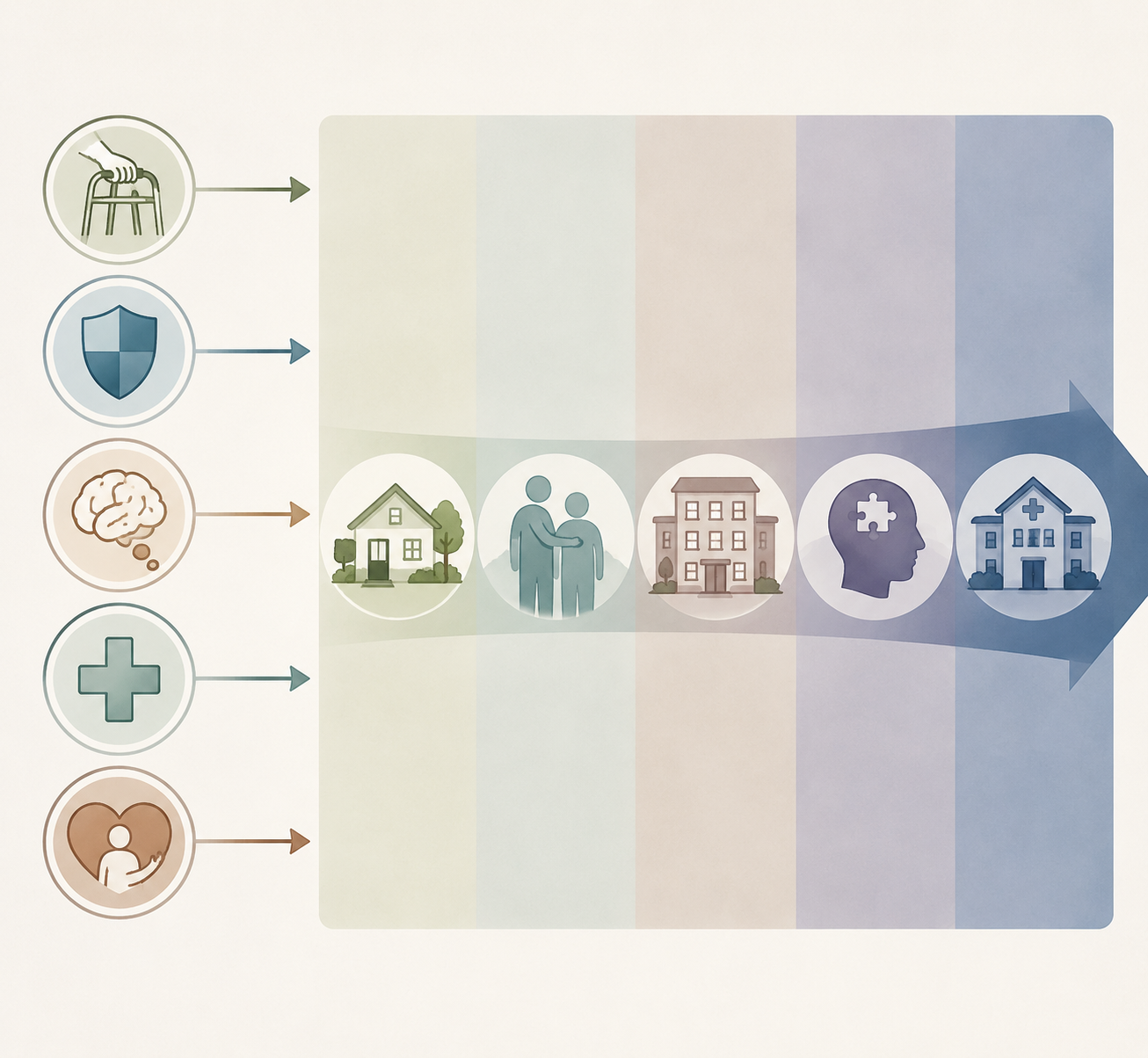
Before choosing a service, assess five domains: daily function, safety, cognition, medical complexity, and caregiver capacity. This is not a clinical scoring tool copied from one agency. It is a practical synthesis built from ADL and IADL concepts used by the National Institute on Aging and CDC, combined with common care-planning questions families have to answer at the kitchen table.[1][2]
First, separate home care from home health care
This confusion can distort the whole decision. Home care usually means nonmedical help: bathing, dressing, meal preparation, transportation, light housekeeping, companionship, and supervision. Home health care means skilled medical care, often ordered by a doctor, such as nursing, therapy, or other clinical services after an illness, surgery, hospitalization, or change in condition.
Medicare does not generally pay for long-term custodial care, assisted living, or ongoing nonmedical help with daily activities. The National Institute on Aging describes Medicare coverage as limited to certain short-term skilled care situations, not a general payment source for long-term personal care.[3] If the main need is help showering safely three times a week, that is not the same payment or service category as a nurse changing a wound dressing under a physician’s plan.
For a deeper payment breakdown after you identify the likely level of care, use Options for Elderly Care or What Will Pay for Senior Home Healthcare in 2026?. For now, keep the distinction clean: nonmedical support solves supervision and daily-life gaps; home health solves skilled medical needs.
The five-domain assessment
Write this down. Do not rely on the family’s general impression that Mom is “mostly fine” or Dad is “going downhill.” Those phrases are too elastic. A repeatable assessment protects the parent from under-support and protects the family from making every decision from the latest crisis.
Domain
What you are trying to learn
Why it changes the care level
Daily function
Can the parent complete basic and household tasks safely and consistently?
ADL and IADL gaps often determine whether family help, home care, assisted living, or nursing-home-level care is realistic.
Safety
Is the home environment manageable, and are falls, wandering, transfers, or emergencies being covered?
A parent may want to stay home, but the setting has to match the risk.
Cognition
Can the parent remember, judge, sequence, and respond reliably?
Cognitive decline can turn small gaps into supervision needs.
Medical complexity
Are needs mostly personal care, or do they require skilled clinical oversight?
Skilled needs may point to home health, rehabilitation, or nursing-home-level care.
Caregiver capacity
Who is actually available, trained, rested, local, and financially able to help?
A plan that depends on unavailable people is not a plan.
1. Daily function: ADLs and IADLs
This is the domain families most often soften. They say a parent “needs a little help,” when the actual pattern is missed meals, unchanged clothes, medication confusion, and a bathroom routine nobody has watched closely because everyone is embarrassed.
Start with ADLs — activities of daily living. These are basic self-care tasks such as bathing, dressing, toileting, transferring, eating, and continence. Then look at IADLs — instrumental activities of daily living — such as cooking, shopping, transportation, money management, housekeeping, communication, and medication management. NIA and CDC materials use these functional categories to describe the kinds of help older adults may need at home and in daily life.[1][2]
Mostly independent ADLs with a few IADL gaps: family-supported aging in place, transportation help, meal support, bill-paying help, or a few hours of nonmedical home care may be enough.
Several IADL gaps plus bathing, dressing, or toileting help: scheduled home care or assisted living becomes a more serious comparison.
Unsafe transfers, frequent falls, continence needs, or inability to toilet without help: the family should not treat this as ordinary “companionship” care.
Needs that occur unpredictably overnight or throughout the day: hourly home care can become thin unless hours increase substantially.
The key is not whether the parent can complete a task once while someone is watching. The question is whether the task happens safely, repeatedly, and without leaving the parent waiting in a risky position. A parent who can shower only if an adult child drives across town, sets up the bathroom, stands nearby, and helps afterward does not have independent bathing. That parent has bathing covered by an informal care system.
2. Safety: the home has to be judged by the weakest hour
Safety is not a feeling about the house. It is what happens when the parent is tired, alone, rushed, dizzy, confused, or trying not to bother anyone.
Falls: Where did they happen, how often, and was the parent able to call for help?
Transfers: Can the parent get from bed to chair, chair to toilet, and toilet to standing without unsafe effort?
Kitchen safety: Are burners left on, food spoiled, or meals skipped because cooking is too much?
Bathroom safety: Is bathing being avoided because it is difficult, frightening, or exhausting?
Emergency response: If the parent falls, gets chest pain, or becomes disoriented, who knows and how quickly?
Home modifications can help when the main problem is the environment: grab bars, lighting, railings, ramps, bathroom changes, and trip-hazard removal. They do not solve a need for hands-on transfers, dementia supervision, or clinical care. If the safety plan depends on “she’ll just remember to use the walker,” cognition belongs in the next column.
If aging in place still looks possible but the home itself is part of the risk, review the home modification guides before assuming the only choices are hourly care or a move.
3. Cognition: small mistakes become care needs when judgment changes
Cognition changes the meaning of every other domain. A parent with mild mobility limits may be safe with grab bars and scheduled help. A parent with similar mobility limits who forgets the walker, misjudges steps, or cannot follow a medication routine may need more structure.
Watch for patterns, not one awkward moment: missed bills, repeated calls about the same issue, getting lost on familiar routes, unsafe cooking, medication errors, poor hygiene that the parent denies, suspicion toward helpers, or inability to sequence tasks that used to be automatic. NIA guidance on memory and safety emphasizes that changes in thinking can affect everyday safety and the ability to live independently.[1]
This is where “a few hours of help” can be exactly right or dangerously thin. If the parent mainly needs reminders, meals, transportation, and company during predictable parts of the day, nonmedical home care or adult day services may cover the gap. If the parent wanders, leaves the home unsafely, becomes distressed in the evening, resists hygiene care, or cannot be left alone, the question shifts toward structured supervision, memory care, or a setting with staff present around the clock.
4. Medical complexity: do not use personal care to cover skilled needs
Some needs are not solved by a kind aide, even an excellent one. Wound care, injections, therapy after hospitalization, medication changes that require clinical monitoring, complex chronic conditions, and post-surgical recovery may require skilled home health care, physician involvement, rehabilitation, or nursing-home-level care depending on severity and duration.
Ask what has to be done, who is legally and clinically allowed to do it, and what happens if it is delayed. A nonmedical caregiver may help with reminders or routine daily support, but families should not quietly turn a home care worker into a substitute nurse because the schedule is convenient.
5. Caregiver capacity: count the actual people, not the promises
Caregiver capacity belongs in the assessment because the parent’s care level is partly determined by what the informal system can reliably cover. This is not a character judgment. It is the difference between a plan and a wish.
List each caregiver and write what they can actually do: weekdays, overnights, transportation, bathing help, medication setup, emergency response, finances, medical appointments, backup coverage, and money. Include distance, work schedules, health limits, relationship strain, and whether anyone can safely do hands-on transfers. A sibling who loves the parent but cannot leave work before 6 p.m. is not available for a Tuesday morning shower crisis.
Financial pressure also belongs here. AARP’s 2026 long-term care affordability reporting found that home care inflation had risen 39% since 2021 and described middle-income older adults as often priced out across care types: too much income to qualify easily for Medicaid, not enough to pay comfortably out of pocket.[6] That does not tell one family what they can afford, but it explains why the arithmetic so often feels impossible.
Once the five domains are written down, the service choice usually becomes less abstract. You are no longer comparing pleasant brochures. You are matching documented risks to coverage.
Parent’s pattern
Care level to consider
Main caution
Independent ADLs, light IADL gaps, safe home, reliable family backup
Family-supported aging in place, home modifications, transportation, meal support, occasional paid help
Do not let one nearby person become the invisible full-time system.
ADLs mostly intact but caregiver needs relief or parent needs daytime structure
Respite care, adult day services, scheduled companion care
Respite should be planned before exhaustion turns into unsafe care.
Bathing, dressing, meals, errands, transportation, or medication reminders are inconsistent
Nonmedical home care
Hours must match when the risk occurs, not just when help is convenient.
Skilled nursing, therapy, wound care, or post-hospital clinical monitoring is needed
Home health care or rehabilitation-oriented services
A doctor’s order and coverage rules may matter; this is not the same as custodial home care.
Several daily needs, social isolation, medication oversight, meals, and safety supervision, but not intensive skilled nursing
Assisted living
Compare total monthly support needs at home against residential care, not hourly rates alone.
Cognitive impairment requires secure structure, dementia-trained support, or supervision that ordinary assisted living may not cover
Memory care
Expect higher cost and ask exactly what behaviors and care needs the community can manage.
Unsafe transfers, frequent falls, continence needs, complex medical oversight, or needs that cannot be covered outside a staffed setting
Nursing-home-level care
A move may be about risk coverage, not about giving up on the parent.
When home care is enough
Home care fits best when the parent’s needs are real but bounded: help with bathing, meals, laundry, errands, transportation, reminders, companionship, and light household tasks. It can also work when family caregivers cover certain hours and paid help fills predictable gaps.
The test is whether the uncovered hours are safe. If the aide leaves at noon and the parent is alone until dinner, what actually happens in the bathroom, kitchen, and hallway? If the answer is “probably fine,” keep assessing. “Probably” is not enough for falls, wandering, toileting, or medication errors.
Many families compare home care and assisted living emotionally before they compare them operationally. Home feels familiar, and familiar can feel cheaper. But once home care hours rise, the math can change quickly.
A Place for Mom’s 2026 cost data lists median home care at $34 per hour, assisted living at $6,200 per month, and a semi-private nursing home room at $9,581 per month.[4] U.S. News reported in April 2026 that home care and assisted living costs can reach parity at higher home care hours, with gerontologist Lakelyn Eichenberger noting the comparison around 44 or more hours per week.[5] Using those figures, 44 weekly hours of home care reaches about $6,478 per month, which is more than the cited assisted living median.
That does not mean assisted living is automatically better. It means “home is cheaper” should not survive without math. Assisted living may offer meals, housekeeping, social structure, medication support, and staff presence that hourly home care does not cover unless the family buys enough hours. Home care may still be the better choice when the parent strongly benefits from the familiar setting, needs are limited, housing costs are already stable, or family coverage is reliable.
When memory care is different from assisted living
Memory care is not simply assisted living with a dementia label. The reason to consider it is supervision and structure: secure environments, staff training, routines, and support for behaviors or cognitive changes that ordinary assisted living may not manage well.
The price difference matters. Comfort Keepers’ senior care checklist describes memory care as commonly costing 20% to 30% more than standard assisted living.[8] That premium should prompt specific questions: what behaviors can the community manage, how are wandering and exit-seeking handled, what happens after a fall, how is medication supervised, and under what conditions would the parent need to move again?
When nursing-home-level care is the safer threshold
Families often hear “nursing home” as the most extreme option, so they delay even naming it. But the relevant threshold is not family guilt. It is whether the parent’s needs can be safely covered in a less intensive setting.
VNA Health Group’s senior home care guidance identifies patterns such as loss of bowel or bladder control, inability to transfer, and frequent falls as signals that may point beyond ordinary home care toward nursing-home-level needs.[7] Those signals do not automatically decide placement, but they should trigger a serious assessment with medical professionals, discharge planners, care managers, or long-term care counselors.
This is also where assisted living can be oversold by hope. If a parent needs two-person transfers, frequent skilled monitoring, extensive continence care, or response that cannot wait until staff are available, ask directly whether the setting can provide that level of care and what would cause a discharge.
Cost should test the care plan, not replace it
Cost enters after the needs assessment because the wrong level can be expensive in both directions. Too little care can mean falls, hospitalizations, caregiver burnout, missed medications, and crisis moves. Too much care can drain savings, restrict the parent unnecessarily, and create a move before the documented risks require it.
Use published figures as directional estimates, not promises. Cost surveys use different methodologies, local markets vary, and a parent’s actual bill depends on hours, add-on services, room type, care fees, geography, and eligibility for programs. Medicaid rules vary significantly by state, so families should confirm options with the state Medicaid agency, a SHIP counselor, or a qualified benefits counselor rather than relying on national generalities.
The useful comparison is not “home care versus facility.” It is: how many hours, what kind of supervision, which skilled services, what backup, what transportation, what housing costs, and what happens at night? A low hourly rate can become a high monthly cost if the parent needs coverage most days. A residential fee can be misleading if the community later adds care-level charges the family did not budget.
A repeatable way to make the decision
If you are early in the caregiving role and still trying to organize documents, appointments, family roles, and first calls, start with Your First 30 Days as a Caregiver for an Aging Parent. Then return to this framework and fill it in with current observations.
Document ADLs and IADLs separately. Mark what the parent does independently, what requires setup, what requires hands-on help, and what is no longer happening.
Write the safety risks by time and place. Bathroom, stairs, kitchen, nighttime, transfers, driving, wandering, and emergency response should be specific.
Record cognition patterns over several days or weeks. Include missed medications, repeated questions, unsafe judgment, getting lost, or inability to manage familiar routines.
Separate nonmedical help from skilled medical needs. Ask the doctor, discharge planner, or home health agency what requires licensed clinical care.
Map the real caregiver system. Include who is available, when, for what tasks, and what backup exists if that person is sick, traveling, working, or exhausted.
Compare the lowest care level that covers the documented risks. If it leaves predictable gaps, move one level up or add a targeted support.
Revisit the assessment after a fall, hospitalization, new diagnosis, medication change, driving concern, caregiver health change, or noticeable shift in memory or mobility. A care plan that was reasonable in March may be unsafe by July. A parent who improves after therapy may need less support than the family feared during the crisis.
The right elderly care service is the least restrictive option that actually covers the documented risks. Not the option that sounds most loving. Not the option that sounds cheapest. Not the option that makes the family feel decisive for one week. The defensible choice is the one that survives the ordinary Tuesday: getting up, eating, bathing, taking medication, staying safe, and having someone capable enough to notice when the plan no longer works.


Comments
Join the discussion with an anonymous comment.