Home Help for the Elderly in 2026: A Complete Directory of Services and Costs
Reviewed: 2026-06-27
Home Help for the Elderly in 2026: A Complete Directory of Services and Costs
A categorized, cost-annotated directory of every major at-home service for older adults — personal care, adult day programs, Meals on Wheels, PACE, transportation, and more — with 2026 national and state pricing, eligibility rules, and the single entry point to find local providers.
By Editorial Team
new caregiver
experienced caregiver
long-distance caregiving
spousal caregiver
working caregiver
daily routines
medication management
personal hygiene
care coordination
first steps
ADLs
IADLs
Most families looking for help for the elderly are not really asking one question. They are trying to sort out whether Mom needs someone to help her shower, whether Dad’s physical therapy visit is covered by Medicare, whether Meals on Wheels has a waitlist, whether a sibling can get paid to help, and whether the next bill will be $300 or $4,000.
That confusion is normal, but it is expensive. In a 2025 caregiver survey, only 24% of caregivers said they felt completely prepared when they started caregiving, and 54% said they wished they had planned sooner.[1] The practical fix is not memorizing every eldercare program. It is building a current map: what service does what, who pays, who qualifies, what it costs in 2026, and which local office can confirm the details.
Start with this: contact the Eldercare Locator at 800-677-1116 or use it to reach your local Area Agency on Aging. Area Agencies on Aging serve every U.S. county and can connect families with benefits counseling, Medicaid application help, meal programs, transportation referrals, respite options, and local provider lists.[2] If you want a deeper explanation of how these agencies coordinate care, see how Area Agencies on Aging help families navigate senior health services.
The quick map: match the need before you shop
Before calling agencies, write down the actual need. “Help at home” is too vague. Medicare, Medicaid, home care agencies, adult day programs, and nonprofit services all hear that phrase differently.
If the older adult needs...
Start by looking at...
Main payment question
Help bathing, dressing, toileting, transferring, or eating
Nonmedical personal care / home care aide
Private pay, Medicaid waiver, veterans benefits, or local programs; Medicare generally does not cover this
Nursing, wound care, therapy, or medical monitoring after illness or hospitalization
Skilled home health
Does the person meet Medicare’s homebound and doctor-ordered skilled-care rules?
Conversation, supervision, light errands, or social visits
Companion care, friendly visitor programs, senior centers
Private pay or local nonprofit availability; Medicare generally does not cover companion care
Daytime supervision, meals, activities, and caregiver work coverage
Adult day services
Medicaid may help in some states; Medicare generally does not cover it
Regular meals or nutrition checks
Meals on Wheels, senior dining, SNAP
Is there local availability, a waitlist, or income-based eligibility?
Rides to appointments, shopping, or senior programs
Paratransit, volunteer driver programs, Medicaid non-emergency medical transportation, local senior transportation
Is the ride medical, disability-related, or general transportation?
A break for the family caregiver
Respite care at home, adult day care, short-term facility respite
State, Medicaid, veterans, or nonprofit respite funding varies locally
Falls, wandering, medication errors, or unsafe home layout
Home safety modifications, medical alert systems, medication management, fall prevention services
Some supports are private pay; some may be covered through Medicaid, local grants, or health plans
A nursing-home level of care but a strong desire to remain at home
PACE, if available locally
Is the person 55+, clinically eligible, and in a PACE service area?
The Medicare rule families need before the first bill
Medicare can cover home health services, but only under a narrow set of conditions: the care must be short-term skilled care, ordered by a doctor, and the person must be homebound. Medicare does not cover ongoing custodial or personal care, 24/7 care at home, meal delivery, or companion care.[2]
This is where many families get caught. A nurse coming after surgery and an aide helping with bathing three mornings a week are both “help at home” in ordinary language. In payment language, they are often entirely different categories. If the need is mainly bathing, dressing, toileting, meals, supervision, or companionship, do not assume Medicare will pay just because the person is elderly, frail, or recently hospitalized.
Directory of home help services for older adults in 2026
Nonmedical personal care
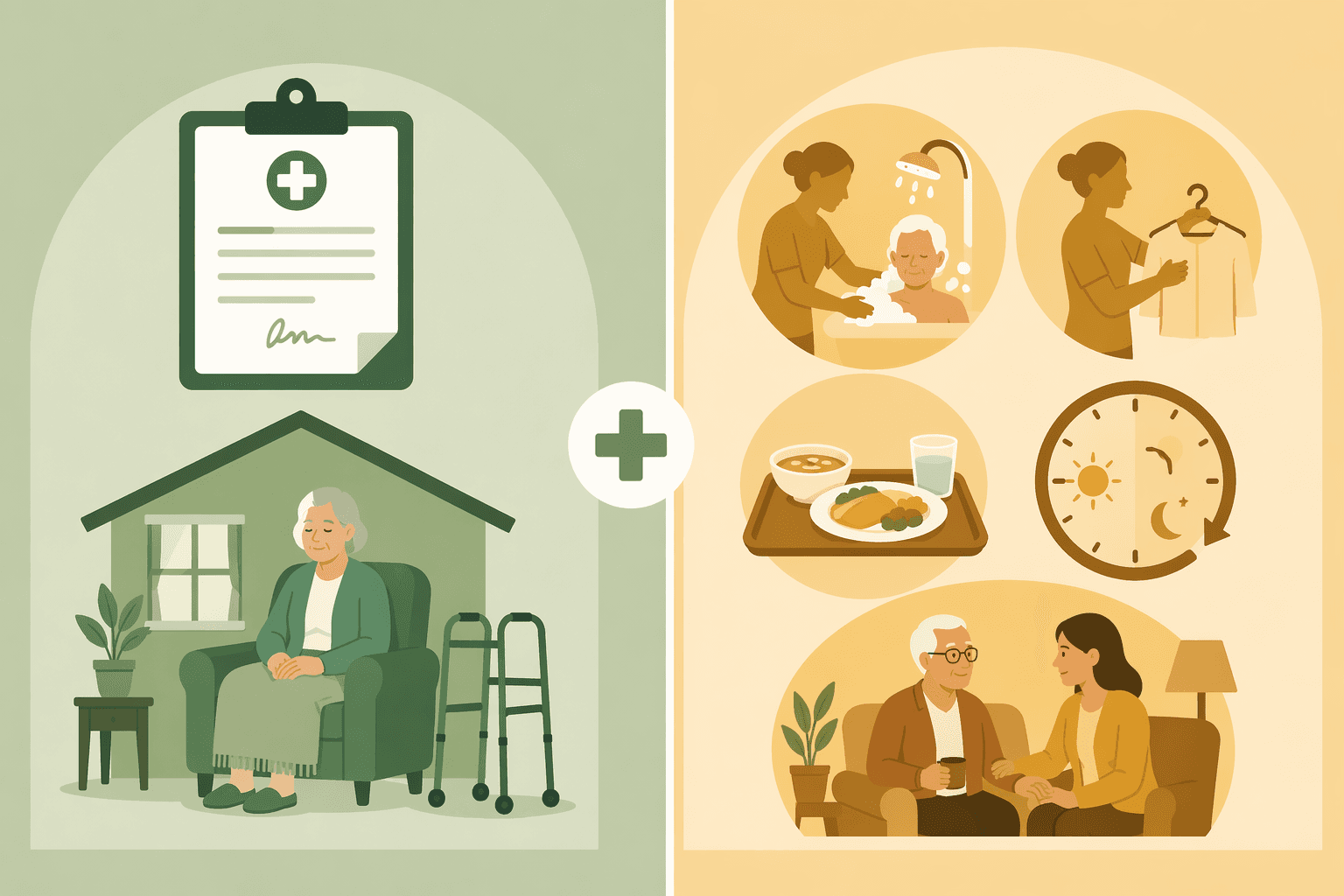
Personal care is the category families usually mean when they say, “She needs help at home.” A home care aide may help with bathing, dressing, grooming, toileting, transferring from bed to chair, walking, eating, light housekeeping, laundry, meal preparation, and reminders. This is not the same as skilled nursing.
For 2026 planning, the national median cost for nonmedical home care is $34 per hour, with state-level medians ranging from $25 per hour in Mississippi to $44 per hour in South Dakota. At 30 hours per week, that national median works out to about $4,416 per month.[3] Treat those numbers as a starting estimate, not a quote. City, agency, shift length, weekend coverage, dementia care, and minimum-hour rules can change the actual bill.
Medicare generally does not pay for this care when it is custodial. Medicaid may pay for some personal care through state Medicaid programs or home- and community-based services waivers, but eligibility, waitlists, covered hours, and whether family caregivers can be paid vary by state. This is one of the first items to ask the Area Agency on Aging or a State Health Insurance Assistance Program counselor to help you sort.
Skilled home health is medical or therapy-based care at home. It may include nursing, physical therapy, occupational therapy, speech therapy, wound care, medication education, and monitoring after an illness, surgery, or hospitalization. It is usually arranged through a doctor, hospital discharge planner, or home health agency.
Medicare may cover skilled home health when the older adult is homebound, needs intermittent skilled care, and has a doctor’s order and plan of care.[2] The word “intermittent” matters. This is not round-the-clock help, and it does not turn into an open-ended housekeeping or bathing benefit.
Ask the discharge planner or doctor’s office three plain questions: what skilled need is being ordered, how many visits are expected, and what nonmedical gaps remain after the nurse or therapist leaves. Those gaps are where families often need personal care, meal help, transportation, or respite.
Companion care and friendly visiting
Companion care is for older adults who are lonely, mildly forgetful, anxious alone, no longer driving, or unsafe without someone checking in. Paid companions may provide conversation, light meal preparation, errands, appointment accompaniment, and basic supervision. Volunteer friendly visitor programs, faith communities, senior centers, and peer-support programs may offer less intensive help, often with limited capacity.
Companion care is usually private pay when purchased through a home care agency. Medicare generally does not cover companion care.[2] Medicaid and local programs may help in specific situations, but this is not a benefit to assume. For a focused payment explanation, see whether Medicare covers companion care. For lower-cost social support ideas, programs where seniors help seniors can reduce caregiver burden may be useful.
Adult day services
Adult day services give an older adult a supervised place to go during the day. Programs may provide meals, activities, socialization, medication reminders, basic health monitoring, dementia support, and help with personal care. For the caregiver, the practical value is often a reliable block of work time or rest time.
A 2026 planning estimate is roughly $95 to $100 per day, or about $2,167 to $2,320 per month depending on schedule assumptions. That can be far less than buying the same number of hours one-to-one at home, but transportation, part-time attendance rules, dementia-specific fees, and local availability matter.[2][3]
Medicare generally does not cover adult day care. Medicaid may cover it in some states or through waiver programs, and some local aging organizations may know of grants or sliding-scale programs. Ask whether the program accepts Medicaid, whether transportation is included, and whether it can handle wandering, incontinence, diabetes care, or other specific needs.
Meal support: Meals on Wheels, senior dining, grocery help, and SNAP
Meal help can mean several different things: home-delivered meals, congregate meals at a senior center, grocery delivery, help applying for SNAP, medically tailored meals through a health plan, or a paid aide preparing food in the home. The right choice depends on whether the problem is money, cooking ability, transportation, appetite, swallowing, memory, or nutrition monitoring.
Meals on Wheels is large, but it is not automatically immediate. Meals on Wheels America reports serving 2.6 million seniors annually through 244 million meals. Its provider benchmarking also found that 33% of providers had waitlists, with about 36,000 older adults waiting.[4] Local funding and staffing can change those numbers, so ask your local program whether there is a waitlist, how often meals are delivered, whether weekend meals are available, and whether special diets can be accommodated.
SNAP is also worth checking, especially for older adults who assume they will not qualify. Many eligible seniors are under-enrolled, and the local Area Agency on Aging or benefits counselor may be able to help with screening and application steps. Do not let pride or uncertainty decide this one at the kitchen table; check eligibility.
Transportation
Transportation help is easy to underestimate until appointments start getting missed. Options may include public paratransit, senior center vans, volunteer driver programs, ride vouchers, Medicaid non-emergency medical transportation, veterans transportation, health-plan transportation benefits, and paid rides through home care agencies or private services.
The first sorting question is whether the ride is medical or nonmedical. Medicaid may cover non-emergency medical transportation for eligible beneficiaries, but a ride to the grocery store or a hair appointment may fall under a different local program or be private pay. Ask about door-to-door versus curb-to-curb service, wheelchair access, advance reservation rules, cancellation penalties, and whether a companion can ride along.
Respite care
Respite is temporary relief for the caregiver. It can be a paid aide in the home for a few hours, adult day services several days a week, overnight care, short-term stays in a residential facility, or volunteer respite through a nonprofit or faith-based program.
Payment is highly local. Medicaid waivers, veterans programs, state caregiver support programs, disease-specific nonprofits, and local aging agencies may have respite funds, but they can run out or require eligibility screening. When you call the Area Agency on Aging, use the word “respite.” It is a service category, not a luxury request.
Home safety, fall prevention, and daily-living supports
Some help for the elderly is not a person coming through the door. It is grab bars, better lighting, a raised toilet seat, a shower chair, a medication dispenser, a medical alert system, stove shutoff support, a ramp, or an occupational therapy home safety assessment.
Payment varies. Some equipment may be private pay. Some durable medical equipment may be covered when medically necessary and ordered through the right channel. Medicaid, local home modification grants, veterans programs, or community nonprofits may help with ramps and accessibility changes. If the concern is falls, wandering, or unsafe transfers, ask the doctor whether a therapy evaluation is appropriate and ask the Area Agency on Aging about local home safety resources.
PACE, the Program of All-Inclusive Care for the Elderly, is not just a ride service or adult day program. It is a comprehensive care model for eligible adults age 55 and older who need a nursing-home level of care but can live safely in the community with support. PACE can include Medicare and Medicaid services, prescriptions, dental, vision, transportation, adult day care, therapies, primary care, meals, and other coordinated supports.[5]
As reported by the National Council on Aging, PACE serves 87,750 participants across 194 programs in 33 states plus the District of Columbia.[5] That footprint is meaningful, but it does not mean PACE is available in every county in those states. Service areas can be quite specific.
For people who qualify for both Medicare and Medicaid, PACE may be covered with little or no monthly premium depending on the person’s situation. Without Medicaid, private-pay PACE can cost about $4,000 to $5,000 per month.[5] That is too much money to guess about. Use the PACE organization’s service-area check and ask the Area Agency on Aging or Medicaid office about eligibility before assuming it is either unavailable or unaffordable.
Payment sources: what to check, and what not to assume
The same service can be private pay for one family, partly covered for another, and unavailable to a third because of state rules or local capacity. That is annoying, but it is also why a local benefits check is more useful than a national promise.
Payment source
May help with
Do not assume
Medicare
Short-term skilled home health when ordered by a doctor for a homebound patient
That it will pay for custodial care, meals, companion care, or 24/7 help
Medicaid
Personal care, adult day services, transportation, respite, PACE, or home- and community-based supports in some states
That every state covers the same services or that there is no waitlist
How to use this directory without turning it into another research project
Use one page, not twelve browser tabs. Write the older adult’s needs in the left column, the likely service category in the middle, and the payment/access question on the right.
List the actual tasks that are failing: bathing, meals, medication setup, transportation, transfers, supervision, wound care, loneliness, caregiver exhaustion.
Separate medical needs from custodial needs. This prevents the Medicare misunderstanding from steering the whole plan.
Put a rough 2026 cost next to each private-pay service. For home care, start with the $34/hour national median and then verify local agency rates.
Call the Eldercare Locator or local Area Agency on Aging and ask specifically about benefits counseling, Medicaid screening, meal programs, transportation, respite, adult day care, and PACE availability.
Ask every program about eligibility, waitlists, service area, start date, documentation, and what happens if the older adult’s needs increase.
If you do only one thing after reading this, make the local call before the crisis call. Identify the parent’s needs, compare the relevant service categories, check the Medicare and Medicaid boundary, and then contact the local Area Agency on Aging through the Eldercare Locator to verify what is available where the older adult actually lives.
Proactive caregiving is not knowing every program by memory. It is having a current, cost-aware map before a hospital discharge, fall, unpaid bill, or burned-out caregiver forces the family to choose in a hurry.



Comments
Join the discussion with an anonymous comment.