What Families Must Know About Home Care Agencies vs Registries
For: adult child10 minutesReviewed: 2026-07-09
What Families Must Know About Home Care Agencies vs Registries
This article explains the critical difference between a licensed home care agency and a referral registry, showing how choosing a registry can make your family the legal employer with unexpected tax, liability, and safety responsibilities.
By Editorial Team
new caregiver
experienced caregiver
long-distance caregiving
spousal caregiver
working caregiver
daily routines
medication management
personal hygiene
care coordination
first steps
ADLs
IADLs
A family searching for agencies for elderly home care may assume every result works the same way: someone sends a caregiver, the company manages the worker, and the family pays the bill. That is not always what is happening.
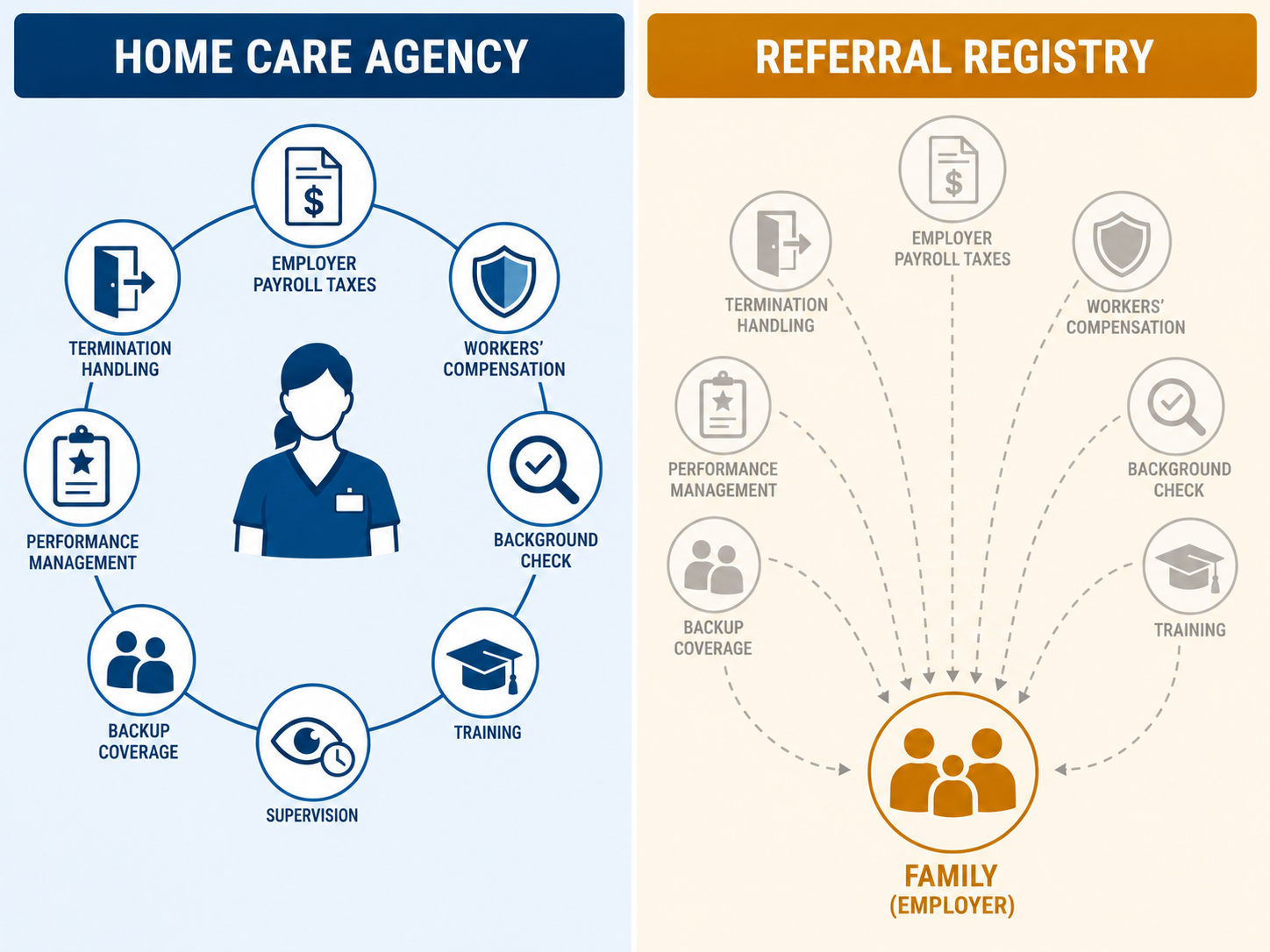
The first distinction to make is plain. A home care agency generally employs the caregivers it sends into the home. A referral registry connects families with caregivers who may be independent contractors. With a registry, the family may become the employer in practice, even if the website feels like a service company and the signup process feels easy.
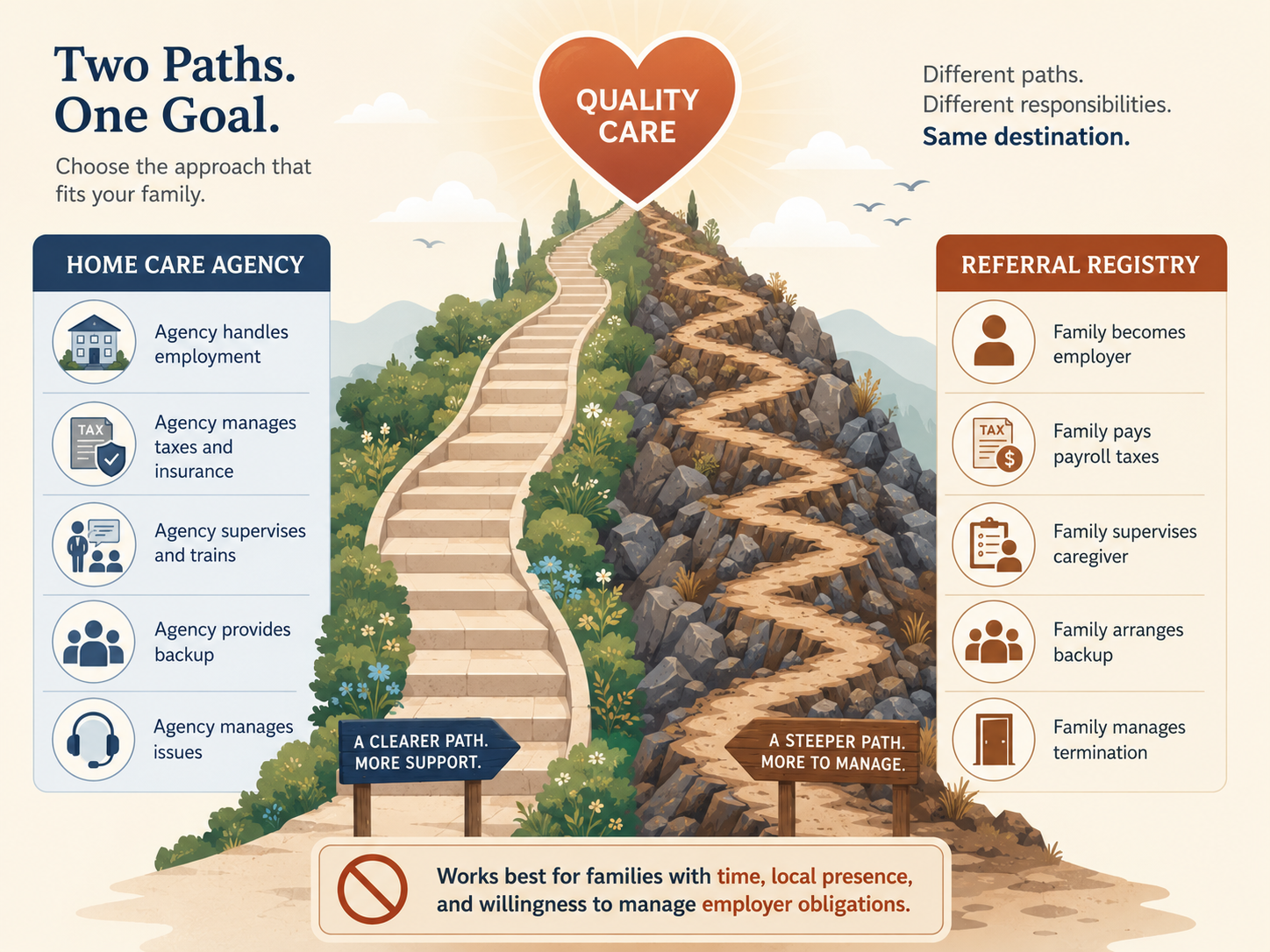
That difference decides who handles payroll taxes, workers' compensation, background checks, training, scheduling, supervision, replacement coverage, and termination. It also decides who is standing there with the problem when the caregiver calls out, gets hurt, stops performing well, or needs to be replaced.
Why the Search Results Feel So Confusing
The home care market is crowded enough that families often meet several types of businesses before they understand the labels. IBISWorld estimated the U.S. home care providers industry at $173.6 billion in 2026, with about 483,000 businesses operating in the space.[1] That helps explain why a search page can contain licensed agencies, franchise agencies, registries, staffing-style platforms, and companies that use warm language without clearly naming the employment model.
The National Institute on Aging describes a broad range of services that can help older adults remain at home, from help with personal care and household tasks to transportation, meals, and health-related services.[2] Those service categories matter, but they do not answer the employment question. Two providers may both offer bathing help, meal preparation, or companionship. One may employ and supervise the aide. The other may only introduce you to someone you then manage.
There is another layer of confusion: home care is not the same as Medicare-certified home health care. Some organizations offer both non-medical home care and Medicare-certified skilled home health services, but certification for skilled care is a separate issue from whether the caregiver in your home is the provider's employee. If payment rules are part of your decision, start with what Medicare actually pays for in home health care versus home care before assuming a company name tells you how the care will be covered.
The Question That Matters: Who Is the Employer?
Families often ask whether a caregiver is kind, available, experienced, and affordable. Those are fair questions. They are not enough. Before you talk about schedules or rates, ask whether the caregiver is an employee of the company or an independent worker being referred to you.
PBS's family caregiving handbook advises families evaluating agencies to ask about licensing, screening, supervision, training, emergency coverage, and complaint procedures.[3] Those questions become even more important when a provider is not actually employing the caregiver. If there is no agency employer behind the worker, the family may be the one expected to handle the very duties they thought they had outsourced.
The labels vary by state and provider, so families should verify the exact employment arrangement before paying any fees.
Responsibility
Agency model
Registry or referral model
Who employs the caregiver
The agency usually employs the caregiver directly.
The caregiver may be an independent contractor hired by the family.
Payroll taxes
The agency handles payroll and employer tax obligations.
The family may need to handle household employer tax compliance.
Workers' compensation
The agency typically carries coverage for its employees.
The family may need to verify coverage or face exposure if the caregiver is injured.
Screening and training
The agency sets hiring, screening, and training requirements.
The registry may screen to some degree, but the family must verify what was actually done.
Supervision and performance
The agency supervises, documents concerns, and manages performance.
The family manages the worker day to day.
Backup coverage
The agency may arrange a replacement when a caregiver is unavailable.
The family may need to find replacement care.
Ending the arrangement
The agency can remove or replace a poor fit.
The family may need to terminate the worker and restart the search.
Right at Home, a franchise home care company, presents the agency-versus-registry distinction around categories such as hiring, training, supervision, payroll taxes, workers' compensation, backup coverage, performance management, safety checks, termination, and total cost.[4] That source has an agency-side point of view, so it should not be treated as neutral consumer research. Still, the categories are useful because they force the right conversation: not whether the brochure sounds caring, but which party is carrying each responsibility.
Payroll Taxes Are Not a Footnote
If an agency employs the caregiver, the agency is responsible for payroll administration. That includes withholding and paying required employment taxes for its workers. The family receives an invoice for care rather than becoming the payroll department.
With a registry arrangement, the family needs to know whether the caregiver is truly operating as an independent contractor or whether the family is functioning as a household employer. That is not something to wave away because everyone is tired and the discharge planner wants a start date. If the family is the employer, payroll tax compliance becomes part of the job.
This is where a lower hourly rate can mislead people. A registry may look less expensive at the moment of comparison, and Right at Home describes registry rates as sometimes appearing 20% to 30% lower from the agency perspective.[4] Even if that is true in a local market, the better question is lower before what? Before employer taxes? Before workers' compensation coverage? Before the time spent finding backup care? Before the risk of doing the paperwork wrong?
Workers' Compensation and Injury Risk Belong in the First Conversation
Home care is physically real work. A caregiver may help with transfers, bathing, mobility, laundry, errands, or household tasks. If the caregiver is injured in the home, the family needs to know whose insurance responds.
In an agency model, workers' compensation is usually part of the employer structure. In a registry model, the family must ask whether the caregiver has their own coverage, whether the registry carries any applicable coverage, and whether the family's homeowner's or umbrella policy would respond. The answer depends on the arrangement and on state rules, which is exactly why it should not appear for the first time after an injury.
This is also where state licensing variation matters. The Home Care Association of America tells consumers to check state requirements and verify that a provider meets applicable licensing or regulatory standards.[5] Some states license non-medical home care agencies more tightly than others, and some arrangements blur the line between agency and registry. A provider's website is not the final authority. Your state licensing board, state health department, or HCAOA resources are better places to verify status.
Screening, Training, and Supervision Are Not the Same Thing
Families often hear “background checked” and relax too soon. A background check is one piece of screening. It does not tell you who trained the caregiver, who observed their work, who documents care concerns, or who steps in when a parent's needs change.
The NIA advises families to ask practical questions about qualifications, services, costs, and whether the provider can meet the older adult's needs.[2] In home care hiring, those questions should get very specific. For example: What checks are required before a caregiver enters the home? Who verifies references? Is there orientation or skills training? Who teaches safe transfer technique? Who reviews the care plan after a fall, medication change, or hospital stay?
In an agency model, there should be a supervisor or care manager responsible for monitoring performance and adjusting the plan. In a registry model, the family may be the supervisor. That can work if a local adult child is organized, confident, and available. It is a much harder fit when the only daughter is three states away, the spouse is already exhausted, and no one has time to investigate why Tuesday showers keep getting skipped.
Backup Coverage Is Where the Model Shows
A missed shift is not an inconvenience when an older adult needs help getting out of bed, toileting, eating, or staying safe while a family caregiver is at work. It is the moment when the employment model stops being theoretical.
Caregiver turnover is one reason this matters. CareSmartz360 reported a 79% caregiver turnover rate in its 2026 home care trends discussion.[6] That figure comes from an industry technology source, not a government survey, so it should be read as an industry-facing indicator rather than a universal law. Still, the operational point is hard to ignore: home care providers need a plan for call-outs, quits, illness, scheduling conflicts, and burnout.
An agency cannot guarantee that every replacement will be perfect or instant. Families should be wary of anyone who promises that. But an agency should be able to explain its backup process: who takes the call, how replacements are assigned, how unfamiliar aides are briefed, and what happens if no one is available. With a registry, backup may mean the family starts calling other caregivers from a list.
When a Registry Can Be Reasonable
A registry is not automatically a bad choice. It is a bad choice when the family thinks it has hired a full-service agency but has actually taken on employer duties without noticing.
A registry may be reasonable when the family understands the arrangement and has the capacity to manage it. That usually means someone is available locally, comfortable interviewing caregivers, willing to verify credentials and references, able to manage schedules, prepared to handle tax and insurance questions, and realistic about backup care.
The family already knows a specific caregiver and wants a formal way to connect or schedule.
The older adult needs a very particular personality fit or routine, and the family is willing to search carefully.
Licensed agency availability is limited in the area, especially for short shifts or unusual hours.
A capable local family member can supervise the work and respond quickly if care breaks down.
The family is prepared to get tax, insurance, and employment guidance before the first shift.
Those conditions are not small. They describe a family that is choosing direct management on purpose. If that is your situation, also compare the registry option with hiring a private caregiver directly and with the steps involved when you hire a home health aide for an elderly parent. The practical burden is closer to direct hiring than many families expect.
When an Agency Is the Cleaner Fit
An agency is usually the cleaner fit when the family wants someone else to carry the employer infrastructure. That does not mean the family becomes passive. Families still need to choose carefully, review the care plan, watch for signs of poor fit, and speak up quickly. But the agency should be the entity hiring, paying, insuring, supervising, replacing, and disciplining its workers.
This matters most when care is urgent, complex, or hard to monitor. A long-distance caregiver may not be able to supervise daily routines. A spouse with health problems may not be able to manage conflict with an aide. An adult child juggling work and children may not be able to become a household employer on short notice. For those families, paying an agency rate is not only buying hours of help. It is buying an employment and supervision structure.
That structure still deserves scrutiny. PBS's agency-selection guidance includes asking about licensing, fees, staff qualifications, supervision, emergency procedures, and complaint handling.[3] HCAOA similarly encourages families to ask direct questions about provider credentials, care planning, supervision, and regulatory status.[5] If you are leaning toward an agency, use a deeper guide to choose a home care agency your family can trust or work through a more detailed 8-step framework for choosing a home care agency.
Do Not Let Service Type Distract From Employment Model
Families often start with the task list: companionship, bathing, dressing, meal preparation, transportation, medication reminders, or light housekeeping. That is understandable. You want to know whether someone can help Dad shower safely or make sure Mom eats lunch.
But service type and employment model are separate. Companion care, for example, may be offered by an agency, by a registry-referred caregiver, or by a privately hired aide. If companionship is the main need, it may help to review what companion care for seniors really means. Then come back to the employment question before signing anything.
The same is true when care is described as personal care, homemaker services, respite, or home health aide support. The label tells you what the caregiver might do. It does not tell you who trains them, who insures them, who supervises them, or who replaces them.
Questions to Ask Before You Share Payment Information
Before giving a credit card, signing an agreement, or scheduling the first visit, ask the provider to answer these questions in writing. If the answers are vague, slow down.
Are the caregivers your employees, or are they independent contractors referred to families?
If a caregiver is assigned to us, who pays payroll taxes and handles required employment paperwork?
Who carries workers' compensation insurance if the caregiver is injured in the home?
What background checks, reference checks, and training are required before a caregiver starts?
Who supervises the caregiver and reviews performance concerns?
What happens if the caregiver calls out, quits, or is not a safe fit?
Where can we verify your license, registration, certification, or other required status in this state?
A legitimate registry should be willing to say, clearly, that it is a referral model and to explain what the family must handle. A legitimate agency should be willing to document its employer role, insurance, supervision process, and backup procedures. The problem is not that both models exist. The problem is letting a family discover the difference only after the first missed shift, injury, tax question, or unsafe match.
If you are still at the beginning of the process, a broader guide on how to get home care for an elderly parent can help you organize needs, budget, schedules, and family roles. But keep this distinction at the top of the page: registries can be legitimate when families knowingly accept the employer role. If you are looking for someone else to carry employment, supervision, safety, and backup responsibilities, you are looking for an agency, not merely a referral source.


Comments
Join the discussion with an anonymous comment.