Does Your Parent Need Home Help? Here's Your Action Plan
For: adult childStage: early independenceReviewed: 2026-07-09
Does Your Parent Need Home Help? Here's Your Action Plan
This article provides a structured week-by-week action plan for adult children who realize their parent needs help at home, guiding them from initial observation to finding and managing in-home support. It helps caregivers avoid overwhelm by breaking the process into small, reversible steps while preserving their relationship with their parent.
By Editorial Team
new caregiver
experienced caregiver
long-distance caregiving
spousal caregiver
working caregiver
daily routines
medication management
personal hygiene
care coordination
first steps
ADLs
IADLs
The moment usually does not announce itself as a caregiving crisis. It looks like three unopened envelopes under a refrigerator magnet, the same bruised bananas on the counter, a pill bottle that should be emptier, or a parent saying “I’m fine” with a little too much force.
If you are wondering whether your parent needs home help for seniors, the first answer is: maybe, and you do not have to solve the whole future tonight. Most older adults are already trying to do what your parent probably wants to do. Pew Research Center reported in 2026 that 93% of adults 65 and older live in their own home, and among older adults currently living at home, 60% said they would prefer to stay there with care rather than move if they needed help with daily activities [1].
That does not mean every home situation is safe. It means the next move should be orderly: observe what is changing, talk about the shared goal of staying home safely, test a small layer of support, and then adjust based on what actually happens.
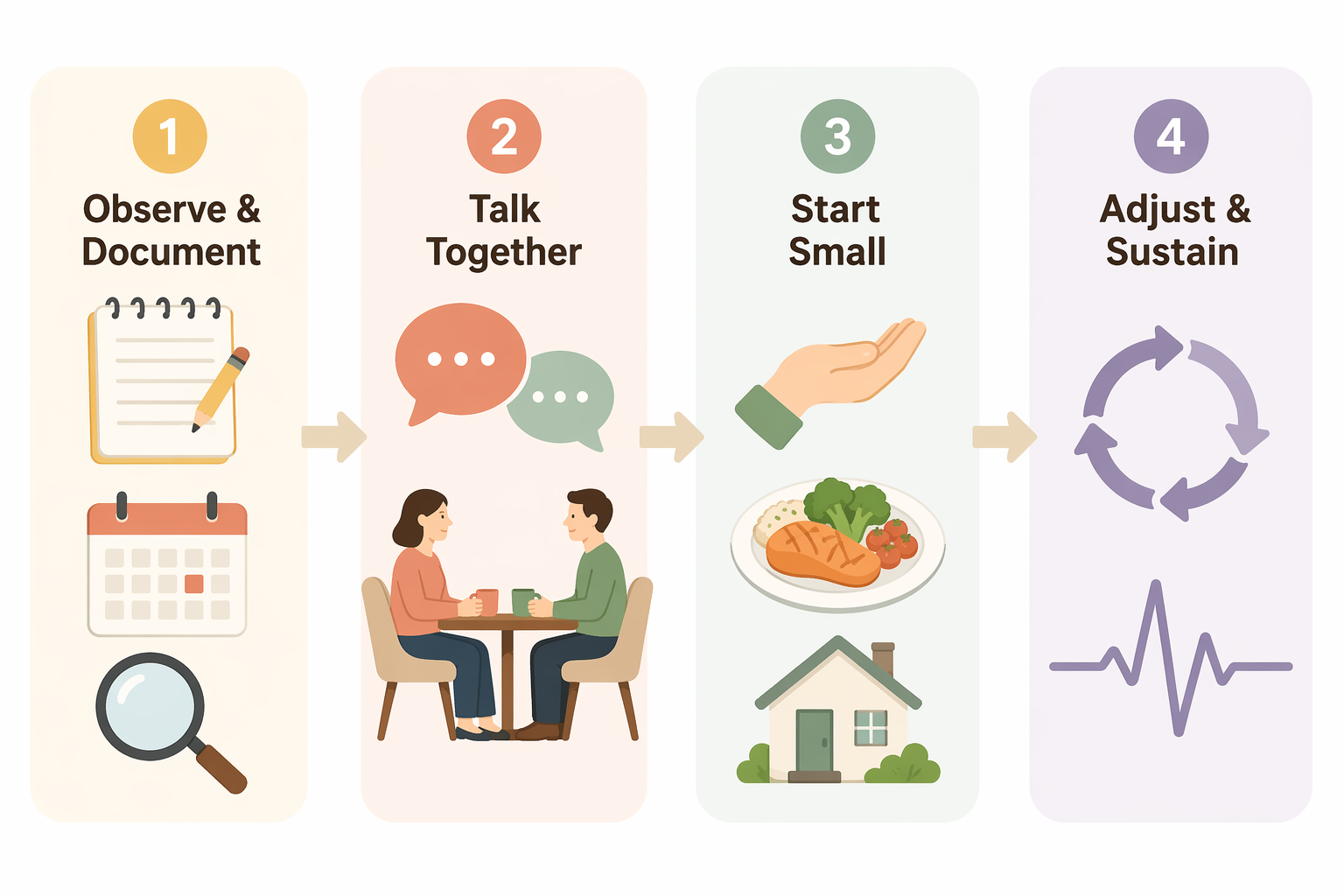
Start With a Four-Week Plan, Not a Family Verdict
Families often jump from “something is off” to “we need to move Mom” in one panicked conversation. That leap can make an older parent feel cornered and can turn siblings into prosecutors. A better first month separates watching, talking, testing, and reviewing.
When
Main job
What you are trying to learn
Week 1
Observe and document
Which daily tasks are slipping, how often, and with what consequences
Week 2
Talk with your parent
What your parent wants to protect, what help they will accept, and where they feel threatened
Week 3
Match needs to support
Whether meals, transportation, medication setup, companionship, housekeeping, personal care, or safety fixes would reduce the real risk
Week 4
Set up a trial and reassess
Whether the support works in ordinary life and what needs to change
This plan is not for handling obvious emergencies. If your parent has fallen and may be injured, is suddenly confused, has signs of stroke, is unsafe with heat or appliances, or cannot get food, fluids, or medication, handle the immediate safety issue first. The measured approach begins after immediate danger is addressed.
Week 1: Observe Before You Fix
The first week is for evidence, not accusations. You are not building a case against your parent. You are trying to stop the vague dread from running the meeting.
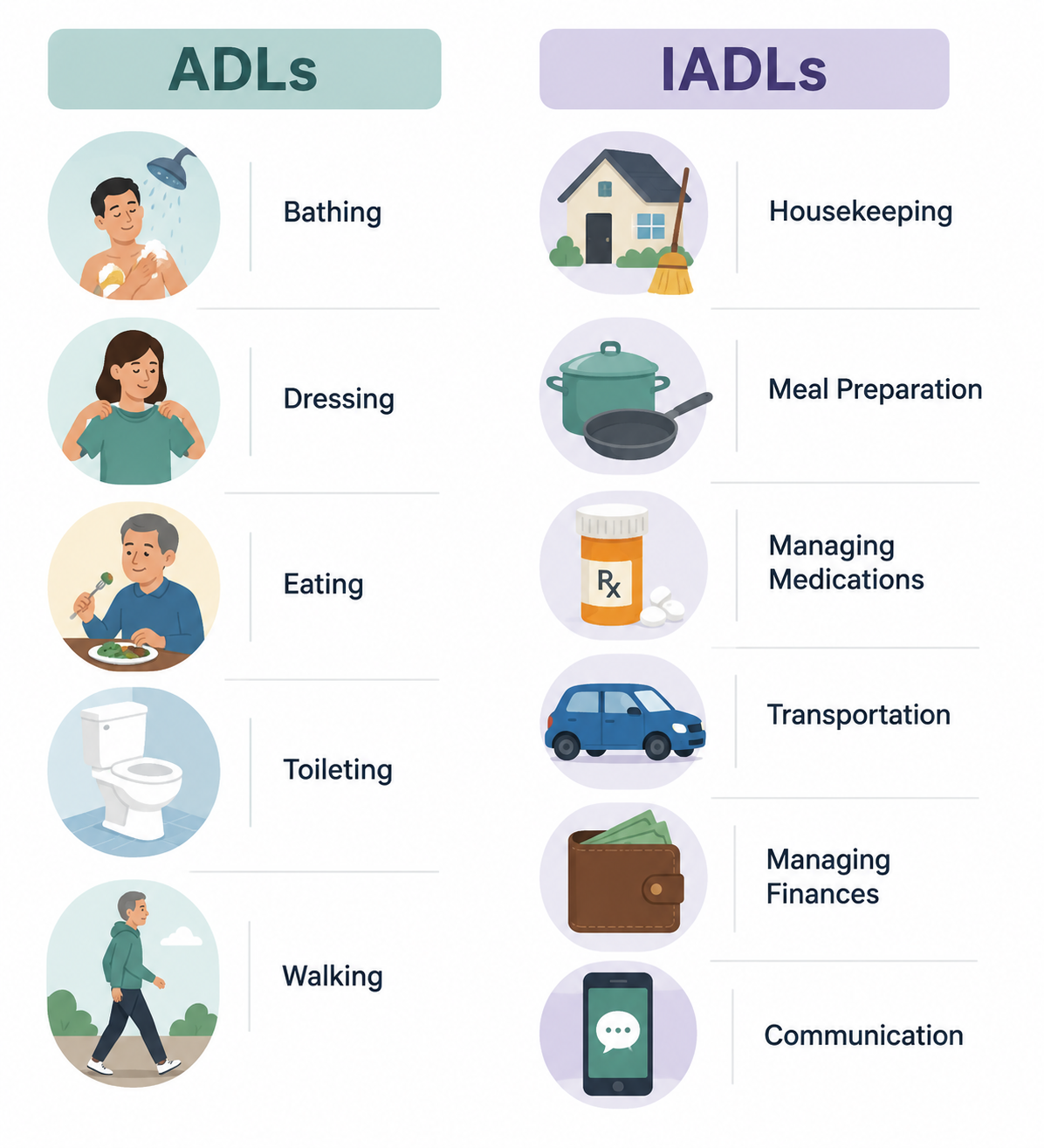
Use the Activities of Daily Living and Instrumental Activities of Daily Living framework. The National Institute on Aging describes daily support needs in practical categories such as bathing, dressing, eating, toileting, mobility, housekeeping, meals, medication management, transportation, and finances [2]. That list is useful because it keeps the conversation out of personality and into observable tasks.
Write down what you see, with dates. “Kitchen messy” will start a fight. “Trash was overflowing on Tuesday and still there Friday” is harder to dismiss and easier to solve.
Bathing and grooming: Is the shower being used? Are clothes repeatedly soiled? Is your parent avoiding bathing because stepping in and out is hard?
Meals and hydration: Is food spoiling? Are there repeated convenience meals because cooking feels too tiring? Is weight changing in a way you can actually observe?
Medication: Are pills missed, doubled, scattered, or expired? Does your parent understand what each medication is for?
Housekeeping and laundry: Is clutter creating tripping paths? Are dishes, trash, laundry, or pet care slipping beyond your parent’s usual habits?
Transportation: Are appointments being missed? Are rides becoming stressful? Has driving become the family topic everyone avoids?
Finances and mail: Are bills unopened, checks misplaced, subscriptions renewed by accident, or unusual charges appearing?
Mobility and home safety: Are there new bruises, furniture-walking, loose rugs, poor lighting, or stairs your parent now avoids?
Connection: Is your parent going days without meaningful contact, skipping activities, or sounding flatter and more withdrawn?
Do not treat loneliness as a lesser problem just because it does not look medical. One in three older adults, 34%, reported feeling isolated in the past year in a University of Michigan finding cited by SeniorLiving.org [3]. For some parents, a companion who comes twice a week may be the first support that makes meals, movement, and mood easier to maintain.
Falls deserve a special pass through the house. RetirementLiving.com cites CDC data showing that the fall death rate among adults 65 and older rose 21% between 2018 and 2024 [4]. That does not mean every throw rug is an emergency, but it does mean obvious hazards should not sit there while the family debates bigger philosophical questions.
If you live far away, ask for eyes without turning neighbors into spies. A trusted neighbor can confirm whether the trash goes out, a pharmacy can flag refill problems, and your parent may accept simple check-in technology if it is framed as backup rather than surveillance. For a deeper remote setup, see Remote Monitoring for Long-Distance Caregivers.
Week 2: Have the Conversation Without Making Help Sound Like Surrender
This is the part where families often lose trust. The adult child arrives with a spreadsheet. The parent hears eviction notice. Both may be frightened, but only one of them feels like their life is being voted on.
Start with the goal your parent is most likely to share: staying in their home as long as possible, with as much control as possible. Then make the proposed support a tool for that goal.
Instead of “You need help,” try “I want to make it easier for you to stay here safely.”
Instead of “You can’t manage your pills,” try “The medication schedule has gotten complicated. Would you be open to a weekly setup so you do not have to think about it every day?”
Instead of “The house is a mess,” try “The laundry and trash look harder than they used to. Could we try someone for two hours a week and see if it helps?”
Instead of “You shouldn’t drive,” try “Let’s test rides for the appointments that are most stressful, not decide everything today.”
Expect resistance. Resistance is not always denial, and it is not always ingratitude. Sometimes it is grief, embarrassment, fear of strangers in the house, fear of cost, or the very reasonable suspicion that “a little help” is the first step toward losing every decision.
If the first conversation stalls, do not keep pushing until everyone is exhausted. Ask whether your parent would talk with someone they already trust: a primary care clinician, clergy member, longtime neighbor, geriatric care manager, or family friend who will not treat them like a child.
Sibling politics need daylight early. One sibling may see decline first because they live nearby. Another may minimize the problem because they only hear the cheerful ten-minute phone version. A third may jump to facility placement because they are scared and do not know what else exists. Before assigning jobs, share the same observation notes. If “equal” is becoming code for “the closest daughter does everything,” read How to Talk to Siblings About Parent Care When Equal Isn't Fair.
Week 3: Match the First Support to the Actual Problem
Home help for seniors is not one thing. It can be a ride, a meal delivery, a medication organizer, a housekeeper, a companion, a personal care aide, a home health service ordered after illness or surgery, or a mix that changes over time. The right first step is the least disruptive support that honestly matches the risk.
If the main problem is food, do not start by interviewing personal care aides for bathing. Try grocery delivery, prepared meals, meal delivery programs, or a helper who cooks once or twice a week. If the main problem is missed appointments, test transportation before taking over the whole calendar. If the main problem is isolation, companionship is not “just visiting”; it may be the support that keeps routines from collapsing.
A Place for Mom cites home care expert Vicki Demirozu on a point families often underestimate: even small amounts of in-home support, such as companionship, meal help, or light housekeeping, can extend an older adult’s ability to live independently [5]. That matters because three useful hours a week may be easier for a parent to accept than a full schedule that makes the house feel occupied by strangers.
What you observed
First support to consider
Why it may be enough for now
Spoiled food, skipped meals, low energy around cooking
Cost is where good intentions meet the calendar. Current national estimates put home care around the mid-$30s per hour, with A Place for Mom reporting a 2026 national median of about $34 to $35 per hour and SeniorLiving.org showing wide state variation [5][3]. Local rates can be much lower or higher, so do not build your plan from a national average alone.
Call the Eldercare Locator at 800-677-1116 and ask for your local Area Agency on Aging. Ask about transportation programs, meal programs, caregiver support, respite options, home modification assistance, Medicaid Home and Community-Based Services waiver information, and local nonprofit help. Medicaid HCBS waiver rules and waitlists change by state, so this is not a place to rely on a generic internet summary.
Agency or Independent Caregiver: Know What You Are Buying
Agencies often cost more than independent caregivers, with a commonly cited premium of 20% to 30%, but the extra cost may buy background checks, training, workers’ compensation coverage, scheduling, supervision, and backup staffing [5][3]. That can be worth it if the family cannot manage payroll, screening, or last-minute absences.
Choice
What it may offer
What the family still needs to watch
Home care agency
Screening, scheduling, backup aides, workers’ compensation, training standards, a manager to call
Higher hourly cost, less control over exactly who comes, possible minimum-hour requirements
Independent caregiver
Often lower cost, more continuity, more flexibility if the match is strong
Family may become the employer and handle screening, taxes, liability, backup coverage, and performance issues
There is no morally superior choice here. There is only the choice that matches your parent’s risk, your family’s capacity, and the amount of administrative work someone is truly able to carry.
Week 4: Set Up a Trial That Can Be Changed Without Drama
A trial lowers the emotional temperature. Instead of asking your parent to accept “care,” ask them to test a specific arrangement for a specific period.
Choose one or two goals: meals eaten, medications taken correctly, trash removed, showers safer, appointments kept, fewer lonely days.
Set a short schedule: for example, two mornings a week for meal prep and laundry, or one afternoon for errands and companionship.
Write down who is responsible for access, payment, communication, supplies, medication lists, and emergency contacts.
Tell the caregiver what success looks like in plain language, not just “help around the house.”
Schedule a review date before the trial starts, so changing the plan does not feel like a confrontation.
The review should be practical. Did your parent let the person in? Did meals improve? Did the aide spend the visit doing what mattered? Did your parent feel respected? Did the family member who used to handle everything get any real relief, or did they just become the unpaid supervisor of another moving part?
If the trial fails, do not assume the whole idea failed. Sometimes the task was right and the person was wrong. Sometimes the timing was wrong. Sometimes your parent will accept a housekeeper but not a “caregiver,” transportation but not bathing help, a neighbor’s visit but not an agency aide. The language and the entry point matter.
Keep a Small Care Binder Before the System Gets Bigger
Once help starts, the family needs one shared source of truth. It can be a folder, a notebook, or a shared digital document. It does not have to be elegant. It has to be findable when someone is standing in the kitchen with a question.
Medication list, pharmacy, allergies, diagnoses, and primary care contact
Emergency contacts and who has permission to receive updates
Care schedule, caregiver names, agency contact, and backup plan
Bills, insurance cards, benefit contacts, and key household vendors
Observation notes: falls, missed medications, appetite changes, mood changes, appointments missed, and what support helped
Starting small is not the same as minimizing risk. Some patterns mean the family needs a faster clinical or professional review: repeated falls, wandering, unsafe cooking, serious medication errors, suspected exploitation, severe self-neglect, rapidly changing confusion, or care needs that require hands-on help most of the day.
In those cases, call the primary care clinician, ask about a home health evaluation if there has been a qualifying medical need, talk with a geriatric care manager if you can, and contact the Area Agency on Aging. If you are far away and something urgent has happened, use The Long-Distance Caregiver's First-Hour Emergency Response Plan rather than trying to coordinate everything by memory and panic.
Facility care may eventually become the safest or most humane option for some families. But it should not be the reflexive first answer to a dirty kitchen, a missed ride, or a parent who is lonely and overwhelmed. A documented baseline, a parent-involved conversation, one reversible layer of home support, a local resource contact, and a scheduled reassessment point are enough for the first turn of the wheel.
The best first response is not doing everything. It is doing the next few things in the right order.


Comments
Join the discussion with an anonymous comment.