
Caregiver decision guide
Live-In Caregiver vs. Assisted Living: The Cost Break-Even Guide for 2026
For families comparing live-in care and assisted living, the cost math is shifting. This guide breaks down national and state-level costs, hidden expenses, and the home equity factor to help adult children make an informed decision.
Why the 40-Hour Rule Doesn't Apply to Live-In Care
If you've read our guide on the 40-hour cost threshold, you know the standard rule: hourly home care is cheaper than assisted living when you need fewer than 40 hours of paid care per week, and assisted living becomes the more affordable option beyond that point. That rule holds true for hourly care — but it was built for a world where caregivers bill by the hour, not by the day.
Live-in care operates on a fundamentally different pricing model. Instead of paying $30 to $44 per hour for a caregiver who clocks in and out, you pay a flat daily rate — typically $200 to $400 per day — for a caregiver who lives in the home and provides care during agreed-upon waking hours, with scheduled breaks and an uninterrupted sleep period. That daily rate changes the math entirely.
The live-in model is most common when a senior needs supervision, companionship, and help with activities of daily living (ADLs) throughout the day — but does not require a fully awake caregiver through the night. One caregiver typically works a schedule of four to five days per week, with an eight-hour sleep period and a four-hour daytime break built into each day. This is distinct from 24/7 shift care, where two or three caregivers rotate to ensure someone is awake and alert at all hours.
National Cost Medians: Assisted Living vs. Live-In Care vs. 24/7 Shift Care
To understand where live-in care fits in the cost landscape, it helps to see all three options side by side. The table below uses the most recent national median data available for 2026.
| Care Option | National Median Monthly Cost (2026) | Pricing Model | Key Characteristics |
|---|---|---|---|
| Assisted Living | $5,419 | Monthly all-inclusive | Rent, utilities, meals, basic ADL assistance, social activities; level-of-care add-ons extra |
| Live-In Care (sleep-break model) | $6,000 – $10,500 | Daily rate ($200–$400/day) | One caregiver lives in; 8-hour sleep period + 4-hour daytime break; 4–5 days/week coverage |
| 24/7 Rotating Shift Care | $24,733 | Hourly ($34/hr national median) | Two or three caregivers rotating; awake coverage 24 hours/day; time-and-a-half overtime applies |
The assisted living figure of $5,419 per month comes from A Place for Mom's 2026 Cost of Long-Term Care and Senior Living Report. That figure represents the base all-inclusive rate — rent, utilities, meals, housekeeping, and a standard level of assistance with activities of daily living. But it is not a fixed price. Most facilities add tiered fees for higher care needs, and memory care units typically add $1,000 or more per month on top of the base rate.
Live-in care at $6,000 to $10,500 per month sits in a range that overlaps significantly with assisted living — especially when you consider that the lower end of the live-in range ($6,000) is only about 11% higher than the assisted living median, and that assisted living's true cost for a higher-needs resident can easily reach $6,500 to $7,500 per month after add-ons.
How Live-In Care Changes the Cost Equation
The reason live-in care can compete with assisted living on price — despite providing one-on-one care in a private home — comes down to its billing structure. Here is how the daily-rate model avoids the cost traps that make hourly care so expensive at high volumes of care.
- No overtime escalation. Hourly caregivers earn time-and-a-half for hours worked beyond 40 per week. For a senior needing 100+ hours of weekly coverage, overtime alone can add 30–50% to the base hourly cost. Live-in care uses a flat daily rate that includes the caregiver's sleep and break time — no overtime clock to watch.
- Built-in sleep and break periods. A live-in caregiver is typically provided with an eight-hour uninterrupted sleep period and a four-hour daytime break. During those hours, the caregiver is not providing active care — they are resting or on personal time. This reduces the total billable care hours compared to a 24/7 awake model, which is why the daily rate is lower than what 24 hours of hourly billing would cost.
- One caregiver, not a team. 24/7 shift care requires two or three caregivers to rotate through the week. Each caregiver bills their own hours, and the agency charges a markup on each. Live-in care typically uses a single primary caregiver who works four to five days per week, with a backup for days off. Fewer caregivers means fewer agency markups and lower total cost.
- Predictable monthly budgeting. A daily rate of $300/day translates to roughly $9,000/month regardless of whether the senior needs 8 hours of active care on Tuesday or 12 hours on Friday. This predictability is valuable for families who need to plan a monthly budget without worrying about hourly fluctuations.
The trade-off, of course, is that the live-in caregiver is not awake and available through the night. If the senior needs someone alert and responsive at 2 a.m. — for dementia-related wandering, frequent bathroom trips, or medical monitoring — then the live-in model is not appropriate, and the family must consider the more expensive 24/7 shift care option.
State-by-State Cost Examples
National medians are useful for a general sense of the market, but senior care costs vary dramatically by state and even by city within states. The table below shows how the cost comparison shifts across different parts of the country.
| State | Assisted Living (Monthly Median) | Live-In Care (Monthly Range) | Hourly Home Care (Median) |
|---|---|---|---|
| Mississippi | $2,844 | $4,800 – $7,200 | $25/hr |
| Texas | $3,500 | $5,400 – $8,100 | $28/hr |
| Florida | $4,000 | $6,000 – $9,000 | $30/hr |
| California | $5,250 | $7,500 – $12,000 | $35/hr |
| New York | $5,400 | $8,000 – $12,500 | $37/hr |
| Washington | $5,750 | $8,400 – $13,200 | $42/hr |
| South Dakota | $4,800 | $7,200 – $10,800 | $44/hr |
Several patterns emerge from this data. In lower-cost states like Mississippi and Texas, assisted living is clearly cheaper than live-in care — the gap is substantial. But in higher-cost states like California, New York, and Washington, the ranges overlap significantly. A family in California paying $5,250/month for assisted living might find that adding memory care or a higher level of care pushes the facility cost to $6,500 or more, at which point a live-in arrangement at $7,500/month becomes a much closer comparison — especially when you factor in the one-on-one care ratio.
The Hidden Costs of Each Option
The monthly rate is only part of the story. Both live-in care and assisted living come with additional expenses that families often underestimate. Here is a breakdown of the hidden costs for each option.
Hidden Costs of Live-In Care
- Home modifications. Aging in place safely often requires grab bars, ramps, stair lifts, walk-in showers, and improved lighting. These costs can range from a few hundred dollars for basic grab bars to $10,000 or more for a full bathroom remodel. See our guide on whether an aging-in-place remodel pays for itself for a detailed analysis.
- Utilities and food. Having another person living in the home increases utility bills and grocery costs. Estimate an additional $200–$500 per month depending on local utility rates and the caregiver's meal arrangement.
- Caregiver room and board. The caregiver needs a private room (or at minimum a dedicated sleeping area) and access to bathroom and kitchen facilities. If the home does not have a spare bedroom, this may require converting a den or office.
- Transportation. If the caregiver uses a personal vehicle for errands, medical appointments, or grocery shopping, the family may need to reimburse mileage or provide a vehicle. The IRS standard mileage rate for 2026 is approximately $0.70 per mile.
- Backup care. When the primary live-in caregiver takes days off or calls in sick, you need backup coverage. This can add 10–20% to the monthly cost depending on how many backup days are needed.
- Medical supplies and technology. Incontinence supplies, wound care products, and monitoring technology (medical alert systems, passive sensors) can add hundreds of dollars per month. Medicare does not cover non-medical in-home care or most of these supplies.
Hidden Costs of Assisted Living
- Community and entrance fees. Many assisted living facilities charge a one-time community fee of $1,000 to $5,000 upon move-in. Some upscale communities charge entrance fees of $10,000 or more.
- Level-of-care add-ons. The base rate typically covers a standard level of assistance (e.g., help with bathing and dressing). If the senior needs help with medication management, incontinence care, or transfers, the facility adds tiered fees that can range from $500 to $2,000 per month.
- Memory care premiums. If the senior has Alzheimer's or another form of dementia, the memory care unit typically costs $1,000 to $2,500 more per month than standard assisted living. This alone can close the gap with live-in care.
- Third-party services. Facilities may charge extra for laundry, transportation to medical appointments, salon services, or special dietary needs. These add-ons are often not included in the base rate.
- Annual rate increases. Assisted living rates typically increase 3–6% annually. Over a multi-year stay, this compounds significantly.
Home Equity: The Factor That Changes Everything

The single most important factor that families overlook when comparing live-in care to assisted living is home equity. If the senior owns their home, the financial comparison is not just about monthly cash flow — it is about whether the family retains or liquidates a major asset.
Here is the core dynamic:
- Sell the home to pay for assisted living. The proceeds from the home sale can fund several years of assisted living, but the home is gone. The senior loses the asset, and the family loses any future appreciation.
- Keep the home and use a reverse mortgage to fund live-in care. A reverse mortgage allows the senior to borrow against the home's equity while continuing to live in the home. The loan is repaid when the home is sold — typically after the senior moves out or passes away. This can provide a steady stream of income to pay for live-in care without requiring the senior to move.
- Keep the home and rent it out. If the senior moves to assisted living but keeps the home, rental income can offset facility costs. However, this requires the family to manage the property or hire a property manager.
Consider a concrete example. A senior in California owns a home worth $600,000 with $400,000 in equity. Assisted living costs $5,250/month, or $63,000/year. Selling the home and using the proceeds to pay for assisted living would fund roughly six years of care — but the home is gone, and the senior has moved out of their community.
Alternatively, a reverse mortgage on that same home could provide a lump sum or monthly payments that cover a significant portion of live-in care costs. The senior stays in their home, retains the asset for their heirs (minus the loan balance), and receives one-on-one care. The monthly cost of live-in care at $7,500/month is only $2,250 more than assisted living — and that gap can be closed entirely by the reverse mortgage proceeds.
Decision Framework: Which Option Fits Your Situation?
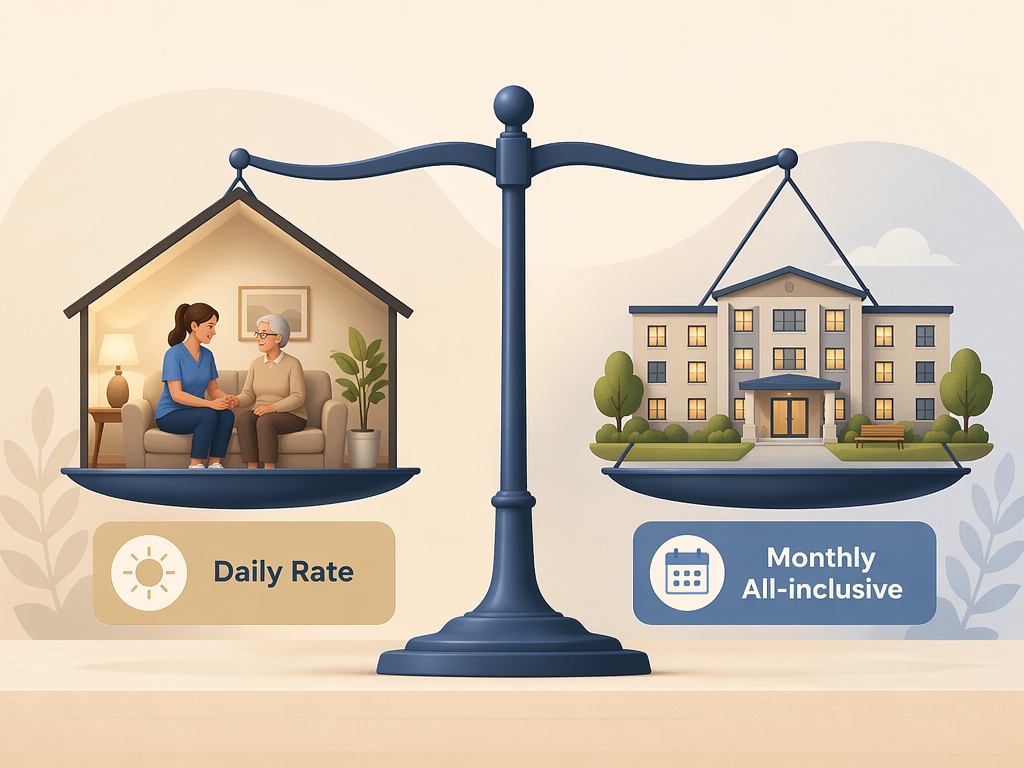
The right choice depends on the senior's specific care needs, financial situation, and personal preferences. The table below maps the cost comparison across different levels of need.
| Level of Need | Live-In Care (Monthly) | Assisted Living (Monthly) | Which Is Cheaper? |
|---|---|---|---|
| Low (supervision, light ADL help) | $6,000 – $7,500 | $4,000 – $5,500 | Assisted living is cheaper by $1,500–$2,000/month |
| Moderate (ADL help + medication management) | $7,500 – $9,000 | $5,500 – $7,000 | Close — within $1,000–$2,000/month gap |
| High (ADL help + incontinence + mobility) | $8,000 – $10,500 | $6,500 – $8,500 | Gap narrows to $500–$2,000/month |
| Memory care (dementia) | $8,000 – $10,500 | $7,000 – $10,000 | Often comparable; live-in may be cheaper in high-cost areas |
| Round-the-clock awake care | Not appropriate — needs 24/7 shift care ($24,733) | $8,000 – $12,000 | Assisted living is vastly cheaper than 24/7 shift care |
Beyond the numbers, here are the key questions to ask yourselves as a family:
- Does the senior own a home? If yes, home equity can fund live-in care. If no, the comparison is purely about monthly cash flow.
- Is memory care needed? If the senior has Alzheimer's or dementia, the assisted living cost jumps significantly (memory care add-ons), making live-in care more competitive. However, the live-in caregiver must be trained in dementia care, and the home must be safe for someone who may wander.
- Is the senior safe alone at night? If the senior needs someone awake and available through the night, the live-in model is not appropriate. You would need 24/7 shift care, which is almost always more expensive than assisted living.
- Does the senior want to stay in their community? For many seniors, the emotional value of remaining in their home and neighborhood is significant. That value is not captured in a cost comparison, but it matters.
- Can the home be made safe? If the home has stairs, narrow doorways, or a bathroom that cannot be modified, the cost of renovations may tip the balance toward assisted living.
- What happens in 12 months? Care needs often escalate. If the senior is likely to need 24/7 care within a year, the cost comparison shifts dramatically. Plan for the trajectory, not just the current state.
For a broader view of the 2026 senior care landscape, including changes in regulations, technology, and care models, see our Senior Care Options in 2026 guide. And for a reality check on costs across all senior care options, our Cost Reality Check article provides a comprehensive overview.
Questions to bring to a clinician or OT
This is not medical, legal, or a family's final decision — only a framework. Bring these questions to a clinician, occupational therapist, or your local Area Agency on Aging.
Find Local HelpRelated reading
Noticed something outdated or inaccurate on this page? Flag a correction. We review every report against CDC, NIA, and AARP HomeFit guidance before updating a page.