Where Should Mom Live? A Caregiver's Guide to Evaluating Senior-Friendly Cities
Traditional retirement rankings emphasize climate and leisure, but the real criteria for aging in place safely are healthcare infrastructure, home care costs, walkability, and caregiver proximity. This guide provides a data-driven framework for adult children evaluating where an aging parent should live.
By Editorial Team
new caregiver
long-distance caregiving
adult children
aging in place
care coordination
📄
A printable version of this guide is available. Use your browser's print function (Ctrl+P / ⌘P) to save or print.
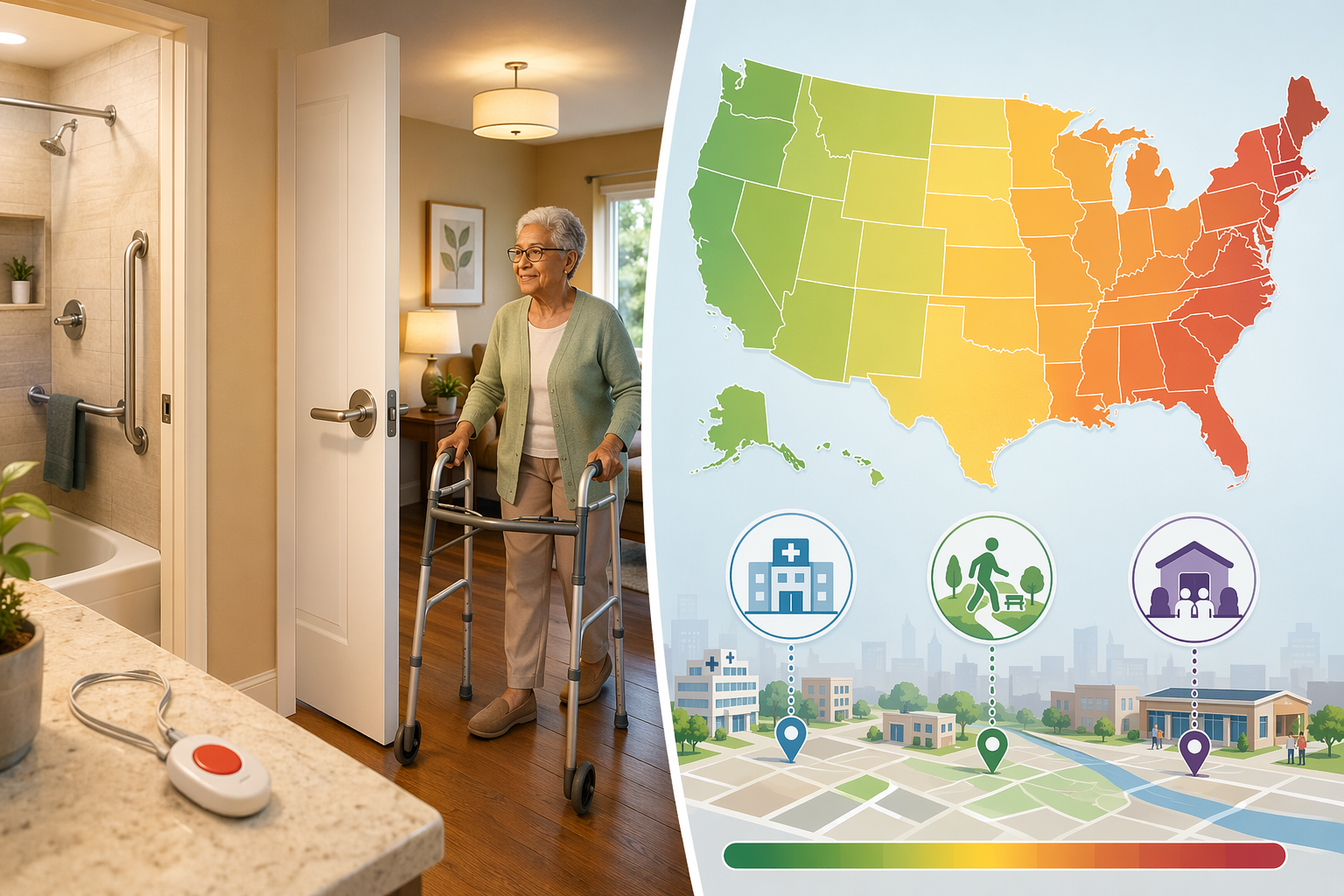
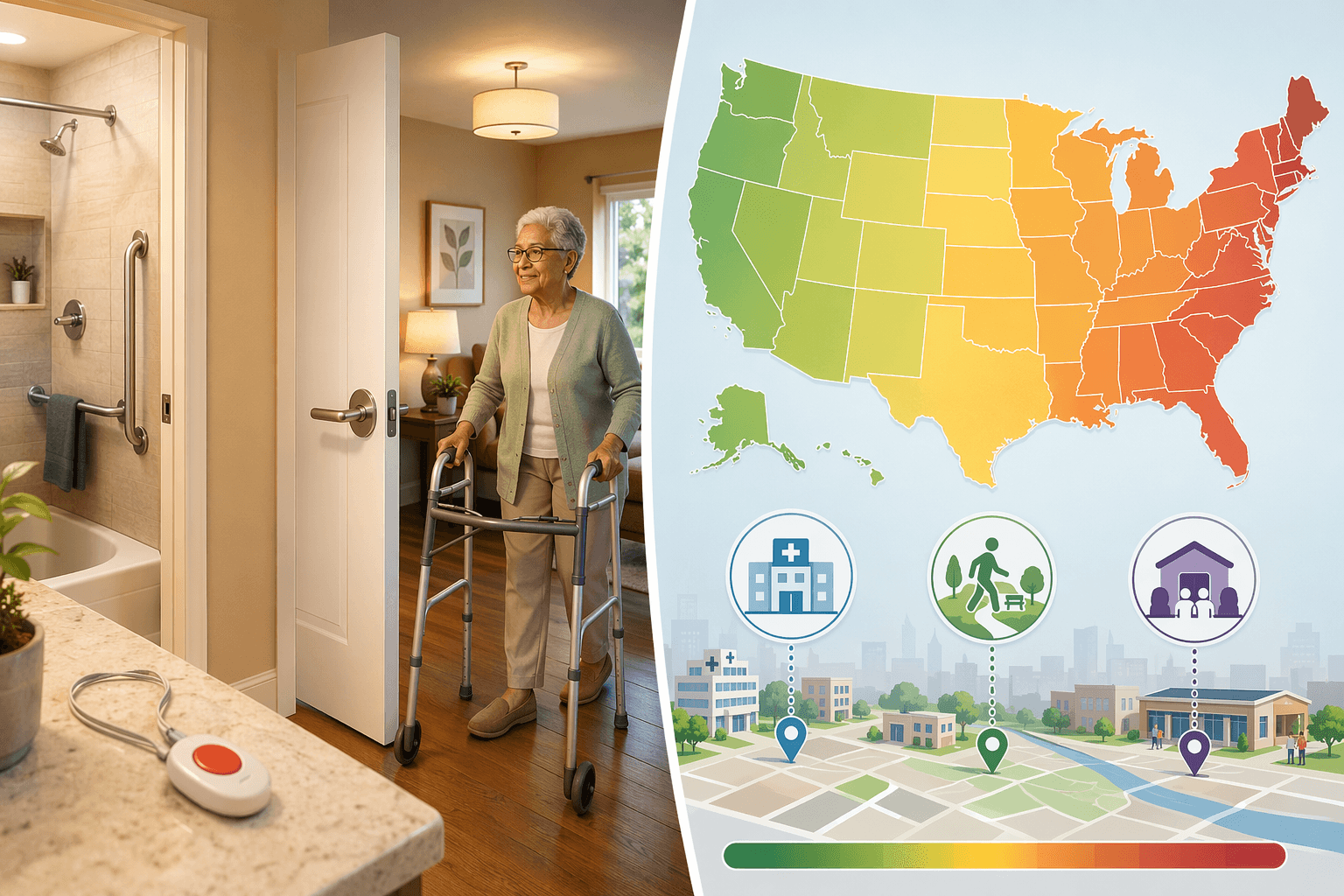
The real criteria for aging in place safely go far beyond climate and leisure.
Why Standard Retirement Rankings Miss the Mark for Aging Adults
Every year, a new wave of "best places to retire" lists lands in your feed. U.S. News ranks the top metro areas. WalletHub scores all 50 states. Consumer Affairs highlights hidden gems. These rankings are useful if you are looking for a warm climate, a vibrant social scene, and a low tax burden. But if you are an adult child in your 40s or 50s trying to figure out where an aging parent should live, these lists can be dangerously misleading.
The disconnect is simple: the priorities of a healthy 65-year-old retiree are not the same as those of an 80-year-old who needs help with medications, has unsteady balance, and relies on a caregiver. The data backs this up. Over 90% of older adults say they want to stay in their own home as they age, according to research cited by Choice Mutual. Yet only 10% of U.S. homes are considered "aging ready" — meaning they have the basic structural features needed for safe mobility. Even more striking: 85% of seniors who plan to stay home do not believe they will need significant modifications, even though nearly 80% acknowledge they would need bathroom grab bars and walk-in showers. Only 18% of adults over 50 have actually made any modifications.
This is not to say the traditional rankings are worthless. They capture important signals about affordability and quality of life. But for a family caregiver evaluating where a parent should live, the criteria need to shift. The question is not "Where is the most fun place to retire?" It is "Where can my parent age in place safely, affordably, and with the support they actually need?"
The Six Criteria That Actually Matter for Aging in Place
When you strip away the golf courses and the beachfront condos, six factors determine whether a city or state can support an older adult through the full arc of aging. These are the criteria that should drive your evaluation.
Access to geriatric care. Not just any hospital — a health system with geriatricians, memory care specialists, and a strong primary care network. A city with a world-class cancer center but no geriatrician accepting Medicare is not senior-friendly.
Home care cost and availability. The national median home care rate hit $34 per hour in 2025, up 3% from the prior year, according to A Place for Mom's Cost of Care report. But that number hides massive state-by-state variation — from $25 per hour in Mississippi to $44 per hour in South Dakota. Geography, not care quality, drives the biggest price differences.
Walkability and transportation. Once a senior stops driving, walkability becomes a lifeline. Can they reach a grocery store, pharmacy, or medical office without a car? Cities with pedestrian-friendly infrastructure and public transit options rank significantly higher for aging in place.
Crime and safety. Fear of crime can trap an older adult inside their home, accelerating physical and cognitive decline. Low crime rates are not just about safety — they are about freedom and mobility.
Social engagement infrastructure. Senior centers, community programs, volunteer opportunities, and age-friendly civic infrastructure keep older adults connected. Loneliness is a documented health risk, and cities that invest in social programming for seniors earn higher marks.
Proximity to family caregivers. This is the factor most rankings ignore entirely. The average long-distance caregiver lives 450 miles and approximately 7 hours from the care recipient, according to AgingCare.com. Nearly half (47%) of long-distance caregivers report high emotional stress, compared to 28% for nearby caregivers. Distance is not just an emotional cost — it is a financial one, with 21% of long-distance caregivers reporting higher financial strain.
State-by-State Comparison: Where Home Care Costs and Healthcare Access Diverge
The most useful way to compare states is not through a single composite score but through the dimensions that matter most for aging in place. The table below pulls together data from WalletHub's 2026 state rankings, A Place for Mom's 2026 Cost of Care report (as cited by Investopedia), and U.S. News metro area rankings to show how states diverge on the criteria that actually matter.
State-level comparison of home care costs, affordability, and healthcare access. Home care rates are state medians from A Place for Mom's 2026 Cost of Care report. Rankings from WalletHub 2026 (data collected December 2025).
State
Median Home Care Rate (per hour)
WalletHub Affordability Rank (2026)
WalletHub Healthcare Rank (2026)
Key Strength
Key Caveat
Mississippi
$25
#3
#48
Lowest home care costs in the nation
Nearly one-quarter of seniors live below the poverty line
Alabama
$26
#8
#39
Very low home care costs
Limited geriatric care infrastructure in rural areas
Louisiana
$26
#11
#47
Low cost of in-home services
High senior poverty rate and weak healthcare rankings
Minnesota
$38
#25
#5
Strong healthcare system and quality of life
High home care costs and cold climate
South Dakota
$44
#15
#4
Top-tier healthcare ranking
Highest home care costs in the nation; rural labor shortages
Florida
$30
#2
#27
High affordability and #1 quality of life
Healthcare ranking is middling; hurricane risk
Wyoming
$35
#1
#33
Best affordability score in the nation
Rural geography limits home care availability
The table reveals a pattern that most retirement rankings obscure: the states with the lowest home care costs (Mississippi, Alabama, Louisiana) often have the weakest healthcare infrastructure and the highest senior poverty rates. WalletHub's own data shows that almost one-quarter of Mississippi seniors live below the poverty level. Low cost does not mean good value if the care infrastructure is not there to support it.
At the other end of the spectrum, states like Minnesota and South Dakota offer excellent healthcare but at a steep premium for home care. South Dakota's $44 per hour rate — the highest in the nation — is driven by thin labor pools and rural geography, according to Investopedia's analysis. For a family needing 40 hours of care per week, that difference adds up to nearly $40,000 per year compared to Mississippi.
The sweet spot — affordable home care combined with decent healthcare access — tends to cluster in the Midwest and parts of the South. This is not a coincidence. U.S. News's 2026 rankings show that Midwestern cities now dominate the top of the retirement list, with Midland, Michigan taking the #1 spot and Altoona, Pennsylvania ranking #8. These cities offer a combination of low housing costs (Altoona's median home value is $115,035; median monthly rent is $665) and access to regional health systems that is hard to find on the coasts.
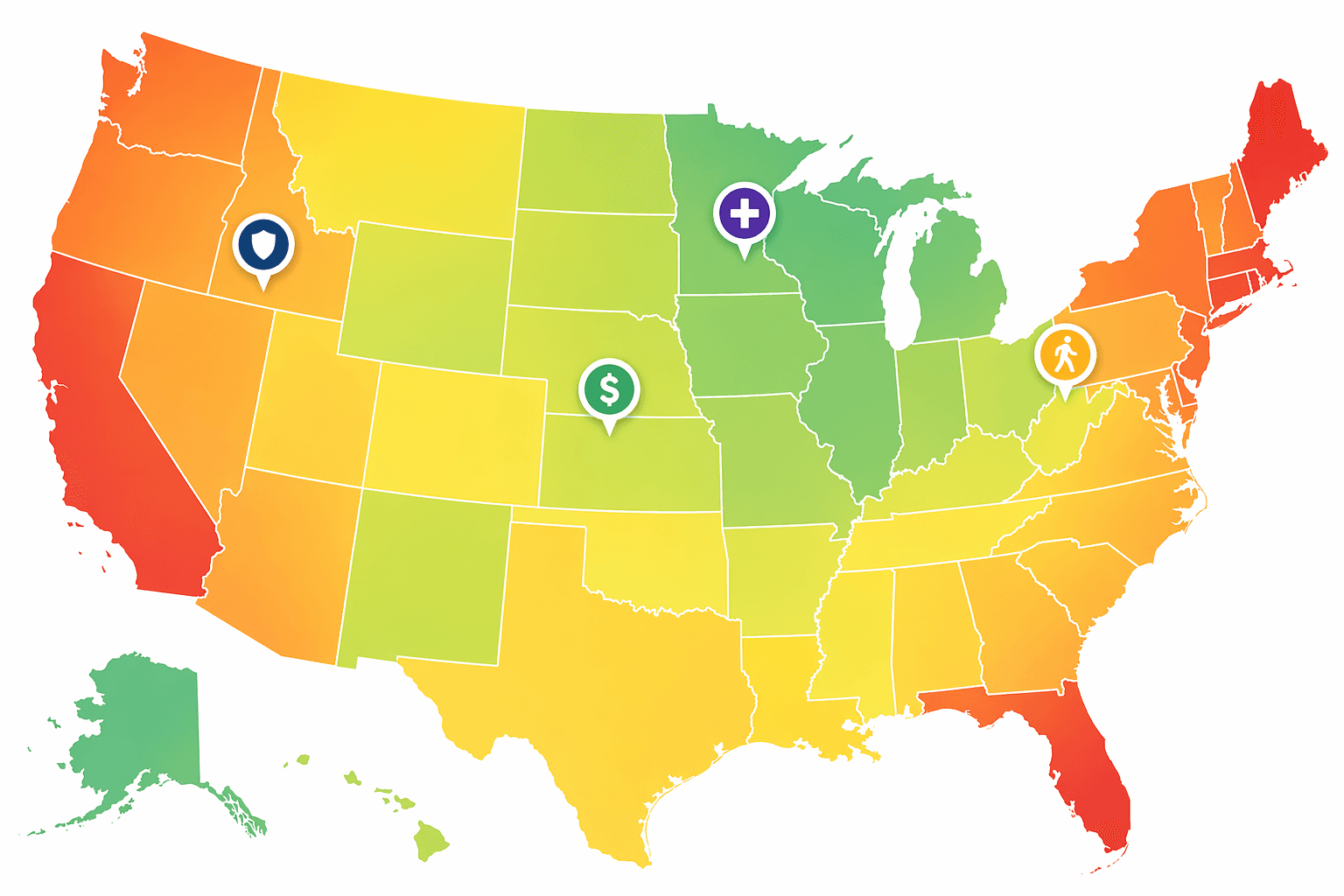
Home care costs vary by nearly 2x across states — geography, not care quality, drives the biggest price differences.
Spotlight Cities: Where Healthcare, Walkability, and Affordability Align
No city is perfect for every family, but four cities stand out for different reasons. Each excels on a different dimension of the six-criteria framework, and each comes with trade-offs worth understanding.
Rochester, Minnesota: The Healthcare Powerhouse
Rochester is home to the Mayo Clinic, one of the world's most renowned health systems. For a parent with complex medical needs — multiple chronic conditions, a recent dementia diagnosis, or a history of falls — having world-class specialists within a 20-minute drive is transformative. The city has invested heavily in senior-friendly infrastructure, including walkable downtown areas and accessible public transit. The trade-off: Minnesota's home care costs are among the highest in the nation at approximately $38 per hour, and the winters are long and cold. Rochester works best for families who prioritize healthcare access above all else and have the budget to support it.
Pittsburgh consistently ranks as one of the most walkable cities in the United States, with strong healthcare systems (UPMC and Allegheny Health Network) and a cost of living that remains well below the national average for a major metro area. The city's neighborhoods are compact and pedestrian-friendly, which matters enormously for seniors who can no longer drive. Altoona, Pennsylvania — ranked #8 by U.S. News for 2026 — is a smaller, more affordable option in the same state, with a median home value of just $115,035. The trade-off: Pennsylvania's home care costs are moderate but not low, and the state's tax structure for retirement income is less favorable than some competitors.
Lincoln, Nebraska: Low Cost, High Livability
Consumer Affairs ranked Lincoln as the #1 best place to retire in 2026, citing its parks, low cost of living, high quality of life, and inclusive community. The city has a healthy older adult population and strong civic infrastructure for seniors. Nebraska's home care costs are moderate, and the state's healthcare system, while not world-class, is adequate for most routine needs. The trade-off: Lincoln is not a major medical hub. A parent with a rare or complex condition may need to travel to Omaha or Denver for specialist care. The winters are also cold, though less severe than Minnesota's.
Boise, Idaho: Low Crime and Outdoor Access
Boise is frequently cited for its low crime rates and abundant outdoor recreation, which supports both physical activity and social engagement for active seniors. The city has invested in pedestrian-friendly infrastructure and has a growing healthcare sector. The trade-off: Idaho's home care costs are above the national median, and the state's healthcare infrastructure — while improving — does not match the depth of systems in Minnesota or Pennsylvania. Boise is best suited for a parent who is still relatively independent and values safety and outdoor lifestyle over access to specialized medical care.
Relocation vs. Long-Distance Caregiving: A Decision Framework for Families
Once you have identified a city or state that scores well on the six criteria, the hardest question remains: should your parent actually move there, or should you continue managing their care from a distance? This is not a purely financial calculation. It is an emotional, logistical, and relational one.
The data on long-distance caregiving is sobering. The average long-distance caregiver lives 450 miles and approximately 7 hours from their care recipient, according to AgingCare.com. Nearly half (47%) report high emotional stress — nearly double the rate of nearby caregivers. More than 40% must rely on paid in-home care because they cannot be there themselves. And 21% report higher financial strain from the travel and coordination costs.
But relocation carries its own risks. The same AgingCare.com article features a case study of an 88-year-old woman who moved from Fargo, North Dakota to be near her son — and never emotionally adjusted. For a parent with strong community ties, a move can accelerate cognitive decline and deepen isolation, even if the new city scores well on paper.
Decision framework for families weighing relocation vs. long-distance caregiving. No single factor is decisive — the pattern across all factors matters more.
Factor
Consider Relocation When...
Consider Long-Distance Caregiving When...
Caregiver proximity
You live more than 2 hours away and visits are monthly or less
You live within 1–2 hours and can visit weekly or biweekly
Parent's health status
Parent has multiple chronic conditions, recent falls, or advancing dementia
Parent is still independent with mild, stable needs
Home care costs
Parent's current location has high home care costs ($38+/hr) and the target city is significantly cheaper
Parent's current location has affordable home care ($25–$30/hr) and adequate healthcare
Home modification needs
Parent's current home needs $50,000+ in modifications and a move to an already-accessible home is feasible
Parent's current home needs minor modifications ($5,000–$15,000) that can be completed in a few weeks
Social ties
Parent has few local social connections or has expressed openness to moving
Parent has strong community ties, nearby friends, or a spouse who is still independent
Emotional readiness
Parent has participated in the decision and is willing to move
Parent is resistant to moving and relocation would cause significant distress
If you are evaluating relocation after a specific crisis — a fall, a hospitalization, or a new dementia diagnosis — the calculus shifts. In those situations, safety and care access often outweigh the emotional disruption of a move. Our guide on aging in place vs. assisted living after a fall walks through the specific trade-offs when a crisis forces the decision.
The relocation vs. long-distance caregiving decision involves balancing healthcare access, cost, social ties, and emotional readiness.
Practical Next Steps: From Evaluation to Action
Evaluating cities and states is the research phase. The next phase is action. Here is a practical checklist to move from analysis to decision.
Use the AARP Livability Index. This free online tool scores neighborhoods across seven categories: housing, transportation, environment, health, engagement, opportunity, and safety. It is the single best resource for comparing specific neighborhoods within a city, not just metro areas. Note that the most recent data available is from 2025; the 2026 refresh may not yet be published.
Contact the local Area Agency on Aging. Every region has an Area Agency on Aging (AAA) that can tell you about local home care agencies, senior centers, meal delivery programs, and transportation options. Ask specific questions: How long is the waitlist for home care aides? Are there geriatricians accepting new Medicare patients? What senior transportation options exist beyond paratransit?
Estimate home care costs for the specific city. State medians are a starting point, but actual costs vary by city. Use our in-home senior care cost guide to understand the full range of hourly rates, monthly projections, and what drives cost differences within a state.
Assess the home modification landscape. If your parent's current home needs modifications, or if you are evaluating a new home for accessibility, understand who does this work. Our guide on CAPS vs. occupational therapist vs. general contractor explains the differences and helps you choose the right professional for the job.
Run the full cost comparison. Aging in place is not free. Between home modifications, home care, utilities, property taxes, and medical expenses, the true cost of staying at home often exceeds what families expect. Our article on the hidden costs of aging in place compares the full financial picture against assisted living, so you can make an apples-to-apples comparison.
Have the conversation early. The most well-researched relocation plan will fail if your parent is not on board. Start the conversation before a crisis forces it. Our guide on how to talk to your aging parent about fall risk and home safety provides scripts and strategies that apply to relocation discussions as well.


Comments
Join the discussion with an anonymous comment.