When Is It Time for Assisted Living? A Practical Decision Framework
A structured five-domain assessment to help adult children recognize when a parent needs assisted living, with practical steps for making the decision before a crisis forces it. Includes conversation scripts and guidance for when a parent refuses.
By Editorial Team
new caregiver
experienced caregiver
long-distance caregiving
spousal caregiver
working caregiver
daily routines
medication management
personal hygiene
care coordination
first steps
ADLs
IADLs
The hard part is rarely noticing one problem. It is knowing what to do when the problems are still small enough to explain away.
A parent has a near-fall but says the rug slipped. Three doses are still sitting in the pill organizer, but maybe the week was unusual. There is less food in the refrigerator, or too much spoiled food, but maybe appetite changes are normal. A daughter starts taking work calls from a hospital waiting room and still wonders whether she is overreacting.
That is the crisis trap. Assisted living for the elderly is often discussed only after a fall, hospitalization, medication mistake, or caregiver collapse has already narrowed the choices. In 2024, 13.8% of adults 75 and older needed help with personal care, which means this uncertainty is not a private failure or a rare family drama.[1] It is a common stage in aging that still feels intensely personal when it arrives in your own family.
The better question is not, "Is Mom bad enough for assisted living?" It is, "Are several parts of daily life now depending on luck, reminders, or one exhausted family member?"
Use five domains instead of one dramatic sign
Assisted living is generally designed for older adults who need help with daily activities, supervision, meals, medication support, or social structure, but who do not need the medical intensity of a nursing home. The National Institute on Aging describes assisted living and related long-term care facilities as options for people who need help with personal care and daily activities, with services varying by setting.[2]
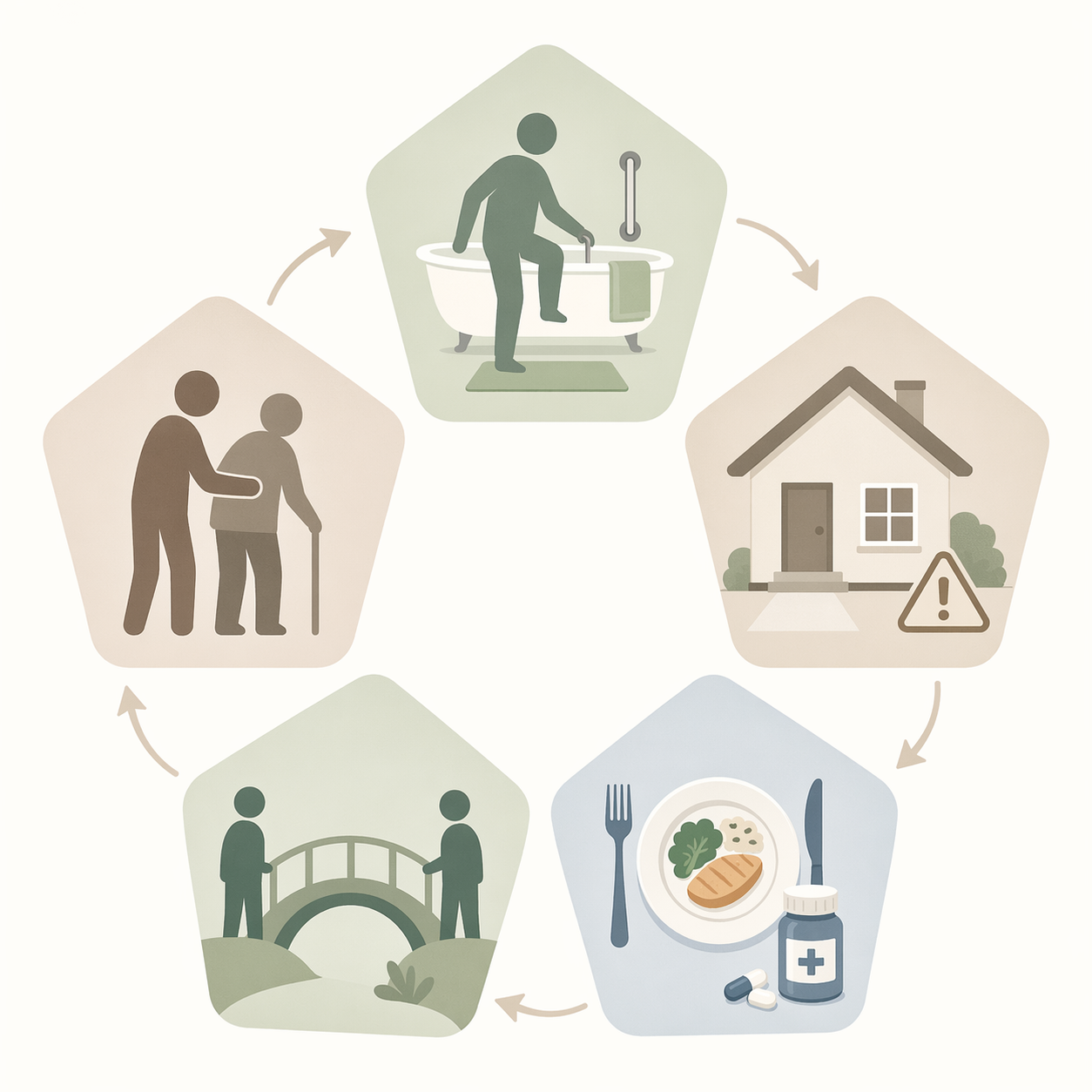
That definition is useful, but it does not settle the family decision. A parent can still have good mornings, insist on staying home, and manage some routines well. The decision becomes clearer when you look for patterns across five domains:
Social wellbeing: isolation, withdrawal, confusion after long stretches alone, loss of routine.
Caregiver capacity: whether family support is still sustainable or has become the hidden safety system.
One weak domain does not automatically mean it is time to move. Two or more domains showing persistent strain should change the conversation. Three or more should usually move the family from "watching" to active planning.
Domain 1: ADL capability
Activities of daily living are the ordinary tasks people often protect from view: getting in and out of the shower, changing clothes, using the toilet, rising from a chair, walking to the kitchen, cutting food, and eating enough to maintain strength. Families often miss decline here because the parent prepares for visits. Hair is combed, favorite clothes are on, and the hard parts happened two hours earlier.
Look for evidence that the task is still technically possible but no longer reliable. A parent may be bathing less because the tub feels dangerous. They may wear the same outfit several days because laundry has become too heavy. They may avoid going out because fastening shoes, managing incontinence supplies, or getting down the front steps takes too much effort.
Bathing is skipped, rushed, or limited to sponge baths because the shower feels unsafe.
Clothes are visibly soiled, inappropriate for the weather, or unchanged for long stretches.
Toileting accidents increase, or the parent avoids fluids to reduce bathroom trips.
Getting out of bed, rising from a chair, or walking across a room requires furniture, walls, or another person.
Eating becomes limited to foods that require little preparation, cutting, chewing, or cleanup.
If this is the main area of concern, a more detailed IADL and daily-function assessment can help you separate tasks your parent can still do independently from tasks that now require reminders, setup, or hands-on help.
Domain 2: Home safety
Home can be emotionally safe and physically risky at the same time. That is one reason families hesitate. The house is familiar. It holds routines, neighbors, pets, photographs, and the feeling of still being in charge. But the same home can become difficult to navigate when balance, vision, memory, or strength changes.
Do not judge safety only by whether a major fall has already happened. Look at what would happen on an ordinary Tuesday night if no one checked in. Could your parent get to the bathroom safely? Would they know what to do if the power went out? Could they call for help after a fall? Are stove burners, space heaters, stairs, pets, clutter, and rugs now part of the risk picture?
There has been a fall, near-fall, unexplained bruise, or new fear of walking in certain parts of the home.
The parent avoids stairs, laundry areas, the bathtub, the mailbox, or the driveway.
Appliances are left on, food burns, doors are left unlocked, or emergency devices are not used consistently.
Pathways are blocked by clutter, cords, throw rugs, boxes, or furniture used for balance.
Family members are relying on cameras, calls, or neighbors to compensate for risks that are increasing.
Some safety problems can be reduced with grab bars, better lighting, medication review, home care, meal delivery, or physical therapy. If assisted living feels like too big a step right now, start with a home-help action plan. The question is whether those fixes actually reduce risk, or whether they only help the family feel less alarmed for a few weeks.
Domain 3: Nutrition and medication management
This domain is where small household details deserve more respect. A refrigerator with expired food, unopened meal deliveries, duplicate pill bottles, or three missed compartments in a pill organizer is not just "getting older." It is evidence that the daily system may be breaking down.
Medication problems are especially easy to minimize because every family has seen an occasional missed dose. But medication errors send more than 600,000 adults 65 and older to the emergency room each year, according to CDC data cited by SeniorLiving.org.[1] The issue is not whether one pill was missed once. It is whether the parent can still manage the whole chain: ordering refills, understanding changes, taking the right dose at the right time, noticing side effects, and telling a clinician what they actually took.
Pill organizers show missed doses, doubled doses, or pills placed in the wrong days.
Prescriptions run out, refills pile up, or old medications remain mixed with current ones.
The parent cannot explain what a medication is for or becomes defensive when asked.
Weight loss, dehydration, dizziness, constipation, or weakness appears alongside irregular eating or drinking.
Meals become toast, crackers, cereal, sweets, or takeout because cooking and cleanup are too much.
A family can try pharmacy packaging, automatic refills, medication reminders, a locked dispenser, meal delivery, grocery help, or scheduled check-ins. Those supports are worth trying when the parent can still follow the system. They are less reassuring when the system only works because an adult child is monitoring it every day.
Domain 4: Social wellbeing
Social decline does not always look like loneliness. It can look like sleeping later, declining invitations, stopping church or card group, letting calls go unanswered, or becoming less steady after several days without seeing anyone. A parent may insist they are fine because they are not asking for company. That does not mean isolation is harmless.
For some older adults, home remains the best emotional anchor. For others, home slowly becomes a place where the day has too few cues: no shared meals, no casual hallway conversation, no one noticing that clothes are looser or confusion is worse after lunch. Assisted living can add structure, but it should not be sold as a guaranteed cure for loneliness. A community only helps if the parent can tolerate the setting, access activities, and receive enough encouragement to participate.
The parent has stopped attending routines that used to matter.
Friends, neighbors, or faith-community members report they have not seen the parent recently.
Phone calls become shorter, more confused, more repetitive, or more emotionally flat.
The parent becomes anxious, suspicious, or disoriented after long periods alone.
Family visits are spent restoring order rather than enjoying time together.
Domain 5: Caregiver capacity
This domain is often treated as secondary, as if the parent’s needs are real and the caregiver’s strain is merely attitude. That is not how safety works. If the current plan depends on one daughter answering every call, one son driving across town every evening, or a spouse with their own health problems lifting and supervising all day, then the care arrangement has a fragile foundation.
Caregiver capacity is not a referendum on love. It is a measure of whether the system can keep functioning without harming the people inside it.
You are missing work, taking calls during meetings, or using vacation time for recurring crises.
One sibling is doing most of the labor while others receive filtered updates.
You feel unable to travel, sleep through the night, or be unavailable without fear.
The parent’s needs now require coordination among doctors, pharmacies, aides, bills, transportation, meals, and emergencies.
Your relationship with your parent is becoming mostly supervision, correction, and crisis response.
If you are unsure whether your own strain has crossed into something more serious, use a caregiver burnout self-assessment. It is common for caregivers to undercount their labor because each individual task feels small.
How to read the pattern
A single bad week deserves attention. A repeating pattern deserves a plan. Use a simple tracking method for two to four weeks unless there is immediate danger. Write down what happened, when it happened, who noticed it, what was tried, and whether the fix lasted.
What you notice
What to record
Why it matters
Missed medication
Medication name if known, date, dose missed or doubled, whether parent understood the issue
Shows whether the medication system is reliable or family-dependent
Shows whether the care plan depends on an unsustainable person
This record is not for building a case against your parent. It is for replacing vague alarm with shared facts. It also helps when you call a professional resource, speak with a physician, or ask siblings to participate.
Assisted living is most likely worth active consideration when two or more domains show persistent strain despite reasonable home-based fixes. It becomes urgent when safety risks, medication problems, nutrition decline, or caregiver exhaustion are recurring and no longer manageable with scheduled help.
The age profile of assisted living residents may also help reset expectations. AHCA/NCAL reports that the average assisted living resident is 87, and about half are 85 or older.[3] That does not mean younger seniors never need assisted living, or that everyone in their late 80s does. It does mean families are not unusual for having this conversation in the years when independence often becomes more complicated.
The same source reports a median assisted living stay of 22 months.[3] That number is worth sitting with. Many families spend years stretching home arrangements, then arrive at assisted living only after the margin has already disappeared.
What to do once the pattern is clear
Once two or more domains are showing strain, do not begin by announcing a move. Begin by widening the circle of information and reducing the chance that the next decision will be made from an emergency room.
Document the pattern for two to four weeks if safety allows. Use dates and concrete observations, not general labels like "declining" or "stubborn."
Call your local Area Agency on Aging or the Eldercare Locator at 1-800-677-1116 to ask what assessments, respite services, transportation, meal programs, and care-navigation resources are available.
Schedule a medical review if medication errors, weight loss, dizziness, confusion, falls, or sudden functional changes are part of the pattern.
Consider a geriatric care manager if siblings disagree, the situation is medically complicated, or you are coordinating from a distance.
Start learning about nearby assisted living communities before you need a same-week placement.
How to start touring without making the move feel already decided
Touring does not have to mean the decision is final. It can mean the family is gathering information while there is still time to compare. The National Institute on Aging recommends looking carefully at staffing, services, safety, cleanliness, resident life, contracts, and whether a facility can meet the person’s needs before choosing a long-term care setting.[4]
Families should pay attention to the difference between a pleasant lobby and daily care. Ask what happens when a resident misses meals, forgets medication, falls at night, becomes withdrawn, or needs more help with bathing. Ask who updates the family and how often. Ask what changes would require a move to a higher level of care.
Bring your five-domain notes and ask how the community would respond to each concern.
Visit during a meal or activity if possible, not only during a scheduled sales tour.
Ask about medication management, fall response, transportation, bathing help, staffing patterns, and family communication.
Clarify what services are included and what costs extra, without letting the whole decision become only a price comparison.
Watch whether residents look known by staff, not just supervised.
Senior housing is not a magic shield against every crisis. Still, NIC/NORC research cited in a 2026 senior housing trends report found that senior housing residents had lower emergency-room admission rates for injury, COPD, dehydration, and urinary tract infections compared with similar peers aging in place.[5] That finding supports a cautious point: in some situations, a staffed setting may reduce certain risks that families struggle to manage at home.
What to say to your parent
The first conversation should not sound like a verdict. If your parent feels ambushed, the subject can become a test of loyalty instead of a discussion about safety and support. Start with what you have noticed, what you worry will happen if nothing changes, and what you want to explore together.
"I know home matters to you. I am not here to take that away today. I am worried that the current setup is asking you to manage too much alone."
"When I saw three missed medication doses and the spoiled food, I realized this is bigger than one rough week. Can we talk about what would make daily life safer?"
"I am worried about what happens if nothing changes. I would rather look at options now than have a hospital discharge planner make us decide quickly."
"Would you be willing to tour one place with me, not as a commitment, but so we understand what the choices actually are?"
"If assisted living is not the answer right now, then we still need a stronger plan for meals, medications, bathing, and emergencies."
Do not expect one conversation to carry the whole decision. A parent may need time to grieve the possibility, argue with it, compare it with what they imagined aging would look like, and still come back to practical concerns. That reaction is not irrational. Home is not only a location; it is proof, to many people, that they are still themselves.
If your parent refuses
Some parents will say no. Some will say no for months. The next step depends on what kind of no it is.
What is happening
How to respond
Clear disagreement
Keep documenting, add home supports where possible, revisit the conversation with specific examples rather than pressure.
Fear or grief
Acknowledge the loss directly, tour slowly, involve a trusted clinician, friend, faith leader, or family member if the parent welcomes that person.
Impaired judgment
Ask the physician for a cognitive and functional evaluation, review legal documents, and consider a geriatric care manager or elder-law guidance.
Immediate danger
Do not wait for agreement. Call emergency services, the physician, Adult Protective Services, or local crisis resources as appropriate.
Family deadlock
Bring siblings into a structured conversation using the five-domain notes, not competing memories of who did what last.
Refusal does not mean you have to keep silently absorbing risk. It may mean the next step is professional guidance rather than another emotional argument. A geriatric care manager, physician, Area Agency on Aging, or elder-law attorney can help clarify what choices are available when safety, capacity, and autonomy are in tension.
The decision threshold
It is time to seriously consider assisted living when problems are persistent across domains, when home-based fixes are no longer enough, or when the caregiver system has become the safety net itself.
That does not require proving that home has completely failed. Waiting for total certainty often means waiting for a fall, a medication emergency, a hospitalization, or a caregiver who can no longer continue. A calmer path is to complete the five-domain assessment, document the patterns, make one professional-resource call, and begin the conversation before the emergency room begins it for you.


Comments
Join the discussion with an anonymous comment.