Private Sitter vs. Agency Caregiver vs. Home Health Aide: Which Is Right for Your Parent?
Compare the three main ways to hire in-home help for an aging parent: a private sitter, an agency caregiver, or a home health aide. This guide uses a head-to-head comparison table, a decision flowchart, and red-flag checklists to help you choose based on care needs, budget, and how much employer responsibility your family can handle.
By Editorial Team
private sitter
agency caregiver
home health aide
in-home care costs
care coordination
📄
A printable version of this guide is available. Use your browser's print function (Ctrl+P / ⌘P) to save or print.
Why the Terminology Matters: Sitter, Companion, Caregiver, HHA, and CNA Are Not Interchangeable
When you start searching for help for a parent, you will encounter a tangle of titles — private sitter, companion, caregiver, home health aide (HHA), certified nursing assistant (CNA). These are not synonyms, and using the wrong label can lead you to hire someone who is legally barred from doing what your parent actually needs.
The core distinction is scope of practice. A private sitter or companion provides non-medical support: conversation, light housekeeping, meal preparation, transportation to appointments, and medication reminders. Under U.S. Department of Labor regulations, care tasks cannot make up more than 20% of the companion's total weekly work hours. They cannot administer medications, change bandages, or perform any healthcare task.
A home health aide (HHA) occupies a different legal category. HHAs must complete state-approved training — the federal minimum is 75 hours, per the U.S. Bureau of Labor Statistics — and pass an exam. They can monitor vital signs, change bandages, care for wounds, assist with catheter or colostomy care, and help with medication management under supervision. A private sitter cannot legally do any of these things.
A certified nursing assistant (CNA) also requires at least 75 hours of training and a state certification exam. CNAs typically work in facilities but can be hired privately for home care. Their scope is similar to an HHA but may include additional tasks like taking blood pressure or assisting with range-of-motion exercises, depending on state regulations.
An agency caregiver is a catch-all term. The person who arrives at your parent's door could be a companion, an HHA, or a CNA — the agency decides based on the care plan. What distinguishes an agency caregiver from a private sitter is not the worker's training but the employment structure: the agency handles hiring, training, payroll, taxes, insurance, and backup coverage. You pay a premium for that infrastructure.
The Three Hiring Models at a Glance
Every in-home care arrangement falls into one of three hiring models. Each comes with a different cost structure, different legal obligations for your family, and a different scope of what the worker can do.
Private sitter (direct hire): You find, vet, and employ the caregiver directly. Typical cost: $21–$35 per hour. You are the employer — you handle payroll taxes, worker's compensation insurance, and backup coverage when the sitter is sick. Best for families who need companionship and light personal care, have time to manage the hiring process, and want maximum control over who enters their parent's home.
Agency caregiver: You contract with a licensed home care agency that employs the caregiver. Typical cost: $30–$44 per hour (national median $34–$35/hr). The agency conducts background checks, provides training, handles all payroll and taxes, carries liability and worker's compensation insurance, and sends a backup if the regular caregiver is unavailable. Best for families who want reliability and legal protection and are willing to pay 20–30% more for it.
Home health aide (HHA): A state-certified professional who can perform medical tasks. Typical cost: $35–$50+ per hour. HHAs are often employed by home health agencies (which are Medicare-certified) and may be partially covered by Medicare or Medicaid if the care is part-time, doctor-prescribed, and arranged by a certified agency. Best for families whose parent needs wound care, vital sign monitoring, or assistance with medical equipment.
The national median cost for nonmedical in-home care in 2026 is $34 per hour, according to A Place for Mom's 2026 Costs of Long-Term Care and Senior Living Report. SeniorLiving.org, using CareScout/Genworth data, reports a median of $35 per hour. The slight difference reflects different data sources, but the takeaway is the same: expect to pay roughly $34–$35 per hour at the national median, with state rates ranging from $25 (Mississippi) to $44 (South Dakota) per hour.
Head-to-Head Comparison: Private Sitter vs. Agency Caregiver vs. Home Health Aide
The table below compares the three models across eight dimensions that matter most to families making this decision. Use it to quickly identify which model aligns with your parent's needs and your family's capacity to manage the employer role.
Eight-dimension comparison of private sitter, agency caregiver, and home health aide hiring models.
Dimension
Private Sitter (Direct Hire)
Agency Caregiver
Home Health Aide (HHA)
Typical hourly cost
$21–$35/hr (national avg ~$21.42 on Care.com; market rate $25–$35)
Varies by worker assignment — companion, personal care, or HHA-level tasks depending on care plan.
Vital sign monitoring, wound care, catheter/colostomy care, medication management under supervision. State-certified.
Vetting and background checks
You conduct them yourself. Must request state and federal background checks, check references, verify identity.
Agency conducts background checks, verifies training, checks references, and often bonds workers.
State-certified after completing approved training (min. 75 hrs) and passing exam. Agency or facility verifies credentials.
Backup coverage
None. If the sitter is sick or quits, you scramble. No guarantee of replacement.
Agency provides a backup caregiver if the regular worker is unavailable. Guaranteed coverage.
Agency provides backup. If HHA is employed by a home health agency, they must maintain continuity of care.
Liability and insurance
None unless you purchase worker's comp and liability insurance as an employer. You are personally liable for workplace injuries.
Agency carries liability insurance, worker's compensation, and often a fidelity bond. You are not the employer.
Agency carries insurance. Medicare-certified home health agencies must meet federal liability standards.
Scheduling flexibility
High. You negotiate hours directly. Can adjust schedule week to week.
Moderate. Agencies often require minimum shifts (e.g., 3–4 hours) and may charge for short cancellations.
Low to moderate. HHA visits are typically scheduled in set blocks. Medicare-covered visits are part-time and intermittent.
Minimum hours
None. You pay only for hours worked.
Common minimum: 3–4 hours per visit. Some agencies require a minimum weekly commitment.
Varies by agency. Medicare-covered HHA care is part-time (typically <28 hrs/week). Private-pay HHA may have minimums.
Paperwork burden for family
High. You must register as an employer, withhold and pay payroll taxes (Social Security, Medicare, unemployment), issue W-2s, and comply with labor laws.
Low. Agency handles all payroll, taxes, and compliance. You receive an invoice.
Low. Agency handles all employment paperwork. If Medicare-covered, the agency bills Medicare directly.
The most common mistake families make is choosing based on cost alone. A private sitter at $25/hour looks cheaper than an agency at $35/hour, but if you factor in the cost of your time managing payroll, the risk of a no-show without backup, and the potential liability if the sitter is injured in your home, the gap narrows significantly. Conversely, paying $50/hour for an HHA when your parent only needs companionship is wasted money and may feel clinical and intrusive.
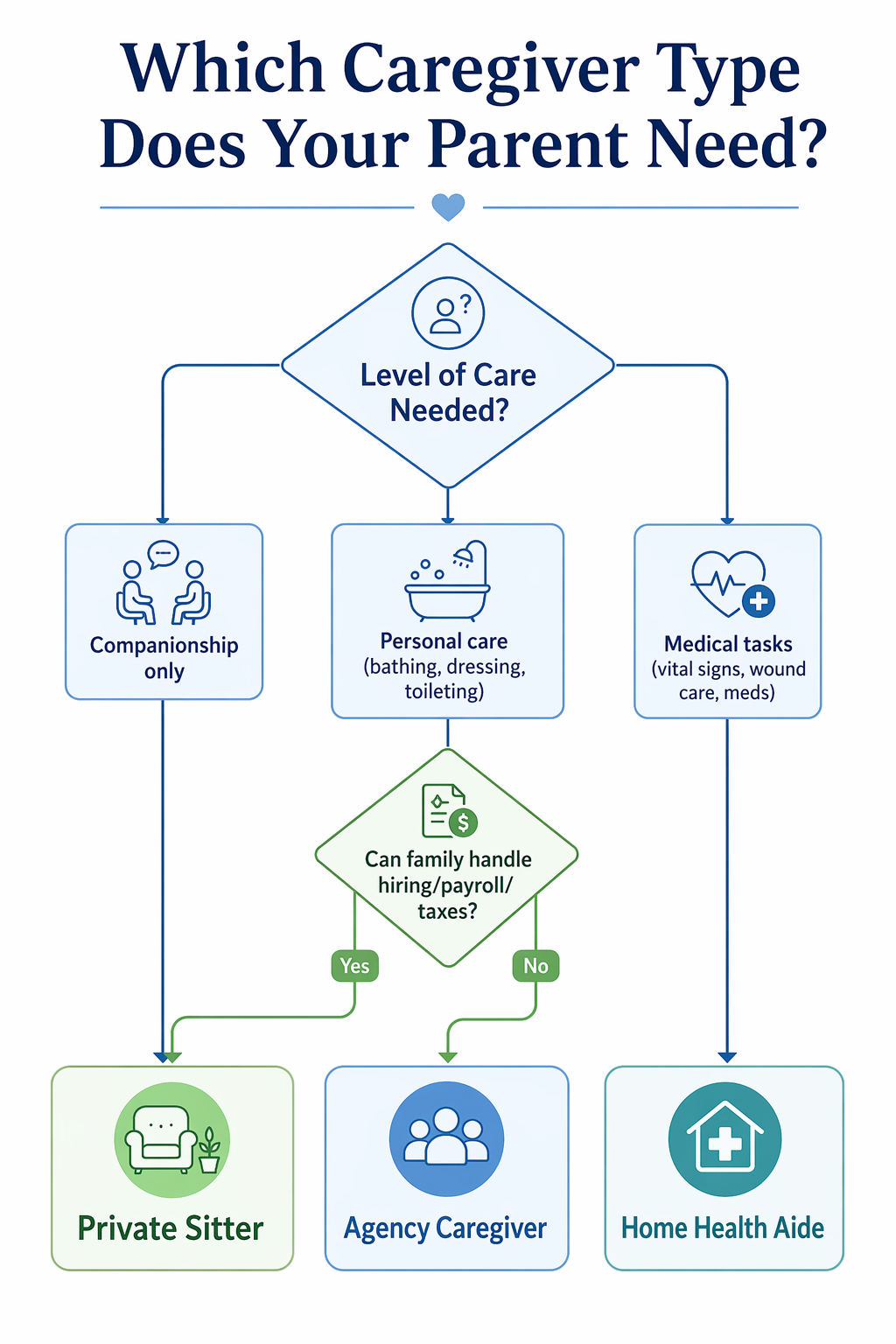
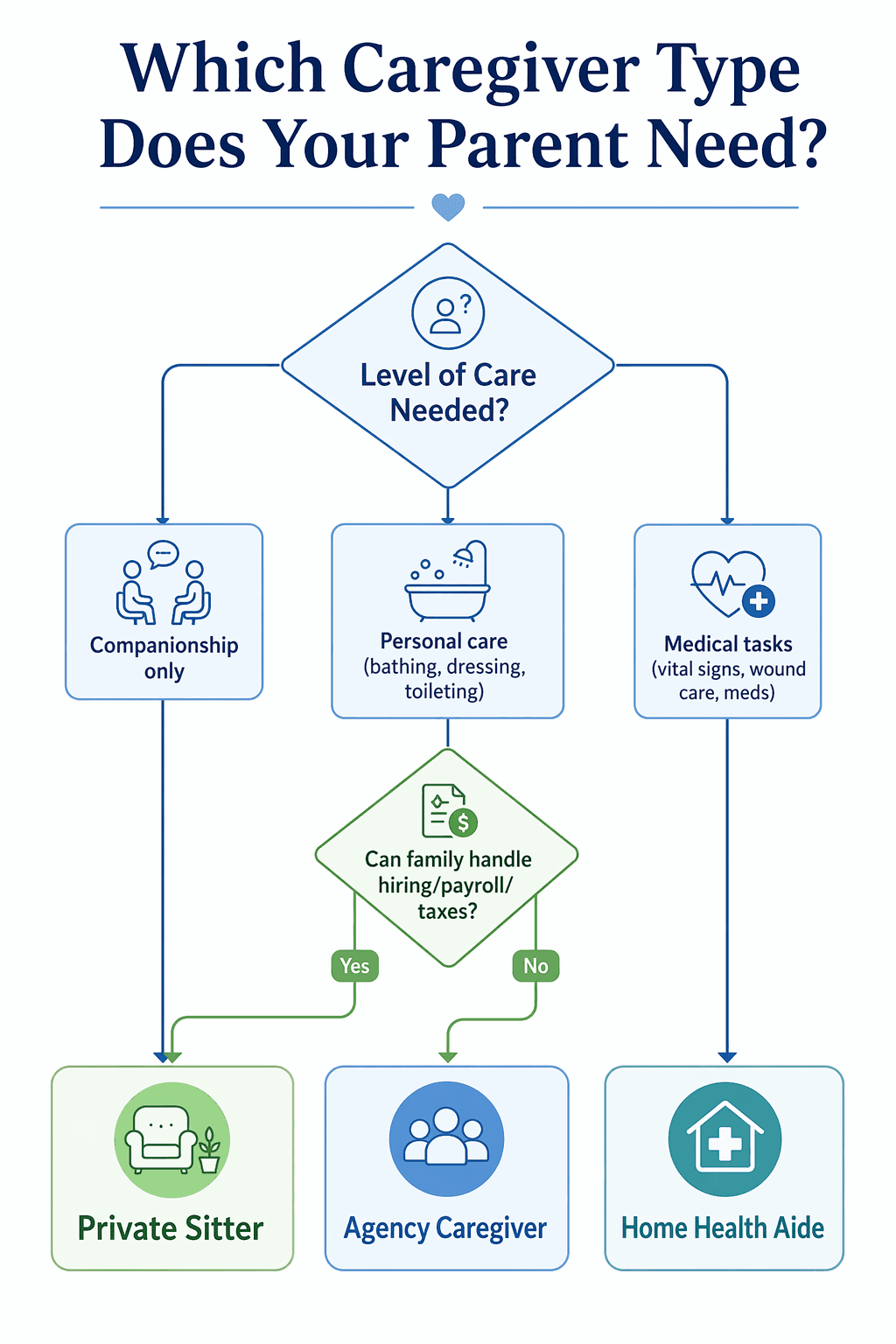
Decision Flowchart: Which Type of Caregiver Does Your Parent Need?
Decision flowchart for choosing between a private sitter, agency caregiver, and home health aide.
The flowchart above walks you through three branching questions. Here is how to read it:
Start with the level of care your parent needs. If they only need companionship, conversation, and light help around the house — no bathing, no toileting, no medical tasks — a private sitter is a strong candidate. If they need help with personal care (bathing, dressing, transferring), an agency caregiver or HHA is more appropriate. If they need medical tasks (wound care, vital sign monitoring, catheter care), you need an HHA.
Next, assess your budget. Private sitters are the most affordable option. Agency caregivers cost 20–30% more but include infrastructure. HHAs are the most expensive, though Medicare or Medicaid may cover some or all of the cost if your parent qualifies.
Finally, be honest about your family's willingness to act as an employer. If you have the time and organizational capacity to handle payroll, taxes, background checks, and backup planning, a private sitter gives you the most control. If the thought of managing an employee feels overwhelming, an agency or home health agency is the safer choice.
The flowchart's three end-nodes are: Private Sitter (low care needs, tight budget, high employer tolerance), Agency Caregiver (moderate care needs, moderate budget, low employer tolerance), and Home Health Aide (medical care needs, any budget, low employer tolerance).
How to Mix and Match: Combining Private Sitters with Home Health Visits
Many families assume they must choose one model and stick with it. In practice, a hybrid approach often delivers the best balance of cost, coverage, and appropriate care.
The most common hybrid arrangement works like this: a private sitter or agency caregiver provides daily companionship and personal care — helping with meals, light housekeeping, bathing, dressing, and transportation — while a home health aide or visiting nurse visits a few times per week to handle medical tasks like wound care, vital sign monitoring, or medication management.
This approach makes sense when:
Your parent needs medical monitoring but does not need a medically trained person present all day.
You want the lower cost of a private sitter for the bulk of care hours, reserving the more expensive HHA for specific clinical tasks.
Your parent's condition requires periodic skilled care (e.g., post-surgery wound checks) but their daily needs are non-medical.
Medicare covers part-time home health visits (which are short-term and doctor-prescribed) but does not cover 24/7 companionship.
Coordination is the key challenge. The private sitter needs to know when the HHA will arrive, what tasks the HHA will perform, and how to communicate any changes in your parent's condition. A simple shared log — paper or digital — can prevent miscommunication. Some families schedule the HHA visit during the private sitter's shift so there is overlap for handoff.
Red Flags for Each Hiring Model
Each hiring model has its own warning signs. Knowing them in advance can save you from a costly mistake or a dangerous situation.
Private Sitter Red Flags
No written contract or service agreement. A handshake deal leaves you with no recourse if the sitter quits without notice or fails to show up.
No liability insurance or worker's compensation. If the sitter is injured in your home, you could be personally liable for medical bills and lost wages.
Cash-only payments. This is a major red flag. Paying under the table means you are not paying payroll taxes, which is illegal and leaves your parent without any documentation of care for tax purposes.
No backup plan. Ask directly: "What happens if you are sick or need a day off?" If the answer is "I don't know" or "You'll need to find someone," you have no safety net.
Refuses a background check. Any legitimate caregiver should be willing to undergo a state and federal background check. Refusal is an immediate disqualification.
Agency Caregiver Red Flags
High staff turnover. If the agency sends a different person every week, your parent never builds a trusting relationship. Ask about their average caregiver tenure and how they handle continuity.
No continuity of caregiver. Some agencies rotate workers intentionally. If you want the same person each visit, confirm this in writing before signing a contract.
Minimum-hour requirements that don't match your needs. If the agency requires a 4-hour minimum but your parent only needs 2 hours of help, you will pay for unused time.
Vague or missing credentials. Ask whether the agency is licensed, bonded, and insured. Verify their license with your state's health department or aging services agency.
Pressure to sign a long-term contract. Reputable agencies offer month-to-month agreements. Be wary of contracts with early termination fees.
Home Health Aide Red Flags
Lack of state certification. HHAs must complete state-approved training and pass an exam. Ask to see their certificate and verify it with the state registry.
Unclear scope of practice. The HHA should be able to clearly state what medical tasks they can and cannot perform. If they offer to do something beyond their legal scope (e.g., administering IV medications), that is a liability risk.
Pressure to perform tasks outside their legal limits. Some agencies may encourage HHAs to do more than permitted to avoid sending a more expensive nurse. This is unsafe and potentially illegal.
No supervision by a registered nurse. Medicare-certified home health agencies must provide RN supervision for HHAs. If the agency cannot describe their supervision structure, that is a concern.
Inconsistent scheduling. If HHA visits are frequently late, shortened, or cancelled without notice, the agency is not managing its workforce properly.
Next Steps: How to Move Forward with Confidence
The right choice between a private sitter, an agency caregiver, and a home health aide depends on three factors: the level of care your parent needs, your budget, and your family's willingness to take on employer responsibilities. There is no universally correct answer — only the answer that fits your specific situation.
Here is how to act on your decision:
If you chose a private sitter: Start by understanding your legal obligations as an employer. You will need to register for an Employer Identification Number (EIN) with the IRS, set up payroll tax withholding, and obtain worker's compensation insurance. Our guide on Home Care Agency vs. Home Health Agency vs. Registry can help you understand the different types of agencies if you decide to go that route instead.
If you chose an agency caregiver: Interview at least three agencies. Ask about their caregiver screening process, training requirements, backup policies, and how they handle caregiver turnover. Request references from current clients.
If you chose a home health aide: Confirm that the agency is Medicare-certified if you plan to use Medicare coverage. Ask for a written care plan that specifies which tasks the HHA will perform and how often a registered nurse will supervise. Read our comparison of Home Care vs. Home Health Care to understand the difference between nonmedical and medical home care.
If you are considering a live-in arrangement: Our analysis of The Real Cost of a Live-In Companion in 2026 covers the hidden trade-offs between live-in care and assisted living.
Whichever path you choose, remember that more than 2.9 million U.S. workers provide paid in-home care for older adults — a workforce that has more than doubled since 2014, according to a PHI 2024 report cited by AARP. The infrastructure exists. Your job is to find the right fit within it.

Comments
Join the discussion with an anonymous comment.